Welcome to our community

Be a part of something great, join today!

  • Hey all, just changed over the backend after 15 years I figured time to give it a bit of an update, its probably gonna be a bit weird for most of you and i am sure there is a few bugs to work out but it should kinda work the same as before... hopefully :)

Ask David Mullen ANYTHING

On my first two 35mm projects, I got an operator. The first was a short film made while I was in film school, but funded by Universal Studios and we were able to get a professional crew to donate their time. I wasn't comfortable operating a heavy 35mm camera, so I opted to get an operator. I was used to our school's 16mm cameras (Eclair NPR's and Arri-S's).

Then I did my first 35mm feature right after film school and again found an operator. It was a deferred pay situation so it wasn't exactly like there was a budget problem with getting an operator -- no one was getting paid!

But after that, for the next 23 features or so, from 1993 to 2003, I operated the camera. Then I started shooting union features in 2003 and had the budget for an operator.

I'm an average operator -- good at composition, not so good at following fast movement on a head (though I'm a good, i.e. steady, handheld operator). The key is to hire an operator that is better than me, otherwise it's painful. Now I'm a bit out of practice though I will jump in when necessary.

I did a couple of small 2nd Unit DP/operator jobs but really did not want to fall into the trap of shooting for other DP's and not making a name for myself. Same goes for operating, I did a little now & then, not for features though, more for EPK's and live events, etc. I also shot some infomercials and EPK's for a couple of years on the side to earn a living. It was good in the long run to have that experience shooting Sony Betacam because it served me well when the Sony F900 HDCAM came out and I started shooting features in HD.

I understand completely the need to take whatever work pays the rent. I have a supportive wife who helped me out, so I could stick to mostly shooting low-budget features and the occasional short film as a DP, even take freebies just to meet new producers and directors. Not everyone has a wife to fall back on, financially. It paid off for her in the long run I guess because now I'm the one making the larger salary, giving her some freedom in terms of job choice, etc. (I guess life is all about making wise investments, in education, marriage, etc.)

I've also made a minor amount of money on the side giving lectures or writing articles, nothing at the volume that would support myself. But I guess I always figured if things went south in terms of shooting work, I'd look for teaching work.

My Key Grip though jokes that I'm "the fifth grip" on the show since I love setting up C-stands and adjusting flags and nets...
 
How exactly do you educate yourself when you're not working on a movie?
Do you read Books, the www or magazines?
Which ones do you prefer?
What do would you reccomend for someone like me, trying to educate himself (because he has been rejected at Film school) besides trying to shoot and watch as much as I can?
 
I educate myself by reading everything I can -- books, websites, magazines, etc. I don't discriminate. When I'm not working, sometimes I go to the Theater Arts Library at UCLA or the AMPAS Herrick Library and just start pulling down anything I haven't read before. I've read every issue of American Cinematographer going back to the early 1920's, and some I've read multiple times. I've read every issue of ICG/International Photographer magazine going back to the 1950's. I've skimmed through every SMPTE Journal going back to the 1950's (only reading what I thought was relevant.) I've read many British film journals over the years. Many amateur filmmaking magazines, mostly published in the 1960's and 70's. And a lot of other magazines. I own every issue of Cinefex starting with #1 (Star Trek: The Motion Picture on the cover).

My film book reading has slowed down a bit over the years, partly because most books are aimed at beginners, there's only so many "intro to digital filmmaking" books you can read. But my web reading has naturally increased.

I have lots of gaps in my knowledge though. I haven't delved too deeply into Photoshop, for example. I'm not hugely computer literate, I don't have the data rates of different formats on the tip of my tongue. I'd be hard pressed to tell you the operating speed of my Mac unless I looked it up.

At some point, I bet I've browsed through every library's film book collection in Los Angeles, at UCLA, USC, AMPAS, AFI, CalArts, etc. not to mention whatever is in the LAPL and Santa Monica PL system. UCLA is probably one of the best, alongside AMPAS, the advantage of AMPAS being that it isn't spread out over several buildings as with UCLA (any journal older than 10 years, and any low-usage book, is sent to the SRLF near the dorms. Magazines like SMPTE are in the Engineering Library.) But the problem with AMPAS is that you are not even allowed to take a ballpoint pen into the room with you.

I also have a pretty good collection of cinematography books.

So my suggestion is to just read everything. You can skim through whatever seems less interesting, but at least you'll know what's in that book in case you need to go back to it later.
 
That's a lot!
What Webpages do you read?

Nothing regularly, like a magazine, mostly stuff I find doing searches. I end up in Wikipedia a lot though...

And I obviously hang out in forums like these.

Maybe I'm old-fashioned, but nothing really beats printed material. The web is a different way of distributing information, better for looking stuff up rather than getting instructionals.
 
Some very insightful answers in the past few pages, David. I hope you realize how helpful your wisdom is to industry neophytes / film students like myself.

Thanks!
 
The director is the boss -- I collaborate with the director, but it all has to get filtered through and approved by the director, to the extent that they choose to get involved. And that degree of collaboration and the degree to which a director wants to manage a lot of the photography just depends on the director. But the director is in charge, it's not an equal relationship. They ultimately are taking the greater risk and getting the greater reward.

When I work with weak directors, I have to do more of their homework, get involved more with the blocking and coverage, but I try to not undermine the director's authority -- they hired me, so I work for them. So even if I have to get more involved, I do it through the director, even if it means having a rehearsal and then sending everyone out for coffee so I can discuss the coverage with the director without anyone listening in. I try and give my ideas to the director and then have them pass it on to everyone else.

Now sometimes in the heat of battle, I do "race ahead" too much because everyone starts asking me what's up, what's next, sensing that I can give them the answer faster and more coherently than the director can. But even then, I try to tell them what I think the director wants, not what I want. I don't want the director to think, in the end, that it's not his movie, that it was taken away from him. I want him to feel proud of what we accomplished together. Now sometimes a producer will take control away from the director, which is out of my hands.

Sometimes an actor will sense when a director is floundering with the staging aspects and ask me to get more involved. But I try to not step around the director to do that, I still relay ideas to the director first.

As far as my relationship with the Polish Brothers, we share a lot of the same tastes, so I know that if I like a certain composition or movement or lighting, they will like it too, so I show them stuff, they comment or make adjustments, etc. We just talk through stuff, or storyboard, and agree on a plan of action. I have them look through the lens, etc. It's really a process of getting each other excited by an interesting image - "look at this!" "Isn't that cool?" "What do you think about this?" Now sometimes I'll have a composition lined-up and find myself showing them two versions -- maybe a centered and off-centered frame -- and seeing which they like more, because I'm not sure which I like more. The thing to know about them is that they love good cinematography, they love images, but that doesn't mean they take over that aspect themselves. We work together on that. It's a true collaboration.

As far as Storaro and Bertolucci go, I've heard that Bertolucci's main obsession was with the staging and movement, leaving Storaro a lot of leeway to light it. But Bertolucci also shoots in sequence, one set-up after the next in editing order, so they can build a sequence without necessarily having to plot the entire coverage in advance.

I assume Kubrick was a control freak and supervised everything, including operating the shots now and then. But Kubrick was not dictatorial in the sense of telling everyone his vision and then having them race off and make it happen. He liked everyone to contribute as many ideas as they could squeeze out of their brains, and then he'd come back for more ideas until they were drained, and then he'd decide what he liked as late as possible. He also tested constantly to reduce surprises. I was told that he lit and shot tests of the bathroom set in "Full Metal Jacket" (where the sergeant is killed) for a week before he would actually start shooting the scene itself. James Cameron called Kubrick a "brain vampire". Arthur C. Clarke used to say that after a meeting with Kubrick, he had to lie down. People stopped working for Kubrick because he exhausted them. John Alcott declined to shoot "Full Metal Jacket" because he said he wouldn't survive the experience, it would be too exhausting, instead taking a vacation in France -- during which he died of a heart attack. Doug Milsome has told me about phone calls from Kubrick at 3AM where Kubrick wanted to discuss focus pulling issues (he started out as Kubrick's focus-puller and apparently Kubrick never really trusted anyone else on that topic again...)

So I'm sure Unsworth worked his tail off for Kubrick no matter how much Kubrick involved himself in the cinematography. But considering back then, the U.K. system called the cinematographer the "lighting cameraman" and gave more control to the operator for set-ups (the "operating cameraman"), Unsworth's main responsibility was probably figuring out the lighting for these sets. In terms of lens choice and composition, I'm sure Kubrick did a lot of that himself.

I don't mind the director getting more involved with that as long as I think they are actually good at it. But obviously I'd like to be involved in those decisions, not just told to only worry about the lighting.

Thanks for such a considered and well written reply, Mr. Mullen!

Bertolucci's obsession with movement and staging of the characters is obvious in The Conformist - They move with a precision you expect more from dance than film. Thanks for a great reply.
 
Hi David,

Just wondering if there is a basic rule as to how to prevent nose shadows. Example: If I’m using a side key light should it be placed far enough in front of the subject that is lights both eye’s but falls off on the far side to give some modelling, or profile enough that it doesn’t light the far side at all. Any tricks of the trade?

PS: appreciate your lengthy emails regarding your start in the industry.
 
What's wrong with a nose shadow? They stick out, so they make shadows.

I've never understood the hang-up people have over seeing a nose shadow. Otherwise you're limited to a completely side-lit face or a completely front-lit face. On my second feature, I had a scene indoors at sunset, and the orange setting sun was raking across the face of our young actress, and she freaked out that she had a nose shadow. When she saw the final film and saw how beautiful she looked in it, she apologized.

If it bothers you, at least make the light very soft so the nose shadow is very soft.

I'd go crazy if I had to spend time making sure noses never cast shadows...

The thing is that often when you side light a face, you still want the light to catch both eyes, so depending on how deep-set the eyes are, how strong the nose bridge is, you will have to cheat the light more frontally, so the possibility is high that if the light wraps around the nose to catch the second eye, it's also wrapping around to create a nose shadow on the cheek.

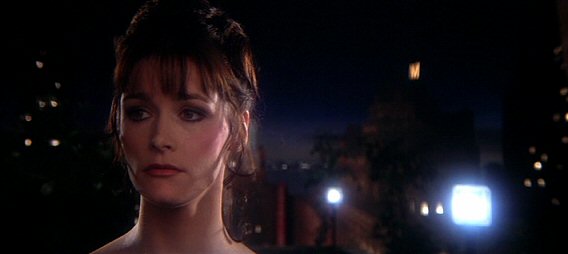
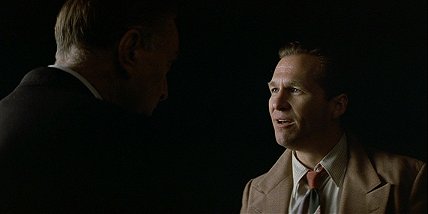
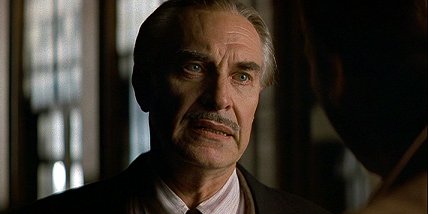
Anyway, I can pull up plenty of shots from famous movies with nose shadows.

Here's a hard nose shadow:
apocalypse3.jpg


I mean, here's a soft nose shadow:
superman19.jpg


Here's sort of a semi-soft nose shadow:
tucker4.jpg


tucker5.jpg
 
Last edited:
Thanks!

I'm now 47.

Besides the icons of my youth passing away yesterday, I had another one of those moments of reflection when I was watching "Lawrence of Arabia" on one of the HD channels. I've always been fond of that movie -- it came out the year I was born (1962) and I grew up in the desert, and I love widescreen epics and David Lean movies, so I remember how excited I was when it was restored to its former glory by Robert Harris after seeing beat-up prints in college in the early 1980's.

So I get to the end of the movie, and it says that the restoration copyright date is 1988. That means the movie was 26 years old when it was restored... and that the restoration itself is 21 years old! Odd to think about it. How time flies.
 
A critic beginning

A critic beginning

hi david,

i'm a cinematographer at the beginning but not for this i'm not critic expecially with indipendents directors(with not or few money to pay your work) about their screenplays and visual immagination.
here in italy is very difficult to found young directors that(also with not money)have great and anticonformisthic ideas.
i love the job(passion)of cinematographer becouse i think that he has to combine two attitude:
creativity(and so madness) and technics(and so discipline).
two attitudes that are present in my ordinary life in a very strange proportion.

so.... my question is....

i know that at the beginning of your job you have to do a lot of experinence ,but do you think that there is a limit?
is there a cultural,moral and human limit to accepts everyting only for experience?
my heart says...YES,THERE IS A LIMIT.
but is this "professional" as cinematographer to not accepts works,expecially at the beginnings?
i think that expecially today (where everything is visual)the cinematographers have an "ecological" mission and a great responsability.
don't help to produce visual products made without passion,ideas,life.
don't collaborate to produce "flat" image and "flat" imagination.
thanks
ivan

p.s.:sorry for my bad english
 
Happy Birthday David, it was also my birthday yesterday, and like you, I spent all day long awash in reflection, memories and thoughts. I hit the big 40, and I feel the best I've felt ever (or so I told everybody) After a big dinner with friends and family, we ended up (wouldn't you know it?) watching a movie marathon, from Casablanca, to Raiders of the Lost Ark, Sato Ichi, and then of course, Lawrence of Arabia :-) Isn't that something?

May this be your best year yet!
 
is there a cultural,moral and human limit to accepts everyting only for experience?
my heart says...YES,THERE IS A LIMIT.
but is this "professional" as cinematographer to not accepts works,expecially at the beginnings?
i think that expecially today (where everything is visual)the cinematographers have an "ecological" mission and a great responsability.
don't help to produce visual products made without passion,ideas,life.
don't collaborate to produce "flat" image and "flat" imagination.

Just depends on how hungry you get...

I had limits when I started out, I didn't want to shoot anything too sleazy, too exploitative. And I didn't want to work for people like that.

But as for comedies, I do them occasionally, some more high-key than others. It's not my favorite style of cinematography, but I look for challenges, like making the women look beautiful or moving the camera in an interesting way, etc. But I tend to avoid those projects when I'm feeling good financially.

You have to make sure that you understand the difference between standing on artistic principle and merely being close-minded about the possibilities of cinema. You don't want to become too one-note in the pursuit of your "vision" so it helps to work with directors who have an opposing opinion and different aesthetic sensibility now and then (within limits.)

Plus you need the experience. But some experiences are better than others. Don't work on anything you can't put your name on.
 
All the best to you!
Talking about letting the women look beautiful.
Did you invate some rules you'd want to share about lighting and shooting difficult faces.
Excuse me I don't know the words to describe it more sensible.
I will have to shoot a girl with a bit bold face. Is the goal to keylight just one side?
But anyway what do you do to let someone look as beuatiful as he can...
I know that's no specific question but maybe you can share some experiences...
 
Back
Top