Welcome to our community

Be a part of something great, join today!

  • Hey all, just changed over the backend after 15 years I figured time to give it a bit of an update, its probably gonna be a bit weird for most of you and i am sure there is a few bugs to work out but it should kinda work the same as before... hopefully :)

Ask David Mullen ANYTHING

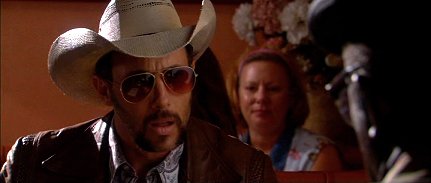
But I see a lot of the modern neo noir films where the talent's face is bright, either both sides or only one or the eyes are bright, but the under side of the hat brim is dark. Every time I tried a low bounce or anything from the bottom or set lower than the hat's brim to catch the eyes, even if the light is just low enough but still points straight forward, I always got light on the under side of the hat brim, making it obvious the light was coming from low. So I was wondering how they do it in these neo noir films lately. Probably do it in post with color correction?
It's mainly just careful lighting. When I went through "Dick Tracy" to find an example of Tracy's hat shadowing his eyes, I couldn't really find any -- Storaro almost always had to key at eye level. I think if I looked through the old Indiana Jones movies, I may find more examples because of the use of harder keys.

The modern trick is to just use softer light closer to eye level, or soft fill. It doesn't have to be a lot to pick out the face.

As far as the underside of the hat getting bright, it depends on the hat for one thing (not an issue with a dark grey or black hat) but you do have a window of opportunity where the light is just barely low enough to get the eyes but still shadow the underside of the brim.

Yes, post color-correction can help either way -- to bring up the eyes or conversely darken the underside of the hat brim, but no DP is going to light an entire movie that way and leave it all to post to fix. It would be more of a "last trick up your sleeve" sort of technique, knowing that you can adjust it further in post. That little spot of light in the eye in the "Dick Tracy" frame I posted... I've done similar things with Power Windows in post, but it gets tricky when the actor moves a lot, you have to keep the window fairly fuzzy around the borders.

But I was figuring that you were asking about when the key light had to be higher up and then the face was definitely in the shadow of the brim.

The thing is to not overdo the secondary key thing, trust that some ambience will get under that hat if there is enough light bouncing around. For example, I did an HD movie called "Jackpot" with a character wearing a cowboy hat throughout. In one restaurant scene, I had an overhead Chinese Lantern and the bounce back off of the table was enough to see his face under the brim. This is not that scene, but here I only had a backlight on his face and the key just came from a white card on the wall next to his face:

jackpot2.jpg


Not exactly what we're talking about but it's the only frame I had lying around from that movie.
 
"I think you'd have to remove any internal IR filtering in front of the sensor (I believe there is some) and then use a camera filter to block most of the visible light."

Well that sounds out of the question! Definitely void the warranty, and perhaps damage the camera permanently.

So, would you rent a film camera and shoot IR film instead?

Also, are there different types of IR photography? I notice that some are very colorful, and some are almost black and white, and some are just black and white.

I'm looking for the colorful "predator vision" variety. Any tips?
 
So, would you rent a film camera and shoot IR film instead?

Also, are there different types of IR photography? I notice that some are very colorful, and some are almost black and white, and some are just black and white.

I'm looking for the colorful "predator vision" variety. Any tips?

I think the only 35mm color IR film is a reversal stock - it was used for a battle scene in Oliver Stone's "Alexander" and it mainly comes out a heavy magenta color.

You can see some examples here:
http://www.vividlight.com/articles/3113.htm

I think b&w IR photography is a lot more interesting.
 
DP as Director

DP as Director

Hi David,

I've gotten through most of this thread and you seem to have a pretty strong command of storytelling in addition to your obvious expertise in cinematography. Would you like to direct? If so, how would you go about pursuing directing after having achieved success as a DP?

On a similar note, the Polish Brothers seem like great helmers, but have you worked with weak or new directors in the past (to remain unnamed) where you've picked up some of the directing responsibilities? If so, how did you navigate those waters without offending the director?

Hope you don't mind a break from the technical questions. I basically think it would be fantastic to see you direct a Sci-Fi feature.

Eric
 
I've got a somewhat related question - I DP everything I direct (which amounts to one single 10 minute short, ha!), so the composition, lighting, camera placement, movement, are all squarely my responsibility, as well as dealign with the actors etc. I plan to continue working this way for the foreseeable future. When you are DPing for a director, how are these duties generally split? Obviously the specific lighting scheme, choice of the film stock etc are The duties of a DP as a given, but does the camera placement and lens choice and camera movement generally fall to the director? What about the composition? And obviously there are all types of directors - from those that don't consider anything other than the performances, subtext, and tone of the film, to those that are very adept at the visual side like Kubrick. Im sure that Every pairing or director/DP has a different working relationship, but I hoped that you could share some generalizations.

The polish brothers for example - how hands on are they from a visual point of view?

Or to bring up a movie that for me has as near perfect compositions and camera placement as any movie I've ever seen, The Conformist - How much of those compositions was Storaro, and how much was Bertolucci, if you would care to make an assumption?

Or how much of the visual make up of 2001 can likely be attributed to Kubrick. How much to Unsworth?

I realize that Im am asking you to do an awful lot of guessing here - I hope It doesn't come across as silly or pointless.

I guess the root of my question is that I am new to film, and to directing, and I come from a stills background. I consider my primary role as a director/dp to tell the story visually, through shot composition and lens choice, etc. I find that the visual aspects of a film are equally as important to the emotional core of a film, and sometimes even more important, than the performances of the actors. If this is true, shouldn't DOP's get equal billing as the director? I've read that for On The Water Front, Elia Kazan stated that he didnt concern himself with the camera one iota. In my mind the movie should be credited as Directed by Elia Kazan & Boris Kaufman, then. I don't mean deny the importance of great performances in film. I just think that film is a uniquely visually medium, and can be so much more than "filmed theater".
I guess this has ceased to be a question and become a confused rant. Forgive the length and lack of focus in this question, please - and dont feel obliged to answer it!

Thank you for being so gracious with your time, Mr. Mullen.

Andrew Wilding
 
Last edited:
The director is the boss -- I collaborate with the director, but it all has to get filtered through and approved by the director, to the extent that they choose to get involved. And that degree of collaboration and the degree to which a director wants to manage a lot of the photography just depends on the director. But the director is in charge, it's not an equal relationship. They ultimately are taking the greater risk and getting the greater reward.

When I work with weak directors, I have to do more of their homework, get involved more with the blocking and coverage, but I try to not undermine the director's authority -- they hired me, so I work for them. So even if I have to get more involved, I do it through the director, even if it means having a rehearsal and then sending everyone out for coffee so I can discuss the coverage with the director without anyone listening in. I try and give my ideas to the director and then have them pass it on to everyone else.

Now sometimes in the heat of battle, I do "race ahead" too much because everyone starts asking me what's up, what's next, sensing that I can give them the answer faster and more coherently than the director can. But even then, I try to tell them what I think the director wants, not what I want. I don't want the director to think, in the end, that it's not his movie, that it was taken away from him. I want him to feel proud of what we accomplished together. Now sometimes a producer will take control away from the director, which is out of my hands.

Sometimes an actor will sense when a director is floundering with the staging aspects and ask me to get more involved. But I try to not step around the director to do that, I still relay ideas to the director first.

As far as my relationship with the Polish Brothers, we share a lot of the same tastes, so I know that if I like a certain composition or movement or lighting, they will like it too, so I show them stuff, they comment or make adjustments, etc. We just talk through stuff, or storyboard, and agree on a plan of action. I have them look through the lens, etc. It's really a process of getting each other excited by an interesting image - "look at this!" "Isn't that cool?" "What do you think about this?" Now sometimes I'll have a composition lined-up and find myself showing them two versions -- maybe a centered and off-centered frame -- and seeing which they like more, because I'm not sure which I like more. The thing to know about them is that they love good cinematography, they love images, but that doesn't mean they take over that aspect themselves. We work together on that. It's a true collaboration.

As far as Storaro and Bertolucci go, I've heard that Bertolucci's main obsession was with the staging and movement, leaving Storaro a lot of leeway to light it. But Bertolucci also shoots in sequence, one set-up after the next in editing order, so they can build a sequence without necessarily having to plot the entire coverage in advance.

I assume Kubrick was a control freak and supervised everything, including operating the shots now and then. But Kubrick was not dictatorial in the sense of telling everyone his vision and then having them race off and make it happen. He liked everyone to contribute as many ideas as they could squeeze out of their brains, and then he'd come back for more ideas until they were drained, and then he'd decide what he liked as late as possible. He also tested constantly to reduce surprises. I was told that he lit and shot tests of the bathroom set in "Full Metal Jacket" (where the sergeant is killed) for a week before he would actually start shooting the scene itself. James Cameron called Kubrick a "brain vampire". Arthur C. Clarke used to say that after a meeting with Kubrick, he had to lie down. People stopped working for Kubrick because he exhausted them. John Alcott declined to shoot "Full Metal Jacket" because he said he wouldn't survive the experience, it would be too exhausting, instead taking a vacation in France -- during which he died of a heart attack. Doug Milsome has told me about phone calls from Kubrick at 3AM where Kubrick wanted to discuss focus pulling issues (he started out as Kubrick's focus-puller and apparently Kubrick never really trusted anyone else on that topic again...)

So I'm sure Unsworth worked his tail off for Kubrick no matter how much Kubrick involved himself in the cinematography. But considering back then, the U.K. system called the cinematographer the "lighting cameraman" and gave more control to the operator for set-ups (the "operating cameraman"), Unsworth's main responsibility was probably figuring out the lighting for these sets. In terms of lens choice and composition, I'm sure Kubrick did a lot of that himself.

I don't mind the director getting more involved with that as long as I think they are actually good at it. But obviously I'd like to be involved in those decisions, not just told to only worry about the lighting.
 
Last edited:
I'd like to direct something small someday. I just saw "Moon" last week and thought it was exactly the sort of movie I'd like to do. But as for making that happen, I haven't pursued it nor am I sure how. But first I'd have to have a project that I cared enough about to put myself through the financial hardship of spending a few years trying to get it made.
 
Hi David-

Quick question about china balls - you said you use photofloods. Do you have specific bulbs you use and prefer? Are there different bulbs you use in different situations? Thanks!
 
I use porcelain sockets (plastic ones melt with brighter bulbs) and often use a 250w or 500w photoflood, or a 213 bulb (250w), and a dimmer. Just depends on the light output needed. I've even made a rig that holds two sockets for two bulbs, separated by some heavy wire. If the bulbs are lower in wattage, there are two-pronged (two bulbs) sockets in plastic -- I've used two bright compact flos in those.
 
Hi David,
You sometimes reply “that you are a DOP” to questions about camera assistant and other crew duties. Is the division of labour so strict in Hollywood that that DOP is not familiar with all aspects of the camera and lighting departments? Or is it that you are university trained and never apprenticed as a lower level crew member. The reason why I asked is to know if there is an apprenticeship system where a person can work their way up from say clapper/loader to focus puller, then up to camera operator and on to DOP.

Gregory
 
There are many paths to becoming a DP. I did it by always being a DP... but climbing the budget ladder, rather than climbing the crew ladder from loader to assistant to operator, etc.

For one thing, I don't think I would have made a good camera assistant.

But if you're asking if a DP needs to know every the job of crew member who works for them, in fine detail, well... I've managed to shoot over thirty features and get into the ASC, and I've never loaded a 35mm camera in my life, though I've shot about 24 features in 35mm. I stopped loading film cameras when I left film school and started hiring AC's. And while I could take the time to learn how to do it, I just have found other things to spend my time learning.

There are lots of things I know and lots of things I don't know. There are other DP's who have more knowledge of some things and less knowledge of other things than I do. That's just the nature of the business -- we're all autodidacts to some degree, self-educated.

I learn what I feel I need to learn to do my job as a DP. I don't necessarily have to be a good focus-puller, but I have to understand what my focus-puller needs from me to be able to do his job. I have to understand the pros and cons of different focus-pulling techniques, devices, etc. But that doesn't mean I have to know how to hook up a Preston, etc. unless my entire camera crew dropped dead of a heart attack and I was the only person left to set-up the Preston.

It has nothing to do with the strictness of division of labor in Hollywood, it simply has to do with learning what I need to learn to do my job. And I've shot a number of small features where I was the DP & operator. I've done a lot of shooting where it was just me and one assistant going out and getting the shots. But the key thing there is that I've always had an assistant when shooting in 35mm. Truth is that the equipment is just too darn bulky to be a one-man job anyway. But I certainly remember me and my one assistant shooting landscapes for "Northfork" and hauling a Panaflex and Primo anamorphic lenses up and down hilltops for a week, just the two of us.

And I've done plenty of shoots where I just had a lighting kit that plugged into household power, and I've done plenty of my own lighting set-ups by myself more or less. In fact, my hands-on approach to lighting has been of some controversy with some of my crews because it is an aspect I like doing myself, setting up lights.

However, any time I had big enough lights to need a generator, I had an electric crew... and thus I have never personally had to set-up a generator. But certainly I've listened to all the reasons why a generator has gone down over the years from my gaffer. I understand the issues regarding flicker and whatnot, but I wouldn't trust myself to lay-out power correctly from a generator. Again, when you're working at the level where you need that much equipment, then you naturally have crew people to help you.

I've done tiny HD features where it was just me, a sound man, and some PA's to help me set-up things.

Ultimately, there are aspects to a DP's job that are unique to the DP -- it's not simply the aggregate of the work and knowledge of camera assistants, operators, electricians, and grips. So no matter what path you take to becoming a DP, ultimately you have to learn the job of being a DP and you have to start shooting material as a DP.

I chose to become a DP in film school, and work as a DP after film school, for a couple of reasons. One is that I didn't want to spend the first decade after film school building a career as a camera assistant or electrician and master that trade -- mainly because I knew I wasn't going to be great at it, nor was I interested in that work.

The thing to remember is that even if your long-term goal is to become a DP, if you choose to become an assistant, you have to be very serious about mastering that art and craft of assisting. Some people spend their whole lives becoming great assistants. A person who is just "dabbling" at being a camera assistant or electrician while they try to become a DP is near useless to the DP who hires him. When I look for a 1st AC to hire, I want to find someone who is passionate about mastering THAT job, not my job.

But certainly it's a valid pathway to becoming a DP, but I'm not sure it's a "superior" pathway, it's just one method. Every path has its strengths and weakness. My path, climbing the budget ladder from no-budget projects as a DP means that I'm fast and flexible, and can work on a budget and schedule, and I don't need or crave a lot of expensive toys. I've seen some AC's who have worked on big movies try to become DP's on small indie movies and start ordering all the expensive equipment that their bosses used on the movies they AC'd on, because that was their experience base. They just assumed that a "real" cinematographer always got a Technocrane and a three-camera package, etc. because their role models did.

On the other hand, the weakness of climbing the budget ladder for me has been that I don't have a lot of experience with expensive toys. I have to spend more time going to trade shows, reading trade magazines, and talking to my crews and other DP's to keep up with those devices in case I'll ever need to order one. I'm much more used to a "meat and potatoes" camera package that gets the job done 95% of the time in narrative filmmaking. I'm more prone to look for simple low-tech solutions. Of course, that's what some producers like about me...

So we all spend our time filling in the knowledge and experience gaps. I do this partly by looking for projects that allow me to use some new technique or technology, which is why I was looking and hoping for a RED project last year.

But people with other backgrounds will know some things more thoroughly than I will. For example, I defer a lot here to equipment owners in regards to questions like what lens to buy, etc. because equipment owners get to know a piece of gear intimately. I'm a renter and I work with crews that do a lot of the physical handling, so I'm less likely to have a strong opinion on things like which lens is easier to hook up to a follow-focus, which has better witness marks, etc.

I do spend a lot of my free time educating myself, but there are levels of knowledge that start to become less and less practical. I once had a conversation with another ASC member about this, the degree in which we need to know how the sausage is made, and our level of interest in that. I don't have an engineer's knowledge of sensors or digital processing, obviously, but the question is: do I need to? Does it serve a practical need? Or am I better-off spending more time learning about lighting large sets? Or learning about art history and graphic design? We all choose how deep we want to explore some technical area in cinematography, but we all choose a different level, we prioritize differently. Which is why we are all different as cinematographers.

As far as apprentice work, it's not as formal as that, it's not like a school curriculum. You can start at the bottom and get a job as a loader, then get hired as a 2nd AC, then a 1st AC, etc. learning on the job from the people above you and looking for opportunities to move up. But it's not a formal system where you graduate to the next level on some sort of schedule.
 
Last edited:
It's set in early spring (I think), when it was shot. There is a school dance in the story that is vaguely like a prom. Initially the script read like a fall story and there was talk about putting fake fall leaves on trees (which the producers had done for parts of "Juno", which had to take place, story-wise, over nine months, obviously) but it would have been a pain to deal with on every location.

Our main problem, though, because we were shooting in Canada (standing in for Wisconsin or Minnesota I think) in April was that it was rather cold, and we had two scenes with our leads in water, outside. We ended up moving the climax of the story, in an abandoned swimming pool, from an outdoor location to an interior location, just to make life tolerable for the crew and actors, because then we could shoot during the daytime for a night scene, and we could heat the water without it steaming. The actors spent three days working in a murky, dirty abandoned swimming pool full of fake trash, etc. We had another scene out at a lake in the daytime that required we build a long plexi tank just below the water line with heated water pumped in just so our actress wouldn't freeze to death. Keep in mind that the snow had just melted off into these lakes a few weeks earlier.

But in general, the story luckily didn't get too specific about which month a scene was set, other than it taking place during the school year. Story-wise, I think most of the main arc takes place over a period of a couple of months.
 
Just a not to say David that i caught The Astronaut Farmer yesterday and its nothing short of exquisite. The plot did have its uneven moments but the photography NEVER let the film down for a frame.

To all who often bend David's ear on this thread who have not managed to catch it, I recommend finding a copy for the visuals alone. well done mate.

Jason

_
 
We shot in Vancouver, BC where the producers had shot "Juno", with a lot of the same crew.

--

Thanks, in regards to "Astronaut Farmer". I just got Verizon FIOS TV in my house and have been watching HD movie channels, and it's played a couple of times already -- it's great to see it in HD. Too bad it's cropped from 2.40 to 16x9 though.
 
I do spend a lot of my free time educating myself, but there are levels of knowledge that start to become less and less practical. I once had a conversation with another ASC member about this, the degree in which we need to know how the sausage is made, and our level of interest in that. I don't have an engineer's knowledge of sensors or digital processing, obviously, but the question is: do I need to? Does it serve a practical need? Or am I better-off spending more time learning about lighting large sets? Or learning about art history and graphic design? We all choose how deep we want to explore some technical area in cinematography, but we all choose a different level, we prioritize differently. Which is why we are all different as cinematographers.

As far as apprentice work, it's not as formal as that, it's not like a school curriculum. You can start at the bottom and get a job as a loader, then get hired as a 2nd AC, then a 1st AC, etc. learning on the job from the people above you and looking for opportunities to move up. But it's not a formal system where you graduate to the next level on some sort of schedule.[/QUOTE]


Thanks for that detailed response David,

I too took a similar path after leaving University albeit in the much smaller marketplace of Jamaica. So I do not know many things about equipment, but I continually educate myself about lighting principles and techniques and I have been somewhat successful shooting documentaries and TV commercials. Although my images please my clients I always had a complex about not knowing everything about all the equipment, thanks for relieving me of that.

I will say though that going the “budget” route is the more courageous and maybe insane method, just because one can starve that way. Were you never tempted to operate for another DP during the lean times?

Regards
Gregory
 
Back
Top