Welcome to our community

Be a part of something great, join today!

  • Hey all, just changed over the backend after 15 years I figured time to give it a bit of an update, its probably gonna be a bit weird for most of you and i am sure there is a few bugs to work out but it should kinda work the same as before... hopefully :)

Ask David Mullen ANYTHING

Tried....no luck....didn't see a place in REDCine to do it, but found it in REDAlert and no luck....it's the same way in finalcut as well.


Is sounds like the filesystem might be corrupt. We might be able recover the footage with access to the original media. Or you can try a file recover tool and see if that works.
 
David, do you perhaps know of some books with lightning setups and examples? Im trying to light a bedroom scene and it doesn't look the way I want it to look. Perhaps reading some books will give me a better understanding of how to light properly. (I'm almost finished reading this thread)

Maybe you could help me? I want to light a room to look like it's dark with moonlight shining trough a big window. The room is a square 25m2. In the east there is a two-persons bed against the wall. Next to the bed is a small table with a table light on it. In the west side of the room there is a huge window. I think it's about 3mx2m.

My equipment is 3 times a 500 watt tungsten worklight. One of them has some homemade barndoors. (Which work pretty well actually) I have a couple of
bouncing boards and a 150 watt tungsten worklight. I could make some flags if I want. I also have 2 stands to place my filters. (Can't place my filters directly in front of the worklights otherwise they will burn) I have some colour filters also. I have a double CTB, Full CTB, half CTB and a evening blue filter.

Now the look I wanted to create is the following:

There is a person lying on the bed. He will have moonlight on him from coming trough the window. I'll try and make some patterns to make the beam more interesting, because I don't think the window will be in the shot. He also will have the light on him from the table light. So I replaced the table light with a 40 watt bulb. I tried to replicate the moonlight by placing the Full CTB filter on the 500 Watt tungsten placing in outside shining trough the window. It gives a very bright light. Bright enough for my camera to "see" without any noise. Now to give the rest of the room a blue night look I placed another 500 watt light with the evening blue filter on it in the same angle as the other light.

I recorded it on camera with exposure set to -7 but somethings is missing. I don't like the picture.

Maybe there is too little contrast? Or there any things I could do to improve my picture?
I hope everything I wrote is clear.
 
David, Thanks for answering all our questions.
I do have a question about low angle shots and prisms.

Would a low angle shot (shooting up from the ground, camera close to the ground) with a prism or mirror be a poor choice when it comes using it with the RED, or any high quality glass/lens? -- knowing the RED is kinda bulky and making a shot like Citizen Kane (steadicam shot) could be easier. (even though anything worth doing is never "easy")
 
Well, from my perspective, the RED is smaller and lighter than what I'm used to, and I'm sure my Steadicam operator would agree...

I haven't used low-angle prisms but if they are the only way to get the job done, they should be decent-enough in optical quality for the RED. Big-budget theatrical movies have used them. They just tend to flare easily.

But if you can get away with just using the RED in low-mode on the Steadicam, I think everyone will be happier.
 
Ok here it goes!

DarkTest.jpg


The quality is very bad and I could not get the image smaller!

DarkTestUnderexposed.JPG


This is underexposed.

Now al the details are getting lost when I underexpose the image. Maybe there is too little lightning?

page5_6.jpg


I would be very cool if it could look something like this. Don't know which movie this is from... :cool:
 
You get into a bit of a logic problem because moonlight is very dim in real life, so it can look odd when it's almost as bright as a table lamp in a scene. I tend to take the approach that when a practical is on, it's the brightest source and the moonlight is very dim, and when the practical is off, the moonlight can be brighter because in real life your eyes would adjust.

But assuming you want the two sources in the room, first of all, I'd clock the bed 90 degrees so that the moonlight isn't shining up her nose, but side-lighting her. And I'd find a lamp with a cloth shade so that you aren't looking as much at a bare bulb.

Otherwise, there's nothing particularly wrong with your lighting. The real problem is that the room is too light-toned and the bedsheets are too white. Dim moonlight always exposes white objects too much compared to faces, so that when you get the level right for the white areas, the faces look too dark, and when you get the light on the face right, the whites look too bright. Unless you can find a way to vignette the light so that it is a bit brighter around the face area. Or do it in post with a vignette or power window on her face to brighten it up.

Trying turning the bed 90 degrees and putting a 100w bulb in the lamp and shooting it day for night with real windowlight and see what that looks like. You can use a digital still camera to test.

And you can reduce shots in Photoshop before you post them -- something only 1K across would be fine, if not smaller.

That shot from "Twin Falls Idaho" was just lit with a 4-bank daylight Kinoflo.
 
Thanks for the quick reply. Gonna work on it immediately.

B.t.w. are you gonna work with the Polish brothers again on their new feature?
 
The RED cameras -- Red One, Scarlet, Epic -- all use a single sensor with a Bayer Color Filter Array (CFA), whether or not that sensor is 2/3", S35, FF35, etc. in size.

Therefore full color (RGB) is derived from that monochrome image with a Bayer mosaic pattern (RAW).

4:4:4 is a video term to describe red, green, and blue information as being given equal amounts of bandwidth - often it is used interchangeably with the term RGB. All the RED cameras debayer the RAW image to RGB, which is more or less the same as 4:4:4.

Whether you then want to further subsample the color to get 4:2:2 video or whatever is up to you. If you shoot on the 3K 2/3" Scarlet, you'll probably be recording 3K RAW, which you'd convert to whatever format you need -- 3K RGB and 1080P 4:4:4 would be more or less the highest quality you'd convert to, but you may also need to make other formats for deliverables.
 
INFRARED

David,

Are the Red One and similar digital cameras capable of recording infra-red photography?

Is there some kind of filter or adapter to buy/rent?

Would you get better results with infra-red film?

Let's say you're on a Red shoot, and the insane, frothing director throws down his bottle of gin and says, "Give me infra-red!"

What are the options?
 
Hey David, just a simple question. Any tips or rules of thumb on lighting people with hats like in film noir where everybody is wearing one? Apart from the obvious that the light needs to be low enough, are there any other tricks or useful techniques? Thanks David.
 
INFRARED

Are the Red One and similar digital cameras capable of recording infra-red photography?

I think you'd have to remove any internal IR filtering in front of the sensor (I believe there is some) and then use a camera filter to block most of the visible light.
 
Hey David, just a simple question. Any tips or rules of thumb on lighting people with hats like in film noir where everybody is wearing one? Apart from the obvious that the light needs to be low enough, are there any other tricks or useful techniques? Thanks David.

No tricks, you just have to decide how you'll get light on the eyes if the hat is shadowing them, if that's what you want. Some people will use a snooted fill that just catches the eyes and center of the face. Some people will use a low soft bounce as if the key was bouncing off of the floor. Some people will have a lower soft side key light that is dimmer and lower than the key, sort of 3/4 frontal to catch both eyes -- or not (I can imagine more of a 1/4 soft edge that catches one eye in the dark.)

You could also put a strip of light across the eyes, or in one eye.

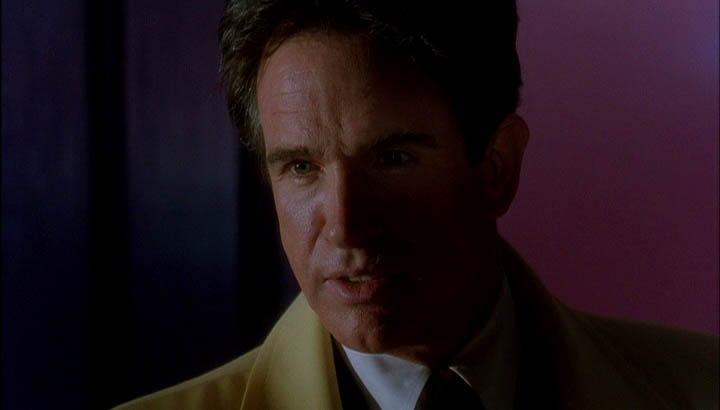
Though I couldn't find a shot in "Dick Tracy" where he wore his hat but his eyes were shadowed by the brim, here's an example of a small eyelight:

dicktracy1.jpg
 
Last edited:
No tricks, you just have to decide how you'll get light on the eyes if the hat is shadowing them, if that's what you want. Some people will use a snooted fill that just catches the eyes and center of the face. Some people will use a low soft bounce as if the key was bouncing off of the floor. Some people will have a lower soft side key light that is dimmer and lower than the key, sort of 3/4 frontal to catch both eyes -- or not (I can imagine more of a 1/4 soft edge that catches one eye in the dark.)

You could also put a strip of light across the eyes, or in one eye.
Thanks David. I have tried the eye light strip or a snoot but that only works for close ups but no longer works in anything between a medium shot and a medium close up where talent tends to move more, unless the director blocks it static but it can be limiting. Tried the low bounce too but found it difficult to get it to a level where it doesn't look like he is being lit from the bottom and look creepy and a level that would be bright enough. Also the under side of the hat brim brights up giving away the lower light source.
Any lighting from the bottom is specially difficult with people with deep eye sockets. People with deep eye sockets and hats are a nightmare.
But I like the lower soft key. I will have to try that next time. As long as no walls are near the talent. It's easy to see why the old film noir films are a double shadow feast.
But I see a lot of the modern neo noir films where the talent's face is bright, either both sides or only one or the eyes are bright, but the under side of the hat brim is dark. Every time I tried a low bounce or anything from the bottom or set lower than the hat's brim to catch the eyes, even if the light is just low enough but still points straight forward, I always got light on the under side of the hat brim, making it obvious the light was coming from low. So I was wondering how they do it in these neo noir films lately. Probably do it in post with color correction?
 
don't gave ant grabs but Deakins did an outstanding job overcoming "the hat problem" inn No Country For Old Men.
 
Back
Top