


David Mullen ASC
Moderator
Skinny rectangular diffusion frames produce an odd soft shadow, sort of sharper in one direction, ala Kinoflos. You only tend to use them for space reasons.
Plus unless the long diffusion is in front of a row of light bulbs, it's not a very efficient use of the light or of space -- you've got the length of the Chimera sticking out from a single light, but only a narrow rectangle of diffusion in front.
But some people have designed "bat strips" (batton strips with a row of light bulbs) with diffusion in front, sometimes Chimeras adapted. My Gaffer in Vancouver, John Dekker, built a light he called a "half dome" which was three light bulbs (usually 213's) in a row with a skinny Chimera in front. Similar to a light by Gaffer in New York on two movies (Kevin Janicelli) built originally for "The Sopranos", which was a row of light bulbs in a lightweight aluminum trough with folded sides, with the eggcrate from a 4' 2-bank Kinoflo in front (which gives you a sense of the dimensions, roughly 4' x 2'.) But Kevin's rig did not add a Chimera diffusion in front because you could just add diffusion gel to the front of the metal trough.
My current Gaffer, Keith Morgan, built something similar as the "half dome" using four light bulbs and a Chimera called a "Woodylite" but it is squarish, not rectangular.
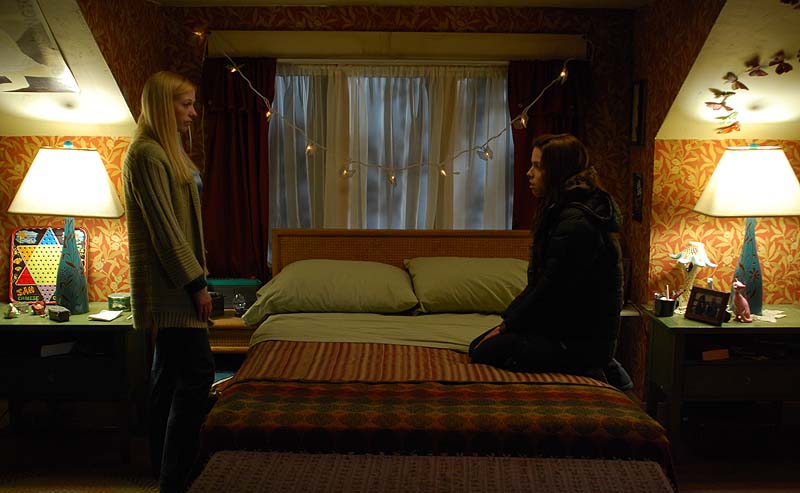
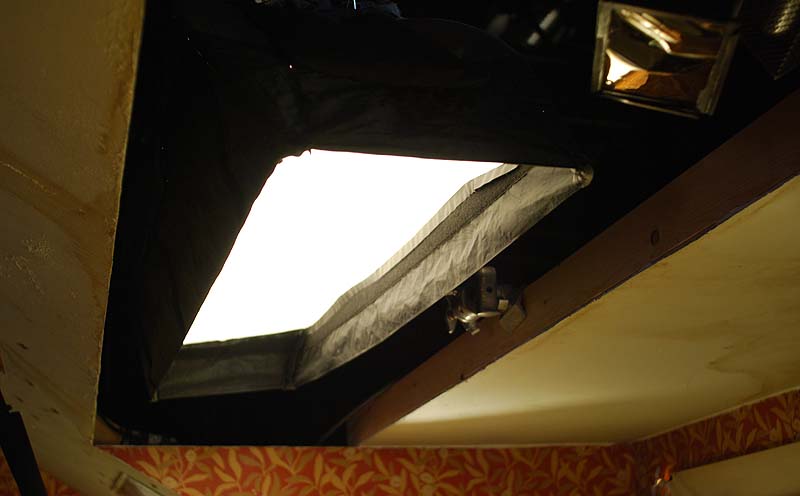
Anyway, here is an example of John's half-dome in a set-up I did for "Jennifer's Body" last spring. I needed a soft light above a bed with a low sloping roof, so I cut a strip out of the set (lucky it was a set) and hid the half-dome above the bed. Here is a photo of the stand-ins and a photo of the light above the bed:
Now I could have gotten a similar effect with a 4' 2-bank Kinoflo, but I prefer the color and quality of a tungsten light through diffusion when possible when shooting in rooms lit with tungsten practicals. I'm more prone to use K55 Kinos in daylight situations, or K32's in night tungsten-balanced rooms with some fluorescent sources, or just use K32 Kinos for fill only instead of a key. Or I'll do the whole scene with just Kinos. But I find that a true tungsten key has a unique quality that is hard to match with other types of sources.
Plus unless the long diffusion is in front of a row of light bulbs, it's not a very efficient use of the light or of space -- you've got the length of the Chimera sticking out from a single light, but only a narrow rectangle of diffusion in front.
But some people have designed "bat strips" (batton strips with a row of light bulbs) with diffusion in front, sometimes Chimeras adapted. My Gaffer in Vancouver, John Dekker, built a light he called a "half dome" which was three light bulbs (usually 213's) in a row with a skinny Chimera in front. Similar to a light by Gaffer in New York on two movies (Kevin Janicelli) built originally for "The Sopranos", which was a row of light bulbs in a lightweight aluminum trough with folded sides, with the eggcrate from a 4' 2-bank Kinoflo in front (which gives you a sense of the dimensions, roughly 4' x 2'.) But Kevin's rig did not add a Chimera diffusion in front because you could just add diffusion gel to the front of the metal trough.
My current Gaffer, Keith Morgan, built something similar as the "half dome" using four light bulbs and a Chimera called a "Woodylite" but it is squarish, not rectangular.
Anyway, here is an example of John's half-dome in a set-up I did for "Jennifer's Body" last spring. I needed a soft light above a bed with a low sloping roof, so I cut a strip out of the set (lucky it was a set) and hid the half-dome above the bed. Here is a photo of the stand-ins and a photo of the light above the bed:
Now I could have gotten a similar effect with a 4' 2-bank Kinoflo, but I prefer the color and quality of a tungsten light through diffusion when possible when shooting in rooms lit with tungsten practicals. I'm more prone to use K55 Kinos in daylight situations, or K32's in night tungsten-balanced rooms with some fluorescent sources, or just use K32 Kinos for fill only instead of a key. Or I'll do the whole scene with just Kinos. But I find that a true tungsten key has a unique quality that is hard to match with other types of sources.


 ]!!


