Welcome to our community

Be a part of something great, join today!

  • Hey all, just changed over the backend after 15 years I figured time to give it a bit of an update, its probably gonna be a bit weird for most of you and i am sure there is a few bugs to work out but it should kinda work the same as before... hopefully :)

Ask David Mullen ANYTHING

low budget acquisition: Red vs 2perf

low budget acquisition: Red vs 2perf

Hello David,
Thanks again for all your contributions on this and other forums. Always illuminating and instructive. With "Manure" in the can, what are your thoughts on 4K Red as compared to 2 perf 35mm for low budget work? (assuming of course the budget can adequately support either format). I should preface this by mentioning that I do own a full 2 perf package, and that I am also in line to purchase a Red. Our experience with Red feature shoots have not been close to "Manure's", technically speaking. Granted your, and your crews level of experience and preparation make a huge difference. Guerilla style location shooting doesn't help either. This question is geared for the next 12-24 months.
BTW, beautiful work on "Manure."
 
Hi David, this thread has been really helpful. Specially for me, a newcomer to all of this.

I have a question for you, and it's about lighting already thinking about the color grading that will be done in post.

I'm preparing to shoot a pilot and since who will grade the shots will be myself as well and I'm really close to the director, I can sort things out and plan the whole chain.

I've been checking some Roscolux gels and specially noticed the 30-60-90 ones, that have Pink (Magenta), Red, Green, Blue etc. And noticed that they reduce the transmission of colors in a precise way.

So, if I wanted to push the color of scene to a more greenish tone but still wanting to preserve a natural skin tone (without having to roto), I could light the talent's face with a 30 Magenta, so that way his/her face would have 1 stop less green. Am I following this the right way?

Is this a common practice? Will that work?

:blush:

Thanks in advance!
 
Yes, it will work... but how well depends a lot on how much you can separate the magenta key from the rest of the ambient light. Often you get spill from the non-magenta lights on the hair, in the shadows, which will go greenish when you time out the magenta in the face.
 
David, I would be curious to hear your techniques for lighting continuity. Do you relight your close-ups much? Do you keep notes on each set-up or just work from your memory?

I find this a difficult aspect of cinematography.

Chris Bell
 
I work from memory and fill by eye, but then, I'm not shooting complicated efx-driven material...

I try to light the master in such a way that the relighting for a close-up in the same direction will be minimal, the most common thing is that the key light may get softer and come slightly closer to eye level, and then the fill light may be handled better, or I may add an eyelight. A harder edge may become a softer edge, etc. I try to keep color and contrast the same and the angle of the light similar, just cheated to be more flattering or more natural-looking (if the positions in the wide master were not at the best angles because of where I had to hide the lights.)

I'll tell the Gaffer & Key Grip while we are shooting the master as to how I plan on making changes for the close-up so they'll be ready.
 
Lighting for nighttime in bedrooms

Lighting for nighttime in bedrooms

David,

How do you approach lighting bedroom scenes which are set at night?

On the one hand, to be totally realistic, it should be very dark, but in a film you obviously need the audience to be able to see things, so we have to cheat.

What always looks bad in "Hollywood" films is where it is so light that you can't believe they could possibly get to sleep!

The 2 options seem to be:
1. Using "moonlight". But this requires curtains or blinds to be open, which is not normal.
2. Having the hallway light on, and leaving the bedroom door ajar, so a streak of light comes in. (This is the approach I normally take).

What do you think looks best?
 
Hello, I guess this have been asked many times before, but what 35mm film stock closest match redone?
 
Speed-wise and color-balance-wise, it's close to 250D stock (since there is no 320D stock...)

Grainwise, it's more like a 50D stock.

Otherwise, the RED ONE images look more like good DSLR photography than 35mm color negative, which is not necessarily a bad thing.
 
How you light a scene that takes place in a bedroom where the lights are off partly depends on the dramatic style of the particular project -- you can't be generic about how you approach lighting. If the project calls for a certain Gothic or German Expressionist quality, something more stylized, then shadowy moonlight may be the best approach.

Otherwise, it comes down to this: if you can see what's going on, there must be light... so where could the light be coming from? You can make up almost any source -- a streetlamp outside the window, passing car headlights, a nightlight, light creeping in from under the door, etc.

Unless it is pitch-black where you live, generally there is some light in a room at night, often coming through the windows.
 
Day For Night

Day For Night

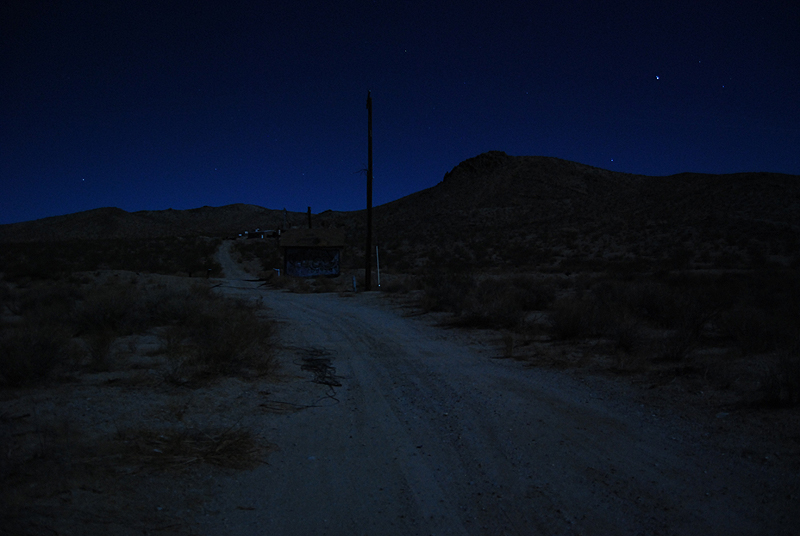
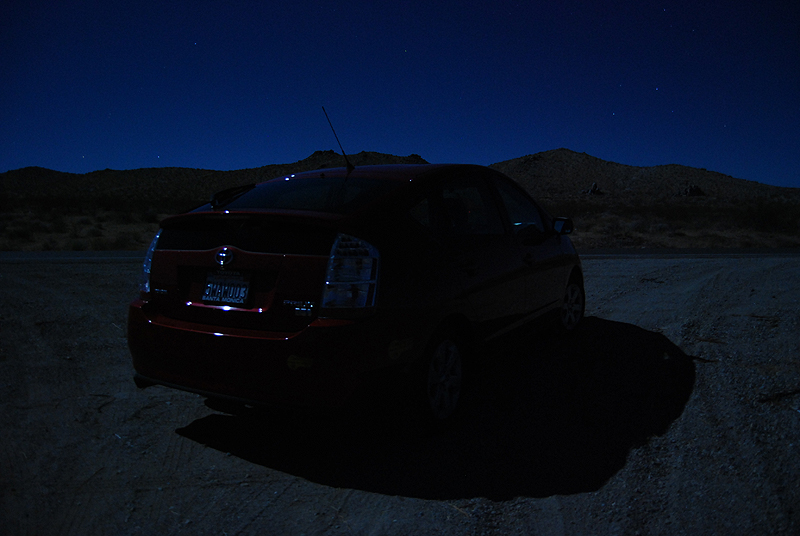
I'm out in the Mojave Desert visiting my parents, and being a full moon tonight, I decided to take my light meter and my Nikon to see what it would be like to shoot a scene by real moonlight.

Figuring that two-stops underexposed would look about right for a moonlit scene, the real moonlight, according to my incident meter, needs to be shot at 8000 ASA at f/1.3 at 24 fps with a 180 degree shutter to end up two-stops underexposed.

I took some photos, at 800 ASA, f/3.5, with a 4 second shutter speed, which is a bit more exposure than what I mentioned above:

moonlit1.jpg


moonlit2.jpg


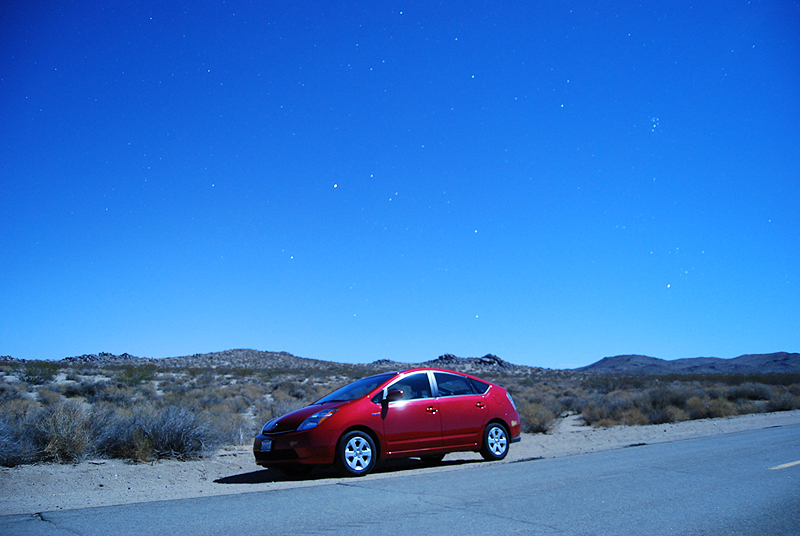
Just for fun, I took a photo of my car with a 30 second exposure:

moonlit3.jpg


Now one thing this experiments teaches me is that a night with a full moon is a bad time if you want to see stars -- normally the desert night sky is full of stars but the moon is too bright tonight to see many.

The photos also suggest that faked day-for-night is not so far off from the look of real moonlight in the desert...

I did some simple Day For Night tests using the moonlit stills that David took. Here they are.

I'm hoping to do some actual DFN tests on the red soon. Does anybody have any DFN before-and-afters that they've shot on the Red?
 
I did some simple Day For Night tests using the moonlit stills that David took. Here they are.

I'm hoping to do some actual DFN tests on the red soon. Does anybody have any DFN before-and-afters that they've shot on the Red?

That's kinda funny to call them DFN tests when the original shots were done at night!
:unsure:
 
"The photos also suggest that faked day-for-night is not so far off from the look of real moonlight in the desert..."

Aside from the "daylight stars," your 30-second exposure proved that moonlight, when exposed long enough, looks indistinguishable from sunlight. So, I was curious to see if the image would be malleable enough to create an acceptable night-time effect in post. Though it's not "true" day-for-night, I think it completes the experiment you began out in the Mojave.

I'll be out in the open desert later this week shooting some daylight stills and doing more manipulations like this. I'll post them here for comparison when I'm done.
 
Trouble is that the look of night is subjective -- it matters less that you're matching reality as it does that it SEEM real. Even the worst-lit night exterior scenes generally look like they were shot at night, just badly. Mainly because the sky is black, etc. So the audience accepts that it is a night scene.

I find that the main problem with DFN is that is looks the most realistic when it is painfully dark. As soon as it is lightened up for TV or because the director wants to see what's going on in the scene, it looks too bright to be night. And the other problem, again, is getting the sky dark enough.
 
I think D4N can look excellent with great lighting! (Can't just pick a spot for your camera, expose 2 stops under, and time it bluer later..)

~S

Here here. My problem with DFN is that it always looks very uninteresting. Very flat. No contrast. There's no vitality to the image. No separation. Just a big giant under-exposed flat lifeless image.

I think the only time I've seen DFN where I thought it actually pretty good was in Apocalypse Now.
 
Day-for-night is no more or less contrasty than regular daytime photography. If you shoot on a sunny day in backlight with long shadows, you will get plenty of contrast, three stops or more difference from key to fill, nearly black shadows once underexposed by two stops, let's say, that can easily be made blacker in post. You can create extremely hi-con day-for-night images if you wanted to.

What you can't do is get a black sky, unless you shoot on a sunny day with a clear blue sky on b&w film and turn it black by using a red filter, and then print it blue on color print stock, or do something similar digitally by shooting on color but turning the blues to black, then making the image monochrome, and then adding a blue tint back to it.
 
When you're at high altitude you can use a pol filter to turn the sky very dark.
 
Back
Top