Welcome to our community

Be a part of something great, join today!

  • Hey all, just changed over the backend after 15 years I figured time to give it a bit of an update, its probably gonna be a bit weird for most of you and i am sure there is a few bugs to work out but it should kinda work the same as before... hopefully :)

Ask David Mullen ANYTHING

Skinny rectangular diffusion frames produce an odd soft shadow, sort of sharper in one direction, ala Kinoflos. You only tend to use them for space reasons.

Plus unless the long diffusion is in front of a row of light bulbs, it's not a very efficient use of the light or of space -- you've got the length of the Chimera sticking out from a single light, but only a narrow rectangle of diffusion in front.

But some people have designed "bat strips" (batton strips with a row of light bulbs) with diffusion in front, sometimes Chimeras adapted. My Gaffer in Vancouver, John Dekker, built a light he called a "half dome" which was three light bulbs (usually 213's) in a row with a skinny Chimera in front. Similar to a light by Gaffer in New York on two movies (Kevin Janicelli) built originally for "The Sopranos", which was a row of light bulbs in a lightweight aluminum trough with folded sides, with the eggcrate from a 4' 2-bank Kinoflo in front (which gives you a sense of the dimensions, roughly 4' x 2'.) But Kevin's rig did not add a Chimera diffusion in front because you could just add diffusion gel to the front of the metal trough.

My current Gaffer, Keith Morgan, built something similar as the "half dome" using four light bulbs and a Chimera called a "Woodylite" but it is squarish, not rectangular.

Anyway, here is an example of John's half-dome in a set-up I did for "Jennifer's Body" last spring. I needed a soft light above a bed with a low sloping roof, so I cut a strip out of the set (lucky it was a set) and hid the half-dome above the bed. Here is a photo of the stand-ins and a photo of the light above the bed:
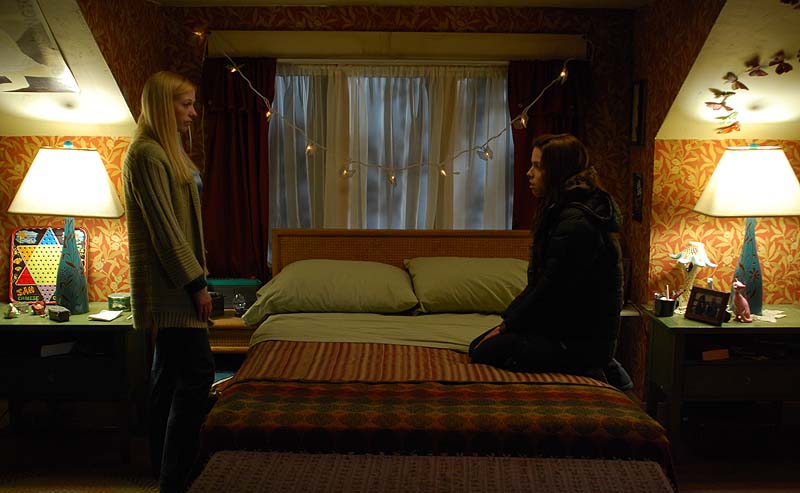
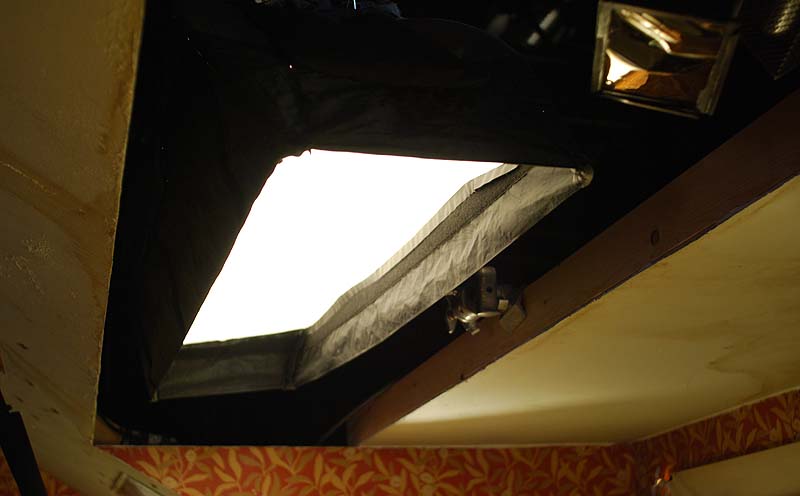
jb13.jpg


jb14.jpg


Now I could have gotten a similar effect with a 4' 2-bank Kinoflo, but I prefer the color and quality of a tungsten light through diffusion when possible when shooting in rooms lit with tungsten practicals. I'm more prone to use K55 Kinos in daylight situations, or K32's in night tungsten-balanced rooms with some fluorescent sources, or just use K32 Kinos for fill only instead of a key. Or I'll do the whole scene with just Kinos. But I find that a true tungsten key has a unique quality that is hard to match with other types of sources.
 
David,
I agree about tungsten sources, especially on skin. I use KinoFlos in mixed lighting situations, or when space, power, or heat are a consideration, but nothing beats a tungsten emitter on skin.
Cheers,
Harry
 
David, would you have any tips to get good results from consumer type fog machines? Thanks.
 
David, would you have any tips to get good results from consumer type fog machines? Thanks.
From my experience, consumer fog machines work fine, if fog is what you want. If haze is what you really want, I have gotten decent results with fog machines by shooting the output into an electric fan to chop it up, and then fan the air with cards or whatever. I finally shelled out for a haze machine, which is is a lot less hassle, more uniform, and it stays in the air longer, which makes it easier to maintain consistency.
 
Somewhere Mark...a nice revival by the way
 
Nice pics David...a huge chimera
Thanks for the lessons
I revisited since the first page...wow
Fantastic cinematography classes
 
David, would you have any tips to get good results from consumer type fog machines? Thanks.

You have to have a draft-free space, sealed-up somewhat, and let the fogger fill the whole room and then spread evenly. You can't just smoke one part of a space because the smoke wants to move. You spend a lot of time wafting the fog around trying to get it to spread and break up, and then waiting for it to settle. It's a pain, which is why hazemakers are nicer to deal with than foggers, though they are similar.
 
This is more a question about set politics and organization psychology, but the thread's title says "Ask David Mullen ANYTHING".

This is my final year in Film School, and in six weeks I start directing a short film about a girl with leukemia that revisits her life in a dream. I had my first meeting with the DOP yesterday, and is was a very awkward situation. She was seemed more interested in directing the film than shooting it, basically demanding it to be "The Diving Bell and The Butterfly 2", covering everything in avant-garde close-ups. After 15 minutes she straight out said that my choices were wrong, hers were right. I tried politely to say that I am the director and she has to trust me, but it did not seem to have any effect.

Any ideas to have to solve the situation in a diplomatic way?

If anybody else has advice they are more than welcome.
 
Well, normally in the real world, you hire the DP so you wouldn't hire someone who has completely different ideas as to how to make the movie. So I guess in this case, you had someone assigned to you, which is an unreal situation. Normally you'd just replace the DP if they can't collaborate. On the other hand, collaboration is a two-way street, so if you think your job as a director is to simply tell the DP what you want, you'll never get the best work out of a DP because you're asking them not to think.

Part of a director's job is not only telling people what you want, it's convincing people that you know what you are doing -- there is diplomacy involved. And you get the best work out of fellow artists by treating them like fellow artists and respecting their talent. It's in your best interest ultimately to get them to do their best work for you.

But in this case, it sounds like you have a DP who doesn't know what a DP's job is, which is NOT to dictate to the director how to shoot and cover a scene. If the film school DP continues to behave like this, I'd talk to the film school folks.
 
Thanks for the answer. The DP is assigned, so it is an arranged marriage we have to figure out. What you say about a two-way collaboration is something I will keep in mind. How is best to let the DP be part of the collaboration but still be clear on how on you will cover the scene?
 
I would suggest diplomatically going to the 'teacher' sinec you are in school and having the roles better explained for each of you. This is a very big deal, especially when you get On Set.

Effin nightmare that anyone on crew wants to argue with the director; pet peeve. :angry03: :angry03: :angry03:
 
Hi !

I have two questions here :

1. How did you find the RED with the tungsten lights. The noise in the blue channel. What were your experiences like. Did you prefer using a 80A filter or balancing the camera to 3200k ?

2. Intercutting between a 4k and 3k shot ? Will there a major jump in image quality ?

Waiting for your feedback.
Thanks.
 
RED was fine in tungsten light as long as you exposed the image fully, didn't start playing with a lot of underexposure. I did have some underexposed (higher ASA) scenes in tungsten light at night which have varying degrees of blue noise in them which I plan on trying to clean up in post.

I didn't use the blue filter because I needed the speed.

I didn't really see much difference in quality between 3K and 4K -- slow-motion shots tend to feel different, unique, anyway, so your eye is less likely to notice a small change in resolution.
 
Here are some tungsten examples. There were from the 4K TIFF's opened up in RedAlert, cropped (not reduced) from 4K to about 1K, so remember that you are only seeing 1/4 of the picture.

320 ASA at 3400K:
RED 320T.jpg


500 ASA at 3400K:
RED 500T.jpg


640 ASA at 3200K:
RED 640T.jpg


You see how much blue noise popped up at 3200K setting in RedAlert at 640 ASA. This is perhaps the noisiest shot I did in the whole movie so I'm a bit loathe to show it uncorrected, but there are ways of reducing this noise. Also, this scene was deliberately underexposed by a stop or so on top of the 640 ASA rating, shot at T/1.3 on the Master Primes, to capture as much background ambience as possible since I didn't light anything other than the car (the lighting in the car was incredibly dim -- I had ND.6 gel on Mini Kinoflos!) The scene is supposed to be set under orange-lit sodium streetlamps, so I have some wiggle room to get rid of the blue.

Here is the whole frame of the last example, roughly color-corrected to reduce the blue noise, for a sodium-lit look:
RED 640T2.jpg
 
What I encourage any filmmaker to do is develop their ability to previsualize, to develop a visual imagination, and find ways of conveying emotion and story information through images. Learning the technical stuff is useless if you don't have a creative idea to express using that knowledge.

David i read your older posts and i liked this one so much it is like

The first visual rule for me

is there is a way to develop those skill befor going to shoot ?

Is there is out there something to read or watch to learn the important

Relationship between storytelling (script , actors ) and visual stuff

(lights, blocking and stagging ).
 
It's best to start by studying what you like in movies and figure out why you like them and work from there. Reading helps, shooting tests and short films helps, editing some footage helps, etc.

Basically you are constantly balancing the acts of shooting, watching movies, reading about movies, and reflecting and analyzing what you have learned and shot to date -- plus expanding your other interests to make you more well-rounded. Theory and Practice basically.
 
David, I love how you use perfect grammar in all your posts.

And thank you for this.

Riley
 
Back
Top