Welcome to our community

Be a part of something great, join today!

  • Hey all, just changed over the backend after 15 years I figured time to give it a bit of an update, its probably gonna be a bit weird for most of you and i am sure there is a few bugs to work out but it should kinda work the same as before... hopefully :)

Ask David Mullen ANYTHING

Yes, the PARCAN's are more useful in some situations than a normal PAR since you don't have to deal with side spill and the tube is long enough to put a gel in a gel frame holder in front without melting (except for the narrow spot ones -- they are called "firestarters" for good reason to be careful how close the light is to a surface). You can also clip a scrim from another light to a PARCAN, or put it on a dimmer.

I also find ellipsoidals like Lekos or Source-4's very useful for lighting, especially as a bounce where the light can be precisely cut to match the area you want to bounce off of. You can see a Source-4 with a 575w Joker HMI inside of it here (normally Source-4's and Lekos are tungsten, under 1K):
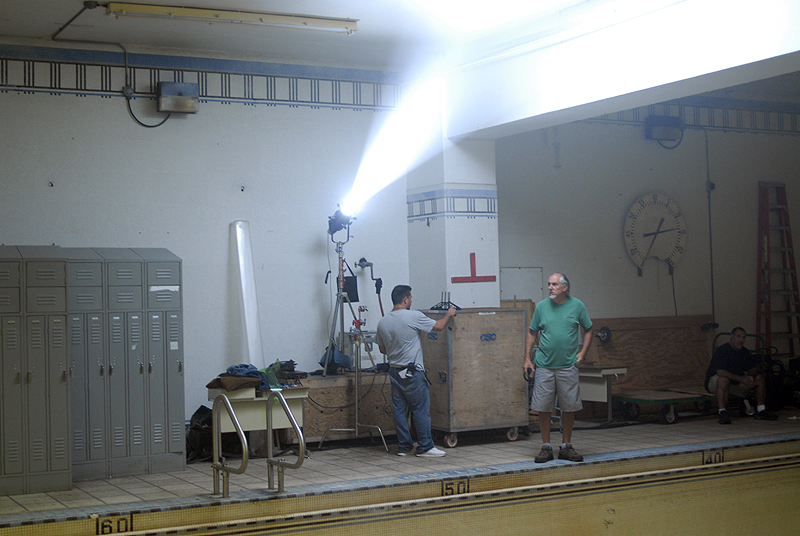
sophomore crew3.jpg


Here the Joker HMI Source-4 (called a "Joe-Leko") is being bounced off of a white card above a window to create a soft backlit effect. Once the card is in place, the spotlight will be centered on the card and then the iris leaves of the Source-4 will be adjusted to match the edges of the white card:
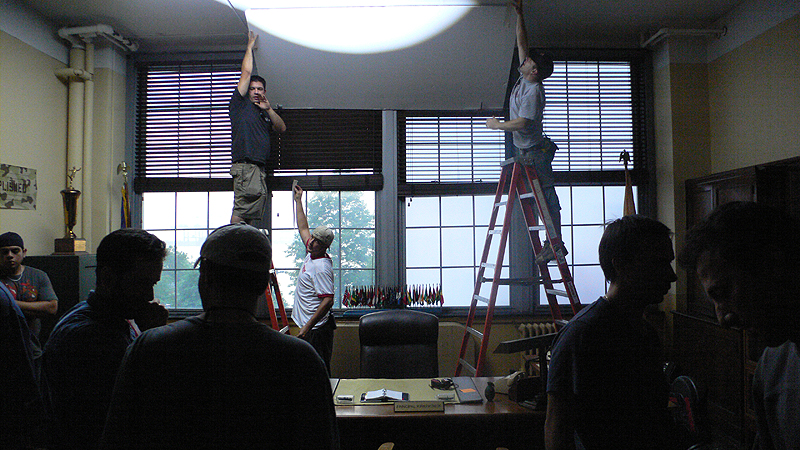
sophomore crew7.jpg


What's great about that trick is that it is much easier to rig white cards to ceilings than a soft light unit. The Source-4 doesn't really spill around the edges (unless the front lens is dusty/dirty) so you don't need a lot of flags to cut the light and get rid of any flare. It only lights what it is aimed at.


Great tips!

Just to make sure we are on the same page, when you say PARCANs you mean just a normal long PAR64 like this right?
http://www.bulbamerica.com/photos/products/2/42/42/thumbnails/250x250/PAR64B.jpg

When you use PAR64’s do you find yourself using the MFL as much as the VNSP or do you feel that if you need a MFL you would rather use another type of fixture all together and use the PAR64's only for distant throw?
I’m just trying to figure if I should get both or just VNSP for my kit.
 
When you use PAR64’s do you find yourself using the MFL as much as the VNSP or do you feel that if you need a MFL you would rather use another type of fixture all together and use the PAR64's only for distant throw?
I’m just trying to figure if I should get both or just VNSP for my kit.

Ditto, same question.
 
Yes, that's a PARCAN. Sure you can use medium PAR's for bouncing and whatnot, if you can buy some cheap, why not? They are a bit long for some small spaces though. And even with a medium globe, the PARCAN tube tends to limit the size of the circle, which may not be good for filling a large bounce surface.

Since I generally carry fresnels and open-faced units, I don't have much need for medium PAR64's, just the spot and narrow spot.
But it just depends -- one of the advantages of PARCAN's is that they look like theatrical lighting (since they are) so they can be dressed into a shot and be visible to the camera. Like for a scene at a music recital, or school dance, public speaking event, etc. where fixtures like that are motivated. So in those cases, you may need a medium PAR for the light effect you want hitting the subject in the shot.

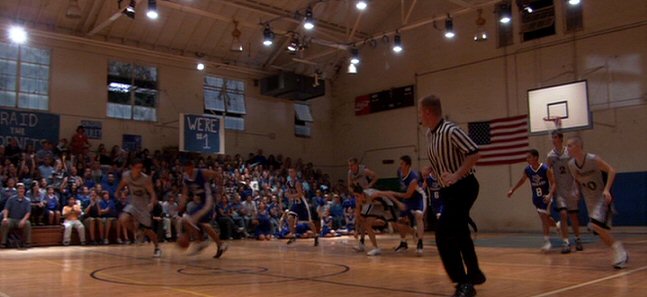
Here is a gym that I lit for "The Sophomore" (still in post) with a grid patten of shiny (not black) PARCAN's. I can't remember if the PAR's were spot or medium, but they produced a circular spot on the floor. I softened the circle slightly by putting a piece of Opal gel at the end of each PARCAN:

gym1.jpg


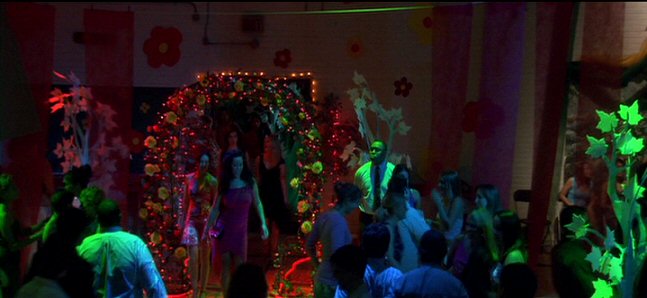
I did something similar for "The Quiet" because in both movies, there was a day of shooting a night basketball game and then a few days later (after the art department did their work) a day of shooting a night school homecoming dance. So I need to have white overhead light for the game and party-gelled spots for the dance. So the grid of PARCAN's helped do both with one lighting set-up. On "The Quiet" I was able to hang more fixtures closer together, and I had heavier diffusion (216) on each fixture, so the game was lit more evenly overhead. Then for the dance, I pulled the diffusion gel and put in party gels.

Here are two examples from "The Quiet":

quiet13.jpg


quiet14.jpg


Now for "The Sophomore", the director wanted the basketball game scene to be a little less evenly-lit so I let the overheads spots be more pronounced.
 
Since I generally carry fresnels and open-faced units, I don't have much need for medium PAR64's, just the spot and narrow spot.

This is what I was thinking too. I always carry fresnels, open-faced, broads etc around when shooting, so I thought the PAR64 MFL wouldn't be of much use since I can use the other fixtures to bounce. There is the scenario you pointed with the basketball game. But I was mainly thinking of getting MFL to light building facades and other structures (from closer) for night shots since they are broader than the VNSP. But I guess for that purpose a broad would do just as well?
I guess I could probably pass on the MFL and get only VNSP.
 
Or are there any other situations you could see a MFL being more useful than a Broad or open faced besides the examples you gave above?
 
Like I said, the main advantage of a medium PARCAN is if it had to be in the shot and had to be medium. The other advantage is that they are naturally "snooted" so you don't need barndoors. Otherwise, I don't see much advantage unless they are cheaper to buy/rent for some reason.

As for medium PAR64's (not PARCAN's), again, it seems the only advantage over other medium tungsten lamps is if they can be dressed into a shot or you have a deal on buying/renting them. Otherwise, I'm more likely to use a Blonde or Redhead for simple bouncing. Yes, for uplighting on buildings, a black PAR64 unit may look more like it belongs there architecturally, compared to a maroon MR Tweenie (usually blackwrapped for this reason.)

Now maybe a Gaffer though can give you more reasons, since I notice they tend to carry some medium PAR64's on the truck. Since they are sealed-beam globes, there may be some other advantages in some environments (wet, dusty, bouncy?)

Like I said, for unique situations, renting a bunch of medium PAR64's may be the best lighting plan. But as for owning them compared to other open-faced or fresnel units with spot/flood capabilities, I am more likely to get the later.
 
Makes a lot of sense David.
I guess I will get a couple of MFL after all. I know I will need uplighting buildings for a next project and it's easier than blackwrapping other fixtures and will look more authentic. I hadn't considered that angle. Since you buy the PAR64 housings and then you can buy different bulbs/globes for them, the extra expensive for a MFL bulbs is worth the flexibility. Other opportunities to use them may pop up.
Thanks for exercising the possibilities and helping me to see the big picture.
 
We call them "rock and roll" lights a lot. PAR stands for Parabolic Aluminized reflector. So sometimes openface HMI's get called PARs as well.

This is a ffn.

Any idea what FFN stands for, or is it just a GE bulb designation? Seems the N should represent "narrow".
 
I noticed on the Mole-Richardson site some globes listed like this:
FFS - (1000PAR64Q/6WFL) SYLVANIA GLOBE
FFN - (1000PAR64Q/1VNSP) SYLVANIA GLOBE
FFR - (1000PAR64Q/5MFL) SYLVANIA GLOBE

I'm not sure the letters mean much -- "FF" might mean "1K PAR64" and the last letter designates beam spread, but I'm not sure why "S" is "wide flood" and "R" is "medium flood". "N" might mean "narrow". But what is spot?
 
TVs have already started producing shows in every genre.
With the entry of RED ONE, now even TV serials will start looking lavish and rich(DOF,Lattitude, quality glass etc).
TVs production welcome fresh talent/variety ideas better than film studios.

Trying understand, what are the elements that actually motivate people to theatres..? Any opinions?
 
Trying understand, what are the elements that actually motivate people to theatres..? Any opinions?

For me, seeing a narrative feature on a huge 75' wide screen with an audience who is enjoying the movie along with me. Going out of the house, sitting in a large room, having the lights go dim, etc. -- the presentation beginning, the anticipation, and then just focusing on the moviegoing experience without (hopefully) distractions like a knock on the door, a ringing phone, etc.

As for TV, most dramatic work on network TV in the U.S. is already shot in 35mm (using high-end optics) and posted in HD, and looks very rich and expensive.
 
Not sure if this one has been asked.


Can you comment on your experience in the ASC? Getting nominated?


I started reading American Cinematographer when I was in my teens, and I'm not sure I will ever give up my lust for those credentials. I'm not usually one that gives to much notice to accreditation but ASC still means something to me.

Thanks again for all your time on this forum.
_mike
 
I'm amazed that I get to go to ASC events, dinners, tech meetings, etc. and chat with my heroes. For example, "Star Wars" came out when I was fifteen and was a major cinematic viewing experience for me -- now I run into Richard Edlund all the time over at the ASC and talk with him about "Star Wars". I am also a big "Star Trek" fan and regularly chat with DP's like Richard Kline, Matthew Leonetti, Jeff Kimball, who all worked on the movie series.

But beyond my teenager interests in sci-fi movies, I also get to chat with so many great DP's, retired and working, it's a great honor and gift. And I think many of them appreciate the fact that I really know their work in such detail, thanks to a good memory for everything I read.

I felt a bit intimidated when I was approached by a member about the possibility of joining, and felt I was too young and it was too early in my career, but the cinematographer insisted that I was well-suited for the organization due to the quality of my work and my scholarly pursuits regarding the history of cinematography, and my interest in teaching and speaking about cinematography to students.

You basically need three letters of recommendation from ASC members to start the process.
 
David, I am about to direct a film which plays on the contrast between 'impartial' institutional power and ordinary human problems. The impartial institutional power is not actually impartial but really partial where vested powerful interests need to be protected, and the ordinary human problems are about life and death of large numbers of people (slow genocide to be precise). The films I make are realist dramas and I work a lot with performance, getting deeper emotional very realist performances from the actors to tell the story. In all my projects so far my cinematographers have mostly stayed intimate in style to capture those performances, often but not always handheld. But I read the comments you made about The Color Purple, where the social environment could have played a stronger role rather than just stay intimate, and I feel that I should find a way of combining both, so that I get the emotionally intimate performances of the actors, but use cinematography to capture the contrast between the institutional power and the individuals who realise that their fight is really fighting against that power. I would love to pick your brains about the things you would consider if you were shooting this film, or what kinds of things I could discuss with my cinematographer, producer etc. It's a low budget film by the way.
 
I was only pointing out the danger of being too subjective in your approach to every scene, too emotionally "immersive" where everything is shown through how it affects the main character.

That's great for drama but you may want to occasionally create a distancing effect, a more "objective" observational style, which makes it easier to introduce broader intellectual, social, and historical ideas, things that the main character would not naturally communicate or explore or experience themselves.

This often manifests itself in wider shots, high and low angles, extreme wide-angle or telephoto shots (non-human perspective, definitely not the main character's POV), third-person narration, scenes where the main character is not present, etc.

"Clockwork Orange" is a good example of a film that manages to both show the main character's subjective experience and yet take on an observational style now & then to get the feeling that there are institutions greater and more powerful than the main character. Kubrick's strong sense of architecture helps. Another film like that is Bertolucci's "The Conformist", which has a distancing effect from a certain modernist "Fascist" look to architecture and camera angles in the Italy scenes, yet is also has a strong sense of personal psychology, wrapped up in the subjective experience of the main character.
 
Thanks David, I'll start talking with my scriptwriter about how we can think about scenes where the main characters may not be present, and I'll definitely check out these films.

In terms of lighting - would you go for strong contrasty lighting for the more objective scenes versus soft lighting for the subjective or do you think that might be too patchworky?
 
David,
I have been looking for a good set of lenses. I currently have a set of Ultranon's BNCR mount. I have heard that the glass on these lenses is considered to be very good and extreamly sharp. What I would like to know is, is it worth machineing Pl mounts for this set.
Or should I sell the house and get a set of S4 cookes, or sell the house and the car and get a set of Zeiss super speeds.
thank you,
yaque
 
Back
Top