Welcome to our community

Be a part of something great, join today!

  • Hey all, just changed over the backend after 15 years I figured time to give it a bit of an update, its probably gonna be a bit weird for most of you and i am sure there is a few bugs to work out but it should kinda work the same as before... hopefully :)

Ask David Mullen ANYTHING

Hi Yaque,

The Ulttanon's are basically Zeiss Superspeeds with 16 Iris Blades. The extra lenses in your set are from a Zeiss Contax, that's why they are not all T1.4.

What is the mechanical & Optical condition of your lens set?

Have you had a quote for machining the mounts?

Your cheapest option would probably be an 'Ultracam BNCR' mount for your Red.

Stephen
 
The issues with a lot of BNCR lenses is the physical size of the exit pupal and rear end of the lens. Some were way too big to fit in PL mounts. Having said that you should have them looked at and get a quote to see if they can be remounted. If all of your lenses are BNCR them maybe a mount for the Red is the simplest solution.
 
In terms of lighting - would you go for strong contrasty lighting for the more objective scenes versus soft lighting for the subjective or do you think that might be too patchworky?

Well, you can't really switch styles of lighting in the same scene, for continuity reasons, but certainly you can come up with a visual approach where the softness or hardness of the lighting changes to suit the tone of the scene.

Look at these frames from "The Last Emperor" -- early childhood is softer and warmer, the Japanese occupation is harder and bluer, and the surrounding prison scenes are greeen-grey-ish:

lastemperor1.jpg


lastemperor3.jpg


lastemperor4.jpg


lastemperor2.jpg
 
David, have you ever made sense of Storaro's claims about color values? You provided a great example of it above, and clearly his approach works dramatically and aesthetically, but the claims he makes sometime seem to border on the religious or mystical....

He published a book a couple of years ago, you're probably seen it, which includes his influences from classical painting. But it's full of claims which can seem impenetrable at times, like medieval theology.... What do you think?
 
Whatever works for him... I remember on a documentary about Storaro, where on the set of "Sheltering Sky", Bertolucci says "Just like some artists need a drink or to smoke a joint to get inspired, Vittorio needs his elaborations..."

I'm reading a book right now called "Harnessing the Technicolor Rainbow" about how color theories developed in the 1930's with the advent of the first workable 3-color process.

Storaro follows the classical notions of color, more or less, that RED is the color of blood, of passion, energy, BLUE is the color of moonlight, of the intellect, etc. Soft colors are more relaxing than bold colors, etc. Storaro gets more specific than that but he also modifies his interpretations to match each script - he HAS to. RED means one thing in one of his movies and it means something else in another movie.

It is basic visual symbolism -- you need to provide some sort of visual code through repetition to associate a color with a theme or character (you've heard the saying, if it happens twice, it's a coincidence, if it happens three times, it's a motif.)

I follow Storaro's methodology to some extent on many of my movies -- I breakdown the story into a structure of light values and color and see if I can develop any sort of coherent theme to hang my hat on, so to speak. It can be pretty subtle though.

For example, in "Apocalypse Now" the visual theme is the clash of two civilizations in the jungle, one modern and one ancient. That clash is symbolized by artificial light (the U.S. military) intruding on the natural light of the jungle. That is best seen in two scenes: the Playboy Bunny show and the Do-Long Bridge battle. And the BBQ on the beach at night, lit by helicopter search lights. There is less use of symbolic color in the movie, though the natural light of the jungle and the VietCong is often colored (golden firelight, blue dusk, etc.) whereas the U.S. military's light is piercing white. And I guess there is the artificial (unnatural) colors like purple from the smoke grenades used by the military.

In "Sheltering Sky" you have the life journey of the male character use the colors of the sun as it moves from sunrise to sunset (oranges), whereas the journey of the female character follows the color of the moon (blues).

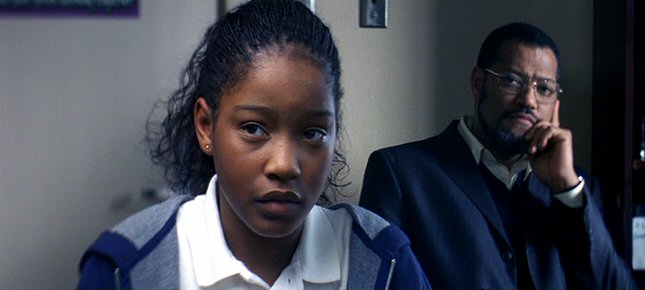
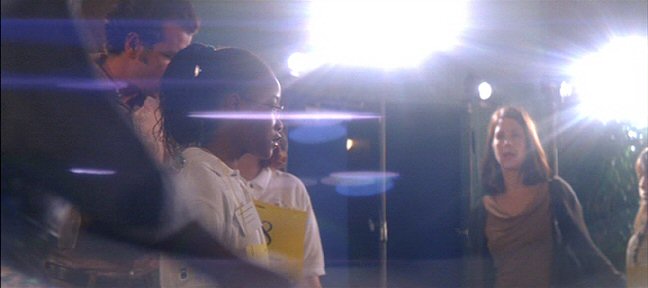
When I shot that family movie "Akeelah and the Bee", I generally had a couple of visual arcs -- one was from cold to warm as she succeeds in her spelling bee contests, and the other was from dark to light. Bright light, like from the stage, symbolized enlightment. There's a key scene where she is reading a quote on a wall where I have the sunlight fade up.

You can see this in these frame grabs:

akeelah2.jpg


akeelah4.jpg


akeelah5.jpg


akeelah6.jpg
 
Vittorio isn't likely to consult me, but I'd argue that The Sheltering Sky is a prime example of the potential dangers of imposing a color symbology on a narrative.

Maybe the difference goes back to the discussion you were having with Redfish -- the tension between the personal and the impersonal. In Bertolucci's hands the subject seemed to become entirely personal. The book, by contrast, is (I'd argue) driven by narrative movement, and "psychology" is revealed only through narrative form, and abstraction.

So the book is more like a movie than the movie was. I guess it's unreasonable to expect Storaro to fight the script, the director and John Malkovich in favor of fidelity to a book, but still.... The thing coulda been a contender. So says I, anyway.
 
David, would you expound on how you see the difference in responsibilities between a DP and Gaffer? And in this grey area, where does the term "Lighting Director" fit in? (I've seen that on several resumes/rate cards now.)
 
Lighting Director is sort of a crossover position from theatrical stage lighting, for event lighting (concerts, awards shows, etc..) I'm not sure, but I think news sets and game show sets also have a Lighting Director rather than a cinematographer.

The cinematographer-gaffer relationship is a little like the director-cinematographer relationship, there has to be some collaboration involved yet there is also clearly one person who ranks above the other.

How much a cinematographer relies on the gaffer to make creative decisions on how a scene should be lit depends on the cinematographer.

Personally, I love to light, and lighting is part of my responsibilities, so I can't imagine leaving those sorts of decisions to the gaffer, like letting them light a whole scene without my input. Rough-in some pre-lighting, maybe, as long as I would have time to change it when I arrive.

However, I certainly will talk a set-up over with a gaffer for their opinion on my artistic approach so that we are on the same wavelength. I also bounce ideas off of the gaffer sometimes to get some feedback if I'm not sure which of my ideas is more worthy. And I will get their ideas too and consider them, especially once we start to work day-to-day with each other and I'm confident that the gaffer "gets" what I'm attempting to do.

There are also really big lighting set-ups where you can leave the finer details to the gaffer, like lighting night exteriors. In that case, I will tell the gaffer the overall approach I want to use, and how the foreground action should look, but I'm not going to necessarily specify every bush or wall I want a little spotlight on in the distance.

After years of working with different gaffers on low-budget films, some good, some bad, and some inexperienced, I've had to learn to know how to light a scene myself, so I tend to be rather specific about what I want, sometimes too specific for some gaffers who want to be more creatively involved. It's just a habit I picked up, so I often have to learn to step back a little and let the gaffer do their job rather than micromanage. It's hard, and some gaffers have complained when they see me dropping in scrims or spotting in a light myself. They often assign an electrician to follow me around on a set. I get the "Hey, David, it makes me look bad when people see the DP touching the lights!" attitude from some gaffers (and key grips) -- others just get used to it ("Hey, you're the boss...")

I can be very specific when describing a set-up -- "I want a 2K over there through a 4'x4' 216 frame, with siders and a topper, and then double-net the bottom off of that coach, I want to rig a tweenie up there in the rafters with a snoot pointed at that painting, I want a 4' 4-bank Kino with 1/4 CTO and Full Grid behind camera..." But as the shoot wears on, the gaffer predicts certain things I will probably call for and is one step ahead. And of course, I will listen to the gaffer's suggestions, like if he feels that a 5K would be better than a 2K, or that we should rig a Dedo instead of a tweenie, or that a bounce for fill would be better than a Kino, etc. And of course, he knows the equipment and the power situation better than me, rigging times for different units, manpower issues, etc.

It's all about efficiency on the set. Just as a gaffer can't undermine my authority, I also can't undermine his -- he has a crew to run and they need to be getting instructions from one guy. So I try to run everything through the gaffer so that you don't have two guys running for the same light because they heard it from me and the gaffer separately. And if I drop scrims in lights, I tell the gaffer so he doesn't wonder why there's a scrim in the light.
 
Well, you can't really switch styles of lighting in the same scene, for continuity reasons, but certainly you can come up with a visual approach where the softness or hardness of the lighting changes to suit the tone of the scene.

Look at these frames from "The Last Emperor" -- early childhood is softer and warmer, the Japanese occupation is harder and bluer, and the surrounding prison scenes are greeen-grey-ish:

lastemperor1.jpg


lastemperor3.jpg


lastemperor4.jpg


lastemperor2.jpg

Hey David

Thanks for all the great insights in your replies to me, really inspiring!
 
Lighting Director is sort of a crossover position from theatrical stage lighting, for event lighting (concerts, awards shows, etc..) I'm not sure, but I think news sets and game show sets also have a Lighting Director rather than a cinematographer.

I may be wrong but I think Lighting Director is also how DPs are called in the UK or at least were called.
Great post about the cinematographer-gaffer relationship by the way! Very insightful.
 
I may be wrong but I think Lighting Director is also how DPs are called in the UK or at least were called.
Great post about the cinematographer-gaffer relationship by the way! Very insightful.

You're thinking of the title "Lighting Cameraman" (DP) as opposed to "Operating Cameraman" (Operator) that they sometimes use in the U.K.
 
You're thinking of the title "Lighting Cameraman" (DP) as opposed to "Operating Cameraman" (Operator) that they sometimes use in the U.K.

After all these years have you handpicked any gaffer or lighting director etc.Do you have a team of your own or work with whoever was hired?
Thx
 
After all these years have you handpicked any gaffer or lighting director etc.Do you have a team of your own or work with whoever was hired?
Thx

I guess that is a stupid or ignorant question.
 
I have certain gaffers and key grips (and 1st AC's) that I try to get hired on first, but often either they are not available or I am working on a distant location where the production wants me to hire locally. So I have to interview new people now & then for different shows.
 
Recently I read an article about how a movie was made. There was a Rain action scene that was shot at 500fps using Super 16mm cam, to capture this effect they have used all available lights in the town, as they have lit a big stadium. Since it was a Day shot I assume they are HMI lights.

Now if I want to achieve similar look with RED, let us say 2k@120fps.as I can't get hold of so many lights, can I put 200/300 regular halogen work lights(not HMI/not Tugesten) together and place some diffussion/satin cloth under it, white balance with RED and achieve the same effect..?
what is that I will be missing if I don't use HMI/Tungsten light, especially at higher fps..?

To make it simple, Film Stocks are fixed to either HMI or Tungsten, with RED if I use any color temperatured lights(of course all are of same temerature) and do a white balance, what are the things that can I wrong? What problems do we face and what precautions to take care?
 
Wow, thanks David! I appreciate the response. It seems that the role boundaries of Director-DP-Gaffer can overlap significantly, though there still is a clear hierarchy.
 
The main problem is color balance -- if you are shooting in daylight conditions and you want your artificial lights to match in color, they have to be 5500K-ish, either by using HMI's or gelling tungsten, and the Full CTB gel that converts 3200K to 5500K loses nearly two-stops of light output. Start out with a small tungsten light and then gel it with Full CTB and you have a pretty weak light.

The problem of matching the color temp of your lights to the natural light in the location is entirely independent of whether or not your camera or film stock is balanced for tungsten or daylight.

Not to mention that tungsten hardware store work lights won't do diddly-squat outdoors in daylight conditions, plus they are probably not bright enough indoors for 120 fps photography (where you've lost about three f-stops of exposure compared to 24 fps photography) unless they are close to the subject, or you have a lot of them -- and then you get into power consumption problems just as if you had a couple of big tungsten lamps.

In other words, a 250w tungsten worklight is not a substitute for an 18K HMI.

For close-up work in slow-motion, maybe a medium shot, in 3200K balance conditions (like a night scene), they could work.
 
I have to interview new people now & then for different shows.
I've refrained from joining this thread for a long time, simply because it's been such a great read, but I've got two questions - the first related to the quote above, and the other purely unrelated...

Here goes:
1) I do a fair bit of focus pulling, and the only people I work with are those who I've worked with by chance who then use me again - I guess (thinking whilst I type) this is a two part question, but how do you find AC's to interview, and what format would your selection process take? Would you expect to see a reel of impressive pulling, or simply a CV and a chat to see if you think the AC in question is confident in their skills? I presume a reel for a puller (I haven't got one, btw) is pretty pointless, as you can always select the shots that are in focus! How do you determine, without working with someone, who's good? Do you only work with those who've been recommended by other DPs you trust?

2) I'm also a low-level DP (of course!), and I've, in the last year or so, been lucky enough to get some great gigs and work on a couple of well respected features, although not as the lead cinematographer - I've done some 2nd unit and some operating for really good guys - and I'm really keen to try to find some low-budget indie features to DP (I've got one to my name, but it's a documentary, which is of course not much use for garnering interest from the drama crowd). Do you have any advice on how to break into that circuit?

In addition to the questions, and at the risk of sounding sycophantic, I'd like to take this opportunity to thank you for (a) being so open with your knowledge and helping, I'm sure, many, many people to improve their skills and also for some wonderfully enjoyable hours of viewing - Northfork is one of my favourite films of the last decade or so, in no small part thanks to your beautiful camera-work...

Actually (sorry, thinking on my feet here!), that leads to another question:
How do you feel about the "loss" of lab/film processes when shooting digitally? For instance, on Northfork I know you flashed the film and used an ENR process at the lab (thanks to your blog!). Do you think, as a simple point of reference, that you could have achieved the same look if you had shot digitally, and do you feel that you gain or lose some ability to express yourself in different ways when shooting on one "format" or the other?
 
Back
Top