Welcome to our community

Be a part of something great, join today!

  • Hey all, just changed over the backend after 15 years I figured time to give it a bit of an update, its probably gonna be a bit weird for most of you and i am sure there is a few bugs to work out but it should kinda work the same as before... hopefully :)

Ask David Mullen ANYTHING

No, HMI's won't make the scene flat and soft-lit unless that's how you light it. Don't confuse the strength of the light with how dark or bright it will make the scene -- I can take sunlight and make it look like moonlight by how I expose it. The only reason to use very dim weak lights to create moonlight is if you are balancing that with another source that is naturally weak, like candles or flashlights, which should read as brighter than the moonlight.

What could be a problem though is a white-walled location. No matter how much you underexpose a scene, a white wall is always going to be the brightest thing in the shot, making it hard to read faces. You're better off with a dark-colored room where the moonlight can be exposed brighter for the faces to read. Though if the room is black, you have the opposite problem, no shadow detail.

As for Kinos, those are soft sources, but they can still make a scene moody if used from a backlit angle. I did an HD movie called "The Quiet" which had a lot of moonlit scenes done with HMI's, daylight Kinos, and small tungsten fresnels gelled blue.

This shot was backlit by a Kinoflo:
quiet11.jpg


HMI in the street (probably a 6K) backlighting the curtains through the trees:
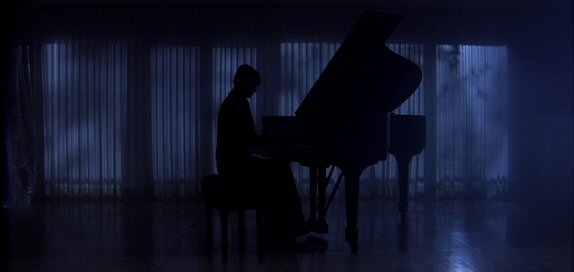
quiet1.jpg


HMI outside a window (probably a 1.2K, but may have been a 5K tungsten with the fresnel removed, with blue gel):
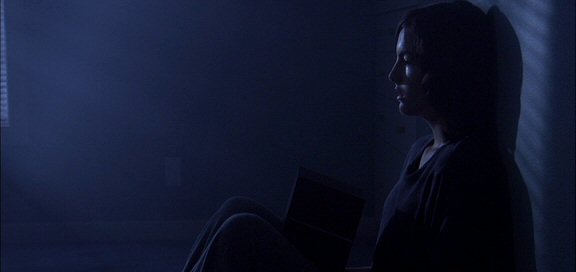
quiet9.jpg


Tungsten gelled blue with flags to create slit of light:
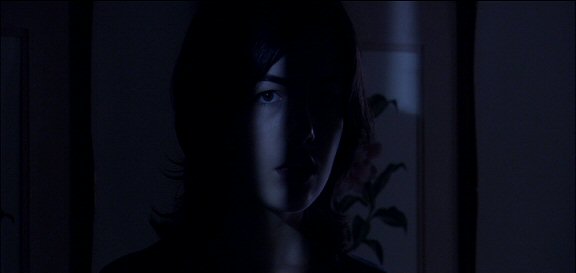
quiet6.jpg


When I need to create good shadow patterns, I prefer tungsten fresnels, sometimes with the fresnel removed. HMI's don't have sharp-enough effects unless backed way, way up. HMI Source-4 Lekos can also be useful for pattern-making.
 
David, I know you're not a sound guy, but I see the mics in your first shot. any idea why one mic would be blimped while the other isn't all in the same room? Thanks

It may be as simple as one was used somewhere where there was air movement and one where there wasn't on a previous setup and they didn't bother removing it or forgot to.

Doesn't look like a full blimp setup anyway - may just be a foam cover.
 
First off, I've read every page of this thread many times now and have learned a great, great deal.

I have a challenge I would love to hear your thoughts about.

I need to light a long, windowless hallway, about 7 feet in width, down which there will be a Steadicam move. The Steadicam looks straight down the hallway the whole time, looking back (in "Don Juan") at a model walking forward.

All the way down the hallway other models will be lined up against the wall, who should be lit in a flattering (soft, not too high angle) manner. There are only two doorways, breaking up one wall into even thirds. I'm really wondering, how the heck is this ever going to work?

Any thoughts would be hugely appreciated.

Thank you again on behalf of us all.
 
Unless you are building a set for this, you're stuck with whatever the overhead lighting is in the hallway during a long Steadicam move, plus whatever else you can squeeze in there, usually just a light on the lens for fill or someone handholding a light like a Kino. It's hard to even rig your own lights unless you can figure out a way to run power to them that won't be on-camera.

The only solution that sometimes works if the hallway is large enough and it makes sense architecturally is to have the art department add fake header beams and columns every ten feet, let's say, that allow you to hide a light behind the beam and run the power down the column. Then you could hide a soft light like a Kino pointed a bit outwards, less toppy, but there are limits to that even because if the Steadicam is looking back and it's too close to the talent, then the light above pointed at the actor may be throwing a camera shadow on them.

I'd find a hallway with the biggest softest overhead lighting you can, or else demand that a hallway set be built.

At least adding fake header beams gives you options to hide anything, something, even if just some light bulbs powered by zip cord.
 
I am over my head here, and it wouldn't work unless it happened to fit the style, but what about building a wall on the right giving you a few inches to add windows with large light panels, not the open LED type but the ones that are a solid white material that looks like some sort of acrylic, and living with the windows looking blown own? Keeping the camera closer to the wall with windows and panned slight left would help.
 
Mr Mullen

Thank you for your reply to my question and for the examples from Assassination of a High School President, which I have just ordered from Amazon and look forward to viewing. I am staggered that you reply to our queries so swiftly and in such detail.

I hope you don’t mind if I ask some follow-up questions about your work on Assassination…

You say that for most scenes you used bounce lighting from within the room – was the available light coming from the windows used to shape in any way or did it just provide ambient fill?

Did the changeable nature of the available light cause you problems?

Did you ever have to flag or diffuse the sun?

Did you always key from the window side of the room?

What did you do for the wide shots, i.e. when the widows were in frame? Did you always put an off-camera light in somewhere to extend the window light effect or was there an occasion when you just went with natural light on its own?
 
Basically I assumed that the natural window light would expose the row closest to the window so I was just bouncing light from that direction to extend the light into the deeper rows where our main character sat. I never had a wide shot of the main classroom where I couldn't bounce a little from above, but in some other rooms where I saw most of the room in a steadicam shot or a very wide-angle lens, what I did was turn on one row of overhead fluorescents nearest the windows for a similar effect, that there was more light near the window end of the room and it fell off. You can see that in an early scene where Funke interviews the school president in the gym, I only had the overheads on along the window side.

The problem with this whole technique was that when I lost the light I had to scramble to add a lot of lighting outside the windows to recreate it, whereas if I had started the scene with more HMI lighting from outside, it would have been more consistent throughout the day, so there are pluses and minuses to this technique. In retrospect I probably would have had a big HMI outside one edge of the window softened and knocked down, ready to roll in closer as the light dropped.

As for sun, it wasn't a problem in this case, all our windows faced north and it was generally overcast.

Just the other day though I had a real problem with a room facing west -- it was overcast and I was creating an orange sunset effect in the room when the clouds parted and I had a much brighter, whiter sunlight slamming through the same windows, overpowering my sunset effect, and this would only happen for a few minutes now and then as the clouds moved. A nightmare. If I had more money, I would have set up a flyswatter (big frame on a condor) outside to shadow the real sun off of the glass, or scheduled those scenes for the morning. But since our whole schedule has been splits, starting in the middle of the day and working into the middle of the night, we don't have any morning hours.
 
I am over my head here, and it wouldn't work unless it happened to fit the style, but what about building a wall on the right giving you a few inches to add windows with large light panels, not the open LED type but the ones that are a solid white material that looks like some sort of acrylic, and living with the windows looking blown own? Keeping the camera closer to the wall with windows and panned slight left would help.

Sure you could design light fixtures into a fake wall running along the whole corridor but that has to work design-wise with the piece, it can't be too weird for the setting.
 
Unless you are building a set for this, you're stuck with whatever the overhead lighting is in the hallway during a long Steadicam move, plus whatever else you can squeeze in there, usually just a light on the lens for fill or someone handholding a light like a Kino. It's hard to even rig your own lights unless you can figure out a way to run power to them that won't be on-camera.

The only solution that sometimes works if the hallway is large enough and it makes sense architecturally is to have the art department add fake header beams and columns every ten feet, let's say, that allow you to hide a light behind the beam and run the power down the column. Then you could hide a soft light like a Kino pointed a bit outwards, less toppy, but there are limits to that even because if the Steadicam is looking back and it's too close to the talent, then the light above pointed at the actor may be throwing a camera shadow on them.

I'd find a hallway with the biggest softest overhead lighting you can, or else demand that a hallway set be built.

At least adding fake header beams gives you options to hide anything, something, even if just some light bulbs powered by zip cord.

Thanks David - A great answer as always.

I think as you suggest I'll get the art dept to figure out some columns, and hide some Kinos behind them.

I had another question: you once said here that you liked the joker 800 better than the 400 - why? Do you find the 800 more often useful?

I ask because we are expanding our owned lights to include units we rent often, and we do often rent the 400 (last year we bought it twice in rental fees...) , but maybe the 800 would be a better choice? (Rental and/or purchase? - Maybe we just have bad habits always taking the 400)

My worry is that the 800 in a photo modifier (beauty dish, softbox, Softube etc.) would be hard to scrim (I've never seen a "scrim beaker" - they should make one maybe...). As such my concern would be that an 800 would be blinding to the models, even in sunlight. Maybe I'm wrong though... Maybe its' OK, and maybe it CAN be scrimmed even when in a softbox somehow.

Your thoughts would be deeply appreciated (they always very much are :-) ) . Thank you again.
 
Whether you need a Joker 800 versus a 400 is the same issue as to whether you need a 575w versus a 1.2K HMI or a tweenie versus a baby. If you don't need a Joker 800, then you don't need it. It's just twice as bright as the 400, so if the 400 is bright enough for you, you don't need the 800.

I'm often in bigger rooms trying to recreate or balance to daylight so I need the output of an 800.

But right now I'm in overcast Vancouver and we never were able to get a Joker 800 Source-4 Leko to work properly, and the 400 has been bright enough most of the time since it's so dim outside.

Trouble is that you need a Joker Bug Lite adaptor for a Source-4 and if they aren't attached properly, the bulb doesn't sit at the right distance and you lose intensity. The rental houses in Vancouver don't seem to get much call for Joker 800 Source-4 Lekos, so the adaptor they sent us didn't work properly, so we sent it back and got a new one, and the new one didn't work. The rental house said they tested it and the light works, but the problem isn't getting the light to work but to get the correct intensity. Right now our Joker 800 Source-4's are as dim as a 100w light bulb, which makes no sense. Luckily the Joker 400 Source-4's work and as I said, it's so overcast out here it's like working at twilight some days.
 
I just wrapped an hour ago (5AM) on a pilot in Vancouver for Lifetime/NBC. We used the ARRI Alexa, Angenieux Optimo zooms (15-40mm, 28-76mm, and 24-290mm), a few shots on Cooke S4 primes, but this was the first time I pretty much used zooms on everything including handheld & steadicam shots. Package from from Clairmont Cameras, Vancouver.

I may be doing a Polish Brothers feature next, small budget but probably on 35mm film.
 
David, when you have lighting fixture problems like you had in Vancover, what do you do while you're waiting for parts/substitutions? Did you do equipment tests on site before talent shows up? Who does the producer lien on when you have these types of dalays? I'm always trying to learn from other's mistakes/misfortunes.
 
David, when you have lighting fixture problems like you had in Vancover, what do you do while you're waiting for parts/substitutions?

Not meaning to be flippant, or to speak for David, but he probably thinks about the likelihood that if they were in L.A., he wouldn't have to wait for either parts or substitutions.

Just kidding....... :smilewinkgrin:
 
David, when you have lighting fixture problems like you had in Vancover, what do you do while you're waiting for parts/substitutions? Did you do equipment tests on site before talent shows up? Who does the producer lien on when you have these types of dalays? I'm always trying to learn from other's mistakes/misfortunes.

Oh, I generally have enough lights to do my work, I can bounce a 1.2K HMI PAR instead of a Joker 800 Source-4, for example, or use either to create a slash, it's just that I'll need more flags from the grips with the PAR.

I wouldn't call it a misfortune on any level, it's just an inconvenience when you've based a way of working on certain equipment that you can't get. It's like the Woodylight, which I can never find on location (they are made and sold by my gaffer in Los Angeles, Keith Morgan) -- a medium chimera bag attached to a flat fixture with four edison sockets (usually with 250w bulbs in each) and one 1K EGT tungsten-halogen in the middle. You can switch between the four lightbulbs or the the 1K globe, you can dim any of them on the back of the unit, you can switch individual globes. So the brightest would be to turn on the 1K globe and the dimmest would be to have just one 250w lightbulb on, dimmed down. Very fast and flexible to use and adjust. Couldn't get one up here in Vancouver, tried just putting a medium chimera on a 1K fresnel, but found that it wasn't as bright and it didn't fill the bag, so it wasn't as soft. And it certainly wasn't as lightweight. Now I maybe could have found a Lowell Rifa, which is similar and which I rented on "Chicago Code", but it's not was flexible as the Woodylight either.

But none of this really matters in the big picture, I can still get what the look I want with different units, it's just a matter of convenience and speed.

Everything is tested during the prep & pick-up by the electricians, but I don't think anyone involved knew how bright a Joker 800 Source-4 Leko was supposed to look, they probably turned it on, saw that it worked and was warming up, and turned it off, moving on to the next piece of equipment. You have too many lights in a package generally to spend a lot of time on each fixture in the prep. I'm just surprised that the rental house didn't know that their Joker 800 bug adaptors were built incorrectly -- basically the slots on the sides to mount and screw down the back of the unit weren't long enough to push the globe far enough into the Source-4, some metal ring was in the way. Next time I'll warn the gaffer to specifically check that in prep.

Sometimes on other shows, I've been surprised when the electrics and gaffer don't realize that a light is not working properly, they seem satisfied that it's working at all... I had a backyard scene where I was trying to backlight someone with a 6K HMI PAR and it wasn't quite as sunny-looking as I wanted, seemed too dim, then we moved to a new set-up where the 6K was too large to rig so I switched to a 4K HMI PAR... and it was twice as bright as the 6K even with the same lens and distance. I had felt that something was wrong with the 6K based on past experience, but it wasn't confirmed until I started using the 4K and it was brighter. But I seemed to be the only one who noticed that now I was getting the right output from the light and that the 6K was acting up.

I seem to have that discussion a lot on a film set... my saying things like:

"Are you sure that's 1/2 CTO on that unit because it looks more like Full CTO..."
"Yes, I'm sure."
"Well, could you check it again? Because I know what 1/2 CTO should look like".
"Yes, I checked it, it's 1/2 CTO."
"Well, could you get the full roll or a swatchbook and check it AGAIN because it looks like Full CTO."

"OK... (grumble, grumble) oh, you're right... it was Full CTO, the cut was mislabeled."

This discussion happens far too often on a shoot, I'm always amazed that so many electricians can't tell the difference between 1/2 CTO and Full CTO just by looking at it. I don't think you need THAT discerning an eye to see that big of a difference.
 
Last edited:
Mystery Lens Mount

Mystery Lens Mount

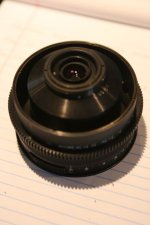
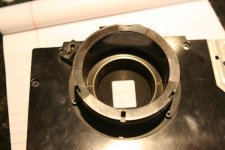
Hello David, I have tried posting pics of this lens housing and camera mount here on RedUser and Cinematography.com, but nobody seems to know what kind of mount this is. The lens and mount are from a guy that built 35mm crash cams using customized B&H Eyemo, Arri 2C, and some homemade cameras. The lens housings are in very nice condition and I would like to find a way to use these lenses on a Red One. Any ideas?

Also, I have sort of a ridiculous (but could be awesome) idea, but I do not posses the skills needed to actually make this part. I'm trying to built a custom lens mount for a Red One, but its not for just any old lens :) Do you know any super creative people with vast knowledge in optics and the ability to have parts machined to tight tolerances? Shoot me a PM if someone comes to mind.

Thanks David.
 

Attachments

  • IMG_0640.jpg
    IMG_0640.jpg
    28.7 KB · Views: 0
  • IMG_0642.jpg
    IMG_0642.jpg
    37.8 KB · Views: 0
Back
Top