Welcome to our community

Be a part of something great, join today!

  • Hey all, just changed over the backend after 15 years I figured time to give it a bit of an update, its probably gonna be a bit weird for most of you and i am sure there is a few bugs to work out but it should kinda work the same as before... hopefully :)

Ask David Mullen ANYTHING

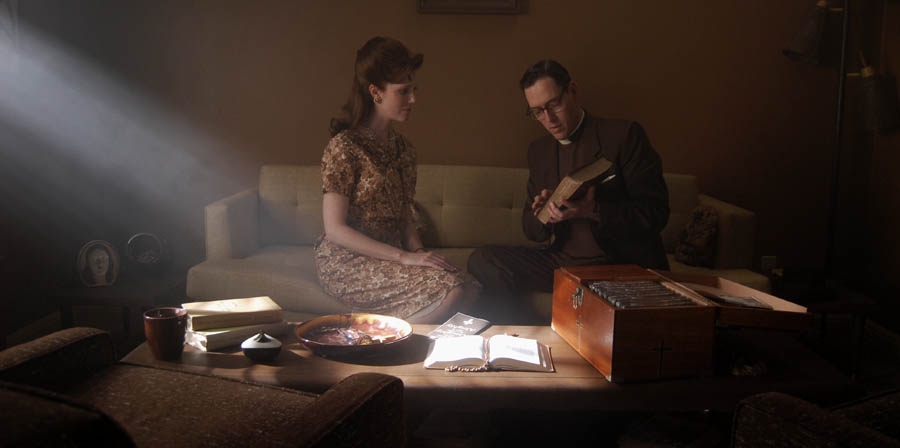
I meant Source-4 Lekos, whether tungsten or HMI, but yes, a Joker 800 in a Source-4 is like a mini-Xenon. Here are some shots I took on the set of "Manure", with shafts of light:

Two Joker 800 Source-4's off camera right:
900manure185.jpg


1K Xenon outside the window:
900manure186.jpg

Thank you David.

Can you comment on the difference between par and fresnel hmi?
I know the par is more powerfull, but if we use a stronger fresnel, what are the pros and con of each?

thanks again,
Ariel
 
David,
I am lighting an upcoming shoot with an actor and a car on a white cyc. We will be in a studio with an overhead lighting grid and we have a full day for pre-rigging. I've shot some green screen work, but never a white cyc - do you know of any fundamental differences?

We're building up our lighting package now, what would you would recommend that would do the job well? I'm thinking about having a range of Kinos that can be our main movable lights to do small tweaks on the actor and the car, but don't know the best way to keep the screen as even as possible using the grid.

Any suggestions?

Thanks in advance, I appreciate your time and expertise.
 
Generally people light a white cyc for a "limbo" effect, sort of shadowless soft lighting from overhead, though that's not a hard & fast rule, you can do whatever you want against a white background, especially in close-ups where you don't see the floor. But in wide shots, usually people want the white walls and floor to blend seamlessly so they use a lot of even lighting. Typically the top of the cyc would be ringed with cyc lights to get rid of the fall-off at the top. Now you could do the whole thing with Kinos but those fixtures are more expensive, though less hot and draw less power.
 
Can you comment on the difference between par and fresnel hmi?
I know the par is more powerfull, but if we use a stronger fresnel, what are the pros and con of each?

Generally a large powerful fresnel has a "flatter" illumination (even intensity across the field in flood) and a cleaner shadow pattern than a PAR (unless backed far away to create a sharper source.) The differences tend to be more obvious when using them as hard key lights and trying to create shadow patterns -- as backlights or when diffusing, it matters less though it's easier to evenly fill a large diffusion frame with a fresnel with a large front element (unless you use a multi-bank PAR.)
 
Generally a large powerful fresnel has a "flatter" illumination (even intensity across the field in flood) and a cleaner shadow pattern than a PAR (unless backed far away to create a sharper source.) The differences tend to be more obvious when using them as hard key lights and trying to create shadow patterns -- as backlights or when diffusing, it matters less though it's easier to evenly fill a large diffusion frame with a fresnel with a large front element (unless you use a multi-bank PAR.)

Thank you very much.
 
Generally people light a white cyc for a "limbo" effect, sort of shadowless soft lighting from overhead, though that's not a hard & fast rule, you can do whatever you want against a white background, especially in close-ups where you don't see the floor. But in wide shots, usually people want the white walls and floor to blend seamlessly so they use a lot of even lighting. Typically the top of the cyc would be ringed with cyc lights to get rid of the fall-off at the top. Now you could do the whole thing with Kinos but those fixtures are more expensive, though less hot and draw less power.

Are you shooting against a seamless cyc? Also, remember the car will reflect all your lights. Bounce boards will help to hide your fixtures.
 
Thank you David.

Yes, it's a seamless cyc. I want to light it as even and flat as possible so that it has the infinity look.

Bob, I am a bit worried about the reflections in the car, any tips on how to avoid this?
 
A car is a big mirror, it reflects everything, especially the ceiling lights, which is why car commercials are often lit with a giant Fisher Light:
http://www.fisherlight.com/level2/fisherlight.html

You could build something similar over a car, let's say a 20'x20' frame of some sort of heavy frost, with a grid of lights behind it, and neatly black-out the sides of the frame with duvetine.
 
David, have you ever been watching a film and come across a lighting setup that stumped or at least left you curious as to how it was pulled off?
 
Sure, there are some big dolly moves in some Bertolucci movies where it's hard to figure out where Storaro hid the lights.

There is that 360 degree move around Russell Crowe in "A Beautiful Mind" when he's staring at the projected codes on the walls where he looks like he's lit by the backlit transparencies but they aren't burned-out / hot enough to be the key. I believe Deakins may have put them on a dimmer so when the camera was pointed that way, they were brought down, they came up again when the camera was on Crowe's face. Maybe.

I'm amazed at some of the lighting that Kaminski pulls off (and hides) during some of Spielberg's complicated wide-angle dolly moves. I've had to guess where some of the lights must have been to get the shot but I swear that he must be moving some of them manually out of the way of the camera's view. For example, there is a hard back/edge light through a car window in "Munich" that hits the actors -- then the car drives off and the camera is looking exactly where the light and stand must have been to get through the window.

Those are the shots where it's hard to figure out how they were lit because you can guess where the light must be coming from and how big or soft it must be... and then the camera points in that direction and the light is hidden.
 
Those are the shots where it's hard to figure out how they were lit because you can guess where the light must be coming from and how big or soft it must be... and then the camera points in that direction and the light is hidden.

What are the odds that in the most extreme of these cases the fixtures were rotoscoped out if they couldn't physically be moved?
 
What are the odds that in the most extreme of these cases the fixtures were rotoscoped out if they couldn't physically be moved?

Low if it isn't a big efx movie. It costs money to paint out parts of the frame and replace them, especially in a big dolly move, so a DP who lights a scene with movie lights left in the shot and tells the producer to just paint them out in post is asking for trouble unless there is a really, really good reason.

Now there can be good reasons, but most of the shots I'm talking about are just examples of clever work by the DP. They are all shots that could have been lit from a different angle where it would have been easy to keep the lights out of the shot, but instead they were lit from a good angle and the lights cleverly disguised, moved, dimmed, etc. to be unseen.
 
Thank you David.

Yes, it's a seamless cyc. I want to light it as even and flat as possible so that it has the infinity look.

Bob, I am a bit worried about the reflections in the car, any tips on how to avoid this?

First, how big is your stage and how high is the grid? David is right about putting a large frame over the car. That is the beat way to give you the soft light you want on the car. Logically, it looks like the cyc continues over the car. But you are going to need enough headroom over the car to hang a frame and then lights over that. If you have enough space you can hang your cyc lights over your diffusion.

As far as hiding lights, the best way to light a car is to use as big a source as possible. That doesn't mean high watt lights but big pieces of white material that will be reflected on the car. 4x8 bounce boards or put a light behind a frame with diffusion. The car won't reflect a pinpoint of light but a large white cube. This will also create flattering light for your actor. You also have to think about your set. Be sure that everything is behind a source that will light it and be reflected in the car.
 
Lighting for Black and White

Lighting for Black and White

Question for David M,

The project is being shot digitally, in color, with black/white treatment being applied in post -- Would you light the scenes differently and if so would you share your considerations on why?

Also in this situation, would use of filter(s) to improve contrast, help or hurt the image in post?

Sure I would light a b&w movie differently, the trick is to make sure it never gets shown in color because the lighting would work less well. Without color to create separation you need to use tone, contrast, etc. to separate objects, whether with a backlight or by staging a dark shape against a bright spot, or vice-versa. You need to direct the eye more clearly to the key areas of visual interest, and in general, bright areas "advance" and dark areas "recede". You want rich blacks, clean whites, not too much middle grey. You generally can get away with harder crisper lighting rather than too much soft lighting.

So I'm not sure contrast-lowering filters are necessary with b&w images where you want to create contrast and strong blacks. I'd only use filters to create halation around points of light, if that's what you want. For example Classic Soft diffusion can create mild rings around points of light on medium to long lenses that feels a bit like the halation artifact in old b&w negative stock.
 
Favorite Film Stock

Favorite Film Stock

For David M. Do you have short list of film stocks that you enjoy lighting for? Conversely, which stock are difficult to light for?
 
I'm not sure the range of looks in modern color negative film stocks are extreme enough for me to like lighting for one a lot more than for another -- it's really just a matter of which look is right for the project, and nowadays, what works for the D.I. color-correction step. These days, ignoring speed and color temp, the grain & sharpness of a stock matter most of all compared to contrast and color saturation, which are more easily tweakable in post these days (though a lower-contrast stock gives you more flexibility in post.)

I'm about to start a shoot on the new Fuji Vivid 160T and 500T stocks, which are much stronger in black levels than other stocks. Now of course I could add more black to any stock in the D.I. but what I like about this crisp, rich look is that it allows me, conversely, to use heavier diffusion filters because the stock's sharpness will cut through some of that... giving the nice halation artifacts I want without as much mushiness.

Sometimes I pick stocks less because they are accurate and have a wide-latitude, but because they have a look that transforms reality into something else, maybe into something a bit more "painterly". I've also leaned towards Fuji stocks, for example, in my more stylized projects.

I will say that one of my favorite stocks was only on the market for one year... it was Agfa XTR-250. It was supposed to replace the popular Agfa XT-320 that was made famous by "Out of Africa". What was great about XTR-250 was that is had the XT-320 creaminess without the graininess. Skintones looked beautiful on it. But after only one year after it was released, Agfa completely got out of making motion picture color negative stock.
 
Color Temperature Meters

Color Temperature Meters

For David M,

This question is regarding the practical matter of using a color temperature meter. If shooting a sequence that extends over several days or weeks, is a meter useful or essential in matching light balance from day to day? Or is there another practical method of managing light balance? In the absence of a color meter, is there danger in making filter and gel decisions based on a published Kelvin Degree chart?

When operatiing tungsten lights off of a household current, is there a voltage fluctuation issue that would adversely affect color temperature during different parts of the day?
 
I don't have a color temp meter but my gaffer always has one. Outdoors, I tend to match time of day, when I can or when it's practical to do so, by eye... You can go nuts trying to make footage shot all day long exactly the same color temperature, and the problem is that in late afternoon, the sun gets warmer but not the shadows, so you have more separation in color between highlights and shadows. Occasionally you may take out a color meter if you really want to match some orange sunset light that is happening to an artificial light, if the character steps directly out of one and into the other. Otherwise, there is some leeway that allows you to just eyeball it.

I haven't had household current be so off that it caused a visible color temp shift in a tungsten lamp. Now sometimes you out tungsten units on dimmers and occasionally use a color temp when you need to know how low the color temp has gotten, in case you have to match that with gels on some undimmed or undimmable light. But again, often you can get away with doing it by eye -- people don't expect every artificial light in a room to perfectly match each other in color anyway. For example, a lampshade can color the light.
 
Back
Top