Welcome to our community

Be a part of something great, join today!

  • Hey all, just changed over the backend after 15 years I figured time to give it a bit of an update, its probably gonna be a bit weird for most of you and i am sure there is a few bugs to work out but it should kinda work the same as before... hopefully :)

Ask David Mullen ANYTHING

I saw one site that said it rents for $30/day but now I see another that rents it for $20/day.

Yes, they are cheap to buy, but remember that the globe itself costs a certain amount, nearly $30.

Anyway, 1K PARCAN's are so common in various schools, theaters, etc. that you can get deals on renting them, or you can maybe borrow one. Or buy a used one.
 
I saw one site that said it rents for $30/day but now I see another that rents it for $20/day.

Yes, they are cheap to buy, but remember that the globe itself costs a certain amount, nearly $30.

Anyway, 1K PARCAN's are so common in various schools, theaters, etc. that you can get deals on renting them, or you can maybe borrow one. Or buy a used one.


Its instructive that ASC DPs actually use "cheap" lamps and common everyday light sources to achieve the required mood. So much of what you impart on this thread is about using one's imagination with the given resources. I also encourage you to write the book for Indy DPs. Thanks again.

Gregory
 
Hi David

Two questions in one post. Have you watched the new series "Southlands" shot on RED? I watched the first ep. There have been comments on the look they have been going for, blown highlights etc which bothers me not as it is a choice. BUT daylight shots, great, night shots another matter. The night feels like video in motion, not neccessarily colour, tone. Why is that? Is it shutter or a post issue AND how can one avoid it?

Second question. When the Scarlet S35 is out we are getting it and a set of lenses. Our budget for lenses is about 15K in dollars. Any suggestions on that front? The lens will be used on drama and docs. Anything with a better budget and we rent anyway so these lenses will be our own home set and wont be going out to anybody else.

Thanks in advance and as usual great thread
 
I haven't seen the night scenes in "Southland" only some day scenes (which are very contrasty.)

Generally when people complain about "video motion" they are referring to the use of shutter speeds longer than what a normal 180 shutter angle would provide, which is often done in digital in order to gain exposure (and a few people like that smeary motion.) I've done it myself, though I don't go as far as a shutterless look (360 degree shutter angle, i.e. no shutter or "open" shutter) -- I've often used a 270 degree shutter to gain a half-stop more exposure.

In low light, it can come down to a choice between more noise from underexposure or more motion smearing from longer shutter speeds. It's just a matter of picking your poison, or what bothers you the least.

Of course, in really low light, you may be doing both, boosting the gain (or boosting an underexposed image in post) and increasing the exposure time. But doing this may allow you to get some interesting available light shots, even if it means more noise and smearing.

But even at normal 24 fps with a standard 180 degree shutter, there is still a subtle difference in look from using an electronic shutter versus a mechanical one, though I'm not going to lose sleep over it.

The thing with motion artifacts is that they are more or less visible due to the degree of motion within the frame, or the motion of the camera.

---

The RED lenses seems like the best all-around deal, but if those are still out of your budget range, I'm not sure what's left, maybe something used like some Zeiss Super Speeds. Maybe start out with one zoom, like the 18-85mm RED zoom, and just figure on lighting for that stop? TV and doc work tends to need a zoom anyway, so maybe get that first and then work on getting more primes over time.
 
Sunset

Sunset

David,

How would you approach an outdoor scene, set just before sunset, that runs several pages with a good amount of setups. Would you be inclined to shoot a few hours each day, or try to shoot through the day, and imitate the lighting. If the latter, what are some of the tricks you might consider to simulate sunset?

Many Thanks,

John
 
Sure, I'd prefer to shoot it over several days at the right time of day (assuming the weather stays the same each day). But that rarely happens. The best you can do is argue that things you can't possibly manipulate with lighting and grip work (or camera angle) have to be shot at the correct time of day -- you may be able to argue for certain shots to be done over two sunsets, for example. But if the scene is several pages long, there is generally no way to shoot it only near sunset, not with coverage.

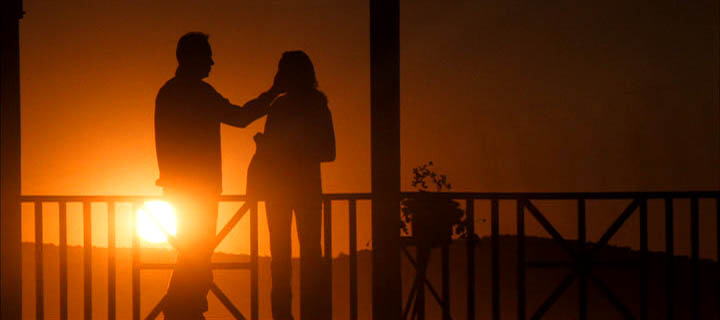
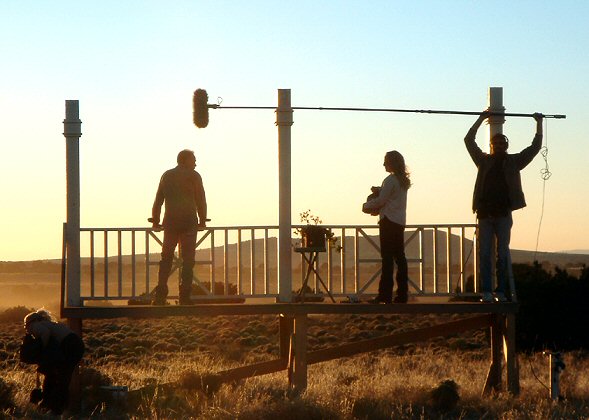
I had a long dialogue scene at sunset in "Astronaut Farmer" -- we shot most of it on a porch in the shade so I could use some lights to create a setting sun effect. We then shot a reverse angle on their backs with the sunset in the background (we actually built a partial porch set for this shot in order to use a telephoto lens on the camera to get a big sunball in the background.) You can see our set-up here:

af17.jpg


So it takes a lot of planning to do this sort of sequence but you need some help -- it's hard to create a sunset effect all day long if two people are standing in a wide-open space with no shade, for example.
 
I'm pretty sure David said he shot on a shady porch (a real one) lighting it to look like sunset, even though it may not have been at the time. Then did shots from behind on the fake porch you can see in the photo at sunset, and by doing so meant he could use a really zoomed-in lens to get the actors in shot with the sun looking really big in the background.

:thumbsup:
 
I got the idea for the fake partial porch from watching "The Color Purple" when I realized that a shot of Celie sitting on a rocking chair on the porch in silhouette against a big sun ball would have required something longer than a 300mm lens, but the camera would therefore physically be somewhere inside the house to back up that far, since most porches are only 10' wide or so. So they must have built the deck outside somewhere so they could back up the camera (not to mention, line it up with the setting sun.)

Anyway, the lack of roof for our partial porch piece did not matter much in my case because the final shot was so silhouette.

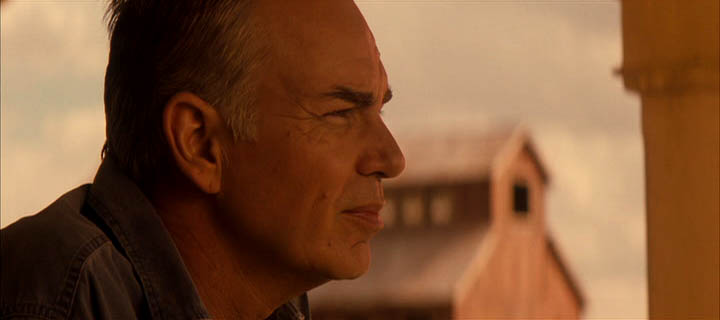
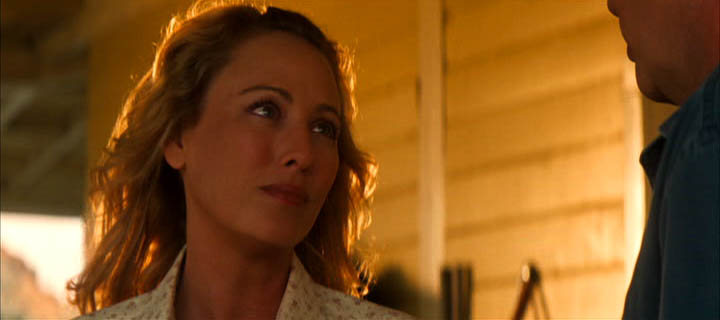
I'm putting some frames up to show you the sequence, not necessarily because it worked but because I can show you what I was dealing with. And while the real porch did point west, the house was in a valley surrounded by hills so the real sun was blocked by a hill well before sunset. So we built this partial set piece on a high hilltop to get a better view.

But the bulk of the scene was shot on the real porch of the house, and in the morning to noon period when the sun was on the opposite side, so I could add my own sunlight effect on the shadowed side of the house.

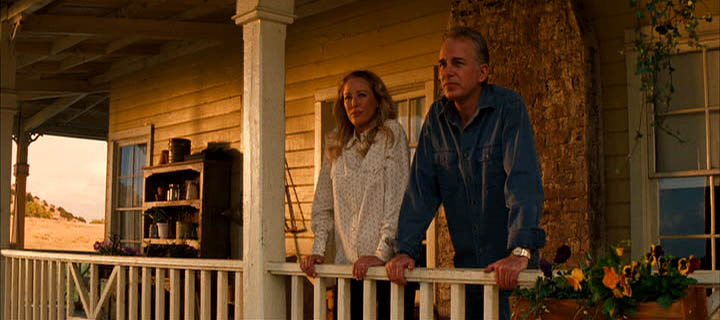
But I ran into a basic problem, that the porch was so open-ended that you saw the real landscape in the real sunlight in the background in the raking side angles. And the other problem I had was that originally I had a big 12-light tungsten MaxiBrute (or maybe a Dino) creating a realistic orange light on the porch from the right direction (dead-on at the actors)... but the actors found that they couldn't stare into it, especially Virginia Madsen, who was very sensitive to bright lights in her eyes (one reason she was always shot in backlight outdoors, with almost no fill). So I ended up moving the frontal setting sun light behind her head as more of a backlight, and for Billy Bob Thornton's close-ups, I softened the setting sun effect to make it more comfortable on his eyes.

So the final effect was not as convincing as it could have been because the actors should have been staring into a bright orange light.

Anyway, here's some frames:

Real porch:
af18.jpg


af19.jpg


af20.jpg


Fake porch on hilltop:
af21.jpg


Now if this was a short dialogue sequence, I might have been able to shoot two raking shots near sunset with two opposing cameras and then gotten the silhouette shot at the end if I hurried up. But it was a long sequence so I knew I didn't have that kind of time frame.

I did also shoot a magic hour dialogue scene in the movie that way though, the two raking angles in early magic hour and then the final silhouette wide shot at the very tail end of magic hour, because I needed more light for the close-ups than I did for the silhouette wide shot. But that scene was much shorter so I knew we could get it in a couple of takes.
 
I loved that shot, David. I had no idea about the tricks required to make it happen. You really hit a few homeruns on that picture, IMO.
 
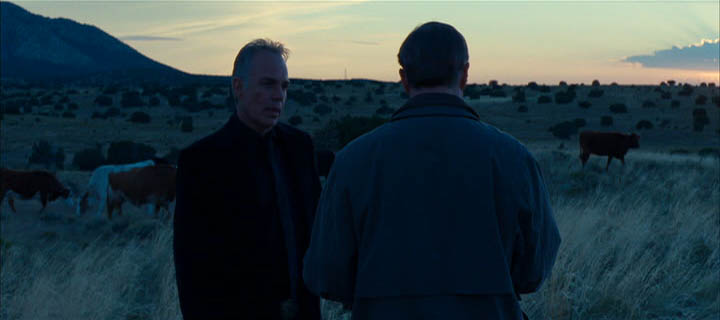
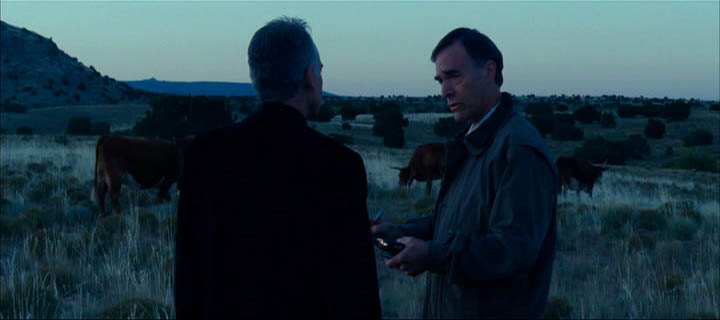
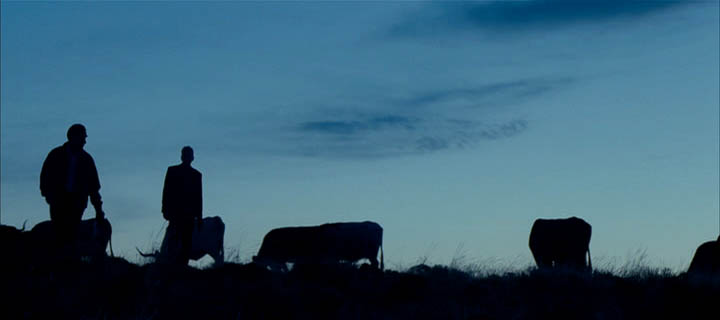
Here is that other sequence, shot at magic hour. In this case, I risked shooting it all in this light, I guess I figured we were there at this farm for another week so if I needed to go back and get one more angle of it later, I could.

Basically we shot both directions simultaneously with two cameras (one for each direction). We only had time for two takes, then we switched lenses and shot two takes of a close-up (the editor only fleetingly used one of them). So by the time we got through those four takes, the light had dropped significantly. I sort of reached the end of the lens, f/2.0 (Primo anamorphics.)

I had a weak amount of light added in the coverage, something like a Kinoflo going through a frame of diffusion that was set between the two of them, acting as a weak side fill.

Then we ran downhill (getting rid of the Kinoflo) with the cameras and shot the actors in silhouette against the last rays of light in the sky, which was exposed fine since I no longer had to see much detail on the faces or ground.

af22.jpg


af23.jpg


af24.jpg


Luckily, Billy Bob Thornton is one of those actors who can nail a scene in only one take, consistently, so you never had to worry about that aspect, freeing me to take a chance on shooting this scene at twilight (it also wasn't one of those deeply emotional scenes where you have to plan on needing more time so that you aren't rushing the actors.)
 
We only had time for two takes, then we switched lenses and shot two takes of a close-up (the editor only fleetingly used one of them).

Possibly because of how great the fields look in that light!?!! :beer: He had probably never seen something like that and realized how special it was. Excellent stuff, as usual, David.
 
David: have you ever used regular grocery store variety parchment paper as a diffusion source in a pinch (or on purpose)? It seems perfectly suited for hot lights since it is intended to be used in ovens. What do you think of the quality of the light produced and what Lee or Rosco diffusion gel would you compare to it? Thanks
 
No, I haven't tried that. In my early days as a Super-8 filmmaker, I used to experiment with colored tracing papers from an art supply store, but you couldn't put a hot light behind it.

Oven-safe parchment paper is probably similar to a heavy white diffusion like 129, or Full Grid Cloth, or 1000H paper. It may have a warm color cast to it. Something that heavy is almost not worth putting on some barndoors on a light because the softness is limited to the size of the diffusion, so you've already filled the area between the barndoors evenly even with something lighter like 216... so after that, you're just losing output. I'd put the parchment paper on a frame, like a 4'x4', and try punching a 2K through it or something.

I have used 1000H paper on frames of course, it's a nice diffusion.
 
RED/Film Question Regarding lighting

RED/Film Question Regarding lighting

HI David, thanks for the great thread,

I have 2 specific questions regarding film vs red, trying to explain this to someone new to red and wondered if you could try help out.

1. Do u need to spend more time on lighting with red to get the look u want compared to film?
ex. manure, if u shot manure on film would it have been less time on lighting to get the look u wanted.

2. Is film more forgiving to mediocre lighting then red.

We have red cameras but have never shot on film, so we need help answering these questions to a potential customer.

Any input very much appreicated.

Thanks
Stricko
 
Generally, lighting is lighting and the time, style, effort, etc. is not really a film vs. digital issue other than the issue of sensitivity (and color balance to a lessor degree.) But these days, the sensitivity of film stocks and digital cameras are in the same ballpark so that's less of an issue.

There are some differences though but I think overall it's a wash. For example, I find that when shooting digital, I save some time because I'm not metering as much and I can see right away if something is working before I waste more lighting time trying to fix something that doesn't need fixing, like some dark corner, etc. Sometimes when shooting film, you cover your ass on some things when you're not sure if something is getting enough exposure.

On the other hand, when shooting film, sometimes the extended dynamic range in bright areas saves you some time when you suddenly have to deal with a hot, sunlit background, for example. Or like when the sun is going in and out of clouds -- with film, I usually expect that overexposed highlights are going to hold, whereas with digital, I have to watch out for clipping.

For a soundstage shoot like "Manure", the lighting time would have been the same either way, on film or digital.

Mediocre lighting is mediocre no matter what you're shooting, though you have options in digital post to fix some things, whether you shot film or digital -- like adding some contrast to something shot in really flat, soft light.

Now 35mm transferred to HD can look really, really sharp but generally you won't see it like that when you're shooting, looking at a viewfinder or a video tap image... whereas many digital cameras deliver razor-sharp HD images on set, and a poorly-lit face is going to be more obvious, and you may be called out on it by someone looking at the monitor if you're not careful.

And sometimes a producer or whatnot can get fixated by a small problem visible on an HD monitor, which can waste a little time to correct on the set... if it's not really important in the greater scheme of things. As a DP, you make judgment calls all the time as to what to fix and what to let slide, i.e. you prioritize. But sometimes with film you have more freedom to make that judgment call yourself without being second-guessed, because only you really know how it's going to turn out.
 
Last thing I did was a pilot for CBS called "The Good Wife" which was picked up, though I probably won't be involved with the series since it is shooting in NYC and I'm based on Los Angeles.

After I did the pilot, I spent two weeks off and on doing the color-correction for the D.I. of "Jennifer's Body", which will get released in September.

I'm not shooting right now, but I'll probably be going back to shooting "United States of Tara" for Showtime from August through October.
 
Back
Top