Welcome to our community

Be a part of something great, join today!

  • Hey all, just changed over the backend after 15 years I figured time to give it a bit of an update, its probably gonna be a bit weird for most of you and i am sure there is a few bugs to work out but it should kinda work the same as before... hopefully :)

Ask David Mullen ANYTHING

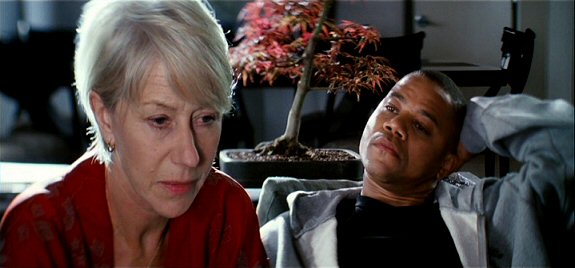
The oldest movie I've ever noticed split-diopter filters used in is "King of Kings" (1961) -- the filters seem to work particularly well with widescreen aspect ratios. But in theory, the filter is so simple in concept (a close-up diopter sawed in half) that I'm surprised I haven't seen earlier examples. The diopter part of the filter allows closer focusing than the clear area, so you set the lens focus for the clear area covering the more distant object you want to be in focus, and then you vary the strength of the diopter that covers the foreground object until it comes into focus. And you do a lot of fiddling with the camera distance, etc.

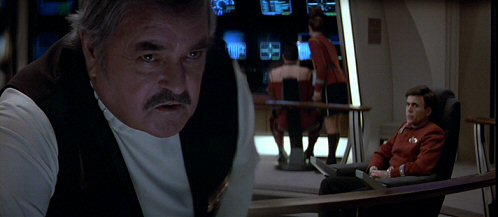
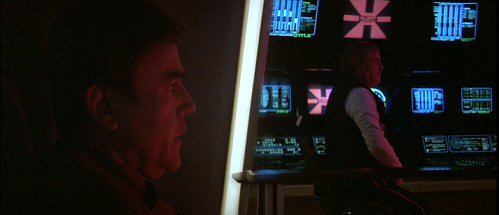
"Star Trek: The Motion Picture" has a record number of split-diopter shots -- the director wanted a deep-focus look but on 100 ASA film using anamorphic lenses in a set with projection screens, there was no way to light to a high enough level for deep focus, so they resorted to using a lot of split-diopters:

startrekTMP4.jpg


startrekTMP5.jpg


They even got fancy and used some diopters cut into special shapes, like this one which only covers the center person but is clear on each side:
startrekTMP6.jpg


And here is a diopter only covering each side but the center is clear:
startrekTMP7.jpg
 
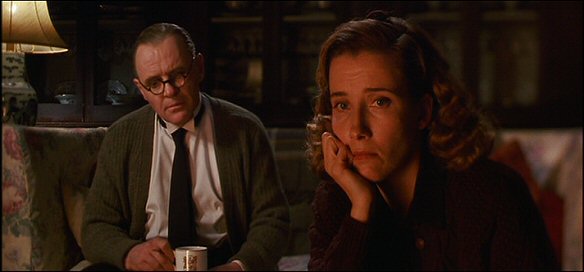
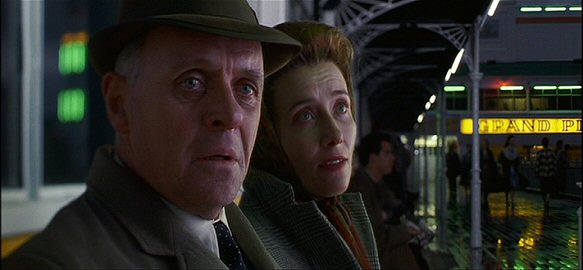
An alternate approach to get a fake deep focus effect is to use a tilt-focus lens, which allows the plane of focus to fall on a receding diagonal plane rather than a flat distance. So one end of the frame is basically at minimum focus and the other end is at infinity, then you try and line up the subjects so that they fall into this receding diagonal plane. You can also adjust the degree of tilt to match the objects.

You can see a tilt-focus lens being used here in "Remains of the Day":

remains.jpg


remains2.jpg
 
Interesting... I just re-watched all the original ST movies (with my son to fill him in on the ST universe prior to the new movie), and didn't notice the abrupt transtion from out-of-focus to in-focus background that I saw in Andremeda Strain, despite it being in hi-def also.

Thanks for the explanation and examples.

-Steve
 
David, I really like the idea of using the tilt-focus lenses like that! I guess it could help bring out a sense of sadness/confusion/clouded-judgment etc to the person who has the bokeh behind them... and for shots where the actor isn't traveling through the frame it should be simple or at least straight forward set up. Are there there are solutions or lenses with PL mounts so you don't have to change mounts mid-day for one setup?

EDIT: Oops... found them already. :)

It seems Cinequipt has some of the Arri and Century flavor in their stock. http://www.cinequipt.com/rental_catalog_equipment.aspx?cid=2&tid=2&sid=86
Have you used either of them before? I am thinking something like the 24mm would suffice for two or three CUs like the ones you posted from "Remains of the Day".
 
Interesting... I just re-watched all the original ST movies (with my son to fill him in on the ST universe prior to the new movie), and didn't notice the abrupt transtion from out-of-focus to in-focus background that I saw in Andremeda Strain, despite it being in hi-def also.

Same director & DP -- Robert Wise and Richard Kline -- for both "Star Trek: The Motion Picture" and "The Andromeda Strain." The first trek is full of split-diopter shots, I'd guess half the non-efx footage has it somewhere.

startrekTMP1.jpg


The rest of the Trek films don't use them much except for a few shots in "Star Trek V":

startrekfive1.jpg


startrekfive2.jpg
 
It seems Cinequipt has some of the Arri and Century flavor in their stock. http://www.cinequipt.com/rental_catalog_equipment.aspx?cid=2&tid=2&sid=86
Have you used either of them before? I am thinking something like the 24mm would suffice for two or three CUs like the ones you posted from "Remains of the Day".

There are tilt-focus lenses made -- usually a 24mm, 45mm, and 90mm, like ARRI's:
http://www.arri.de/camera/lenses/35_format_lenses/tilt_focus_lenses.html

And there are shift-tilt mounts made like this one:
http://www.arri.de/camera/lenses/35_format_lenses/shift_tilt_system.html

The tilt-focus lenses have less range of adjustment but are simpler and faster to use.

I find that the 45mm one is the most common one to use. Often 24mm photography already has enough depth of field and the 90mm version just looks too weird to slant because of the more telephoto view. I think those shots from "Remains of the Day" were done with the 45mm. Being that close with a 24mm would look more like an Orson Welles movie.

But you can see a lot of use of the 24mm slant-focus lens in the HBO series "Six Feet Under".

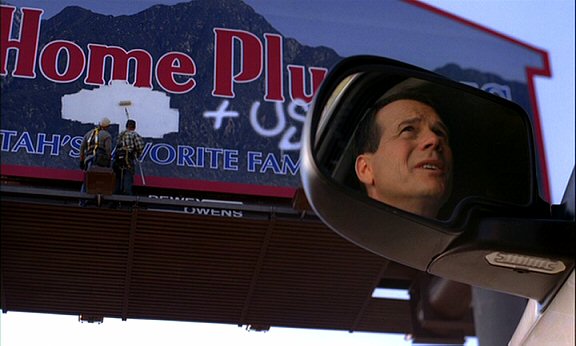
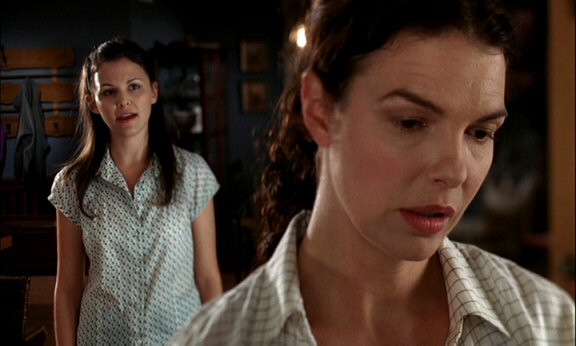
I used the 45mm slant-focus for two shots in HBO's "Big Love":

biglove25.jpg


biglove26.jpg


If you are using them to get a deep focus effect, it helps to also stop down the lens as well, the more the better -- the first example above was shot outside so I was also able to stop down to like f/11 or so. The second one was shot at f/4. You can see on the second one why getting in close with a 45mm is about as wide-angle as you'd want to be a lot of time, unless you like distortion on faces.

Split-diopter filters, on the other hand, don't benefit from stopping down because then the edge of the split glass comes too much into focus -- you need it to be a blurry edge.
 
Same director & DP -- Robert Wise and Richard Kline -- for both "Star Trek: The Motion Picture" and "The Andromeda Strain." The first trek is full of split-diopter shots, I'd guess half the non-efx footage has it somewhere.

I hadn't realized that... they must be fans of that technique.

Well, it actually figures I didn't notice... ST:The Motion Picture was the one we actually didn't watch all of because my kids fell asleep and we moved on to #2 because they thought #1 was a bit slow.... I guess I'll go finish it and keep an eye out.

Thanks again David.
 
Ok, yea, I was worried about being too close with a wide angle. The 45mm sounds great, but I guess the DP would take a closer look at the location. One of these moments would be in a small room while the rest happen outside, and in daylight. I hope we can find a bigger room or a way to get enough small HMIs or whatever may be necessary for stopping down as necessary in there.

I think I like was done with Anthony H. in the second shot, where the out of focus area isn't all around him but just behind him.

I really like the way you shot "Barbara" with a shallow DoF effect while keeping "Margene" in focus, but I think I may like the idea of shooting the actor from the side so as to give more of a visual representation of what is ahead of the actor and what is behind, where they are coming from and where they are headed.

I guess I might be interpreting the effect as shot from the side a bit more an a look at their internal struggle from more of a voyeuristic perspective, while you gave more of a personal feel to your shot.
 
Hi David, (and anyone else that would like to chime in) I have a question about lighting and framerates and in particular about lighting for music videos but first a little about what I am doing.. I have come from a mostly stills background and have started shooting a couple of music videos recently. I am using a mixture of tungsten and kino lighting and also natural lighting where I can. At the moment I am shooting with a Sony EX3 with a Letus using Canon FD lenses. To get the 'dreamy' look I am often overcranking in camera. I recently shot a short epk sequence where I had the artist lipsync over a playback track that was playing 20pc faster so I overcranked in camera from 25fps to 30fps (in Australia we have 50hz power), problem was the footage now has a gentle flicker to it. I understand that the 30fps overcrank caused this even though I was using a 1/50 shutterspeed etc. I have seen the panavision recommended framerates etc for PAL and NTSC countries but there are alot of very odd numbers that I personally cant achieve with the EX3.

My main questions are, can the RED camera overcrank in these odd framerates (ie 30.333 fps) or when cinematographers are shooting music videos (not on film) and want that dreamy overcranked look do they speed up the playback music but slow the footage down in post with something like Twixtor? I understand that this isnt an issue if you keep to the safe numbers like 25fps or 50fps but having an artist lipsync back at 2x the speed of a song is often impossible.

Thanks so much for participating in this forum and sharing your wealth of knowledge.

Cheers
 
I don't know about the RED doing frame rates at less than whole numbers other than 23.98 (and maybe 29.97, 59.94, but not sure.) You can vary the shutter speed though in increments that should be the right combination for 50hz or 60hz lighting at off-speeds.
 
Panavision converted a 45mm slant-focus to anamorphic using a rear anamorphic adaptor, effectively turning it into a 90mm anamorphic. I used it in a movie named "Shadowboxer" for a number of shots, sometimes to blur parts of the frame like here:
shadowboxerDVD8.jpg


And sometimes to create hold focus in a raking two shot like here:
shadowboxerDVD11.jpg
 
out of the blue question about "Arriflex Image Stabilizer"

out of the blue question about "Arriflex Image Stabilizer"

Hello Mr. Mullen and all,

I'm sorry to derail the conversation but I just quickly wanted to ask for your opinion on the Arriflex Image Stabilizer made back in the '80s. The one based on gyro-stabilized parallel mirrors which goes in front of the lens, thus causing vignetting on 35mm at focal lengths less than 75mm.

Here's a picture of it:

80kj7.jpg


Does it work? I'd like to be able to hand hold, with shoulder support, a non-IS 200mm on a 5D mark II, but I'm getting too much wobble. Despite the Vistavision frame, at such a focal length I would assume the vignetting of the Arri Stabilizer would not be such a problem. However, perhaps the Arri is no match for modern Canon IS or something like a Kenyon Gyro KS-8. I've yet to hear much praise for the Arri, despite only having talked to their reps! Maybe you or someone else here has some experience with it.


Thanks for your time and expertise!

Paul Martin
 
I never used one but a friend of mine once had one on a 16mm camera for some handheld stuff shot from a car of someone riding a motorcycle -- it did a good job in smoothing out the bounce and shake for telephoto close-up shots. Seemed a bit "swishy", hard to describe, and I'm not sure about the sharpness. Worth testing.
 
Hey David,

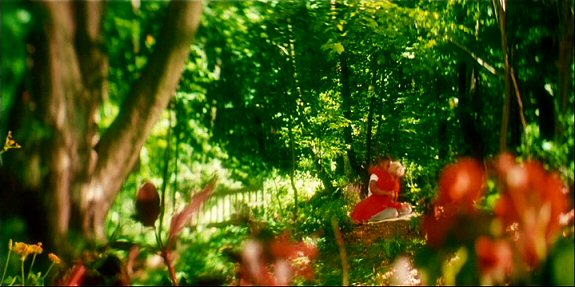
I'm shooting a music video soon and the bands want a look and feel similar to "Eternal Sunshine of the Spotless Mind." They were mostly thinking of the scenes where it just looks like a flashlight following them and everything around them is in blackness. What do you think would be the best lights to use and the best way to light that?

Also, very good work on US of Tara. I saw your name in the credits and was like "Holy crap, I didn't know he was DP on that show." Very well shot. When are you guys gonna be working on production for the next season?

Thanks,
Jerrod
 
The April 2004 issue of "American Cinematographer" covered that movie... DP Ellen Kuras said that for closer shots, they had a "clip light" attached to the camera (I guess something like a small clamp-on desk lamp / reading light) and for wider shots, they used a PARCAN (1K tungsten).

It seems to me though in post they opted for a cooler color look though, I guess in timing (considering the whole movie was shot on 500D Fuji Reala stock, daylight-balanced, that's quite a correction in post to make a tungsten spot look blue-ish. Unless they gelled their light. At least, that's how I remember the effect, that it was a blue-ish spotlight.)

--

Thanks for compliment on "Tara", it's such a simple-looking approach that I'm not sure anyone noticed the photography. We start back in August for Season Two.
 
I'm guessing they just used a gel over the tungsten. Could have just been more cost effective then just using an HMI or something. What do you think would be a good/cheaper alternative to the 1K?

And I can't wait to see what you guys are cooking up for Season 2.
 
It's hard to imagine a movie light much cheaper than a 1K PARCAN -- I think it rents for $30/day at some places. It's more or less a staple in any small theater stage. A 1K Par globe in a cylindrical housing:

http://extranet.mole.com/public/index.cgi?cmd=view_item&parent=-1899-1900-1905-1915-1927&id=9387

Sure, you can wrap some blackwrap around a light to create a snoot, like a 650w Tweenie or 1K Baby, it's just that a 1K PAR is such a simple and cheap light relatively speaking.

You can try a smaller light, like getting a 75w spot bulb from Home Depot, in an ordinary lamp socket. More or less the "clip-on" light Ellen Kuras was talking about. Just depends on how bright you need the light to be and how spotty you want it to be. Any light can work as long as you can narrow the beam, like with a snoot.
 
Back
Top