Welcome to our community

Be a part of something great, join today!

  • Hey all, just changed over the backend after 15 years I figured time to give it a bit of an update, its probably gonna be a bit weird for most of you and i am sure there is a few bugs to work out but it should kinda work the same as before... hopefully :)

ARRI ALEXA LF - 4k, FullFrame announced

Cool promo vid. Love the moving light thing. Chair @1:00 looks a bit clippy but who know really from a YT upload
 
I don't know what it is with you and I but you always end up countering my arguments based on the exact opposite of what I said. Also, you are quite literal.

First, that image development trend, as it stands, exists in the context of the capture device, the camera, and its corresponding ISO settings. From the user's perspective, it's a behavior of the camera.

If the trend changes, the camera will presumably seem to behave differently, regardless of where or how the actual change is taking place.

So, when I said the camera, you could've just resisted the urge to be contrary and gone with it. But, because you are the way you are, let's say the sensor, before any image development manipulations, can accommodate a full 7.5 stops above middle gray and 7.5 stops below it when rated at the lowest ISO setting, which is usually 250 in-camera for RED.


Second, I didn't say a 1 stop increase in sensitivity. I said a 1 stop increase in ISO rating. I then progressed in 1 stop increments from 250, to 500, to 1000 ISO. What makes you think I was talking about increasing sensitivity in the part of my post you quoted?


I never said 7 stops over wasn't good. My point is any company that releases a camera in hopes of unseating the Alexa or at least giving it a serious run for its money is going to have to beat it in the one area where it reigns supreme. That's overexposure latitude.

9 stops over mid is film territory for some stocks and what we've already gotten used to seeing and shooting for several decades.

If RED's argument that 2K wasn't a good enough resolution for a film replacement, especially given film's ability to resolve at least 4K worth of resolution when scanned, then neither should only 7 stops above mid gray be good enough. 9 stops, by their own logic.


Just some odd questions to the theory.

- What ISO would you want this 7-9 stops above 18% gray?
- Why at ISO 250? Especially since digital is cleaner and more sensitive.
- Film, modern Vision 3, tops out at 13-15 stops of total captured DR. That's from Kodak as well as my measurements. Actually Kodak says 13, I say you can get 15. But that depends on a variety of things.
 
Between the sensor reading voltages behind the bayer mask, and constructing an RGB image with a target gamma and color space/volume (i.e. rec 709 2.4) that can be viewed - a lot goes on. RED and ARRI handle that portion of the signal path rather differently. Panavision clearly does as well with the DXL. In broad terms - RED gives you a less formed piece of clay if you will, giving you great control in RAW development. With the Alexa, ARRI's pipeline does some characterization along the way that - to my eye - mimics the look of later Kodak 5219 variants. This is a much desired look, lush and rich with nice blacks.

Excited to see ARRI offer a FF35 gate, just to push the lens manufacturers to make more "large" (45mm image circle please) format glass with cinema mechanics. Hoping the Sigma CINE series, the Zeiss Compact Zooms, etc are just the first wave...

Cheers - #19
 
Some thoughts:


ALF is basically an A65 you can own. A65 footy is incredible not so much for it's rez but more so for it's color/DR subtlety and FOV.

I haven't had the chance to play with Dragon VV or Monstro or DXL but I have heard good things from a few people.

I've only heard good things from A65 shoots (besides the obvious hassle with uncompressed 6.5K and dealing with the codex vault xl).

I've been shooting tests with the new Sony Venice for the past couple of days. On paper it is the camera everyone wants for christmas. The internal NDs are the best thing ever. Image is razor sharp. Highlight retention is F65 level amazing. Workflow is instantaneous. Yet I'm unsure about color and highlight rolloff. Needs more testing but for the cost and size it is awesome.

There is a reason Arri is sticking with the ALEV3 sensor. And it is not because they want to milk 10yr old tech.

There is also a reason the A65 sensor assembly is housed in such a large body. Same reason the ALF sensor is in a slightly larger SXT body.

Meaning those waiting on a half-priced ALF-MINI will probably be waiting for quite awhile.
 
I've seen a few films that were shot on the Alexa. Some nice, but no nicer than the F65 or RED. Some don't look nice at all. I don't know what shit people are smoking.

I think Blair is right: there's a sort-of-LUT internally that gives it its look, and you can undo it (at your peril). I think RED can and will out-manoeuvre its competition, regardless (and they won't have to make a Super 8 camera to do it).

EDIT: BTW, Showtime approved the 3.2K Alexa for Twin Peaks, even though Showtime has a 4K policy. Don't shoot the messenger.
 
Don't bring a 4K sensor to an 8K fight.

This ain't no 8K fight. No one is releasing content in 8K and 8K TVs are yet to be seen anywhere. 8K is irrelevant at this point.
Props to Arri for sticking to DR and Color. Resolution is overrated.
 
I don't know what it is with you and I but you always end up countering my arguments based on the exact opposite of what I said.

If I misinterpreted you here, mea culpa.

First, that image development trend, as it stands, exists in the context of the capture device, the camera, and its corresponding ISO settings. From the user's perspective, it's a behavior of the camera.

Yes it exists * in the context of - * and is * suboordinate to - * the camera behaviour.


If the trend changes, the camera will presumably seem to behave differently, regardless of where or how the actual change is taking place.

Camera always behaves the same.
Trends come and go. Its usage either harvests its full potential ot not.

Today mostly not.
Tomorrow...who knows.

Second, I didn't say a 1 stop increase in sensitivity. I said a 1 stop increase in ISO rating. I then progressed in 1 stop increments from 250, to 500, to 1000 ISO. What makes you think I was talking about increasing sensitivity in the part of my post you quoted?

Logic and faster reading.

ISO rating is related to sensitivity.

9 stops over mid is film territory for some stocks and what we've already gotten used to seeing and shooting for several decades.

9 stops over mid is quadruple the light intensity over 7 stops over mid, achieved with largest pixel size in the domain.

We can fantasize and throw numbers as we please but principles of electronics will still dictate how much electrons can the pixel hold before it oversaturates. We can also assume that the Munich folks have some kind of irrational childish fixation on huge pixels. While others had an epiphany with resolution but not with 7 over mid in the same time for some reason.
 
This ain't no 8K fight. No one is releasing content in 8K and 8K TVs are yet to be seen anywhere. 8K is irrelevant at this point.
Props to Arri for sticking to DR and Color. Resolution is overrated.

RED's VV sensors are 8K (and then there's Helium). RED is now the strongest choice for anamorphic - it wasn't before. Resolution lets you capture more and better color. And RED sensors have more DR than any other brand (not that other brands aren't good - I'm not saying that).

If you want the best color, shoot film.
 
This ain't no 8K fight. No one is releasing content in 8K and 8K TVs are yet to be seen anywhere. 8K is irrelevant at this point.
Props to Arri for sticking to DR and Color. Resolution is overrated.

And here I am shooting and delivering 8K "for something" that will be available this year. Wonder why.......

What is irrelevant for you is not necessarily irrelevant for others and perhaps the future. We had this conversation about 4K a few years ago too. Added to that the various things you can do with more resolution than not, but I'll keep those cards off the table for now.

There's a pattern, I dare say a rhythm, to this technological advancement in the motion picture industry.

The divisive concept of DR and Color mattering and Resolution not is an alarmingly silly perspective. Especially now. It all matters.
 
I think people are missing the point. Arri has a regular Netflix/Amazon approved camera.

It doesn’t matter how good it is or that it is a cynical stopgap to poach customers before a proper new sensor is released.
 
I am slightly confused by the main thrust of RU reaction to ARRIs announcement..

I was there at the event and my take away from a Red perspective was there was 2 major anoucments plus an interesting camera..

The 1st major anouncment was the mount... this surely is the big news..

The 1st question I expected to see on this forum is when can we see a LPL mount for a red camera.. I was assured by senior ARRI management the licence for the mount was symbolic only and not for profit!!

Interesting the flange focal plane is exactly the same as Eos... but the throat is bigger

Ps and all the major optical companies have the mount details and are already on board...

The 2nd big news was the lenses ..( specifically but not limited to the aesthetic and ergonomic change of direction for ARRI)

Very plane side telecentric
Light weight
Very high res but contrast not ARRI/ziess ... more 'ziess snap'
Different attitudes to out of focus part of the picture

... and then of course there was another Alexa camera for the DPs that want to shoot ARRI on Netflix and Amazon.. the camera looked interesting but outside the affirmation of FF not sure it is the big news for Red guys... surely the mount and lenses matter to Red users more?
 
Alexa LF

Alexa LF

Hi,
When we got the RED ONE in 2009 , it was the best value for money product (with all its pros and cons) and was accepted worldwide and lot
of rental houses including ours developed their business model on RED cameras.

Then with EPIC the market grew as Alexa was not only pricey but was heavy and with new form factor EPIC / Dragon became a rage with DOPs worldwide.
The ALEXA was still not affordable specially in our region.

NOW with ALEXA LF which has price of 10% to 15% more of MONSTRO price , as a RENTAL house it make sense to invest in ALEXA....HOTCAKE selling..no convincing/oiling the DOP..

So I wont be surprised if RED DROPS or make special offers on price of MONSTRO VV ....as they did one fine day with EPIC prices.

Harcharan
 
I can't believe they made a non s35 unit in general whether you see it as monstro and Alexa 65 affirming or yet another repackaging of their well respected but fairly old sensor? I own this sensor in many form factors and in both 16/9 and 4/3. Some can uprez and some do 200fps and one of them even has a broken board and won't record internally now.

So I love arri for many respects but get bummed on others at times. I think hydrogen one will be very interesting. I don't think others will easily jump on this market. So red seems to be innovating ahead of this and Sony Venice too
 
Logic and faster reading.

ISO rating is related to sensitivity.


We can fantasize and throw numbers as we please but principles of electronics will still dictate how much electrons can the pixel hold before it oversaturates.
We can also assume that the Munich guys have some kind of irrational fixation on huge pixels. While others had an epiphany with resolution but not with 7 over mid in the same time for some reason.


Just some odd questions to the theory.

- What ISO would you want this 7-9 stops above 18% gray?
- Why at ISO 250? Especially since digital is cleaner and more sensitive.
- Film, modern Vision 3, tops out at 13-15 stops of total captured DR. That's from Kodak as well as my measurements. Actually Kodak says 13, I say you can get 15. But that depends on a variety of things.

I apologize in advance for the lengthy post.

Okay, more than 14 hours without eating kinda derailed my thinking and I started combining a few concepts in a way I shouldn't have and muddied my argument. Let me try to correct those mistakes and clarify my point.

Yes, sensitivity is related to ISO. The higher the ISO, the more sensitive you're making the camera to light.

Anyhoo, I was so focused on the net result of what happens during the rating part of "rating the camera" I momentarily forgot what's also happening in terms of ISO. I don't go through this next part because I think you don't know it. I'm saying it so you know where I'm coming from. I just want us all to be on the same page.

So, rating (as I meant it) for an ISO is a two step process: setting the ISO in the camera and adjusting how much light enters the lens based on the amount of light you need to achieve middle gray.

In most practical situations, this means adjusting the exposure on the lens. You could also move the lights or diminish their output. If you're doing camera tests or something, you may choose to adjust the shutter angle.

You can determine what middle gray is in a number of ways. A light meter will give you a value after you take a reading based on the ISO and frame rate you tell it you're using.

You could also use the formula 100 ASA @24 fps with a shutter angle of 180 degrees with 100 fc of light @ f2.8 = middle gray, and adjust the numbers from there to get the values you need.

Let's say you're using a light meter and lens aperture to adjust how much light enters the lens. Raising the ISO is essentially making the camera more sensitive to light. The meter then indicates you can stop down the lens in order to cut the amount of light entering it because of the camera's increased sensitivity.

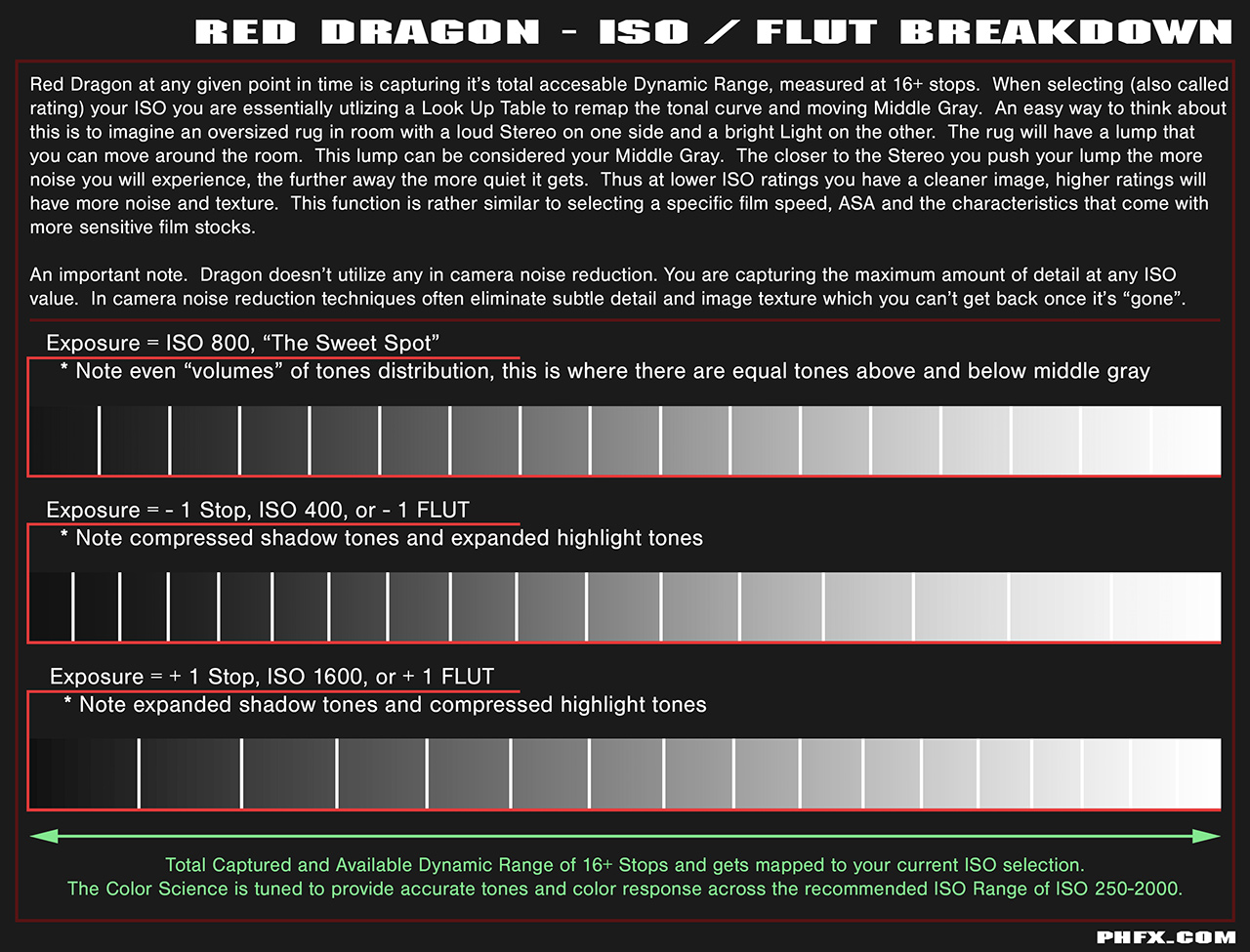
This is where I started to screw my argument. With RED cameras, lower ISOs distribute more stops below middle gray and higher ISOs distribute more stops above middle gray.

This redistribution method, combined with what I just described when rating the camera, produces the net result which can be seen in Phil's charts below.

Specifically, rating (as I describe it, not just setting) at a higher ISO will increase noise but also increases highlight latitude (because you're also stopping down), which is what we're after if my theory is correct.

This relationship is what was causing me to not take how ISO functions into account. I was also thinking about sensor sensitivity in terms of how sensitive it is natively, before any digital gain (ISO) is applied. Hopefully, my explanation answers some of the questions you had, Phil.

Now, I'm not qualified to say what needs to be done from a technical standpoint in order to achieve the type of highlight latitude I'm talking about. All I can do is describe what should happen and let the experts figure out how to get it done.

Basically, it's this: take an Alexa and a RED (or whatever) and point them at the same scene in which some areas may clip the sensor depending on exposure settings and some are bright enough to clip no matter the settings.

If the camera that's not the Alexa shows significantly more highlight latitude than Alexa at every ISO rating between 250 - 2000, that's what I'm talking about.

How that has to happen is beyond my realm of knowledge. Maybe all it would take is a recalibration of an existing sensor to give the perception of more highlight latitude. As long as the user experience reflects that perception, that's all that matters.

EDIT: This is the test I was thinking of. The sky and building on both Alexa and Dragon blow out in the ISO 250 +4 stops overexposure test but Alexa holds the face better at :55 secs. I don't know which OLPF. That's probably why I chose ISO 250 in my previous post, Phil. https://vimeo.com/101107159

If a camera achieves 7-9 stops over middle gray at an ISO rating of 800, 1000 or even down at 500, I guess that's a good middle point. I dunno.

What I do know is Arri hasn't bothered to dig deeper into the shadows like everyone else for one simple reason. They don't have to because extreme shadow detail isn't what puts their cameras in such high demand.

They claim better sensitivity with LF but that's probably due to improvements in other hardware, similar to what RED achieved with the DSMC2 bodies.

Regarding film, it may only have 13-15 stops but it stacks most of them up top, does it not? That's all I'm asking from a digital sensor and what I think will make a huge difference in who will provide any serious competition to the Alexa dynasty.

Yes, with a clean enough sensor, you could expose for the highlights and raise the mid and shadow levels in post but that's pitting "All you have to do is..." against not normally having to think about it.

Right or wrong, people tend to gravitate towards less work and what they know. It comes down to planning and adjusting and compensating versus human nature. Good luck with that.

Greater or even equal highlight latitude is the only thing that hasn't been copied from Alexa in other camera systems that have equaled or bested it on every other front.

You only need look at one spec and note the absence of one phrase to know if that camera is going to do any damage to Alexa's stronghold.

That spec is dynamic range and the phrase is something akin to, "with a whopping 8 stops above middle gray at ISO 800." or whatever. If that ain't there, companies are merely releasing an alternative to the standard, not a successor to the throne.

"When you have eliminated the impossible, whatever remains, however improbable, must be the truth." – Sir Arthur Conan Doyle, stated by Sherlock Holmes

The only way to prove me wrong is to do it.


phfx_redDragon_ISOFlutBreakdown.jpg


phfx_redDragon_ISOExamples.jpg
 
Last edited:
Hi,
When we got the RED ONE in 2009 , it was the best value for money product (with all its pros and cons) and was accepted worldwide and lot
of rental houses including ours developed their business model on RED cameras.

Then with EPIC the market grew as Alexa was not only pricey but was heavy and with new form factor EPIC / Dragon became a rage with DOPs worldwide.
The ALEXA was still not affordable specially in our region.

NOW with ALEXA LF which has price of 10% to 15% more of MONSTRO price , as a RENTAL house it make sense to invest in ALEXA....HOTCAKE selling..no convincing/oiling the DOP..

So I wont be surprised if RED DROPS or make special offers on price of MONSTRO VV ....as they did one fine day with EPIC prices.

Harcharan

Very true.

I own and run a rental house in Madrid, Spain.

These days Alexa Mini cameras are the ones with more demand (and maybe followed by Amiras, XT, SXT and early Classic/Plus models, and then the other brands). Sony's have good reputation in terms of image quality, but most people complain abour their menu systems (F55) and size/weight (F65). That may change with the new Sony Venice, which I believe has had a well reception, though no one has already used it the field. RED lost its moment when they released (IMHO) a very flawed Dragon sensor, with a color science that wasn't reliable enough, and caused red noise even at low ASA settings. Then they had to introduce swappable OLPF's to try to fix that, make people learn (including) myself) the hard way about black shading (I kinda mastered it an even teached it to others!)... and the rental market went straight to the already well known and established Alexas and Amiras. That's the truth. People with the power to decide the shooting format (producers, directors, cinematographers) just wanted ARRIs.

As a DP I like what you could do with an Epic Dragon, I found the look and resolution to be very nice after RED solved most of the problems... but since I owned the cameras I knew I could trust them, something most DP never did either because they weren't owners of had heard horror stories about noise and black shadings. I've always thought that DSMC2 came much earlier than it should and that was planned, and that was due to the fact that the DSMC1 bodies and Dragon (which required a very high temperature to give its best performance) couldn't allow the sensor to shine.

Weapon was way overpriced and though RED offered us owners discounts to replace our cameras, I did know from day 1 that I wasn't going to follow the upgrade path because the demand wasn't RED cameras: everybody with a decent budget wanted ARRI's.

I kinda feel betrayed by RED when they released the Helium sensor, as my previous Dragon investments, still DSMC1, which were in demand for lower budgeted jobs, had seen its value lowered by the brand itself very quickly. I never owned an Helium, but I can understand how their owners feel these days after the release of another sensor, Monstro. Then I decided to jump ship, buy some more ARRIs and sell the remaining RED cameras as soon as possible. With all these new releases, new sensors, new names, new gadgets being released so often, I just can't see REDs as a good investment. Just have a look at the second hand market of DSMC2 bodies, and how much they sell for these days.

With this ALEXA LF movement, ARRI has taken care of all the Alexa Mini owners in the world, as their cameras will be used together with the LF and 65 if 4K isn't a must (i.e. Netflix). And with its excellent 3.4K ARRIRAW or 3.2k Prores XQ, they will provide great images for years. I just can't mix a Dragon with an Helium or Monstro, since they are all different sensors. Even with their 4K 16/9 mode, which has a diagonal of 36+mm, they have taken care of owner of most Super 35 glass, as many modern sets will still cover from their 25mm / 32mm lenses, which will be wider-angle anyway (so less need for lenses below 24-25mm). Don't know if some discount or special price will be offered to SXT owners (I know they offered upgrades to SXT to some XT owners).

ARRI has proved to have an excellent sensor since 2010 or 2011, when it was first introduced. During that time, I've seen Mysterium-X, Dragon, Helium and Monstro. Still haven't met anyone (from assistants, directors, cinematographers, production companies) preferring RED if it's not from a money related point of view. I've met lots of people that were students five years ago, started DPing commercials, shorts, etc. shooting RED and, as soon as they have an industry career well established and moved to bigger assigments, they all switched to ARRI.

Does this happen only in Spain or everywhere? Because this is what I've seen during the last six years owning a rental house here and owning RED cameras till a couple of weeks ago.
 
A 6k S35+ Dragon/Monstro based camera with the same feature-set as the Alexa SXT W, with a really decent view-finder for about 1/3 of the price of the Alexa-W would be a really great production camera for both narrative television and feature films.
 
Back
Top