Welcome to our community

Be a part of something great, join today!

  • Hey all, just changed over the backend after 15 years I figured time to give it a bit of an update, its probably gonna be a bit weird for most of you and i am sure there is a few bugs to work out but it should kinda work the same as before... hopefully :)

ARRI 4K Super 35 Camera Will be Launched Next Month

Dehancer is indeed rather impressive in regards to its film grain emulation. And, as of today, is my favorite for grain.

Also, regarding my dream-come-true camera, oh, I mean the ALEXA 35, I hoped eventually the day would come when acquiring dreamy amounts of Dynamic Range would be technologically achievable. Now I dream that the price point for this dynamic range acquisition goes down fast. : )
 
Martin,

Plus I like the fact that Dehancer is " Color Space Aware" so that no matter what Color Managed Workflow you choose you know that you will be getting the most optimal results for that workflow. Also Dehancer I believe has one of the most extensive List of Film Print Color Emulation Models of almost any other Film Print Emulation Program I've seen out there.

Yeah, the Arri Alexa 35 has set an even higher standard for other Competitors to try to duplixate. I also wish it was cheaper like pretty much everyone else in this thread but I guess you get what you pay for with the Alexa 35. That dream will only be possible in probably about 7 to10 years on the used market.
 
I had hoped that this would become PC capable https://videovillage.co/filmbox/ anyone compare the speed and stability of Dehancer and Filmbox on Mac?

Michael,

I personally haven't seen any.But it seems some of the best programs like LATTICE, ColourLab AI for look development and other control APPS for Cameras and for other uses for Both Computers and phones seem to be for the Mac ONLY. Windows seems to be the " Redheaded Stepchild" of the Operating Systems
 
ARRI TEXTURES
https://www.arri.com/resource/blob/...372f38a21d7927/2022-05-arri-textures-data.pdf

Screenshot-4977.png
 
I had hoped that this would become PC capable https://videovillage.co/filmbox/ anyone compare the speed and stability of Dehancer and Filmbox on Mac?

My "source" tells me that FILMBOX will release on Windows rather soon, with SCATTER soon to follow.

SCATTER is mind-blowingly great, and nothing compares to it that I know of.
 
My "source" tells me that FILMBOX will release on Windows rather soon, with SCATTER soon to follow.

SCATTER is mind-blowingly great, and nothing compares to it that I know of.

SCATTER does seem very good... their scene referred approach to diffusion is correct (IMHO) and with cameras like the Alexa 35 reaching 17 stops post diffusion is getting very close to matching what is possible when you do it for real!
 
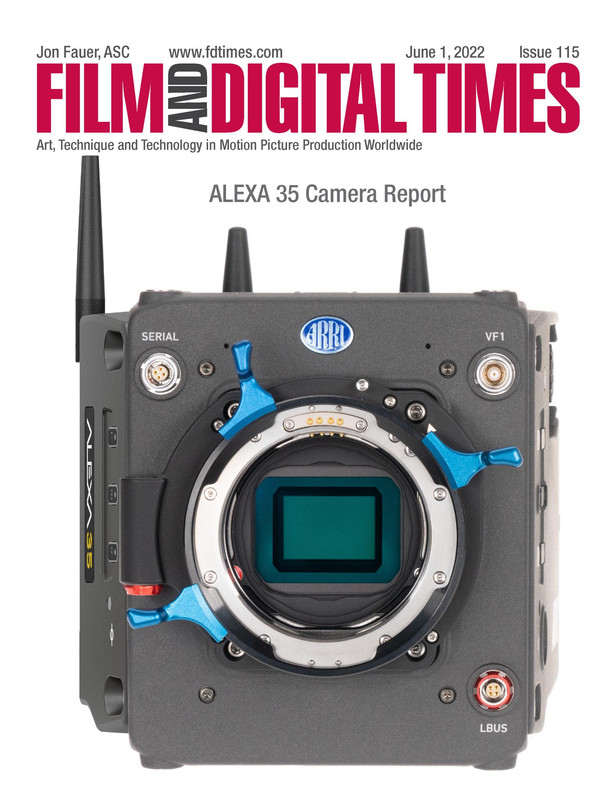
June 2022: Issue 115
115FDTimes-June2022-2.04-150.pdf


June 2022: ALEXA 35 Report

Introduction: ALEXA 35 4-5
ALEXA 35 Details 6-9
ALEXA 35 Camera Body 10
“Accessories oft Proclaim the Camera” 11
Camera Prep: Lens Mounts and Front 12
Prep: Camera Left Side 13
Prep: Camera Right Side 14
Prep: Camera Right Rear with PDM-1 15
Prep: Camera Left Rear 16
Prep: Camera Top 17
Camera Bottom 17
Cool Running 18
This BUD’s for Air and Balance 19
Outfitting ALEXA 35 20
Studio Mode 21-22
Almost Unlimited Viewfinder Positions 23
Multi Viewfinder MVF-2 In-Out, Front-Back Positions 24
Multi Viewfinder MVF-2 25
ALEXA 35 Textures 26
ALEXA 35 Lens Mounts 26
Batteries 27
ARRI Camera Companion on iPad (or M1 Macs) 28
ARRI Camera Companion on iPhone 29
ALEXA 35 and DaVinci Resolve Introduction 30-31
Sensor Modes, Resolutions, Formats, Dimensions, Frame Rates 32
Recording Formats, Data Rates, Recording Time 33
Recording Formats and Pre-Record 33
ALEXA 35 Specifications 34-35
Some ALEXA 35 Sensor Modes (Recording Formats) 36
Some ALEXA 35 Framelines 36
ALEXA History 37
Christoph Stahl, ARRI Shareholder Representative 38-39
Dr. Matthias Erb & Dr. Michael Neuhaeuser, ARRI Executive Board 40-41
Stephan Schenk, ARRI General Manager Global Sales and Solutions 42-43
Walter Trauninger, Head of Business Unit Camera Systems 44
Marc Shipman-Mueller, Senior Product Manager at ARRI 45-49
Dr. Achim Oehler, Head of Sensor Design and Imaging Front-End 50-1
Harald Brendel on Image Science 52-55
Dr. Tamara Seybold on Textures 56-57
Christian (Geoffrey) Grafwallner, Workflow Product Manager 58-60
ARRI Reference Tool (ART) 61
Christian Hartl, Director of Global Production 62-63
Sandra Yap, Head of Assembly and Testing 64-65
Jeanfre Fachon, Product Manager for Camera Support Systems 66-67
“Jeanfre Wants to See Daylight through the Accessories” 68
Dr. Michael Frank, Head of Business Unit Camera Systems and R&D 69-71
Elisa Weiss, Head of Center of Competence R&D Excellence 72-73
Clean Room 74
Michael Stadler, Head of Testing 75-76
Jan Heugel, Global Field Test Coordinator 77
Field Tests 78
Henning Raedlein on ALEXA 35 Encounters 79-80
Eleven ALEXA 35 Encounters 81
Argentina: An Ancestral Path 82
Argentina: An Ancestral Path 83
Australia: Sweetheart 84
China: Tigerine 85
France: Avoid Boredom 86
Germany: Nice 87
India: Through the Colors 88
Japan: Found It 89
Korea: Treasure Hunter 90
Nigeria: The Painting 91
UK: The Siren 92
USA: The Swing 93
 
The most important spec the Alexa 35 and ALEV 4 have to offer is 1.5 stops more latitude in the highlights. Arri put more stops at the top than they did at the bottom, unlike EVERY OTHER MANUFACTURER in the last 12 years. This was no accident. They did it for the exact same reason they strove to achieve 7+ stops above middle gray at E!800 in the original ALEV 3 when everyone else was getting maybe 4.5 - 5...it's the perceived superior image quality of wider dynamic range, but particularly in highlight latitude, which they weren't willing to sacrifice in order to increase resolution to 4K. They published a white paper about it circa 2010.

Below is a quote from a post I made back in February of 2018. In it, I describe how the most important factor that led to the Alexa's success was its highlight latitude. Over the last 10 years (more so in the last 5) I've implored RED to increase highlight latitude by 2-3 stops and have been met with backlash every time from Redusers. I was told to simply rate the camera at a higher ISO/underexpose the image by 2-3 stops, or use ND, or 16+ stops was plenty, or asked what purpose it would serve, or told it'd be a waste because the meat of the image is in the middle.

Well, apparently, Arri and I agree that the best (not only) indicator of the perceived quality of an image is ascertained from the middle to the top of the image instead of from the middle to the bottom. The history of the ALEV 3 supports this. Humans are extremely tolerant of noise, both auditory and visual. Besides, no one has ever watched a feature film and said they could tell it was shot on Alexa because of all the noise in the shadows. The Alexa 35 is 1 stop better than previous models. And, I maintain that the more an image replicates what our eyes see on a daily basis at the top, the richer and more pleasing the overall image is.

Alas, like I said in the quote, the worst thing camera manufacturers could do would be to let Arri beat their own highlight latitude spec. They did it with the Alexa 35. So, unless RED is working on a 10-stop followup to the Raptor sensor we don't know about yet, they'll have to be content with a battle for a distant second place with Sony when it comes to narrative tv and film jobs.

I tried to tell you.

For years, my ramblings on this subject have gone ignored. I say yet again, Arri wins on two main fronts: color and highlight latitude, with the latter being the main deciding factor.

Doubt me if you will but camera systems with colors that arguably match or surpass Alexa still lose on the highlight front, where the perceived quality of an image is most apparent and initially judged, whether we are aware of it or not.

If ANY camera manufacturer is going to dethrone the Alexa, the highlight queen, they're going to have to outdo the ALEV III on highlight latitude. I feel it's as simple as that, although it's easier said than done. If it were easy, someone would've done it by now.

No amount of digging into shadows with a sensor is going to cut it. We already have cameras that are more sensitive than Alexa. If extreme sensitivity were the deciding factor, that would've dethroned Alexa by now as well. That's a niche feature.

Alexa's popularity is also not due to the other arguments people have given over the years. Although they are pluses, it's not form factor, post workflow, easy-to-use menu, build quality, yada yada yada. Everyone who thought that has already copied all of those things, to no avail.

The one thing no one has managed to do is get more stops up top and it's why they all fall short in the end.

If RED (or anyone else) wants to gain back some market share from Arri, they need to develop a sensor that gets at least 8 stops of undeniable, undisputed latitude above middle gray at an ISO 250 rating. If they have to go dual readout or develop a cheat or whatever, that's what it's going to take.

You can think I'm full of crap on this but the biggest mistake any of them can make is let Arri be the one to beat its own highlight latitude. Then it really will be game over at the high end.

RED has nothing to lose and everything to gain by trying it my way, by whatever means necessary, even if they have to relinquish a few stops on the bottom, and seeing how it goes.

Trust me. I'm intuitive like that.
 
The most important spec the Alexa 35 and ALEV 4 have to offer is 1.5 stops more latitude in the highlights. Arri put more stops at the top than they did at the bottom, unlike EVERY OTHER MANUFACTURER in the last 12 years. This was no accident. They did it for the exact same reason they strove to achieve 7+ stops above middle gray at E!800 in the original ALEV 3 when everyone else was getting maybe 4.5 - 5...it's the perceived superior image quality of wider dynamic range, but particularly in highlight latitude, which they weren't willing to sacrifice in order to increase resolution to 4K. They published a white paper about it circa 2010.

Below is a quote from a post I made back in February of 2018. In it, I describe how the most important factor that led to the Alexa's success was its highlight latitude. Over the last 10 years (more so in the last 5) I've implored RED to increase highlight latitude by 2-3 stops and have been met with backlash every time from Redusers. I was told to simply rate the camera at a higher ISO/underexpose the image by 2-3 stops, or use ND, or 16+ stops was plenty, or asked what purpose it would serve, or told it'd be a waste because the meat of the image is in the middle.

Well, apparently, Arri and I agree that the best (not only) indicator of the perceived quality of an image is ascertained from the middle to the top of the image instead of from the middle to the bottom. The history of the ALEV 3 supports this. Humans are extremely tolerant of noise, both auditory and visual. Besides, no one has ever watched a feature film and said they could tell it was shot on Alexa because of all the noise in the shadows. The Alexa 35 is 1 stop better than previous models. And, I maintain that the more an image replicates what our eyes see on a daily basis at the top, the richer and more pleasing the overall image is.

Alas, like I said in the quote, the worst thing camera manufacturers could do would be to let Arri beat their own highlight latitude spec. They did it with the Alexa 35. So, unless RED is working on a 10-stop followup to the Raptor sensor we don't know about yet, they'll have to be content with a battle for a distant second place with Sony when it comes to narrative tv and film jobs.

I tried to tell you.

Sony was coming close to Arri in highlight latitude with the Venice. It had about 6 2/3 stops of highlight latitude at 800 ISO. The Venice 2 actually reduces highlight latitude to 6 stops at 800 ISO. It seems Sony thinks that high ISOs(Dual Native) were the real selling point of the first Venice. The success(or lack of) of the Venice 2 might be a good test of your thesis.
 
important

Just pictures now.

phfx_ARRI_Alexa35_01.jpg


phfx_ARRI_Alexa35_03.jpg

phfx_ARRI_Alexa35_04.jpg

phfx_ARRI_Alexa35_02.jpg


Just to be thorough, the final shipping camera will have the plastic anti-scratch shields near the I/O ports on the AC/Dumb Side.
 
Last edited:
Apparently, it took ARRI a year to find acceptable coatings to suppress stray light in the camera, which is impressive, so I guess I’ll have to retract my “charming story” comment from earlier.

Also, I don’t know whether anyone brought this up before, but according to ARRI, the textures were designed for HDR viewing, and according to Matthew Allard, they are difficult to see unless you’re viewing in HDR on a big screen.
 
Last edited:
Gee... I wonder just how many stops of highlight latitude modern 35mm negative empirically has?

: )
 
Grade School: Breaking down Arri's new color workflow w/ a pro colorist

By
Cullen Kelly


Sony was coming close to Arri in highlight latitude with the Venice. It had about 6 2/3 stops of highlight latitude at 800 ISO. The Venice 2 actually reduces highlight latitude to 6 stops at 800 ISO. It seems Sony thinks that high ISOs(Dual Native) were the real selling point of the first Venice. The success(or lack of) of the Venice 2 might be a good test of your thesis.

Yeah, I noticed that when the Venice 2 was released. It's the first spec I look for in a new camera/sensor announcement. That one was a head scratcher to me because, to my knowledge, it wasn't like the original Venice was starting to overtake the Alexa in the narrative film and tv space. I don't expect Venice 2 to do any better.
 
Kind of funny how RED was bashed with "out of standard" connectors or ways of doing and Arri comes with

"Hey guy let's use 24v battery "as we used to"" and every body says

"what a genius idea!"

"Let's buy new batteries, I'm fed of those old Vlock 12v batteries anyway... "


Most problematic point on the Alexa35 is the preprocessing stuff going on. Internal denoise should be a no go on a professional camera.
 
Just pictures now.

I'm afraid I don't know who or what "the horse" is.

I can totally see how a then 6 to 8-year-old sensor (allowing for development time up until its intended 2020 release) may eventually start to "lose ground" to newer sensors in newer, more capable (in certain respects) cameras. On the other hand, a 6 to 8-year-old sensor without a new sensor design (sorry Dragon, you had a nice long run but Helium, Monstro, Gemini, Komodo and Raptor disqualify you) is unmatched in the industry and a testament to just how good the ALEV 3 and design philosophy behind it actually are, despite that sensor's shortcomings. And, some productions favoring Sony or RED cameras over Alexas has happened throughout Alexa's lifespan. So, I wouldn't expect RED's current offerings to be any different.

As for RED influencing what Arri and others do in terms of size, design, modularity, etc. - absolutely. They have been for years. In fact, the other white paper Arri published circa 2010 was about the importance of higher resolutions and how 4K+ was essential to an alias-free viewing experience.

Testing cameras at various ISOs is the way to go. As best as I can recall over the years, Alexas always beat REDs at overexposure latitude, particularly at lower ISOs. Because of RED's weighting, their cameras always faired better in highlight latitude at 800 and higher ISOs. Still, even when testing at various ISOs, the method is always the same: set them all at 250, 400, 500, 800, 1600, 3200 and see what you get over and under. Almost every digital cinema camera ever produced was a loser next to Alexa in overexposure latitude, regardless of ISO, IIRC. Talk of weighting and ISO can introduce ambiguity into my position that I now try to avoid, which is why I prefer to explain it like this - before any weighting happens, whatever light intensity causes a photosite on the best highlight performer in the current RED sensor lineup to clip, design a new sensor that can handle 3 more stops of light intensity than that before any clipping occurs.

Why 3 stops you all ask? Shit, make it 4, that's even better. I used to say 2-3 but, after having seen the Alexa 35 demo movies, the added 1.5 stops doesn't seem to be enough to handle the holy grail of digital cinema camera acquisition - brake lights. Now, I don't know if it can't do it or if it can but the cinematographers simply weren't exposing in a way to capture the fully saturated red because a) they deemed other aspects of the image more important or b) it didn't occur to them because they've gotten so used to capturing white blobs with pink halos for the last 15 years.

So, there may still be hope for RED or someone else in this regard after all. When these cameras can shoot an in-focus brake light from 6 feet away and the reds saturate like they do on most modern film stocks without having to stop down so far the endeavor becomes pointless, that will be when digital acquisition will have truly become film's replacement.

I know many will think I'm being ridiculous but Arri mentions brake and neon lights specifically in their literature and Tech Talk video on Alexa 35 image quality. It's really as if they've been reading my posts here on Reduser for the last 11 years. Given that direct performance claim, Phil, maybe you can specifically test for that when you put the camera through its paces.
 
Last edited by a moderator:
Gee... I wonder just how many stops of highlight latitude modern 35mm negative empirically has?

: )

I dunno. But, as I explained to Phil, whatever gets a camera to be able to capture brake and neon lights with the same color saturation that can be achieved with film, as opposed to a white blob with a colored halo, I'm all for it. Obviously film saturates color differently than digital cinema cameras do but I assume we would all want the end result to be the same, however it's achieved. Maybe it's more highlight latitude. Maybe it's Panasonic's organic CMOS sensor. Maybe it's ditching CMOS altogether. Who knows? Alls I know is film still handles those types of light sources vastly better than digital and I wish we could get over that final hump already.
 

I 100% agree that Arri have taken lot of RED's philosophy and product design. The boxy camera design, module accessories, pogo pins are all from RED for sure. Saying that the side monitor panel on the Raptor and Venice look a lot like the original Alexa bodies and everyday things we take for granted like dovetails and rosettes came from ARRI. My issue with the some of the RED community is that people are not willing to call a spade a spade. ARRI's have always had better dynamic range no matter how you dice it/distribute the stops and they haven't tried to advertise dynamic range that isn't there. Every test I have looked at even if you rate the Monstro at 1600 didn't out do the ALEV 3 sensor, it may be within a stop but it didn't beat it and yet it somehow it has 17 stops to ARRI's 14.5. That should be recognised and owned.

ARRI as a company are extremely conservative and slow moving but that means their systems are generally pretty reliable where as RED has the reputation of beta testing on its owners which is not unfounded. On the flip side RED's have been a fast mover, innovative, the cameras are more power efficient, have better frame rates, better in low light and my favourite they do proxies. These are not things to sneeze at as they are import traits.

The new ARRI is not perfect, the power draw, the old ND system and low light are a let down for me. Pointing out the image is now denoised full time in camera as a minus is equal to RED's reconstructing the highlights to eek out additional dynamic range. Everyone is pulling tricks to get the most out of their systems. The new FD Times Issue ( https://www.fdtimes.com/pdfs/free/115FDTimes-June2022-2.04-150.pdf ) goes pretty deep into how they do things I think the most significant thing I saw was the sensor is 18bit which is pretty insane. A far as I know no one else is doing that.

For me the tension comes between the two brands from the die hards that are not willing to own the weaknesses in each system and fighting to the death to defend something that doesn't need to be defended. One does this better the other does that better. Criticism and owning that criticism only makes things better, denying flaws never improved anything.
 
Back
Top