


Karim D. Ghantous
Well-known member
When the history of Red is written, part of the lore will be this chart:
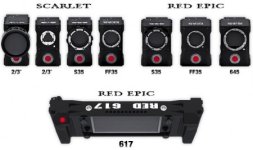
I still believe that Red is working on a 645 sized sensor. But not for the sake of it - there absolutely has to be a significant advantage, otherwise it's just size for size's sake. (For those new to photography, larger formats have the exact same perspective compression as smaller formats). We can't use the same one-dimensional metrics for digital as we do for film. Digital is more elastic.
The big three advantages of a sensor that large are sensitivity, DR and resolution - and a lot of each. But there's a catch. Electronics get better as they get smaller, and they get less efficient as they get bigger. CPUs have more transistors than ever before, yet they are smaller and less power hungry. Image sensors are a different thing - they are transducers, and as such, image quality get worse as they get smaller. But, as they get bigger, they use more power, they have a much slower refresh rate, and the lenses get bigger.
So, if there is to be a point to a 645 sensor, it has to improve in at least two out of the three catogories: DR, resolution, sensitivity. But, with a sensor that big, can refresh rate be kept under control? Sure, the Red ONE was popular even though its refresh rate was double that of Dragon, and probably four times that of Monstro. But, nobody wants to go back to that.
The refresh rate problem could be solved with a rotating shutter, but that would limit shutter angle choice, and just introduce more moving parts. So there's only one thing left to do: make it a CCD.
The power draw will be pretty significant, but, if I understand CCDs at all, you'll have a global shutter as an innate part of the system. DR will be handicapped, just like it is for Komodo. But, it could be the case that overall image quality is one step up from V-Raptor.
Perhaps Red knows how to make a large CMOS sensor with a global shutter, but they choose not do due to DR considerations. ARRI can't do it at all, so it's not like there's any competition.
I hope that you enjoyed this thought experiment as much as I did.

 As for the idea about pixels of differing sensitivity, I suggested something like that several years ago. My idea was to have every other green photosite as either an L (luminance) pixel or a G pixel with a 2 stop ND. But apparently if neighbouring photosites are oversaturated, they spill over into the next one in that row. Or something stupid like that. I wonder if that happens on Komodo, given its global shutter.


