Welcome to our community

Be a part of something great, join today!

  • Hey all, just changed over the backend after 15 years I figured time to give it a bit of an update, its probably gonna be a bit weird for most of you and i am sure there is a few bugs to work out but it should kinda work the same as before... hopefully :)

What filters do you consider essential?

I was talking about ND grads, not regular ND's. I try to carry up to an ND1.8 if possible.

I use the regular ND.30 all the time actually but often indoors when I want to control depth of field, reduce it by a stop.


Roger that David, now we are on the same page... ;)


Even so I do have also the .9 and 1.2 of both the Vertical and the Landscape Soft Graduate ND's, as I tend to find myself in situations were I have super bright clouded Sky and a much dark City scape or Mountain range and such, so they do at times become very handy, even with HDRX.
 
When u say u use a 1/2 CTB u are using it on the actual light fixtures right? I would essentially get the same result with an 81c filter in front of my lens right?

I said up to a 1/2 CTB :) You can do it on the lights or you can do it in front of the lens, Schneider makes glass filters like this.

Once you get up to 3 or more lights though you are applying a filter to each light. In those cases I prefer to put a filter in front of the lens. Also when dealing with mixed sources I've found certain pros and cons. If I was balancing a daylight source like a window or skylight and adding tungsten fill, that would certainly be a situation to add filtration to the light source. If I'm shooting an interior with several on site lamps and coming in with tungsten key light and maybe a fill, I often go with the glass filter. Just depends on what needs to be done and how you want to do it.
 
Do not stack IRND's.

The IRND's - or any IR filter should be the outermost filter from the lens.
The IR filters are reflective - if placed in the optical path behind another filter, some of the light will bounce back to the rear surface of the filter in front of it.
It goes without saying, make sure the reflective surface is facing out.

Also, if you stack normal ND's behind an IRND, make sure they are from same filter manufacturer - the IRND's do introduce a color shift - mixing them up can have a detrimental result on your images.
 
I was shooting in Times Square in NYC one night and got an f/5.6 at 500 ASA, it was so bright out there, so I used an ND.30 to bring it down to an f/4.0. Same goes for shooting in a supermarket or some other bright interior location, I sometimes use ND filters so that I don't get too much depth of field. Sometimes what I do is use the ND.30 on the wider shots and then in telephoto close-ups, pull the ND and stop down to regain some depth of field to make focus-pulling easier. Once you get beyond 150mm or so, a background goes soft in a close-up even if stopped down quite a bit, so there isn't much reason to shoot wide-open unless for exposure reasons, it already looks shallow-focus anyway if you want that look.
 
Roger that David, now we are on the same page... ;)


Even so I do have also the .9 and 1.2 of both the Vertical and the Landscape Soft Graduate ND's, as I tend to find myself in situations were I have super bright clouded Sky and a much dark City scape or Mountain range and such, so they do at times become very handy, even with HDRX.


Sure, an ND.90 grad is occasionally useful, even an ND1.2 grad, but if I were aiming for a minimal filter package, I'd get the ND.60 grad since that's the most commonly-used strength.
 
I said up to a 1/2 CTB :) You can do it on the lights or you can do it in front of the lens, Schneider makes glass filters like this.

Once you get up to 3 or more lights though you are applying a filter to each light. In those cases I prefer to put a filter in front of the lens. Also when dealing with mixed sources I've found certain pros and cons. If I was balancing a daylight source like a window or skylight and adding tungsten fill, that would certainly be a situation to add filtration to the light source. If I'm shooting an interior with several on site lamps and coming in with tungsten key light and maybe a fill, I often go with the glass filter. Just depends on what needs to be done and how you want to do it.

Thanks Phil for pointing me towards the Schneider CTB filters. Will have to get some. If I were going to get only one density would the 1/4 CTB be the one to get?
 
Sure, an ND.90 grad is occasionally useful, even an ND1.2 grad, but if I were aiming for a minimal filter package, I'd get the ND.60 grad since that's the most commonly-used strength.

Correct, its just that I like to be prepared for all things, as the only one or two times I wasn't I greatly paid the price and lost the shot, for this I always suggest to have all that you reasonably can to insure you are prepared to take your shot under even some of the most difficult conditions... ;)
 
I am also preparing to purchase ND filters (for Scarlet). Can we say that there is a consensus as to which make/model of combo IRND/Hot Mirror or HMND combo is best for the MX sensor? What would it be? Is the one-piece glass approach the one which makes the most sense, or is there an intelligent combination of HMND and plain old straight ND, such as a HMND 1.2, plus a straight ND.6 (=1.8)? Or is that much glass stacked together going to degrade the image from one piece of HMND 1.8?

Also, is a UV filter ever necessary with an HMND?
 
Great information here! I'm curious as to whether HDRx can be used in a pinch to mitigate the need for carrying a full set of ND's. I'm planning on running some barebones tests, soon. But as of yet do not own a full set of quality ND's, just a few cheap ones. I'm not asking whether or not HDRx will "replace" the need for ND's, just if I get caught without the right intensity, can HDRx compensate?
 
HDRx may make an extremely overexposed shot a bit more savable in post but I certainly would not use it as a substitute for an ND filter. Either you are carrying ND filters or you aren't, so as long as you have an ND.90 at the heaviest, you'd be able to get proper exposure even in full frontal hard sunlight given the Sunny 16 rule of photography (i.e. f/16 at 50 ASA with a 1/50th shutter speed... so at 400 ASA, you'd need an ND.90 to shoot at f/16, but in a pinch, you could also shoot with a 90 degree shutter angle and lose another stop.) So you could even get the right exposure with just an ND.60 in full sunlight, so I'm trying to imagine why you'd ever need to use HDRx as a substitute for an ND filter.
 
Since I rent my camera packages, usually the filters come from the rental house, though sometimes the AC's rent their own sets to the production. So the only filters I own are oddball diffusion filters that I don't use that often but may need now and then -- I have, for example, a #1/4 Fog, a #1/4 White Frost, a #1/4 Hollywood Black Magic, and a 3mm Blue Streak filter. Plus my homemade black net filters. Now if I'm going to diffuse a whole show on multiple cameras, then I'll rent sets of what I need, so my small collection is just for the occasional shot.

Diffusion filters range from the "mist" types that are more designed for a foggy halation around lights, versus ones that soften detail, some of which cause more halation than others.

Hey David,

Two questions for ya...

1.) Diffusion filters v.s. diffusion in post. What are your thoughts on using diffusion to achieve a look in camera v.s. doing it all in post? I have heard several opinions on this. However, most VFX guys I speak with claim that the effects of just about every filter can now be achieved in post given today's advanced processing capability.

2.) What blue streak filter is your go-to? Considering buying one buy a company called "Optefex" Have you ever heard of this brand? Given the option I'd much rather shoot Anamorphic and get genuine flares. However, as you a probably well aware budgets do not always permit that :(

Thanks for all your advice!
 
HDRx may make an extremely overexposed shot a bit more savable in post but I certainly would not use it as a substitute for an ND filter. Either you are carrying ND filters or you aren't, so as long as you have an ND.90 at the heaviest, you'd be able to get proper exposure even in full frontal hard sunlight given the Sunny 16 rule of photography (i.e. f/16 at 50 ASA with a 1/50th shutter speed... so at 400 ASA, you'd need an ND.90 to shoot at f/16, but in a pinch, you could also shoot with a 90 degree shutter angle and lose another stop.) So you could even get the right exposure with just an ND.60 in full sunlight, so I'm trying to imagine why you'd ever need to use HDRx as a substitute for an ND filter.

I agree with this...with HDRx on the Epic, I've yet to get over 12 stops of D/R. Leaving you with the option of clipping your highlights or losing your blacks....just from what I can tell at least.
 
[COLOR=#FFFFFF !important]my basics:
mirrored ND 6
mirrored ND 9
mirrored ND 1.2
ND 1.5 all schneider
Polarizer with internal gear (TruPol)
Low light Pola for complexions (takes shine away)
ND6 Center Clear from Filter Gallery
ND 6 soft grad
ND 9 soft grad
Blue Streak from Filter Gallery
White Streak from Filter Gallery
Gold 1 2 3
Hollywood Black Magic Diffusion Set
Soft Centrics (and learn how to use them!)
Digicon set (they work)
Tessive Time Filter for fun
All in P size which can also use 5X5 trays for grads, center clears, and centrics
[/COLOR]
 
Thanks Phil for pointing me towards the Schneider CTB filters. Will have to get some. If I were going to get only one density would the 1/4 CTB be the one to get?

That will be dependent on you. After speaking with Evin about his experiences for a bit and testing out all the Schneider CTBs I find I use the 1/2 CTB the most. I use this primarily when shooting VFX elements on blue or green screen, but also interiors. Personally I like nice, clean, pristine material. It's not a necessity, but for the work I do I somewhat feel that it is.

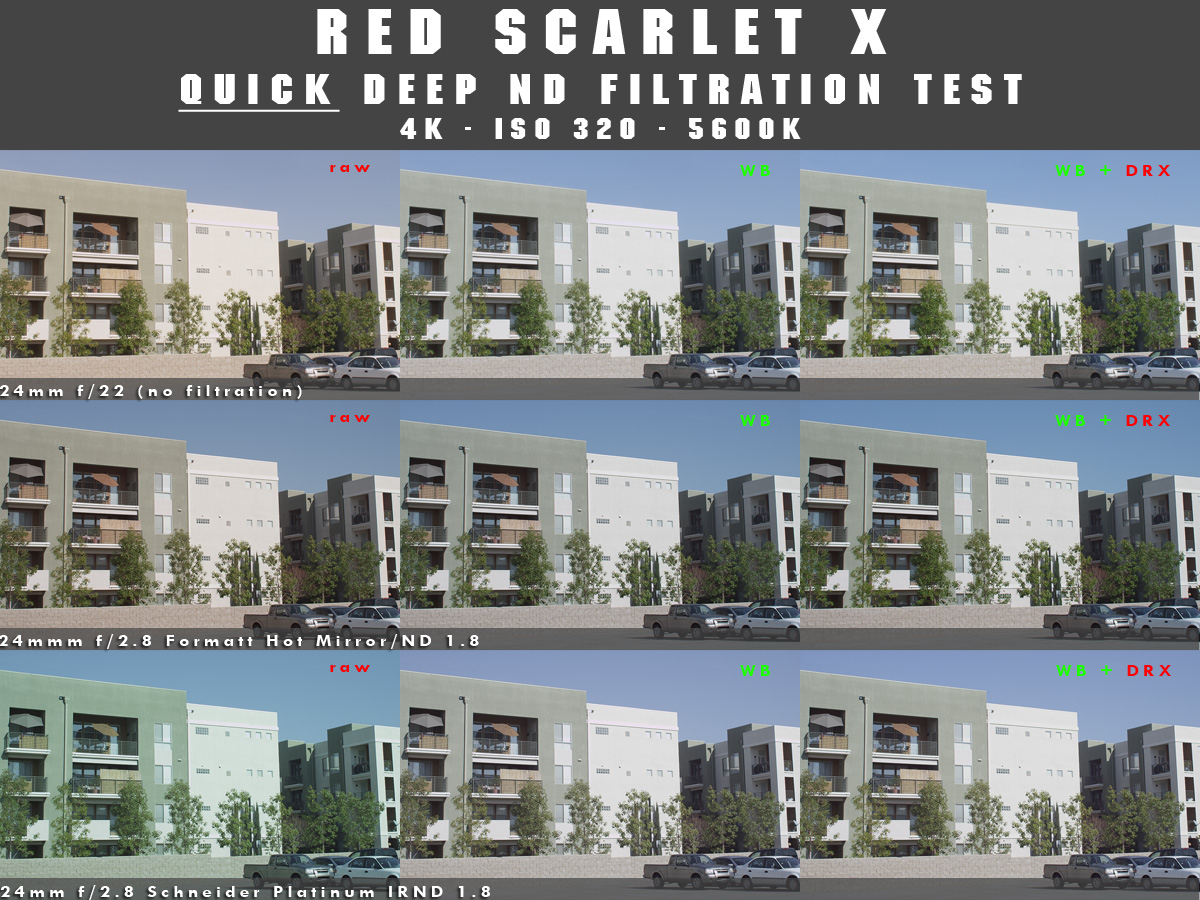
Same thoughts about Formatt HMND (Hot Mirror/ND combo filters). You can use Schneider or Tiffen and grade the difference, but Formatt appears to give me a better image. Here's my post comparing the Schneider IRND and the Formatt HMND.


Quick and Dirty Deep ND Filtration Test (Schneider Platinum 1.8 and Formatt HMND 1.8)
While running about and in between meetings I zipped over to Panavision for something else entirely. However, while I was there we did a very quick and dirty deep ND filtration test using the Schneider Platinum IRND 1.8, my Formatt HMND (Hot Mirror/ND) 1.8, and just the clean lens as a control. We jogged out into the parking lot and shot these all within a few seconds of each other. The results shocked me and I feel I may have to do more tests. Like a lot more tests. Let me show you the test image:


phfx_redScarletQuickDeepNDTest.jpg


So "raw" is just the R3D out of the camera at 5600k, ISO 320 due to bright daylight. The "WB" means I white balanced off that center building, again this was quick and dirty. The "WB+DRX" is a white balanced and DRX set to 1.0 adjustment to remove the red/pink tint. The top row is the control and was shot with just the bare lens.


So my observations of what's going on here is that the white balanced Formatt HMND is pretty damn nice, which I knew. Rich shadow detail with no color tint and that's with no DRX applied! The odd thing here, and the thing that really shocked me was that the white balanced Schneider IRND image retains so much of the pink in the highlights and there's a color cast in the sky. Another odd thing I noticed in the Schneider IRND images is that the rolloff to highlights is slightly different, almost as if it's brighter in general. The area you should pay special attention to is the white rectangular bar on that center building and also the general hue of the blue sky.


Honestly, this confused me and is causing me to recondsider everything at this point as I was going to order a set Schneiders and a new matte box this week. Now I feel I'll actually need to rent a full set and really test them under different lighting conditions to really "know" what's going on. I've got a few days to sort all this out though. Right now I'm feeling the Formatt HMND are currently the best solution, which is really not what I expected.


I have done more tests since then and feel particularly towards deeper ND filtration (past 0.9) it becomes more and more important. I recommend and use the Formatts, but the Schnieder IRNDs are again within color correction range for me.

Man. Formatt should send me a full set of 4x5.65s at this point :)
 
Hey David,

Two questions for ya...

1.) Diffusion filters v.s. diffusion in post. What are your thoughts on using diffusion to achieve a look in camera v.s. doing it all in post? I have heard several opinions on this. However, most VFX guys I speak with claim that the effects of just about every filter can now be achieved in post given today's advanced processing capability.

2.) What blue streak filter is your go-to? Considering buying one buy a company called "Optefex" Have you ever heard of this brand? Given the option I'd much rather shoot Anamorphic and get genuine flares. However, as you a probably well aware budgets do not always permit that :(

Thanks for all your advice!

Sometimes I hate the Lion OS upgrade... I was typing a long reply when my finger on the magic mouse accidentally slid me back to the previous forum page and I couldn't return to the page I was still typing on, so I lost my reply before I could post it.

We've discussed filters in camera versus in post many times, there are pros and cons both ways.

Sure, most diffusion effects can be created in post, but if it takes you a minute to monkey around on a shot trying to fine-tune the digital diffusion effect, and you have 120 shots to do that effect to, you could be adding 2 hours to your time allotted for the D.I. on a feature. In my recent work on TV, there are just too many shots and too little time to color-correct them for me to leave it all to post. Plus I want the effect visible on the set monitors and in dailies and in the offline cut, etc. And a halation caused by a filter may affect how you operate and compose the shot -- I did a fantasy song sequence recently with a net filter in front of the lens and bright spot lights coming in and out of the frame as the dolly circled around the singer and we tried to time the flares to certain moments in the song, it was all very fluid and organic, panning slightly in and out of the flare.

But if I were going to mainly shoot a feature sharp, I'd leave selective diffusion for post when I can figure out exactly where it is needed and why. That's more the cosmetic use of digital diffusion, to smooth skin, hide flaws, etc. But if I wanted a ProMist effect on every shot, I'm more likely to do it in camera, though my general rule is to use the next lighter grade filter than the one I like, because I can always increase the effect in post if I want to.

I just bought that Optefex Blue Streak filter (3mm strength), haven't tried it yet on anything.

Ugggh the dreaded mac swipe. I've done that a couple times and erased entire messages, etc. Such a stupid design! :/

Interesting rule about decreasing your diffusion by one grade than you'd normally use. Totally makes sense though.

Let me know what you think of the Optefex. Its a lot of money but if the streak is believable it might be worth it. Have you done any tests yet?? I'm wondering what makes it better than say a Tiffin 3mm streak filter?
 
Supposedly the type of blue streak filters that don't just etch lines on the glass look more natural in the flare, but I don't know if that's just marketing, but they are more expensive. Is the Tiffen streak filter just white?

Truth is that I've never used a blue streak filter before but I figured I should carry one now just in case. We do so many shots on "Smash" with lens flares due partially to the theatrical & urban environment that I'm always looking for something to enhance the flares in different ways in case I get a fantasy musical number to shoot.

Something I wrote in my longer post that got erased was that digital diffusion is the only way to get blacks to glow instead of whites, if you want that effect. And digital diffusion often smooths out or reduces noise/grain, whereas optical diffusion, because of the contrast-lowering mainly but also the texture of the filter, can make the image look a bit noisier or grainier (if film). Slightly. But I've had some issues with digital diffusion for a feature shot on film where the few post-diffused shots were now less grainy and thus didn't match the texture of the surrounding shots. This is less of an issue with digitally-shot material which is already very clean to begin with.

Of course one of the biggest advantages of doing it in post is that you can isolate the effect to select areas of the frame and track it as it moves.
 
Last edited:
Supposedly the type of blue streak filters that don't just etch lines on the glass look more natural in the flare, but I don't know if that's just marketing, but they are more expensive. Is the Tiffen streak filter just white?

Truth is that I've never used a blue streak filter before but I figured I should carry one now just in case. We do so many shots on "Smash" with lens flares due partially to the theatrical & urban environment that I'm always looking for something to enhance the flares in different ways in case I get a fantasy musical number to shoot.

Something I wrote in my longer post that got erased was that digital diffusion is the only way to get blacks to glow instead of whites, if you want that effect. And digital diffusion often smooths out or reduces noise/grain, whereas optical diffusion, because of the contrast-lowering mainly but also the texture of the filter, can make the image look a bit noisier or grainier (if film). Slightly. But I've had some issues with digital diffusion for a feature shot on film where the few post-diffused shots were now less grainy and thus didn't match the texture of the surrounding shots. This is less of an issue with digitally-shot material which is already very clean to begin with.

Of course one of the biggest advantages of doing it in post is that you can isolate the effect to select areas of the frame and track it as it moves.

Gotcha. Yeah the Tiffin is just a clear streak filter. The light sources streak to whatever color they are. I'm curious how the Optek is able to create blue streaks without coloring the rest of the image...let me know when you use it. I'm curious to see the results. Their website is kinda crummy and lacks any real good examples.
 
The more expensive streak filters embed a cylindrical glass rod or something like that, very thin, and that can be dyed a color. The higher the number, 1mm thru 4mm, the lighter the effect, though it is less about how often or dramatic the streak appears but how large it appears, the 1mm produces a bigger softer blue smear, the 4mm produces a fainter, sharper blue line (most people buy the 2mm apparently). Stan Wallace at the Filter Gallery makes some special-order ones where the blue streak only happens in one area of the filter for those people that only want the effect near the bottom third, let's say, for car headlamps, etc. I'm sure those cost even more.
 
Thanks Phil for pointing me towards the Schneider CTB filters. Will have to get some. If I were going to get only one density would the 1/4 CTB be the one to get?

IMO yes, the 1/4 CTB is the perfect compromise.

Due to the optimization that Graeme has done in the algorithm to compensate for the inherent physics of silicon/sensor profile/etc I no longer try to correct by filtration anything in the 3500 - 6500K range even with mixed light sources. Under 3000K I always pull out the 1/4 CTB, and if my lighting has weak CRI I might even pull it out at 3,200. The reason I stay away from the 1/2 CTB is that in most situations it has the potential to do more harm than good.

I have posted in the past, and if anyone can prove it unfounded please tell me why:
80 series filters have a very specific mired shift designed for the particular metrics of typical film stocks. In order to make that shift as neutral as possible 80 series filters cut more total light than is required when working with a digital sensor like RED employs. Since location shooting lit by practicals is the typical place a sub 3,200K WB is encountered I want to have as little stop loss as I can. YMMV.

Cheers - #19
 
Back
Top