Welcome to our community

Be a part of something great, join today!

  • Hey all, just changed over the backend after 15 years I figured time to give it a bit of an update, its probably gonna be a bit weird for most of you and i am sure there is a few bugs to work out but it should kinda work the same as before... hopefully :)

VistaVision and Monstro and cinematography?

But the if you get the right booster, not just one that covers FF but one that cover the whole circle of the VV lenses then it would work just the same.

You write: "Best a pocket with a Speedbooster can do is an effective f/0.74"

But thats is just due to the amount of boast, no? Going from the FF circle down to (what ever the metabones aim for) think 3/4 sensor gives you that number. If you squeeze a VV circle down to the same size then naturally you would get even faster.

Björn, there are limits to what you can do with glass, because glass has to have some amount of thickness to refract light. Once the focal point of the lens is within the lens itself, you don't have a fast lens, you have a joke lens:
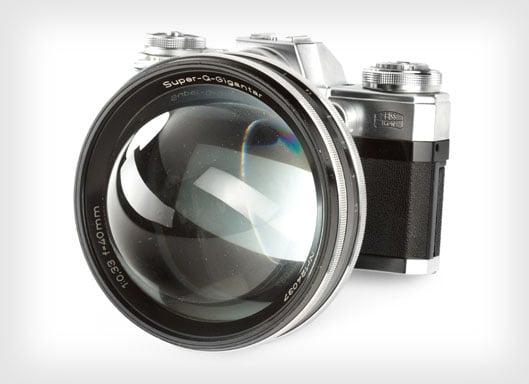
f033.jpg


The general facts of optical design are that glass lenses scale according to a cubic equation. If you have an optic that's 35mm f2 and you want to scale it by a factor of two while retaining the speed, the resulting 70mm f2 lens will have 2x the focal length and 2x the diameter, but 2x the diameter means 4x the area. And once you have that larger lens, it needs to be 2x thicker to keep the light bending the same. 2x * 4x = 8x.

What's that got to do with 35mm? Well, 35mm lenses just happen to be a sweet spot in terms of size and weight. The m43 crowd begs to disagree: they think their much smaller, lighter, and faster lenses are where it's at. And of course, one can make amazing zoom lenses for 2/3" and smaller sensors. But, for all intents and purposes, somewhere between m43 and 35mm is an ergonomic and performance sweet spot for us humans.

In the other direction, as much as we like to romanticize 2"x3" cameras (and even the mighty Speed Graphic 4x5) they had to make massive compromises when it came to lens design and options. A 135 f4.5 "normal" lens for a Speed Graphic is not exactly fast, even if it does have the bokeh of a 34mm f1.1 lens for 35mm photography. A 135 T1.5 covering a 4" x 5" image circle would be a total beast. They don't make them because they cannot. They don't make them because nobody could afford them and nobody could realistically use them.

As anybody who has played with graphing calculators knows, the cubic equation really adds up quickly. I have a 400mm f4 DO lens that I can hand-hold with a little effort. But a 1700mm f4 with a 6cm x 6cm image circle (4x the length, 4x the image circle area, and no f-stop change) requires a dedicated truck:

zeiss.jpg


Because of the rapid growth of the cubic equation, one set of practical speed/weight/cost/size optima don't easily scale much to a format 2x or larger.
 
Michael, what a brilliant post you did! Both clear/educative and pretty complex, thanks!
 
So there's definitely something to be said about nodal points in lenses. I did the same comparison I posted before with the salt shakers, but with wider lenses at a closer base distance. The closer you get, the more significant that nodal point difference becomes relevant in the conversation. There's a parallax shift because even though your camera might be in the same position, the light rays are converging at two different points in space. One lens might virtually put your camera "closer" than another.

Looking at this database, we can see that the swing for the lenses tested is 100mm in front of the lens mount to -450mm behind it. That's almost two feet of perspective shift if you were comparing perspective between the two extreme examples. That's a significant difference if you're up close to your subject.

I guess my question since we're in a discussion about large formats is this.

Do lenses designed for larger formats have nodal points which are typically further back than smaller formats? Or maybe it's a byproduct, do longer focal lengths typically have nodal points which are further back than shorter focal lengths? If either of these are true, then perhaps that's what people see in the larger formats. If true, then putting a small format and a large format in the same physical spot with equivalent focal lengths, the larger format's nodal point actually further away from the subject, which is flattening perspective.

Of course, to compensate would mean moving the smaller format back a smidge and using a slightly longer lens. But that's not intuitive when people make comparisons. So perhaps this, combined with less barrel distortion in the longer focal lengths is giving the perception of "flatness" that people are seeing with the larger formats.

And now that I'm learning all about these things, is it theoretically possible to design a lens where you could mechanically change the nodal point, thus giving your lens the ability to dolly in on a scene?
 
Michael, what a brilliant post you did! Both clear/educative and pretty complex, thanks!
That's for sure, we are lucky to have him post in reduser. I was thinking how often I reference or use something Michael has done and it was like some crazy high number per second. I think this is also one of the exceptional things about reduser, is the huge diversity of expertice we have here in the posts.
 
So there's definitely something to be said about nodal points in lenses. I did the same comparison I posted before with the salt shakers, but with wider lenses at a closer base distance. The closer you get, the more significant that nodal point difference becomes relevant in the conversation. There's a parallax shift because even though your camera might be in the same position, the light rays are converging at two different points in space. One lens might virtually put your camera "closer" than another.

Looking at this database, we can see that the swing for the lenses tested is 100mm in front of the lens mount to -450mm behind it. That's almost two feet of perspective shift if you were comparing perspective between the two extreme examples. That's a significant difference if you're up close to your subject.

I guess my question since we're in a discussion about large formats is this.

Do lenses designed for larger formats have nodal points which are typically further back than smaller formats? Or maybe it's a byproduct, do longer focal lengths typically have nodal points which are further back than shorter focal lengths? If either of these are true, then perhaps that's what people see in the larger formats. If true, then putting a small format and a large format in the same physical spot with equivalent focal lengths, the larger format's nodal point actually further away from the subject, which is flattening perspective.

Of course, to compensate would mean moving the smaller format back a smidge and using a slightly longer lens. But that's not intuitive when people make comparisons. So perhaps this, combined with less barrel distortion in the longer focal lengths is giving the perception of "flatness" that people are seeing with the larger formats.

And now that I'm learning all about these things, is it theoretically possible to design a lens where you could mechanically change the nodal point, thus giving your lens the ability to dolly in on a scene?

Nope.

try this, put on a medium format lens of any focal lenght, shoot alexa xl, monstro and and black magic pocket camera.... Picture will look different but the nodal point if the lens does not change as you change the the sensor size of camera behind it.
 
Nope.

try this, put on a medium format lens of any focal lenght, shoot alexa xl, monstro and and black magic pocket camera.... Picture will look different but the nodal point if the lens does not change as you change the the sensor size of camera behind it.

That's not what I said. I'm not talking about the same lens across different formats; the nodal point is inherent to the lens design and that will never change. I'm talking about different lenses on different formats.

Do the lenses designed for different formats have differing nodal points in any noticeable pattern? For example: Does designing a 50mm for VV typically result in a nodal point closer to/further from the imaging plane versus say a 50mm designed for S35? Or is it random?

Do different focal lengths have differing nodal points in any noticeable pattern? For example: Do longer lenses typically have a different nodal point to wider ones? Or is it random?
 
Last edited:
That's for sure, we are lucky to have him post in reduser. I was thinking how often I reference or use something Michael has done and it was like some crazy high number per second. I think this is also one of the exceptional things about reduser, is the huge diversity of expertice we have here in the posts.

If Michael makes a masterclass about optics I would love to do it.

Pat
 
I have to say, I've learned SO MUCH form this thread. And it has changed how I view optics. Thanks to all of you for sharing, and pushing.
 
Thanks, y'all! My brother is the one who actually knows about optics, as did my father. I just pay attention. A figure from my father's 25th patent:

US3532417-0.png

This looks like a projection lamp with a condenser lens. Was he getting royalties on it? It has probably expired by now.
 
That's not what I said. I'm not talking about the same lens across different formats; the nodal point is inherent to the lens design and that will never change. I'm talking about different lenses on different formats.

Do the lenses designed for different formats have differing nodal points in any noticeable pattern? For example: Does designing a 50mm for VV typically result in a nodal point closer to/further from the imaging plane versus say a 50mm designed for S35? Or is it random?

Do different focal lengths have differing nodal points in any noticeable pattern? For example: Do longer lenses typically have a different nodal point to wider ones? Or is it random?


Aha, Yes short focal lengths normally has a nodal point closer to the sensor than longer onces.

When doing moco/milo work it´s quite crucial to adjust for the nodal point. Especially when using snorkel and such then it´s not only an offset in Z but in Y aswell, so the whole rig starts to excersize from a simple roll move. Then you got the skaterscope that has a 45 deg angle and shit all of a sudden get even more crazy.

But it´s quite easy to find the nodal of a lens simply by sliding on the dove tail back and forth and pan until you have absolutely no parallax when panning. Then it´s to taste of course but ideal is something like 14 cm forward from that point. Which is about the same as your eyes is offset from your neck pan node. Something that should be done when comparing lenses which not too many people do.
 
This looks like a projection lamp with a condenser lens. Was he getting royalties on it? It has probably expired by now.

Nope: angle of incidence = angle of reflection. It's a mirror, designed to optimize efficiency of a laser cavity by allowing perfect convergence to a point even when the light source is not perfectly centered. The link to the patent is in my previous post, but also here. As an employee of GE, he never received royalties from his patents, but they compensated him well in many other ways. His most significant patent was, essentially, the CCD, independently co-invented by Bell Labs. He used to joke "they got all the papers, but we got all the patents." After his death, the Nobel Prize committee awarded the Physics prize to the living team of inventors at Bell Labs for this invention. But he also invented many other things, spanning a wide range of applications.
 
There's an additional "thing". I'm working on something to explain it and it's hard to explain. AOV is easy to match if you are just looking at side by sides, and certainly one thing is just how different focal lengths draw, but there's another allure to large format cinematography.

I think larger sensors mean we can have proportionately better optical performance from equivalent shorter focal lengths. In other words to achieve the same AOV (Angle of view) we can use (off the shelf) lenses (assuming appropriate lens choice), that have superior Modulation Transfer Functions (MTFs), higher resolution and contrast across the whole frame. Building to a combined system MTF* that is overall superior. [as compared to having to put much shorter focal length glass to much smaller sensor sizes and formats].

What does that look like?

If need be, (depending on desired effect/"look"), spookily well resolved image detail (edge to edge) with amazing color depth/density and dynamic range. [Seems Monstro's VV extra photo sites are helping there].

Doubly spooky, is that one normally ONLY experiences that with still images... (with a few rare exceptions), So to see that level of (larger format) still quality actually MOVING, is really something else.

Very immersive and compelling effect overall.

I think Phil made the point earlier that a lot of these things are best viewed on UHD monitors and the like.

-----> Separate note the impression I get from Monstro VV (so far) and some of the work that Phil has thrown out there and others (with the Otus lenses/ special glass) that it seems very reminiscent of Ektachrome... In a good way. Digital Ekatchrome... (+ Phil's grading :-) ).

_____________________________________________________________________________________________________________________________________________________________________________________________


On a personal note for technical work it is frustrating to try and find high quality wide angle lenses for a smaller format (of the order of 20 mm or smaller (horizontally)... Having sensors to match lenses to that are of the order of 40mm to nearly 60 mm is a dream by comparison (especially if you need AOVs between 90 and 120 degrees).

____________________________________________________________________________________________________________________________________________________________________________________________


* This has been my "Goto" for explanation of MTFs http://leutikabooks.com/books/85075...n-in-optical-and-electro-optical-systems.html

"Modulation Transfer Function In Optical And Electro-Optical Systems" by Glen D Boreman.

It's a good reference even if you are not a mathematical genius or "whiz" at Physics... There is some math in there but it is all really well explained even if you are a non-mathematician/physicist. (Good diagrams and explanations).

^^^ It seems you can down-load it for free now... (nice) [No affiliation ].
 
Not neccessarily. S16 lenses have traditionally been sharper wide open than 35mm lenses because the image circle is smaller. It's difficult to design a very sharp lens with big image circle.
It is much easier to design very sharp lens with smaller image circle. The extreme precision over large glass surfaces that is required for hi performance large image circle fast lenses gets low yields that make the cost and lead time huge hurdles.
Just ask Angenieux and Leica.
 
Regarding precision:

One might argue that the precision of the small surface for a 16mm imager would by necessity require greater attention as a smaller piece of imager real estate is used to make a greater percentage of the viewable area. Resolution with the smaller imager would require higher MTF performance because you would have less film “grains” or photosites to Resolve a Target.

One could ostensibly resolve 8K on a larger sensor with lower tolerance control on the glass... of course if you’re trying to resolve higher resolution across the board with a high density “future proof” 16k vistavision format you would again need higher tolerances.

Naturally there are trade offs.

An 8K vistavision sensor would require less MTF performance than an 8K super 16 format sensor just to resolve the same image - this is part of what I meant by density.

Density, contrast, and MTF are all directly related.
 
Back
Top