Welcome to our community

Be a part of something great, join today!

  • Hey all, just changed over the backend after 15 years I figured time to give it a bit of an update, its probably gonna be a bit weird for most of you and i am sure there is a few bugs to work out but it should kinda work the same as before... hopefully :)

VistaVision and Monstro and cinematography?

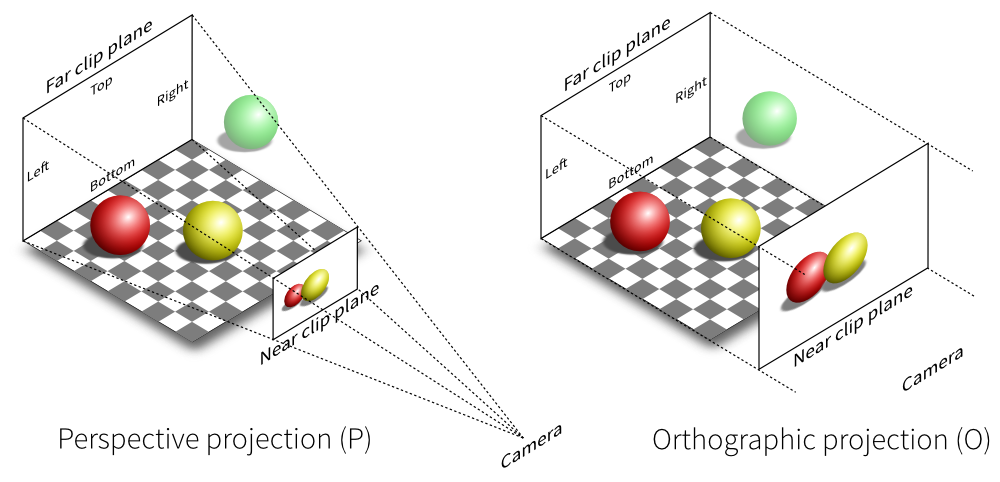
Show us the salt shaker with a non-orthographic shot.

It's already not orthographic. An orthographic view would be a parallel projection, which would show both shakers the same size regardless of distance between them because a parallel projection rejects perspective.
projection.png


I would need to use a telecentric lens to show you an orthographic image, or a close enough approximation would be to get my camera as far away as possible, neither of which I did.
 
Haha that's a nice spin. You are showing distortion numbers for a 35mm format lens and apply them to 16mm frame? These numbers do not apply nfortunately. The distortion changes as you change the radius . Not to mention the fact that whether is .5% or 2% distortion it has zero effect on face features. I suspect you will not see that difference at all.
BTW I heard CNN was hiring haha...

Using distortion for full frame glass is relevant because in the case of Monstro, it's the type of glass many RED users own (something I know you're well aware of).

For us RED owners, its valuable information to know Monstro will encourage us to use more of our lenses with the least amount of distortion.
 
Well I've projected thousands of lenses

Not to mention the fact that whether is .5% or 2% distortion it has zero effect on face features. I suspect you will not see that difference at all.
BTW I heard CNN was hiring haha...

That's so very odd because so much is visible in the .1% through .8% typical range of distortion between wides and teles that will make or break a lens as a CU option. I mean, don't tell anybody who prefers Cooke S4s or Leica Summilux-Cs that basically as they are on both spectrums of that camp. Not to mention general rectilinear geometric reproduction across a set of primes or within a zoom range.

I will agree you are correct about the radius in relationship to distortion, but don't minimize the effect of distortion on a captured subject matter. Lenses can live or die by that. It is each unique lens design that results in the final distortion number, there is not "general" wides are always 2%, and that's what should be noted. You can have a highly correct lens set for instance.

And on a side note in relationship to projection it's great to see, measure, and locate potential issues with lenses. However, you are always dealing with a two dimensional subject versus the more revealing concept of having a scene with three dimensional depth. Specifically if you take into account foreground, mid subject, and background rendering. Which is rather important in relationship to the original topic and indeed plays a role in VV capable and designed for optics.

To the original topic and many are on the right path of general FOV in relationship to what becomes your standard focal lengths for each format, it is indeed that variation in the focal lengths, lens designs, and how they draw to that specific format that play a massive role. Yedlin's examples show that, though it's not discussed much, and I'm working on something that discusses it further. Likely done this week.
 
Last edited:
Vista Vision
Normal lens is a 50mm
Distortion of Milvus 50mm Macro (highly regarded too):0.5%

And what if you chose to use the 50mm 1.4 instead, which has ~1.5% distortion? Do we suddenly lose the magic of the large format? Is it only "VistaVision" if we have totally rectilinear images?

Also, you're totally forgetting that the crop is gonna negate some distortion. Reread those charts, image height U' is distance from center on the image circle.

S16mm format has a 14.5mm image circle, so the radius is ~7mm, so the distortion on the 15mm f2.8 is showing ~0.33% distortion.
S35mm format has a 28.5mm image circle, so the radius is ~14.25mm, so the 35mm f1.4 is showing ~1% distortion.
VV format has a 46mm image circle, so the radius is 23mm which is off the chart, but at least 0.75% distortion on the 50mm macro where the chart stops.
65mm 5-perf has an image circle of 57mm, and Alexa 65 needs a 60mm image circle, so a 30mm radius is not even possible with that lens so that's pointless to look at. But even if you eyeballed it you could see it was well on it's way to approaching 1% by 30mm.

So hopefully we can agree how silly this is, since the Super 16mm scenario just proved to be the one with the flattest distortion.

Also worth discussing, check out the Ultra Prime 8R for S35. It's wonderfully rectilinear if that tickles your fancy.

And is barrel distortion such a bad thing in the end?

latest


medium-shot.jpg


La-La-Land-Emma-Stone-and-Ryan-Gosling-1307x500.jpg


33f9c50dff1f93d47e7e636d550a5045.png


I personally don't get the feeling that when an image has some distortion that it feels like a lesser format. Consequently, I don't feel like an image without distortion feels larger, either. I think they are different ways to represent the same perspective. And each one is valid.

Very much looking forward for Phil's thoughts.
 
And what if you chose to use the 50mm 1.4 instead, which has ~1.5% distortion? Do we suddenly lose the magic of the large format? Is it only "VistaVision" if we have totally rectilinear images?

Also, you're totally forgetting that the crop is gonna negate some distortion. Reread those charts, image height U' is distance from center on the image circle.

S16mm format has a 14.5mm image circle, so the radius is ~7mm, so the distortion on the 15mm f2.8 is showing ~0.33% distortion.
S35mm format has a 28.5mm image circle, so the radius is ~14.25mm, so the 35mm f1.4 is showing ~1% distortion.
VV format has a 46mm image circle, so the radius is 23mm which is off the chart, but at least 0.75% distortion on the 50mm macro where the chart stops.
65mm 5-perf has an image circle of 57mm, and Alexa 65 needs a 60mm image circle, so a 30mm radius is not even possible with that lens so that's pointless to look at. But even if you eyeballed it you could see it was well on it's way to approaching 1% by 30mm.

So hopefully we can agree how silly this is, since the Super 16mm scenario just proved to be the one with the flattest distortion.

Also worth discussing, check out the Ultra Prime 8R for S35. It's wonderfully rectilinear if that tickles your fancy.

And is barrel distortion such a bad thing in the end?

latest


medium-shot.jpg


La-La-Land-Emma-Stone-and-Ryan-Gosling-1307x500.jpg


33f9c50dff1f93d47e7e636d550a5045.png


I personally don't get the feeling that when an image has some distortion that it feels like a lesser format. Consequently, I don't feel like an image without distortion feels larger, either. I think they are different ways to represent the same perspective. And each one is valid.

Very much looking forward for Phil's thoughts.

Aaron good point about the distortion of Milvus glass being less visible on a s16 crop /frame. Totally concede that.

Also - I'm not saying Vista is the better format, overall, that wouldn't be fair. S35 seems like the ideal ratio of depth falloff, speed of lens, and focusability.

S16 is superb for doc work, as the glass is so much smaller, in particular the zooms, that can weigh 3-4lbs, and have 10x zoom ratios.

And Large Format has it's downsides. Sometimes there is too much fall off (making it harder to know where you are at times), and obviously holding focus becomes increasingly more difficult.

And yes by the way that 50 1.4 does have above average distortion, but it's based on a very old (Contax) design and won't be as corrected as newer designs. Notice the Otus 55 is much more corrected, as I'm assuming is the Sigma Art, and the new Tokina.

And my other point still stands. For RED users who've been using full frame glass already on Helium/Dragon, get ready to start seeing less disortion on a day-to-day level as you start to move up a slot in your primes, and your 50mm is now your normal.
 
Last edited:
That's so very odd because so much is visible in the .1% through .8% typical range of distortion between wides and teles that will make or break a lens as a CU option. I mean, don't tell anybody who prefers Cooke S4s or Leica Summilux-Cs that basically as they are on both spectrums of that camp. Not to mention general rectilinear geometric reproduction across a set of primes or within a zoom range.

I will agree you are correct about the radius in relationship to distortion, but don't minimize the effect of distortion on a captured subject matter. Lenses can live or die by that. It is each unique lens design that results in the final distortion number, there is not "general" wides are always 2%, and that's what should be noted. You can have a highly correct lens set for instance.

And on a side note in relationship to projection it's great to see, measure, and locate potential issues with lenses. However, you are always dealing with a two dimensional subject versus the more revealing concept of having a scene with three dimensional depth. Specifically if you take into account foreground, mid subject, and background rendering. Which is rather important in relationship to the original topic and indeed plays a role in VV capable and designed for optics.

To the original topic and many are on the right path of general FOV in relationship to what becomes your standard focal lengths for each format, it is indeed that variation in the focal lengths, lens designs, and how they draw to that specific format that play a massive role. Yedlin's examples show that, though it's not discussed much, and I'm working on something that discusses it further. Likely done this week.
If you are after low distortion there are lenses for that in every format. The depth o field is what separates the planes. Everything else is all about one's size compared to another's as much in life is all about. BMPCC and Monstro can create identical images geometrically. With the speed booster maybe even shallow DOF identicall given the right conditions ....
 
I am thoroughly enjoying this technical talk about lenses and formats but remember it is about telling a story visually. My friend Matty Labatique does amazingly visual work in Super 16 (Black Swan and Mother) while Richardson does equally great work in 65mm.

It is all about how we help the director tell a story visually whether it is through format, lens choice, lighting or a combination of all of the above.
 
Amen to that. Lets not forget it is 90% the artisan and 10% the tools
 
I am thoroughly enjoying this technical talk about lenses and formats but remember it is about telling a story visually. My friend Matty Labatique does amazingly visual work in Super 16 (Black Swan and Mother) while Richardson does equally great work in 65mm.

It is all about how we help the director tell a story visually whether it is through format, lens choice, lighting or a combination of all of the above.

Amen to that! And it's funny that you use Black Swan as an example, because that was the film that permentately stamped this idea into my head!!!

P.S. If you don't mind, the next time you see Mr. Libatique, please pass on my deepest thanks!!!!

P.P.S. This has been an absolutely fascinating technical discussion! Thank you everyone for sharing your wisdom, and I look forward to learning more when Phil releases his findings!
 
BMPCC and Monstro can create identical images geometrically. With the speed booster maybe even shallow DOF identicall given the right conditions ....

Yes, but Monstro can get shallow DOF much more easily, under normal conditions, even outside - so you're much more likely to see this effect.

On BMPCC, you'd prob need to be at 1.2 with a speedboster, which creates several problems: the first is the speedbooster itself inserts optical anomalies, and the second is that with the speedboster you are now at a T1, which is A LOT OF LIGHT under normal circumstances. Shooting at T1 outside would require enormous amounts of ND that presents other optical problems. Whereas Monstro even at a 2.8 or 4 with a long lens gets you there easily, both inside and outside.

Again, we're talking about difference btw theory and practice.

Theoretically, BMPCC can get you there sure.

But in practice, Monstro/VV gets you there basically just by turning the lights and camera on.

Amen to that. Lets not forget it is 90% the artisan and 10% the tools

Yes agreed! The ART is paramount, and always is, but the TOOLS also help...and shouldn't be under-estimated.

There's a reason there isn't a massive market for s16 digital cameras.
 
Last edited:
The reason is IQ and costs- everyone knows that ;-)

Not sure I follow?

A new blackmagic micro is $1,300, and shoots 4K...so clearly s16 tech is making huge strides and is quite affordable, and yet is still not that popular (as opposed to the A7 Full Frame platform, which sells like hotcakes, and is't that much more expensive: an A7 II is $1,500 ).

On the flip side, I do think Helium @ 4K/5K is a pretty great S16 option, however that's far more expensive...and again...few people seem to have any interest (at least on these boards, which is full of Helium users).
 
Sorry to be annoying ... but...

Do we know that your 50mm and 100mm lenses are not near telecentric designs?

No, there's a difference. You might be thinking of sensor-side telecentric lenses which reduce the oblique ray angles hitting the sensor, to reduce problems like color vignetting. I'm talking about object-side telecentric lenses.

working-of-tc-lens.jpg


1710VSD_PF_F2.jpg


You can see because the light rays coming from the object are parallel, it removes all sense of perspective and will show you a cross-section type image. Things the same size will look the same size regardless of distance.

The Zeiss Contax aren't object-side telecentric. You would have no perspective or leading lines, I don't think artists would find that very useful for most situations. Telecentric lenses are more for machine vision applications where measurements need to be taken off of the recorded images and parallax error and perspective needs to be eliminated from the equation.
 
Not sure I follow?

A new blackmagic micro is $1,300, and shoots 4K...so clearly s16 tech is making huge strides and is quite affordable, and yet is still not that popular (as opposed to the A7 Full Frame platform, which sells like hotcakes, and is't that much more expensive: an A7 II is $1,500 ).

On the flip side, I do think Helium @ 4K/5K is a pretty great S16 option, however that's far more expensive...and again...few people seem to have any interest (at least on these boards, which is full of Helium users).

Of course if one has the choice they would pick FF sensor. Everyone knows that, too. Pretty obvious. The virtues of free market at work.
 
BMPCC and Monstro can create identical images geometrically. With the speed booster maybe even shallow DOF identicall given the right conditions ....

Given the right conditions, sure. But if you're using the Tokina VistaVision Primes wide open at T1.5 on Monstro, forget it. For the 18 through 85mm set at T1.5, you'd need a set of 5.5-26mm at T0.46 (either naturally or after using the booster) to have the same FoV and DoF.

Best a pocket with a Speedbooster can do is an effective f/0.74 with an f/1.2 lens in front, which is equivalent DoF (with equivalent focal lengths) to S35 at f/1.5, Dragon at f/1.8, Monstro at f/2.4, and Alexa 65 at f/3.2. Which is no slouch, but even shallower is easily possible on all the other formats, if that's what you're aiming for.
 
Given the right conditions, sure. But if you're using the Tokina VistaVision Primes wide open at T1.5 on Monstro, forget it. For the 18 through 85mm set at T1.5, you'd need a set of 5.5-26mm at T0.46 (either naturally or after using the booster) to have the same FoV and DoF.

Best a pocket with a Speedbooster can do is an effective f/0.74 with an f/1.2 lens in front, which is equivalent DoF (with equivalent focal lengths) to S35 at f/1.5, Dragon at f/1.8, Monstro at f/2.4, and Alexa 65 at f/3.2. Which is no slouch, but even shallower is easily possible on all the other formats, if that's what you're aiming for.

But the if you get the right booster, not just one that covers FF but one that cover the whole circle of the VV lenses then it would work just the same.

You write: "Best a pocket with a Speedbooster can do is an effective f/0.74"

But thats is just due to the amount of boast, no? Going from the FF circle down to (what ever the metabones aim for) think 3/4 sensor gives you that number. If you squeeze a VV circle down to the same size then naturally you would get even faster.
 
But the if you get the right booster, not just one that covers FF but one that cover the whole circle of the VV lenses then it would work just the same.

You write: "Best a pocket with a Speedbooster can do is an effective f/0.74"

But thats is just due to the amount of boast, no? Going from the FF circle down to (what ever the metabones aim for) think 3/4 sensor gives you that number. If you squeeze a VV circle down to the same size then naturally you would get even faster.

I guess, theoretically, yeah. But I'm just going off of what Metabones is saying about their product. I don't know exactly what the design limitation is there. But that's what they're saying about the BMPCC specific booster. Does something exist for S16 formats that can take a VV image circle and allow faster than f/0.74 effective aperture?

This is as much a discussion of what's theoretically possible and what's realistically available for end users. VV is probably the easier way, even at an $80K+ entry point. I don't see companies bothering to make the necessary lenses/boosters for that kind of speed on S16. I'm sure the price point would be far outside what is a consumer camera/format, therefore not marketable.
 
Last edited:
I guess, theoretically, yeah. But I'm just going off of what Metabones is saying about their product. I don't know exactly what the design limitation is there. But that's what they're saying about the BMPCC specific booster. Does something exist for S16 formats that can take a VV image circle and allow faster than f/0.74 effective aperture?

This is as much a discussion of what's theoretically possible and what's realistically available for end users. VV is probably the easier way, even at an $80K+ entry point. I don't see companies bothering to make the necessary lenses/boosters for that kind of speed on S16. I'm sure the price point would be far outside what is a consumer camera/format, therefore not marketable.


I think the point is. The bigger the image circle the slower the lens. Then what booster and fast lenses are available is more about whats in demand. 35mm has been a standard for quite some time. It´s due to the resolving power of celluoid film and the cost of it. 35mm was used in film cameras and it turned out to be convenient to use the same but in horisontal mode for still cameras. Then sure there where other formats large and small both for film and still cameras. But the bulk of good, fast and well priced glass has been built for the high demand of 35mm format as there is a lot of many cameras in circulation that has a format fitting for it.

Then sure a large format lens is easier to make without diviations as the tolerances becomes smaller the bigger lens you build but you loose in speed when the circle gets bigger.

The above is simply the reason why you not find any super speed large format glas.


VV is as big as it gets before you get out of the zone of FF 35mm lenses. The Tokinas are actually built for sensors bigger than monstro. So they could be faster and probably resolve better resolution if they where specifically built for monstro sized sensors but they decided to aim beyond FF35, which I think is vice.
 
Back
Top