

- Banned
- #1,241

Pawel Achtel
Banned
- Joined
- Oct 12, 2007
- Messages
- 3,648
- Reaction score
- 0
- Points
- 0
- Location
- Tasmania
- Website
- www.achtel.com
The best advice I can give to keep the shots steady is to balance your camera, good diving skills and lots of experience.
With experience (and thousands of dives), you will feel the water and its movements and feel a part of it, relaxed and making predictable and controlled camera movements. It is about feeling the water with your entire body and aligning yourself to the current and surge almost like fish do.
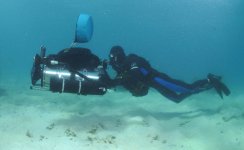
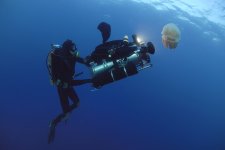
I like using a custom made BCD to balance my housing to the desired buoyancy and trim. I haven't seen anyone else doing this.
Some film makers like using tripods underwater. I personally don't like them. I like slow and steady camera movements giving perception of depth and space. For example, here are some of my favourite shots I took: https://vimeo.com/29346689
Footage shot with fish-eye lenses appears more steady than with rectilinear lenses because of the compression of space on the edges. For this and other reasons it has been the preferred choice by many. I personally do not like the fish-eye look particularily when associated with camera movement. I would use fish-eye sparingly as a specialty lens, not as the main lens.
Some film makers use extreme (more than 100 degrees) wide angle lenses to reduce perception of shaky camera. My personal preference for motion picture is a narrower field of view (80 - 90 degrees) allowing for extended smooth pans and revealing camera movement rather than trying to get everyting in the frame at once. I think it is more interesting, but harder to keep it steady.
I never stabilised any of my underwater footage in post. I pay big attention to stability of shots because of the effect that it has on the perception on the large screen. Large housing can help, but even with a small housing, like DeepX, and heavy surge you can still get nice long and steady shots (example: https://vimeo.com/44598489 ).
BTW, you can always make small housing into a big one by strapping big lights, scuba tank or a scooter to it. You can't make big housing smaller.



 hmy: