Welcome to our community

Be a part of something great, join today!

  • Hey all, just changed over the backend after 15 years I figured time to give it a bit of an update, its probably gonna be a bit weird for most of you and i am sure there is a few bugs to work out but it should kinda work the same as before... hopefully :)

Underwater Bubble Blowers User Group Thread NEW

Status
Not open for further replies.
The best advice I can give to keep the shots steady is to balance your camera, good diving skills and lots of experience.

With experience (and thousands of dives), you will feel the water and its movements and feel a part of it, relaxed and making predictable and controlled camera movements. It is about feeling the water with your entire body and aligning yourself to the current and surge almost like fish do.

I like using a custom made BCD to balance my housing to the desired buoyancy and trim. I haven't seen anyone else doing this.

Some film makers like using tripods underwater. I personally don't like them. I like slow and steady camera movements giving perception of depth and space. For example, here are some of my favourite shots I took: https://vimeo.com/29346689

Footage shot with fish-eye lenses appears more steady than with rectilinear lenses because of the compression of space on the edges. For this and other reasons it has been the preferred choice by many. I personally do not like the fish-eye look particularily when associated with camera movement. I would use fish-eye sparingly as a specialty lens, not as the main lens.

Some film makers use extreme (more than 100 degrees) wide angle lenses to reduce perception of shaky camera. My personal preference for motion picture is a narrower field of view (80 - 90 degrees) allowing for extended smooth pans and revealing camera movement rather than trying to get everyting in the frame at once. I think it is more interesting, but harder to keep it steady.

I never stabilised any of my underwater footage in post. I pay big attention to stability of shots because of the effect that it has on the perception on the large screen. Large housing can help, but even with a small housing, like DeepX, and heavy surge you can still get nice long and steady shots (example: https://vimeo.com/44598489 ).

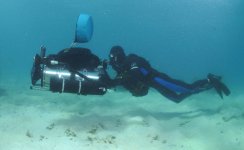
BTW, you can always make small housing into a big one by strapping big lights, scuba tank or a scooter to it. You can't make big housing smaller.
 

Attachments

  • _FFS0494.jpg
    _FFS0494.jpg
    83 KB · Views: 0
  • _FFS2969.jpg
    _FFS2969.jpg
    87 KB · Views: 0
Thanks for taking the time Pawel. i wish i had your housing and the epic for these shoots, i don't like the fisheye look of the go pro either, not sure what my ideal FOV is yet, time will tell. What i love is how the light dances off the surface, there is a whole world of wonder where men don't breath, if you take the time to find these places and explore, they change you.

i love my time on the surface and i love to disappear into the blue when i get a chance. Finally, i love to share this place so few see. Working on holding my breath at least 1 minute, underwater i struggle to stay down 20 seconds so far.


The best advice I can give to keep the shots steady is to balance your camera, good diving skills and lots of experience.

With experience (and thousands of dives), you will feel the water and its movements and feel a part of it, relaxed and making predictable and controlled camera movements. It is about feeling the water with your entire body and aligning yourself to the current and surge almost like fish do.

I like using a custom made BCD to balance my housing to the desired buoyancy and trim. I haven't seen anyone else doing this.

Some film makers like using tripods underwater. I personally don't like them. I like slow and steady camera movements giving perception of depth and space. For example, here are some of my favourite shots I took: https://vimeo.com/29346689

Footage shot with fish-eye lenses appears more steady than with rectilinear lenses because of the compression of space on the edges. For this and other reasons it has been the preferred choice by many. I personally do not like the fish-eye look particularily when associated with camera movement. I would use fish-eye sparingly as a specialty lens, not as the main lens.

Some film makers use extreme (more than 100 degrees) wide angle lenses to reduce perception of shaky camera. My personal preference for motion picture is a narrower field of view (80 - 90 degrees) allowing for extended smooth pans and revealing camera movement rather than trying to get everyting in the frame at once. I think it is more interesting, but harder to keep it steady.

I never stabilised any of my underwater footage in post. I pay big attention to stability of shots because of the effect that it has on the perception on the large screen. Large housing can help, but even with a small housing, like DeepX, and heavy surge you can still get nice long and steady shots (example: https://vimeo.com/44598489 ).

BTW, you can always make small housing into a big one by strapping big lights, scuba tank or a scooter to it. You can't make big housing smaller.
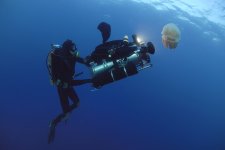
 
I used this marshal Monitor last december....it's an excellent monitor, small compact, but is realy nice to have larger monitor to make alignments like the transvideo

The monitor housing is for field work. You can align the cameras in the studio using large moniotor and you do not need a housing to do it. The advantage of having a small moniotor, which can also re-clock and multiplex two HD signals, is that it is more portable and does not require a crane to lift it. I would see it as an advantage in all situations except maybe impressing the girls.

Aligning cameras in the ocean on a small monitor is complete and utter waste of time. If you have not aligned your cameras beforehand, it is relatively easy and routine process to do so in the post. Particularily when you are dealing with full 5k footage that is not crippled by severe CA and distortions produced by a flat port.

At $140,000 3Deep is far more expensive than what I have invested in and far less capable when it comes to adjusting stereo perimeters IA and convergence.....am I missing something? Smarter, better cheaper????? I don't see how you can adjust focus and iris at the same time let alone access the controls efficiently?

I didn't know that Deep Atom + Atom Beam Splitter + Lenses + motors, etc... all cost significantly less than $140k. The design of housing for the Solido cost $3m and about $300k to make it. But, the real cost is in setup time, transport, post production corrections, crew and logistics that would be associated with such complex and heavy rig.

And, besides, how do you know 3Deep costs $140k?

How do you you know how much is dual DeepX with a Wet Beam splitter?

Firstly, I wouldn't call terrestial convergence control in a housing with a flat port a convergence control. I would call it a variable Chromatic Aberration control allowing the operator to make an adjustment from "Extreme" to "Even Higher" because this is exactly what it will do to the image from behind a flat port. The fact that you can adjust convergence does not mean that it is a sensible thing to do and the asymetric distortions and severe CA associated with converging behind a flat port are not just a problem, they are an expensive and silly mistake.

Secondly, a housing that is not capable of resolving even standard definition across the entire sensor (because of the limitations of a flat port) does not offer me the opportunity to produce sharp images regardless whether my focus control is positioned at the back or the front of the housing. It is not going to produce sharp images doesn't matter what you adjust or how.

Thirdly, I find a housing that I can't lift on my own, take on a plane or put in a Zodiac and handle it in the field, greatly limiting in the type of footage that I can get. I think mobility is a key in obtaining animal behaviour and sequence work.

When I go on a boat or get into the water I want to focus on getting the footage by getting to the location and follow the action, not setting up or lugging large amount of heavy equipment.

The focusing on 3Deep is quite easy and accurate. There is an optional device that can be installed to lock the focus of the two lenses however, I do not often find the need for added complexity for the rare occasion when I would actually need to pull the focus during the shot underwater.

As I said in previous posts your rig might be suitable for big wide establishing shots complimenting other rigs so it is not in your best interests to bag those rigs which might be complimentary to what you are doing. As for your wet beam splitter rig... vapour until you actually have a unit and prove it can work. You keep negatively critiquing "The Last Reef 3D" but these guys have actually gone out and produced for the big screen. "Aliens of the Sea" had no storyline what so ever but people have been very kind to you over the years. Before you set yourself up as the know it all oracle of everything to do with underwater cinematography you might carve out a credit list or films you have actually produced and not just musical wall paper.

How is Aliens of the Sea (which actually has won several prestigious internaltional awards at the time) that I shot over 12 years ago related to the benefits of the housings that I currently offer to the filming community? The fact is that you don't really know what I shot or produced in the past decade.

I'm not sure what films John Ellerbrock or Michael Hastings produced recently, but I do know that it is completely irrelevant to the argument.

What I do see, however, are real problems associated with 3D underwater film making:
- Poor optical performance not able to resolve even standard definition quality across the entire sensor
- Severe distortions making it difficult for the brain to fuse two 3D images
- No wide angle capability when using flat port
- Loss of light, reflections and ghosting when using a beam splitter
- Huge weight and size making it costly and difficult to transport and obtain footage in the field
- Unnecessary complexity and time needed to setup the rig and break it down
- Drag in the water and difficulty to control the movements of the housing

All the above I see as much more fundamental problems than a fixed IA, which film makers used for decades with excellent results. And, if it is still limiting, there is dual DeepX with Wet Mirror for macro and CU. It is all about using the right tools for the right application.
Precision machined Titanium is expensive, but this is why we could make a 3D housing that weighs less than 14.5kg and one that can offer about 50 times the corner sharpness of the housing that you are using.

All I'm trying to do is to offer and suggest solutions to real problems and limitations that manufacturers ignored or were not able to solve to this date. I'm excited that for the first time in the history of motion picture we can make sharp and undistorted pictures underwater. This was never possible before with any housing or recording medium, not even in IMAX!.

And this is what motivates me.
Post #3000 :thumb_postwhore:
 
Re your quote 10th March 2012 "The final price of the complete unit is $140k plus taxes."

Firstly, this is not the price that I offered to you in the email. It is false, misleading and inappropriate for you to quote a different amount than that I actually offered to you.

Secondly, Did the email that you referred to also contain the following text?

Email Confidentiality
This message is for the named person's use only. Privileged / Confidential Information may be contained in this message. If you are not the addressee indicated in this message (or responsible for delivery of this message to such person), you may not copy or deliver this message to anyone. If you receive this correspondence in error, please immediately delete it from your system and notify the sender. You must not disclose, copy or rely on any part of this correspondence if you are not the intended recipient. Internet communications are not secure and therefore we do not accept legal responsibility for the contents of this message.
 
My point is Pawel your system will compliment other rigs which can do close ups and medium shots I think the 2 systems could work together.
 
The monitor housing is for field work. You can align the cameras in the studio using large moniotor and you do not need a housing to do it. The advantage of having a small moniotor, which can also re-clock and multiplex two HD signals, is that it is more portable and does not require a crane to lift it. I would see it as an advantage in all situations except maybe impressing the girls.

Aligning cameras in the ocean on a small monitor is complete and utter waste of time. If you have not aligned your cameras beforehand, it is relatively easy and routine process to do so in the post. Particularily when you are dealing with full 5k footage that is not crippled by severe CA and distortions produced by a flat port.

Aren't most of us shooting either from a boat or boat based or usually in the field? Where will anyone align cameras in a studio when on location? You sort of lost me on that post. In fact i was just on a job in Antarctica shooting 3d using that martial monitor and it has NO WHERE the capability of the Transvideo monitor---Larger indeed, but when you go to align cameras every morning....it's far superior than the Martial and more reliable---This is not to take anything away from the Martial...but it's just if you are choosing one over the other---well, hands down you'll be far more reliable and capable using the larger Transvideo.
 
Ross, i'm not at all sure how a side by side rig with 2.5" IA or IO can benefit or compliment work with another rig these days---Reality is where is a budget so big to have two 3d rigs on set? .....Sell that one to a producer....so your convergence is at what? 15' or more? and fixing everything in post is not what anyone usually wants to hear. But how do you get closer convergence or do you?
 
Aren't most of us shooting either from a boat or boat based or usually in the field? Where will anyone align cameras in a studio when on location? You sort of lost me on that post. In fact i was just on a job in Antarctica shooting 3d using that martial monitor and it has NO WHERE the capability of the Transvideo monitor---Larger indeed, but when you go to align cameras every morning....it's far superior than the Martial and more reliable---This is not to take anything away from the Martial...but it's just if you are choosing one over the other---well, hands down you'll be far more reliable and capable using the larger Transvideo.

You do not need to get wet in order to align lenses in a 3D underwater rig. Just hook up a standard (not housed) monitor externally to your housing. There is no need for a monitor housing to do so.

You may be confusing lens alignment with measuring the amount of parallax on the screen, which you need to assess during the actual filming. This can be very easily done with magnification on the camera and/or on the monitor itself. It is quite easy and very well implemented in the Marshall OR-70-3D.

I'm sure Transvideo is a good monitor. In particular, I like the higher brightness that it offers and this was an important consideration for me. However, on balance, I have decided that the smaller size and weight would be more important for me. Particularily for rigs like 3Deep or dual DeepX with Wet Mirror, which are very light weight and facilitate mobile production far better than other offerings.

It may not make much difference on a 400kg (?) housing, but the advantages of being able to shoot 3D with a highly portable rig that is even lighter and smaller than many single camera housings, made me lean towards the Marshall. Again, it is all about choices and I'm just offering another choice to those that would find it useful.

There is no one monitor that is best for all scenarios. Far from it.

In my view, having an option of a smaller and lighter 3D monitoring underwater that also offers re-clocking and multiplexing out of the same box, is a valuable and useful addition. Also, glasses-free 3D operation and ultra-high resolution of the Marshall are very useful as a client or producer monitor on a wet set. That's all it is: an option. It is a better option for me, it may be different for you and someone else may like to have both depending on the specific requirements.

I intentionally did not want to make another housing for a Transvideo monitor because there is another company that already made one.

As to the reliability, what actual failures did you encounter with Marshall OR-70-3D monitor? What experience did you have with both to make a conclusion that one is more reliable than the other? I have not encountered any problems with mine.
 
I don't believe i mentioned anything about getting wet to align and setup lenses.

Then you do not need a monitor housing. You can use any size monitor you like. I don't sell monitors. I'm offering a housing for the Marshall OR-70-3D, which I think is an attractive alternative or addition to the Transvideo housing made by Gates. I can't see how this wouldn't be a good thing.
 
Pawel I am looking at a second focus monitor for Deep Atom soon when will your Marshall housing be ready?
 
For the Marshall OR-70-3D monitor housing I expect the lead time 6 weeks.
I am expecting to be able to post the first pictures of the housing by the end of this week.

Band Pro will be able to provide pakage prices in US and Europe as they are dealers for both Achtel Pty Limited and Marshall Electronics.

For other countries, please contact me directly.
 
All,

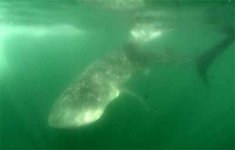
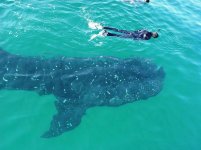
Just wanted to solicit the opinions of the assembled illuminati here, whale shark shoot coming up in September, in an undisclosed location in Mexico. (Undisclosed because commercial fisherman watch this site and target appropriately, rape and pillage follows, must be very cautious. The Taiwanese fad food of choice at the moment is whale shark meat. Johhny knows where it is, he's had similar experiences.)

I'm not a filter guy, especially with the current post capabilities, but in this case, a brief perusal of grab one below from a previous shoot there, shows a very green water, due the large presence of plankton, which is why the whale sharks are there in the first place. Last time there, seven of them in the water at one time, amazing stuff.

Because I will be shooting very shallow, lots of light to work with, not really concerned with light loss, am even considering an ND to keep my Duclos in the sweet spot range, possibly a Pola. What are your views on intensely green water, aside from the general knowledge that is already out there?

Thanks
 

Attachments

  • Whale shark turn.jpg
    Whale shark turn.jpg
    16 KB · Views: 0
  • Submarine.jpg
    Submarine.jpg
    87.7 KB · Views: 0
Hi Tom,
Not sure of the standard Green Water filters would be worth their salt, similar to the Cyan filters for Blue Water. You may also want to try Magic Filters which were designed specific for underwater imaging by Alex Mustard, a pretty big shake in the UW Photography world.

Magic Green Water Filters

Cheers,
Mark.
 
Tom:

I shot whale sharks for 2 years in a row in the thick green pee soup in Holbox, Mexico. I'm not sure ANY filter (Magic or otherwise) is going to help much. We finally found that the green nutrients ran in bands (like weed lines) and we could follow the sharks as they exited a band and entered clear water. I understand that the more recent aggregations are closer to Isla Mujeres where the water is much better.
 
This is a setup for taking sides Tom: I am adament about not using filters (color correction).....you can gain back any filter adjustment in post easily.....in fact you can just add any color filter in post quickly and easily with no loss of light. I'd be much more appreciable of using ND filters....that is without a doubt (IMO) best way to go so you don't have to sacrafice your ISO or shutter settings. And if you are in any of the places typically known here in Mex....you'll need ND's....and on any given day each filter can produce drastically different results...in fact some can be comical in the sense that they will dramatically enhance colors beyond the point of what you may want.
 
Thanks Mark,

Have room on my aircraft for one additional reprobate of note, you seem to fit the bill ;-). For God's sake Mark, bring your own supply of beer.

Departing Los Angeles Hawthorne Airport for regions in Baja that only J Friday is ken with, maybe he will even show, who knows, but a great honor to have you aboard. Astonishing footy to be had.

Mexico has closed down many of these remote strips due significant drug movement from regions south. However, I am carrying the Flying Doctors, at my own expense, medical pros who donate their time and professional expertise to heal, assuage, and help the poor of Baja. I am humbled at what they do, the personal sacrifices they make. In doing so, my involvement is perhaps somewhat selfish, in the bigger picture of things, but maybe, just maybe, I can score a Karma point or two.

Let me know Mark. Seat reserved for you, unless you tell me otherwise.

Cheers,

Tom
 
Hey Tom, heartfelt appreciation mate but can't make it at this time. Three months away from our first baby, three weeks away from opening our first store/gallery in Bali and three minutes away from my second Latte of the morning. Good things happen in three's, apparently (Johnny being more of an authority on that than I) :ohmy:

I've swapped my RED and all for DSLR's and a drive to bring a product range to market that will, for now, remain untold. About two months away from our first release, fingers crossed.

Sterling work with the Flying Doctors too, just check their luggage on the return trip!

Cheers, and give my best to Johnny 'El Diablo del Karaoke' Friday when you see him.

Mark.
 
Status
Not open for further replies.
Back
Top