Welcome to our community

Be a part of something great, join today!

  • Hey all, just changed over the backend after 15 years I figured time to give it a bit of an update, its probably gonna be a bit weird for most of you and i am sure there is a few bugs to work out but it should kinda work the same as before... hopefully :)

The times we love...

I just can’t believe it…

http://pro.sony.com/bbsc/ssr/show-h...bsccms-assets-show-highend-F65.shtml#/f65t1_1

click on the “4k is just the beginning” tab and the section “20 million photosites Versus “4k”

They are still trying to kick “old uncle Bayer” in the nuts again and are still using the screwy and mis-leading marketing…(cough)… “math”. I’m sure their own engineers that read that kind of rubbish feel very uncomfortable with what they present...

If you rotate a sensor 45 degrees and have de-Bayering algorithms that pay more “attention” to green then you are not doing anything new (at all). A diagonally architected, 45 degree twist (other than fast read out times, and the possibility of a more “global-ish” shutter), does not give you a free lunch in terms of true resolution. That one was done to death on a couple of threads over a year ago.

The camera is very broad in the shoulder (as Jim pointed out 14”???). The form factor of the EPIC is waaaaaay better.

It makes me feel like I want to do a hidden camera interview/doco with the marketing guys for this camera, and get them to explain the ...(cough) ... "da math" (from) first principals written out on a white board. This is really nuts…

No matter how much respect someone might have for SONY (camera division), you have to say, come one guys, that one really crosses a line…

Ta.

Eric

Like Colbert, do we now have to think in terms of “truthiness”, or instead “mathiness”, i.e. "oh no.. its not actual math, but kinda math like..."
 
Eric, the key will be to measure their 4k and see how it performs with regards to aliasing... And if it's "proof is in the pudding" or "the image on the screen", their demo showed they could make lovely images, just like a 4yr old RED One can.

Graeme
 
Eric, the key will be to measure their 4k and see how it performs with regards to aliasing... And if it's "proof is in the pudding" or "the image on the screen", their demo showed they could make lovely images, just like a 4yr old RED One can.

Graeme

I think you are right about that.

Given the architecture of the sensors that they (SONY) are using, and first stage processing I would have predicted that the dynamic imagery will have a much more sterile look. I would also have predicted that the imagery has a much more choppy appearance than let’s say than (redcode + Epic ++?). But you say that they can crawl up to the edge of an original REDONE. To be honest, given the way and mindset that they push this notional 100% green, I would have expected at the higher (spatial) frequencies more erratic (higher contrast) aliasing artifacts, almost similar to an image that has been over sharpened. So what you say is very interesting in that (perhaps) the way that SONY (in this case) de-mosaics IS, in fact a particular flavor of De-Bayer (whether they like it or not)…

It is interesting that Jim and yourself and the others (that I cannot name) have had this smoother film like image in mind (right from the start), both statically and dynamically.

This mechanical shutter that they introduce is interesting, given what they have said in the past, that one would think that such a mechanical device introduced to the optical path would not be necessary?

Ta,

Eric
 
Very close. The original 1966-1969 Star Trek was shot on the Desliu lot at Gower & Melrose, adjoining Paramount.
.

If we're going to get technical and specific, the lot you're referring to was originally the RKO Radio Pictures lot, sold to Desilu in 1957 and then merged into Paramount when Gulf and Western bought Desilu. Since it was literally next door to the original Paramount lot, with only a wall separating them, most of us think of it all as Paramount, which it is today. I point this out because the original poster was implying that these productions happened on the Cahuenga lot that Red now owns, which is not the case. The Cahuenga lot was home to many things, especially in television, but most of those things were half hour sitcoms - although I did work there during the first season of Ally McBeal, a one hour "dramedy", and the first two seasons of The Practice, a one hour drama. For that first season of "Ally", which was 1997-98, David E. Kelley productions basically took over the lot for those two shows, prior to moving to Manhattan Beach in 1998 as the first (and for a while, only) tenant at the Manhattan Beach Studios. The only other productions I recall having there during that period were Mad TV (which later moved to Hollywood Center Studios on Santa Monica and Las Palmas) and some music videos.

Many industry related properties, especially movie lots, have changed hands over the years but are still referred to by those in the industry by their old names. The most notable is probably the Sony lot in Culver City, which is still referred to as MGM by many of us who once worked there, and rather fondly I might add. The lot now called "The Lot" on Santa Monica and Formosa, was Warner Hollywood for a number of years, but is still referred to by many as the Goldwyn lot, which it was prior to the Warner purchase. The lot that today houses KTLA/Golden West Broadcasting was the original Warner Brothers lot prior to the move to Burbank, and Sunset Gower was the original Columbia lot prior to their sharing the Warner Bros. Burbank lot, and ultimately moving to Culver City when Warners bought Lorimar (which had already purchased the MGM Culver City lot) and Sony bought Columbia. In fact, one of the only lots I can think of that never changed hands is the 20th Century-Fox lot in West L.A., but that lot used to take up a large portion of what's now Century City (hence the name) until the backlot was sold off to developers.

Hollywood history. It never ends.
 
diagram.jpg
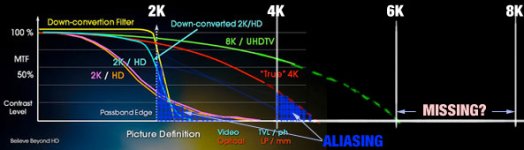
Remember how I said math doesn't lie - well, it seems that diagrams don't either.... Taking the diagram from the Sony F65 I've annotated it with the regions representing aliasing marked in. I've also added in markers for the resolution axis - adding in 2k, 4k, 6k and 8k. I notice a number of things:

1) the curves shown in orange and purple ("conventional" HD cameras) appear to have a different shaped MTF curve than the 4K and 8K curve indicating to me that the lens is being included in their curve, whereas on the 4k and 8k curve there are no lens effects visible. - they look purely like a sensor MTF curve.

2) the "True 4k" curve shows significant MTF at 4k and if you extend the curve, aliasing beyond that.

3) the 8k / UHTV curve doesn't seem to get to 8k, never mind beyond....

Does "true 4k" just mean 4k+aliasing?
 
So whats the consensus here of the LPMM that the lens has to actually resolve to use the full resolution of this '8k' sensor ?
 
Oh, at least 150 lp/mm I'd think...

Graeme
 
View attachment 16472
Remember how I said math doesn't lie - well, it seems that diagrams don't either.... Taking the diagram from the Sony F65 I've annotated it with the regions representing aliasing marked in. I've also added in markers for the resolution axis - adding in 2k, 4k, 6k and 8k. I notice a number of things:

1) the curves shown in orange and purple ("conventional" HD cameras) appear to have a different shaped MTF curve than the 4K and 8K curve indicating to me that the lens is being included in their curve, whereas on the 4k and 8k curve there are no lens effects visible. - they look purely like a sensor MTF curve.

2) the "True 4k" curve shows significant MTF at 4k and if you extend the curve, aliasing beyond that.

3) the 8k / UHTV curve doesn't seem to get to 8k, never mind beyond....

Does "true 4k" just mean 4k+aliasing?


Graeme,

Beautiful…, nicely done. [I had to look at the original for comparison].

I guess we have for SONY’s marketing materials, Thruthiness, Mathiness, and now Graphiness, i.e. not really a scaled (rational) graph, but one that is graph-like (perhaps).

I guess what you are saying and a little in what I suppose that would naturally be the result of such a sensor, i.e. high contrast (erratic) aliasing artifacts for the SONY sensor,… that instead they put a pretty hefty OLP(filter) to make the imager producer images that look like as “nice” (as Graeme would say) as a REDONE from yester year?

I guess this lends credence to lessened OLPFs but with smarter processing (ala RED). Sony in their marketing literature try to claim both… but you can only do one or the other but not both (I think)?? Then they try to pour doubt on no matter how clever you think you might be with your de-Bayer algorithms, you are still “boned”.

They say “However sophisticated the de-Bayering algorithms may be, they still cannot fully recreate image information that was never captured to begin with. For this reason, the final resolution falls, to various degrees, short of true 4K.”

And yours does what now…? (Rhetorical question to SONY pro-camera division)

Ta

Eric

“I am afraid the shields will be quite operational…”

Not!
 
They say “However sophisticated the de-Bayering algorithms may be, they still cannot fully recreate image information that was never captured to begin with. For this reason, the final resolution falls, to various degrees, short of true 4K.”

I don't think the graphs show OLPF either in the case of 4k & 8k. And of course, their "logic" carefully ignores mention of aliasing, OLPFs and lens MTF. What a wonderful world it must be to live in where you can safely ignore such things...

But what I love is the quote you mention above, which takes us back to my earlier post that if their 4k shows aliasing it's not "true 4k", and the only way they could achieve that is to use the method that RED uses - more pixels than you need so aiming for a higher resolution than you need, and get low aliasing too. Aiming for exactly what you want, as they're doing for 4k is only going to lead to aliasing as their graph kindly shows. On the other hand, if bayer is as bad as what they're saying, their 8k is not, and can never be 8k and they should stop mentioning 8k because they themselves have got on their anti-bayer high horse. To want to have things both ways is rather hypocritical.

Now as they showed at NAB, they can make a nice 4k image that looked very similar in look and feel to RED One 4k footage. They have no need for any of this - they can just show the great image they make and and it will stand. They can show their form factor and workflow pieces and people can see that they like or not what they see. But to want to appear as anti-bayer as they do while simultaneously using a bayer pattern on their high end cinema and digital stills cameras is just pure magic to watch.

Graeme

No.. I Know the graphs don’t show the OLPF (on the 4k and notional 8k etc.) but what I meant was from what you had anecdotally reported (saying it looks like a RED ONE image from four years ago), I inferred that they must be using more severe OLPF. I haven’t seen their images in the flesh (yet) but you have.

I agree it’s pure insanity, I just hate the fact that they latch onto pseudo technical buzz words and diagrams that they know are going to stick in people’s heads. It’s like watching FOX “news” (or is it news-iness, maybe I shouldn’t go there).

That’s the whole marketing thing, people will be saying “yeah.. but it’s really 8K you know…”

(slap head..) Arg!

Maybe they should ride on their anit-de-Bayer horse at an angle of 45 degrees and see what they find...Their high horse doesn’t seem so high anymore at 45 degrees!

It really is FALSE product differentiation. There’s no question about it. [They can’t say that maybe we are doing something a bit “RED-like” on a 45 degree slant (years later).] That doesn’t sound so good from a marketing perspective… The fact that they choose to go down the marketing road that they have chosen shows real hubris; how could they not expect things to get super ugly…

There are several (possible) advantages for the layout that they have and resolution is NOT one of them!!! It seems stupid that they don’t actually talk about the potential strengths that their sensor might have, and instead dwell on things that the sensor clearly does not possess (except only in a weird marketing space).

Eek?!

It’s not a case of giving people what they want, it’s more of a case of making people believe that what they have is what they want. Two completely different realities.
 
My understanding of Sony's definition of "True 4k" is that there are atleast one Green, Red and Blue photosite within the sample they use to make a pixel. I don't think the graph you are trying to use to determine aliasing etc from was made for that kind of analysis. It's a way to compare various formats visually to an audience. Not to try and determine the point in which aliasing occurs on the F65, or if they used a lens, or anything other than a basic broad strokes comparison between formats.

I think the point they are trying to make with their "True 4K" campaign is you'll be able to get 4k resolution out of each of the Green, Blue and Red channels, independently. Not just the Green channel.
 
If they use a more severe OLPF they won't measure 4k and hence their "true 4k" claim will be invalid, and the 8k claim even more invalid. Obviously the NAB viewing conditions are no good for such comparisons, but to me, the footage looked very much like the first RED One demo reel - obviously high resolution, smooth and noise free - almost "glossy". It was very deja-vu to me...

So now that's why I need to measure it....

Graeme
 
They imply that for sure Adam, but blue and red for sure won't measure 4k given their arrangement. Not that it especially matters to the vast amount of imagery shot, or to the human visual system... Actually I think that graph is perfect to determine aliasing - an MTF plot is great for such a thing. Of course, if it's not accurate, that can hardly be my fault. And as for if a lens is used or not, that can be determined from the shape of the plot because the MTF of a sensor alone (who shoots with just a sensor????) has a different shape.

The second point is that fundamental sampling theory has things to say about resolution and aliasing. And they do show on their graph how HD resolution is improved and aliasing lower through shooting a much higher resolution and downsampling, marking the "passband" with a line, so it's not like I'm inventing a use for the chart that they didn't think of.
 
If they use a more severe OLPF they won't measure 4k and hence their "true 4k" claim will be invalid,
and the 8k claim even more invalid. Obviously the NAB viewing conditions are no good for such comparisons, but to me, the footage looked very much like the first RED One demo reel - obviously high resolution, smooth and noise free - almost "glossy". It was very deja-vu to me...

So now that's why I need to measure it....

Graeme

"If they use a more severe OLPF they won't measure 4k and hence their "true 4k" claim will be invalid,..."

That would be very funny, if it didn’t …quite… make it…

Have you actually seen published MTFs?

Will Jim be buying one or renting one (for your tests)?

Ta.

Eric

[Obviously it’s an oxymoronic double standard to even say under your breath "8K" (I’m surprised that they are not paying for that one already).]
 
Well, the plot I annotated is a "published MTF" - even though it's obviously incorrect. Of course I'm sure Sony will be showing resolution charts, zone plates and MTF plots before long.

Graeme
 
Well, the plot I annotated is a "published MTF" - even though it's obviously incorrect. Of course I'm sure Sony will be showing resolution charts, zone plates and MTF plots before long.

Graeme

That's very funny..(classic)
 
I still think you're trying to pull out scientific data from a none scientific chart for no other reason than to try to say is lying to the public. They aren't saying that chart was created from measurement taken from the F65! It is a general format demonstration not a chart made from measurements taken from any specific camera systems, read the labels.

The whole "true 4k" thing goes back to how some companies define what a pixel is. Some companies/engineers say a pixel is made of a sample from atleast one Green, Blue and Red photosite while others say a photosite is a pixel. I'm glad you said the blue and red channels won't measure 4k. Do you think they'll measure around 3.2k instead? So what would the red and blue channels of a camera measure that has half the number of pixels in those channels measure?

You're going back and forth on us here too, trying to say their technical side doesn't add up and that is the more important thing and they're lying etc etc. Then you say the technical stuff doesn't matter as much as how the overall image looks. Those are two different schools of thought and it's difficult to have a productive conversion when you keep changing the importance of each subject. You can't go saying the F65 is going to have horrible aliasing problems when you've never seen a resolution test chart/graph made from a real test it or tested it yourself.

You and others at Red have complained to high heaven about how people come on this forum and spread FUD about your camera systems and now here you are doing the same exact thing about another companies camera system. Don't turn this into a "well they did it so we can do it" or a "they started it," either, grow up guys. Stop making so many assumptions from charts and literature made by marketing people who are not engineers. When you're able to get your hands on an F65 and do your own tests and publish those then we might be able to have a productive conversation but until then it's nothing but FUD.
 
Back
Top