- Thread starter
- #3,021

Tom Hamilton
Well-known member
- Joined
- May 17, 2009
- Messages
- 1,157
- Reaction score
- 0
- Points
- 0
- Location
- Port Orange
- Website
- www.redseapictures.com

Follow along with the video below to see how to install our site as a web app on your home screen.

Note: this_feature_currently_requires_accessing_site_using_safari
Tiffen 80A blue filters on the lights take care of that Paul, looking forward to your grading tutorial!
Are you on the Resolve 14 public beta? Thoughts?

Quote from TrueBlue OLPF info (website, Linkdn and pdf):
"RED H2O OLPF is a regular OLPF with stronger UV cut and less aggressive IR rejection (as there is no IR underwater, there is no need to filter it out). However, UV has rarely been a problem underwater because UV is filtered out by water almost as quickly as red spectrum. It's been mostly a problem on land. Also, filtering out UV more aggressively is not going to make the sensor all of the sudden discriminate blue for red. It is just nonsense. Also IR filtering in regular OLPF is not responsible for the problem which, clearly, has nothing to do with IR as it affects visible blue spectrum.
The first step in solving a problem is to understand what it is that we are trying to fix.
TrueBlue is different. TrueBlue does't rely on selective spectral filtering to achieve the goal. In fact, selective spectrum filtering (whether narrow band, low pass or high pass filter) is unlikely to make any difference. However, TrueBlue improves the separation between blue and red by about 2 stops. This is enough to bring out deep, saturated blues like sky or water without affecting other colours, in particular red."
....
"Cameras, such as RED Epic® MX and Dragon®, suffer from poor discrimination of blue colours and make it impossible to achieve "deep blue" skies or water, even with extensive post-processing. This is because the camera sees blue as magenta leaving insufficient colour separation to separate the two without causing posterization. TrueBlueTM is recommended for general cinematography as well as blue screen and can be used in most shooting conditions, particularly where cool colours need to be reproduced accurately."
....
That rises several questions:
1 - Regarding the sentence "However, UV has rarely been a problem underwater because UV is filtered out by water almost as quickly as red spectrum." it looks like this is not confirmed by other sources where it's shown that UV can reach 25 m (and violet up to 100 m) while red just reach 5 m : https://en.wikipedia.org/wiki/Underwater_vision
2 - Has anyone done any true comparative tests between RED's and Achtel's filters? It's strange that so far there is none (as far as I know). Where can we find some true reliable data comparation and not just "brand claims"?
3 - If the problem is a common one between several sensors (and camera brands) and even above water (since it looks like a problem in the sensors and not water related, although maybe more visible uw because there is so much blue), shouldn't this kind of correction be present in all the OLPF's? Why it's not?
4 - Even uw, apart form the lateral bands that I've posted (that only shows up with heavy tint shift in the WB adjustment), with so many shooting scenarios (green murky water to cristal clear blue tropical water; all at several depths and shooting angles), does the H2O OLPF or the TrueBlue OLPF be an improvement in all them or in just a few?
5 - Even using just RED OLPF's, it will be highly beneficial to make some comparative test with for example a standard and an H2O OLPF. Same shooting day, same depth, same scenarios, just switching OLPF and dive again to reshoot. Then publishing both footage side by side will be greatly appreciated and a very clear way to show the real diferences in pratice.

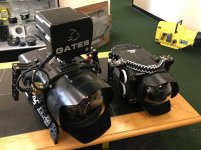
This looks cool.
PA is a gates housing, more compact that the standard gates housing?


Hi all,
I know it's not a good practice and should be avoided whenever possible. But a director wants that I shoot a person jumping into the water, while jumping alongside, with the camera recording. Not a 10 m jump, of course, but I wonder if anyone know how hight is safe to jump in, with housing in hand.
I've saw some promo/bio video somewhere where a diver jumps from a peer (maybe 3 m high, don't remember exactly) with camera/housing in hand.
Obviously this is also highly housing-dependent, since different brands will have different impact/sealing resistance.
I'm using a Nauticam LT housing, so maybe Ryan Canon have some feedback he can share...
Anyone else have routinely jump to the water with housing? From how high?
Thanks!
Will -- here's a comparison. PA is quite compact. Everything will pack into a carry-on, including camera secured inside the housing.
More info here: https://www.gateshousings.com/pro-action/
J-
View attachment 99310
Very interesting take on this Mike, some valuable info based on your long experience.
I do have hesitation though, in that testing at ever greater parameters, until the housing finally breaks, ok that's the limit, time to get a new housing and only jump from this particular height; I've personally witnessed aircraft wings on test beds break and shatter at design test loads. Was a spectacular sight. And an expensive one. Do not try this at home.
Last I checked, the Nauticam LT was going for ca. 12K kitted out, depending, maybe Paul can comment on the VFX do-ability of the shot in question.