Welcome to our community

Be a part of something great, join today!

  • Hey all, just changed over the backend after 15 years I figured time to give it a bit of an update, its probably gonna be a bit weird for most of you and i am sure there is a few bugs to work out but it should kinda work the same as before... hopefully :)

The Gentleman's Underwater Bubble Blower Thread

Also revealing is the is the way this OLPF renders the photographer's strobe and the Manta's white underside.
 

Attachments

  • TrueBlue.jpg
    TrueBlue.jpg
    6.4 KB · Views: 0
i feel like stuff getting too close to your lights and turning red is a more normal thing that needs (sometimes complicated) secondary corrections
 
Tiffen 80A blue filters on the lights take care of that Paul, looking forward to your grading tutorial!

Are you on the Resolve 14 public beta? Thoughts?
 
Tiffen 80A blue filters on the lights take care of that Paul, looking forward to your grading tutorial!

Are you on the Resolve 14 public beta? Thoughts?

i actually like the redness of the lights! because red doesn't travel well underwater, only a problem when you get too close. do whatever you want, though! we'll fix it up ;)

i haven't used resolve since the beta release but i'll probably definitely use it for the tutorial and i'll report back, but i bet it's good?
 
Quote from TrueBlue OLPF info (website, Linkdn and pdf):

"RED H2O OLPF is a regular OLPF with stronger UV cut and less aggressive IR rejection (as there is no IR underwater, there is no need to filter it out). However, UV has rarely been a problem underwater because UV is filtered out by water almost as quickly as red spectrum. It's been mostly a problem on land. Also, filtering out UV more aggressively is not going to make the sensor all of the sudden discriminate blue for red. It is just nonsense. Also IR filtering in regular OLPF is not responsible for the problem which, clearly, has nothing to do with IR as it affects visible blue spectrum.

The first step in solving a problem is to understand what it is that we are trying to fix.

TrueBlue is different. TrueBlue does't rely on selective spectral filtering to achieve the goal. In fact, selective spectrum filtering (whether narrow band, low pass or high pass filter) is unlikely to make any difference. However, TrueBlue improves the separation between blue and red by about 2 stops. This is enough to bring out deep, saturated blues like sky or water without affecting other colours, in particular red."

....

"Cameras, such as RED Epic® MX and Dragon®, suffer from poor discrimination of blue colours and make it impossible to achieve "deep blue" skies or water, even with extensive post-processing. This is because the camera sees blue as magenta leaving insufficient colour separation to separate the two without causing posterization. TrueBlueTM is recommended for general cinematography as well as blue screen and can be used in most shooting conditions, particularly where cool colours need to be reproduced accurately."


....

That rises several questions:

1 - Regarding the sentence "However, UV has rarely been a problem underwater because UV is filtered out by water almost as quickly as red spectrum." it looks like this is not confirmed by other sources where it's shown that UV can reach 25 m (and violet up to 100 m) while red just reach 5 m : https://en.wikipedia.org/wiki/Underwater_vision

2 - Has anyone done any true comparative tests between RED's and Achtel's filters? It's strange that so far there is none (as far as I know). Where can we find some true reliable data comparation and not just "brand claims"?

3 - If the problem is a common one between several sensors (and camera brands) and even above water (since it looks like a problem in the sensors and not water related, although maybe more visible uw because there is so much blue), shouldn't this kind of correction be present in all the OLPF's? Why it's not?

4 - Even uw, apart form the lateral bands that I've posted (that only shows up with heavy tint shift in the WB adjustment), with so many shooting scenarios (green murky water to cristal clear blue tropical water; all at several depths and shooting angles), does the H2O OLPF or the TrueBlue OLPF be an improvement in all them or in just a few?

5 - Even using just RED OLPF's, it will be highly beneficial to make some comparative test with for example a standard and an H2O OLPF. Same shooting day, same depth, same scenarios, just switching OLPF and dive again to reshoot. Then publishing both footage side by side will be greatly appreciated and a very clear way to show the real diferences in pratice.

1 - Yup there is just no supporting evidence for the claim that UV gets filtered out as quickly as red and every scientific reference I've ever read indicates the depth of UV penetration to be second only to violet/blue. After such misinformation is presented as a basis for a products existence I struggle to take it seriously.

2 - I haven't seen such a comparison. I'd genuinely like to understand what its doing too.

3 - I think it just varies, its not a huge problem topside, I've only seen people worrying about it when shooting at serious altitude. I think we are enormously lucky to have a camera where we can change our OLPF so easily and that that is supported by the camera company. I've used the H2O, low-light, skin tone and Kipper-ties Full Spectrum and IR OLPF. I don't know of any other camera that does this. But of course by having choice its possible to use the wrong one. Again there is just no reason to not use the H2O OLPF underwater.

4 - I think the benefit varies in magnitude but always from neutral to positive - no negative. In the clear blue, you'll cut the UV and get a much better looking image at all depths. In very green water at depth there is not much between the H2O and Low-light but in the shallows (and this is another feature of the H2O OLPF that is overlooked) the reds really pop with the H2O OLPF, way more than the Low-Light (and at greater depth) and way-way more than the skin-tone OLPF. (I'm aware these are not units of measurement and I do have data to back that up, just not in a nice form to present here). Hands down by far the best image I've seen off a camera underwater.

5 - I would love to do this. But it really has to be done with two identical setups (camera, lens, housing and dome), side by side and crucially at the same time. Trying to repeat the dive will just introduce too many errors in the results to have confidence in the results. One day maybe things will line up to do it!
 
Astonishing stuff Paul. We deal with uw low light stuff all the time, video noise is a huge factor at those depth-dependent light levels, something many fail to take into account. Resolve Studio has the NR goods to take an otherwise unusable clip, and turn it into gold, will post some samples shortly.
 
i agree, i like neatvideo for noise reduction but i always hear good things about resolve studio
 
Hi Hugh,

Thanks a lot for your detailed answers! Very helpful...
I agree that the comparative tests should be done side by side with two setups. But in case that's not possible and if the dive spot is easily and quickly achievable for a repetitive shoot, it should be good enough to show up the differences.

Cheers,
 
Jumping to the water with housing

Jumping to the water with housing

Hi all,

I know it's not a good practice and should be avoided whenever possible. But a director wants that I shoot a person jumping into the water, while jumping alongside, with the camera recording. Not a 10 m jump, of course, but I wonder if anyone know how hight is safe to jump in, with housing in hand.

I've saw some promo/bio video somewhere where a diver jumps from a peer (maybe 3 m high, don't remember exactly) with camera/housing in hand.

Obviously this is also highly housing-dependent, since different brands will have different impact/sealing resistance.
I'm using a Nauticam LT housing, so maybe Ryan Canon have some feedback he can share...

Anyone else have routinely jump to the water with housing? From how high?

Thanks!
 
Rui, 50% of terminal velocity (195 km/hr divided by 2) is reached in three seconds, anything other than a gentle leap off the back of the boat, and even that has its risks, your camera/housing will not survive the impact.

What I suggest, affix the camera at various points on a pier piling or other embedded vertical structure, have the diver jump numerous times with the camera at successively lower increments, composite into a single sequence in post. Time consuming, but should save you an insurance claim on your rig.
 
i hate to say it but this is what gopros are for. don't risk your camera for one risky shot... hero4/5 black captures 4k, make sure you turn the artificial sharpness off, then you'll have some grading to do
 
Hi all,

I know it's not a good practice and should be avoided whenever possible. But a director wants that I shoot a person jumping into the water, while jumping alongside, with the camera recording. Not a 10 m jump, of course, but I wonder if anyone know how hight is safe to jump in, with housing in hand.

I've saw some promo/bio video somewhere where a diver jumps from a peer (maybe 3 m high, don't remember exactly) with camera/housing in hand.

Obviously this is also highly housing-dependent, since different brands will have different impact/sealing resistance.
I'm using a Nauticam LT housing, so maybe Ryan Canon have some feedback he can share...

Anyone else have routinely jump to the water with housing? From how high?

Thanks!

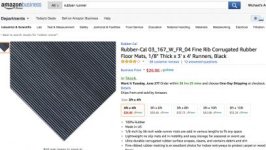
Of course the manufacturer's default position is that you shouldn't do it since the housing wasn't designed for that. However, with that said, I have jumped off the dive platform with housing in hand many times without issue. The main thing you are worried about is that the hydraulic pressure of impact will blast past the main seal (I highly doubt that there would be a problem with control shaft seals). You can prevent this in part by either running some tape over the outside of the seal area - mainly at the bottom since that is where the impact will be at the seal. You could also fashion a larger protector out of something like the rubber matt material like in the picture below. This material is handy for making improvised shades, protecting surfaces while working on the housings, etc.

Whatever you do, you should be able to easily and safely test by jumping into a pool from various heights with the housing - WITHOUT THE CAMERA INSIDE.

You can also determine the best way to hold the housing without getting smashed in the face when you hit the water.

----------------------------


Side question:

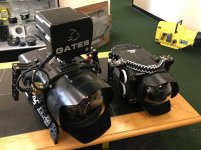
Will -- here's a comparison. PA is quite compact. Everything will pack into a carry-on, including camera secured inside the housing.

More info here: https://www.gateshousings.com/pro-action/

J-


View attachment 99310

John: Do you mind giving the actual volume/displacement of the PA? I'm curious how much difference from the shortest version of our Epic housings.


-
 

Attachments

  • rubber matt .jpg
    rubber matt .jpg
    20.9 KB · Views: 0
Jumping into water with housing

Jumping into water with housing

Rui and all --

Some experience and comments as they relate to Gates equipment:


  • The asymmetric forces on a housing that result from impact with water are understandably concerning. It is true that housings are generally not designed for this, but it's not the entire housing or all circumstances to which this applies.

  • As Mike points out, a few feet of giant stride with housing in hand is fine. Aquavideo (according to Mike) and Gates are designed for this. The latches on Gates have 150 to 200 lbs of retention force on the main seal for just this reason.

  • Going beyond that we must address the seal types and how they are engaged. By way of example we recently had a custom project to mount on of our larger cinema housings to the front of a boat. It was required to withstand 2-3 knots with the housing smashing in / out of the water. So we modified the housing so the main seal was supplemented with additional retention. We also specified a minimum vacuum level to keep the seals energized while in or out of the water, and during the smashing transition.

    Everything worked perfectly, even at nine knots. NINE. You can imagine the stress and forces on the housing were substantial.

  • I turn attention now to Pro Action. It was designed for similar abusive forces, and as such has no latches. The main housing seal is purposely secured with four bolts to withstand action scenarios including surfing, pole mount, rapid diver entry, and other scenarios with abusive, asymmetric forces.

So Rui -- I am confident Pro Action will meet your 'diver jumping into the water' shot. And as Mike also points out, the question you need to address is safety for whomever is handling the rig. I suggest using a boom or drop slide instead of a diver.


J-

PS -- A note about those four bolts. The misperception is they require a long time to remove / replace for a battery / media change.

Reality: The difference between latches and bolts is 15 seconds. We timed it. Fifteen seconds.

 
just about anything is doable vfx-wise these days... one shot above water just barely going in and another going down might not be too much trouble but i still say gopro and be done with it, unless you guys think the housing will hold up for sure.
 
Very interesting take on this Mike, some valuable info based on your long experience.

I do have hesitation though, in that testing at ever greater parameters, until the housing finally breaks, ok that's the limit, time to get a new housing and only jump from this particular height; I've personally witnessed aircraft wings on test beds break and shatter at design test loads. Was a spectacular sight. And an expensive one. Do not try this at home.

Last I checked, the Nauticam LT was going for ca. 12K kitted out, depending, maybe Paul can comment on the VFX do-ability of the shot in question.

My idea was more along the lines of say jumping from 10 feet or less height - to simulate a shot of jumping off a dock or boat. I highly doubt this would cause any actual damage to the housing - the failure point as you go higher and higher would be a spurt of water getting past the seal at the point/time of impact. Probably just a few ounces or less as the housing would typically immediately reseal itself. The intrusion point would be at the bottom part of the housing seal and due to the instantaneous high pressure from the impact - which could be avoided by physically covering the seal area at the bottom with tape or that rubber matt which would take the impact force.

One of these days I will check this out, but I am pretty sure a less than 10 foot drop would be okay.
 
Hi all,

Regarding the magenta lateral banding issue, I have searched between other shots taken with another fisheye (Nikon AF-D 16mm f2.8 fisheye) and even moving the WB sliders a lot the lateral banding never appears.
So it looks like its an issue restricted to this Sigma lens. But I also had take a look at still photos taken with it and a Nikon DSLR D800 and also no problem there.

Maybe this is an issue that only happens with this combination of this specific Sigma lens and this Red Camera (Weapon Dragon 6K). Not sure if it’s the way the lens rear elements projects the light at a very high angle that make it worst at the edges of the frame. But since with a DSLR its Ok, there must be something in this Weapon 6K that is causing it.
Maybe is sensor related? Or STD OLPF related?

Thanks.
 
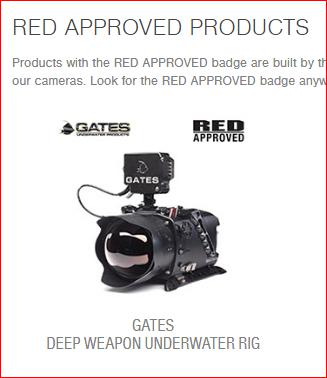
RED Approved Third Party Accessory

RED Approved Third Party Accessory


I first met Jim in 2006 when RED made a big splash at NAB. Since that first meeting it has been, and continues to be an honor collaborating with such a dedicated, inspired team. Recognition of Gates as an Approved Third Party Accessory is humbling, and a celebration.

Thanks to our many friends and colleagues at RED for everything.

http://www.red.com/third-party-accessories


Gates-RED-approved-3rd-party-accy.jpg


J-
 

Attachments

  • Gates - RED approved 3rd party accy.jpg
    Gates - RED approved 3rd party accy.jpg
    20 KB · Views: 0
Back
Top