Welcome to our community

Be a part of something great, join today!

  • Hey all, just changed over the backend after 15 years I figured time to give it a bit of an update, its probably gonna be a bit weird for most of you and i am sure there is a few bugs to work out but it should kinda work the same as before... hopefully :)

Starry sky is impossible for Epic, oh wait, is it?

Lauri Kettunen

Well-known member
Joined
Aug 6, 2007
Messages
1,063
Reaction score
0
Points
36
Location
Finland
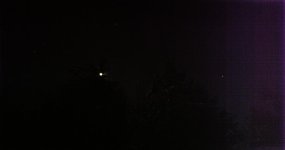
Here a test shot of the starry sky with Epic-X. It was completely dark expect the stars and the moon, and on the right there's some reflections from street lights. It wasn't one of those nights one can see the stars by a naked eye, but rather was able to see only some of them. At first calibrated the camera for 8fps and shutter speed 1/8s and took a short shot with a wide angle lens 10mm/f4.0 compression rate 1:3 in 5K 2:1 mode. In post just added some rgb-frames above each other to find out what happens. The other image is the result of addition, the other is a sample of a single frame.

The real question is this --and I guess this should go to Graeme: In principle the sensor output should have a linear correspondence with light. So, is it possible that the longest shutter speed was extended by allowing one to add raw frames arithmetically to each other in post? Are the raw files that raw and is the sensor that linear? In other words, what is difference between the sensor "adding" the light and adding the output of the sensor afterwards in post before color grading?
 

Attachments

  • Sample-stars.jpg
    Sample-stars.jpg
    20.1 KB · Views: 0
  • Original-frame.jpg
    Original-frame.jpg
    27.6 KB · Views: 0
There is a thread here about black shading I think this might be an issue with the sensor calibration changing as the sensor warms up.
 
Look up combine over x frames. then you can make several frames into one and by doing so get away from the noise.
 
I think that's why Tom Lowe is using the t1.3 Master Primes. The added 3+ f-stops of light you get will really make a difference in such a low light situation.
When adding together frames of stars isn't the main problem the fact, that stars keep moving?
 
There is a thread here about black shading I think this might be an issue with the sensor calibration changing as the sensor warms up.

I've found the red one needs blackshading if you're going to jump from short to long, or long to short shutter speeds. I set the shutter I want before the blackshading, other wise I find I always get pure R, G or B hot pixels. They're easily fixed in post but better avoided. I don't normally worry about temperature changes too much, though its better to blackshade a warm camera than a cold one

I'd rather shoot without compression with a 5d and a 30sec shutter speed than combine frames, but its a common technique in astro photography, and stop motion animation
 
To emphasize the bigger point, notice, in principle it is a completely different thing to add raw- or rgb-images above each other. For, assumingthe raw files are really raw and the sensor is linear, then it makes no difference whether you add in the sensor (that is when collecting light) or after the sensor (that is by adding the outputs of the sensor). But as soon as one has rgb-images, then some gamma curve has already been applied and this no-difference-before-or-after, that is, linearity does not hold even hypothetically.

This is why adding images in post might make a difference with RED r3d-files in RedCine-X pro. And *if* so, then something like this should be possible as well: In difficult conditions shoot 100fps 1/100s and depending on light choose in post whether you want to add either one, two or three frames to each other (and consequently, skip three, two or one frame, respectively) to come up with an ordinary 25fps footage. Of course, this affects how motion will appear, but that's another story.
 
Back
Top