Lauri Kettunen
Well-known member
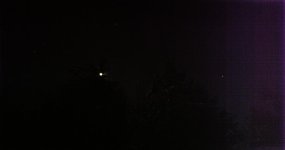
Here a test shot of the starry sky with Epic-X. It was completely dark expect the stars and the moon, and on the right there's some reflections from street lights. It wasn't one of those nights one can see the stars by a naked eye, but rather was able to see only some of them. At first calibrated the camera for 8fps and shutter speed 1/8s and took a short shot with a wide angle lens 10mm/f4.0 compression rate 1:3 in 5K 2:1 mode. In post just added some rgb-frames above each other to find out what happens. The other image is the result of addition, the other is a sample of a single frame.
The real question is this --and I guess this should go to Graeme: In principle the sensor output should have a linear correspondence with light. So, is it possible that the longest shutter speed was extended by allowing one to add raw frames arithmetically to each other in post? Are the raw files that raw and is the sensor that linear? In other words, what is difference between the sensor "adding" the light and adding the output of the sensor afterwards in post before color grading?
The real question is this --and I guess this should go to Graeme: In principle the sensor output should have a linear correspondence with light. So, is it possible that the longest shutter speed was extended by allowing one to add raw frames arithmetically to each other in post? Are the raw files that raw and is the sensor that linear? In other words, what is difference between the sensor "adding" the light and adding the output of the sensor afterwards in post before color grading?