Welcome to our community

Be a part of something great, join today!

  • Hey all, just changed over the backend after 15 years I figured time to give it a bit of an update, its probably gonna be a bit weird for most of you and i am sure there is a few bugs to work out but it should kinda work the same as before... hopefully :)

Soderbergh is a wild man...

Status
Not open for further replies.
Its about the result, not the resolution

Its about the result, not the resolution

The true 2:1 anamorphic lenses produce stunning images when used by a talented cinematographer like Steven.

It's easy to obsess about resolution or sharpness (been guilty of that myself quite often) but it's just one piece of the story telling puzzle.

Quote of the thread. At least for me.

Digging through some old frame grabs, some more examples of the sort of soft, stretchy background of low-light anamorphic photography...

And pics of the day. Thanks David.
 
So is the Panavision C-Series lens using an adapter that allows the lens to focus on a smaller spot because of the reduced height of the sensor?

I'm not sure I understand the question -- when using 2X anamorphic lenses on the RED, you'd use the full height of the sensor, you just don't need the full width. I'm guessing the whole (enabled) portion of the sensor is being recorded but that it's being cropped on the sides to get back down to 2.39, probably in post, I'm not sure you can pick how much of the sensor to record.

I just caught the post I missed by Jim that Soderberg was using C-Series Panavision lenses -- so I guess he must have installed a PV lens mount on the RED?
 
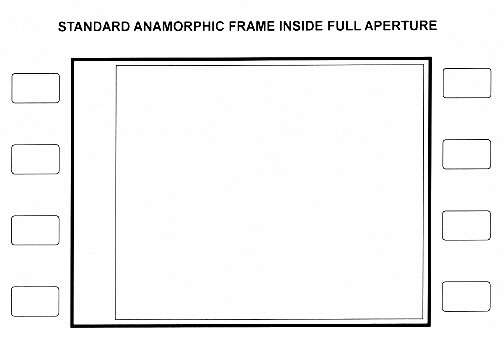
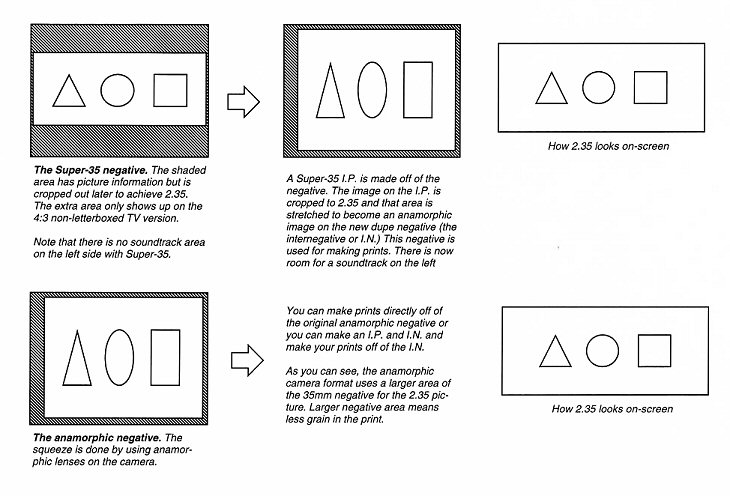
For those interested, here are some old diagrams I drew of the anamorphic camera gate, and the difference between 4-perf Super-35 and anamorphic (the blow-up steps for Super-35 were written back when it was done optically, not using a D.I.)

anamorphic2.jpg


anamorphic3.jpg


The main reason I'm showing this is for people to get a clear idea that 2X anamorphic photography only uses/needs a squarish target area, since the image has a 2X squeeze.
 
David,
I think I understand the difference. Do you have any examples of the same shot (or very similar shots) done spherical and anamorphic?
 
David,
I think I understand the difference. Do you have any examples of the same shot (or very similar shots) done spherical and anamorphic?

It would be hard to find a movie where the same set-up was shot twice in two formats. The next best thing is to compare movies with sequels that changed formats - for example, "X-Men 1" was shot in anamorphic, but the next two X-Men movies were shot in Super-35. At least you'd see the same sets shot in different formats.

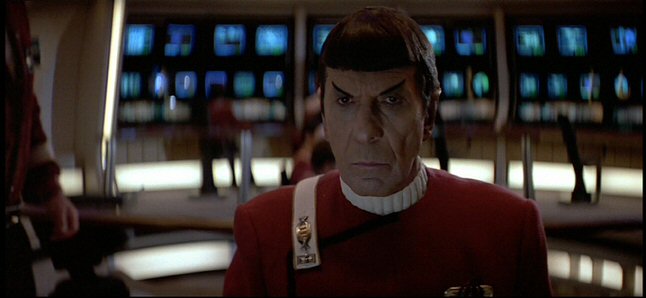
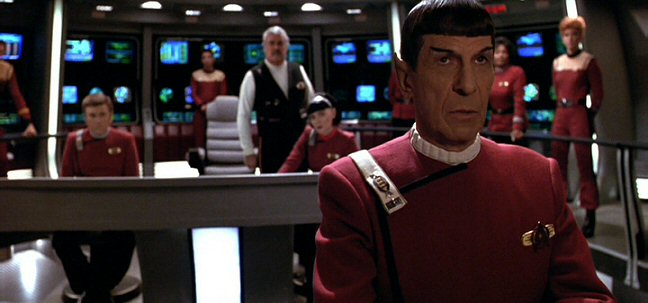
All of the "Star Trek" features were shot in anamorphic except for "Star Trek 6", the only one shot in Super-35. I found a frame from each that are similar enough to see the difference in how the background goes out of focus in anamorphic (Star Trek 5) versus spherical (Star Trek 6):

Anamorphic:
startrekfive4.jpg


Spherical:
startreksix3.jpg
 
I also recommend people spend some time wandering around the American Widescreen Museum, especially the chapter on CinemaScope for info on anamorphic:
http://www.widescreenmuseum.com/widescreen/wingcs1.htm

I clicked on the site to take a quick peek and ended up reading all 8 pages!
Fascinating stuff. I especially liked the part about having to pull focus on both the original anamorphic adapter and prime lens simultaneously. That must have been a fun job! Thanks for your contributions, David!
 
I also recommend people spend some time wandering around the American Widescreen Museum, especially the chapter on CinemaScope for info on anamorphic:
http://www.widescreenmuseum.com/widescreen/wingcs1.htm

David, thanks for this link. History is fantastic stuff and it makes me wonder if those of us involved as customers may not be able to tell others that we remember 'this feature being enabled' or 'that upgrade being developed' when the RED museum recounts all that has happened with this camera.

On the other hand, I have to go back and correct some misinformation I posted previously, and that your link has made clear. (John Wayne was later killed by cancer from working on the "Conqueror" movie... not "The Searchers"):blush:
 
It would be hard to find a movie where the same set-up was shot twice in two formats. The next best thing is to compare movies with sequels that changed formats - for example, "X-Men 1" was shot in anamorphic, but the next two X-Men movies were shot in Super-35. At least you'd see the same sets shot in different formats.

All of the "Star Trek" features were shot in anamorphic except for "Star Trek 6", the only one shot in Super-35. I found a frame from each that are similar enough to see the difference in how the background goes out of focus in anamorphic (Star Trek 5) versus spherical (Star Trek 6):

Anamorphic:
startrekfive4.jpg


Spherical:
startreksix3.jpg

David, all of your posts in this thread have been extremely educational, thanks... Great stuff, and I learned something new!

Now, I take it if you shoot digital with anamorphic lenses, opposed to cropping the SUPER 35 frame, it will exhibit similar characteristics as the examples you've posted?
 
Don't think anamorphic is a walk in the park -- there are a lot of downsides, which is one reason it has been in decline over the years. There are fewer anamorphic lenses in existence, in fewer styles and focal lengths and special features.

They tend to be physically larger & heavier in general.

Many are not faster than f/2.8 and many aren't particularly sharp at f/2.8 -- most anamorphic zooms, for example, are nearly f/5.6 at the fastest.

Many don't focus very closely -- some of the longer anamorphic lenses won't focus closer than 7 feet, which is annoying for ECU work.

The wider-angle lenses all tend to have some barrel-distortion problems.

They breathe when you rack-focus, which is distracting enough that you have to think about why and when you rack-focus during dialogue because it's not invisible.

They are more expensive to rent.

And the main reason that anamorphic has been on the decline whereas Super-35 has been on the rise is the depth of field issue -- the anamorphic format in general has less depth of field because the focal lengths used in general are nearly twice as long. So pulling focus on a close-up in anamorphic at f/2.8 is harder than shooting a close-up at f/2.0 in spherical, because you're likely to use a 135mm in anamorphic when you'd use a 75mm in spherical.

I love the anamorphic format but producers have heard enough horror stories over the years that you have a big selling job to convince them to use it, and focus-pullers generally hate the format.

My general rule for 2.39 movies has been that if a movie will mostly be made up of day exteriors and day interiors, and very little night work, then I will advocate anamorphic -- but if the movie has little day work but a lot of interiors and low-light night exterior work, I will advocate Super-35.

Unless for stylistic reasons, you want that super-shallow-focus, swimmy, flarey, distorted look of anamorphics shot wide-open. Then they are great. Otherwise, their big advantage, at least in 35mm, is for landscape movies shot in daylight.
 
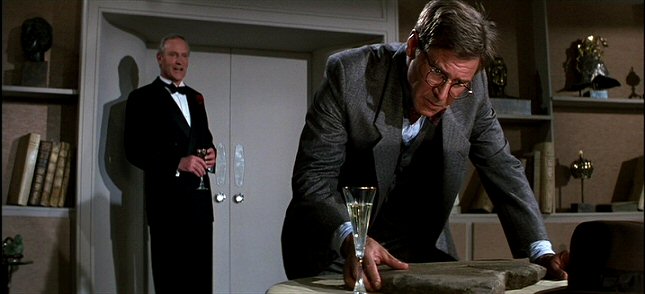
This is a more subtle example, but you can see the barrel distortion of a wider-angle anamorphic lens (probably a 40mm E-Series, a guess) in this frame for "Indiana Jones and the Last Crusade". Since the scene was lit to a very high f-stop, the focus is pretty deep, which is not typical of anamorphic:

lastcrusade1.jpg


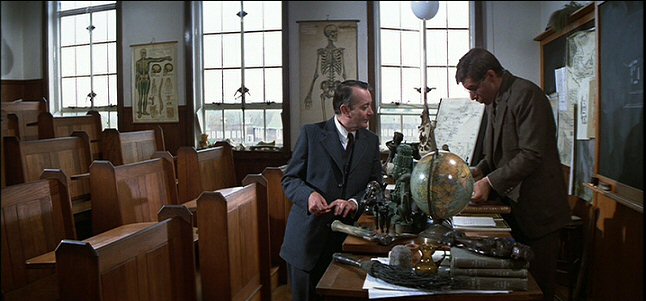
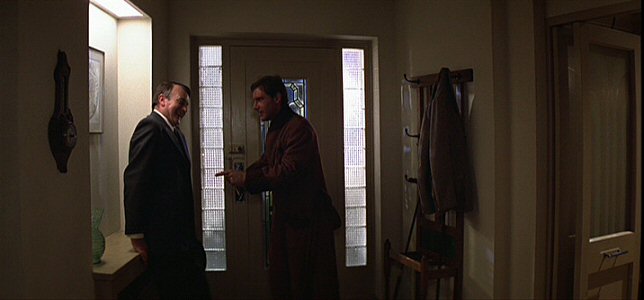
Some frames from "Raiders of the Lost Ark" (probably a 40mm C-Series):

raiders1.jpg


raiders2.jpg
 
David, I was going to say if you write a book, I would buy it, but then I googled and realized you already did. :)
 
All of the "Star Trek" features were shot in anamorphic except for "Star Trek 6", the only one shot in Super-35. I found a frame from each that are similar enough to see the difference in how the background goes out of focus in anamorphic (Star Trek 5) versus spherical (Star Trek 6):
Very interesting example! Is it my imagination or is Spock's face actually wider on the anamorphic shot? I thought the later generation lenses didn't suffer from "anamorphic mumps" ?
 
Getting back to the topic, if others decide to jump in as fast as he did and continue to use the RED, you will probably get a technical award Oscar in a few years.
 
Status
Not open for further replies.
Back
Top