Welcome to our community

Be a part of something great, join today!

  • Hey all, just changed over the backend after 15 years I figured time to give it a bit of an update, its probably gonna be a bit weird for most of you and i am sure there is a few bugs to work out but it should kinda work the same as before... hopefully :)

Soderbergh is a wild man...

Status
Not open for further replies.
It sounds like he's using a standard 2X anamorphic cine lens on the camera, which means that he will have to crop in post on the sides to get the image back to the standard 2.39 ratio.

If the sensor is capturing at 16x9 (1.78) then the unsqueezed image would be 3.56 : 1 if left uncropped -- and if the sensor is capturing at 2:1, then he would get a 4:1 image when unsqueezed.

So wasting the sides of the captured image in post is necessary to return the width back to a standard 2.39 ratio for release. With a 2X image squeeze, you only need an approx. 1.19 : 1 pixel ratio on the original to get a 2.39 : 1 image.
 
I love Steven Soderbergh's style. He shoots "Guerrilla" with two RED beta prototypes, "Mars" and "Bombay", in the steaming hot jungles of Spain. He wraps and tells film "he has met someone". Then... he decides to be brave (once again) and shoot "The Argentine" in SoderScope. He is now using "Paris" and "Beijing", two of our 25 pre-production cameras, and shooting anamorphic. Who would have thunk it?

It turns out that Steven has so much confidence in RED resolution that he is using only about 2.4K's worth of RED... with a completely different look for each movie.

There aren't many Academy Award winning Directors with as big o' balls as Steven. Gotta love it. You heard it 1st on reduser.net.

Jim

I like Soderbergh style, it has touch a bit of the best European films and NY avant-garde from the 60's. Also I have almost all his movis on DVD in my collection.
 
It sounds like he's using a standard 2X anamorphic cine lens on the camera, which means that he will have to crop in post on the sides to get the image back to the standard 2.39 ratio.

If the sensor is capturing at 16x9 (1.78) then the unsqueezed image would be 3.56 : 1 if left uncropped -- and if the sensor is capturing at 2:1, then he would get a 4:1 image when unsqueezed.

So wasting the sides of the captured image in post is necessary to return the width back to a standard 2.39 ratio for release. With a 2X image squeeze, you only need an approx. 1.19 : 1 pixel ratio on the original to get a 2.39 : 1 image.

Steven is shooting the center of the frame only, which then expands. He is thrilled with the tests and started shooting this Monday.

Jim
 
Soderscope vs cropping

Soderscope vs cropping

If Steven merely cropped the top and bottom out of an S35mm frame to get 2:40 - wouldn't he be getting more resolution that using anamorphic lens?
 
If Steven merely cropped the top and bottom out of an S35mm frame to get 2:40 - wouldn't he be getting more resolution that using anamorphic lens?

That is the 1st question I asked him... and the answer is yes. But he is going for a different "look" to this film. I was skeptical at 1st, but when I saw the tests... it occurred to me why he is the director and I am the camera builder. :-) The footage looks awesome, even though it technically is less resolution. From what we have seen of "Guerrilla" and what he is doing on "The Argentine", I guess my second-guessing Soderbergh days are over.
The good news is that our camera seems to be very versatile. Ask it any question and it gives you the answer you are looking for.

Jim
 
All Great News Great News!!!! Love The 72fps...love It Love It...cant Wait To Shoot The Kings When They Get Back From Europe...
 
The true 2:1 anamorphic lenses produce stunning images when used by a talented cinematographer like Steven.

It's easy to obsess about resolution or sharpness (been guilty of that myself quite often) but it's just one piece of the story telling puzzle.
 
His other anamorphically-lensed movie (as a DP/director) was "Solaris", which was some of his best work photographically.

Of course, I'd still love to see someone make a set of 1.33X anamorphic lenses for use on 16x9 sensor cameras...

Solaris looked GREAT.

That being said, what are the advantages of using anamorphic glass over regular cine glass?

Once projected, what qualities does it bring to the image over regular glass?
 
The main advantage in 35mm is that you use a larger negative area than Super-35 cropped to 2.39, so the image is finer-grained and more detailed on the big screen, all else being equal (same stock, same exposure, etc.)

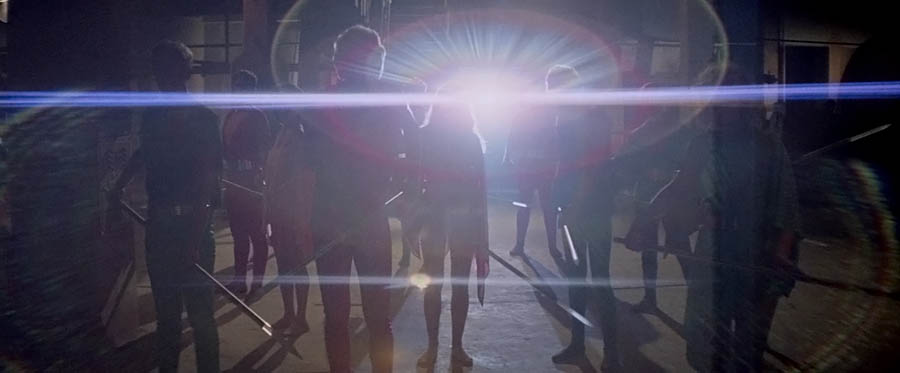
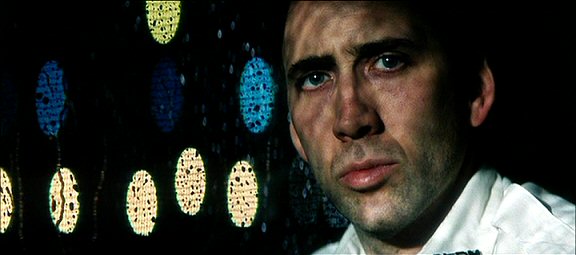
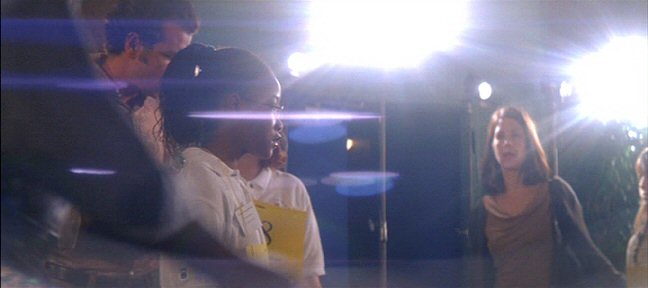
Optically, though, anamorphic lenses are more distorted than spherical lenses and produce artifacts that increase the more wide-open you shoot them (stopping down increases depth of field, which then hides a lot of the anamorphic lens oddities.) Out-of-focus backgrounds get more than the 2X compression so look skinny, stretched, and as you rack-focus, you can see the optical compression/squeeze change, creating "breathing." Out of focus points of light become ovals instead of circles. Bright lights hitting the lens will create a blue horizontal flare.

Though most of these artifacts are common to prime anamorphic lenses below 200mm, which normally have a large cylindrical anamorphic element in the front; zooms and telephotos tend to be adapted spherical lenses with a small cylindrical anamorphic element in the back, so you don't get the breathing or the blue flare or the ovals... but out of focus lights can become square-shaped sometimes.

Also, there is less depth of field with anamorphic photography since the 2X squeeze makes all lenses behave more like wide-angle lenses (a 40mm anamorphic lens "sees" the same horizonally as a 20mm spherical lens) and thus you typically use longer focal lengths in anamorphic photography (you'd use a 40mm lens in anamorphic versus a 20mm lens in Super-35 cropped to 2.39).

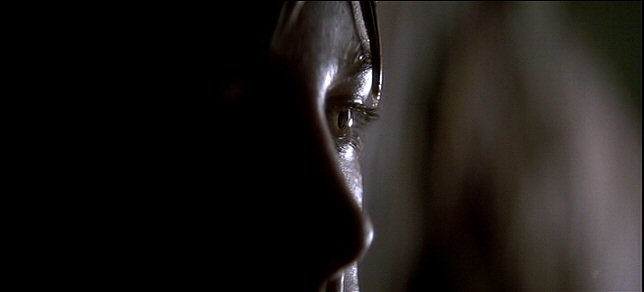
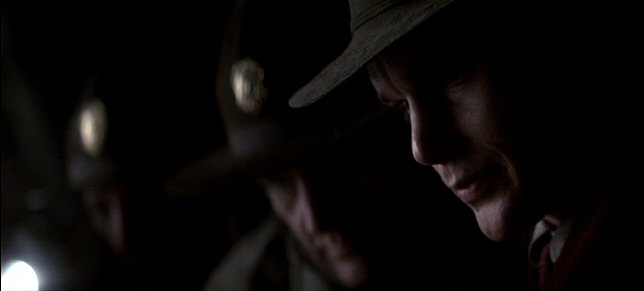
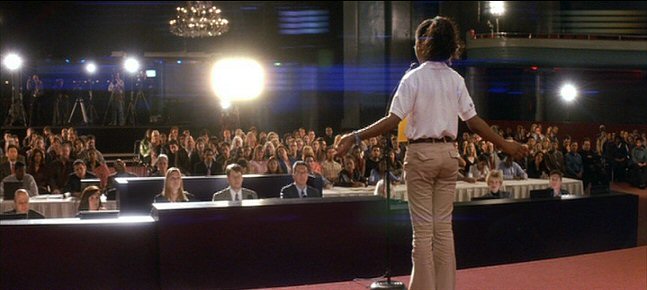
Here are two shots from a movie I shot in anamorphic called "Akeelah and the Bee" that show some of the lens flare characteristics of anamorphic lenses:

akeelah6.jpg


akeelah7.jpg


Here is a frame from "Logan's Run" that also shows an anamorphic lens flare:

logansrun1.jpg


Here is a frame from "Bringing Out the Dead" which shows the points of out of focus lights becoming ovals instead of circles:

bringoutdead1.jpg
 
David - wow. Thanks for that response, it was great.

So a hard source of light in the background willl warp due to the particular properties of the lens.

What about more diffused light from a non-point source. Obviously the effect will not be as obvious as a point source, but will that light achieve a different, altered look?

Sorry about the tangent, I've just never shot with anamorphics before and always assumed that it was to simply fit more into frame, I never thought to myself that there may be some sort of interestinf differences in the images produced!

edit - your next lot of pictures answered my ill-stated follow ups :) hah.

edit #2 - why doesn't the foreground image warp at all? Or this property only in the highlights?
 
Hello,

Very cool, David. Thanks for putting those messages together.

Best,

ATF
 
AWESOME! well this closes the discussion started months ago about whether or not we can use anamorphic lenses. I'm psyched! :)
 
Hi Jim,

So it did not take long for the 1st Panavised RED.

Stephen
 
Will there be an option to only record the center part of the image, to lower the data rate?
And maybe even a setting to squeeze the image for monitoring?
Just thinking out loud.
 
Thanks for taking the time, David. Very informative. I learn something new every day.

aloha,

Keith
 
It's amazing soderberg is even working in hollywood. By definition he should have been crushed by the machine long ago.
 
Status
Not open for further replies.
Back
Top