Welcome to our community

Be a part of something great, join today!

  • Hey all, just changed over the backend after 15 years I figured time to give it a bit of an update, its probably gonna be a bit weird for most of you and i am sure there is a few bugs to work out but it should kinda work the same as before... hopefully :)

Robert Richardson lighting style: how to?

omar robles

Well-known member
Joined
Nov 16, 2008
Messages
325
Reaction score
0
Points
16
I am trying to light a scene in the style of Robert Richardson. In my research it appears he uses par cans to create the overhead halo look. In the opinion of the forum users here. What would you suggest to achieve this look? I noticed coming out of my movie theater halogen bulbs create that effect.

Thanks in advance
 
I have a thought on this.

The bounce is as important as the source. What gives his images a style is the quality of the bounce while allowing the overhead to blow out. It's a particualr way of filling what should be a silhouette.

I really appreciate his styles and this looks. It's distinct and I can think of a few movies where his look really added to the story.

David
 
Last edited:
Richardson lighting style?

Richardson has done so many films with so many looks! Like most good DP's it isn't so much that he has a style and more that he gives his projects a style.

So, do you have images with the specific look you are trying to emulate?

From your question, I think you mean this:

inglourious-basterds-hickox-hammersmark.jpg


Here's a clue:

The_Aviator_(2004)-image-494545.jpg


That's a classic Hollywood mid-farside key. You just put a powerful fixture, ideally a fresnel, on the far side of the subject from the camera perspective. If you want the glow around highlights, then I recommend some filtration. Maybe a classic soft ... I'd have to do some homework.

Then you control the fill to create the sort of look you need. The Inglorious Basterds shot has a very low fill level, while the Aviator shot has a much higher fill level.

This is one type of shot that can really break a digital camera of any sort. So, if you really want the over exposed areas, I recommend shooting without any overexposure, then blowing it out in post, but using the data to give that blowout a soft rolloff. The more real dynamic range you can capture, the better you'll be able to deliver the look.

You can do this in camera ... but you are riding the razor's edge if you try, though with being able to send curves to the camera I'd be more willing to go for it.

If you want to know more about this classic style of high key lighting, then check out Painting with Light by John Alton. Its a bit dated now, but classic, and quite frankly it shows in detail a lot of classic techniques for sculpting the close-up that just aren't used anymore.

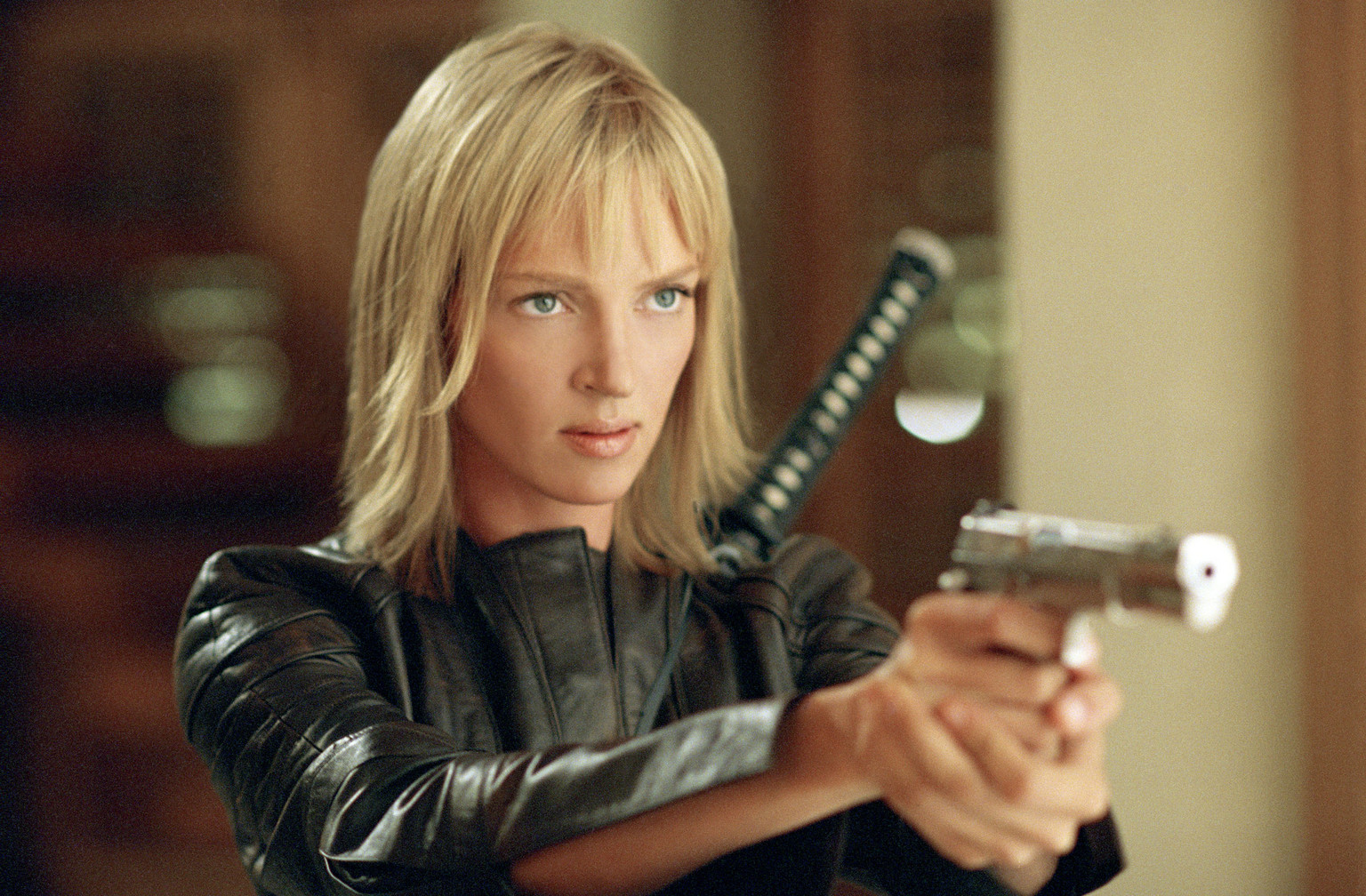
This is a very different look:
Kill+Bill.jpg


You can see that the key is a large soft source. (You can see the instrument in Uma's eyes.) Because Richardson&Tarantino selected a nice camera position&composition, this still manages to be a farside key, although Uma is basically in sidelight.

Here is yet another look, one I frankly don't like, but which works in this instance.

kill_bill_b_10.jpg


(here is a link because I am not seeing the image above on the forum.)

Here we have a powerful soft source as nearside key pushing through the wall to frame left. Normally I would want to place the camera on the other side of the hall, but in this instance doing so would have resulted in a much uglier and overexposed background. The environmental lighting here is fantastic, and is what really sells this shot to me. (Lucy's costume is still overexposed, but holds much more detail in the film prints.)

Next up we have one of the classic stills from cinema.

platoon-original.jpg


This shot is really about the subject (Willem Dafoe) and his performance. I should also note that this shot is much darker in the film. Here we are actually seeing the shot lit by the sun, and Richardson really just controlled the fill. The primary fill is actually the sky. There is negative fill in front of Dafoe and some large bounce to screen left in roughly the traditional (45º) keylight position.

The shot actually has rather dynamic lighting. Just a bit after this frame the background action is overwhelmed with an explosion then washed out with smoke. Remember this is in the days before DI, so fill had to be carefully controlled otherwise the image would be very flat.

The next shot is from one of my favorite sequences in Kill Bill 1.

bscap0025i.jpg


It is a mixed lighting setup. The background is tungsten, with I think a little CT Straw gel. The outdoor background is daylight, my guess is bounced HMI with blue gels (steel?). The fill is a small difused source close to camera- again you can see it in Uma's eyes. Its not only filling her but giving her a nice eyelight.

I didn't do any research on this ... just my guesses based on the images themselves.
 
The first picture is exactly what i meant by it.

so your saying its achieved using a powerful source behind the actor? Because to me it appears a large blast of light is coming from above.
 
In my research it appears he uses par cans to create the overhead halo look. In the opinion of the forum users here. What would you suggest to achieve this look?

Just use par cans? They are so cheap to rent and easy to rig almost anywhere.
If you want to exaggerate the halo effect, filter or net your lens to taste.
 
The first picture is exactly what i meant by it.

so your saying its achieved using a powerful source behind the actor? Because to me it appears a large blast of light is coming from above.

I think there is also some smoke in that fist shot to enhance the effect and I think the fill is a soft bounce from the backlit source. The fill is so subtle against that hard back/rim light.

David
 
The "classic" Robert Richardson look from the 1990's, as in "JFK" and "The Doors", involved spot PAR's as a toppy backlight, so that actors moved, they momentarily passed through the hottest spot of the beam, going way overexposed. When this was combined with lens diffusion (often ProMist back then, later nets) you got a lot of halation. Richardson did less of this lighting technique in "Snow Falling on Cedar", going more for very soft single-source side lighting. He also moved away from ProMists and towards nets on the back of the lens it seemed. Lately he hardly uses any diffusion at all, probably just the lightest grade of Black ProMist or something like that, if anything. But in the 1990's, it looked more like a #1/2 Black or White ProMist was being used.
 
The "classic" Robert Richardson look from the 1990's, as in "JFK" and "The Doors", involved spot PAR's as a toppy backlight, so that actors moved, they momentarily passed through the hottest spot of the beam, going way overexposed. When this was combined with lens diffusion (often ProMist back then, later nets) you got a lot of halation. Richardson did less of this lighting technique in "Snow Falling on Cedar", going more for very soft single-source side lighting. He also moved away from ProMists and towards nets on the back of the lens it seemed. Lately he hardly uses any diffusion at all, probably just the lightest grade of Black ProMist or something like that, if anything. But in the 1990's, it looked more like a #1/2 Black or White ProMist was being used.

Your memory of the specific techniques of so many cinematographers is impressive David! Did you remember that from AC articles or some such, or did you just figure it out looking at the pictures again?
 
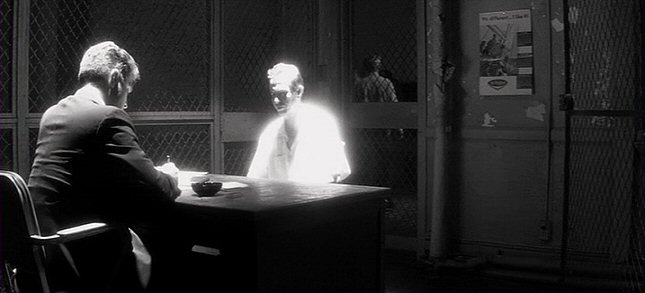
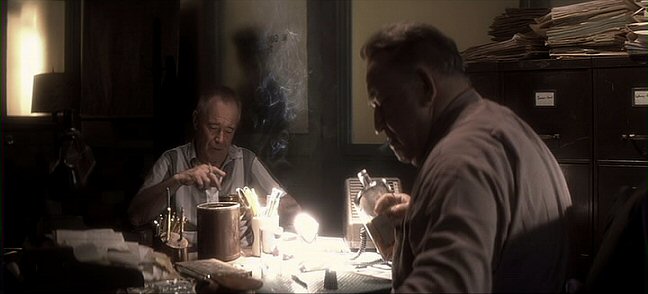
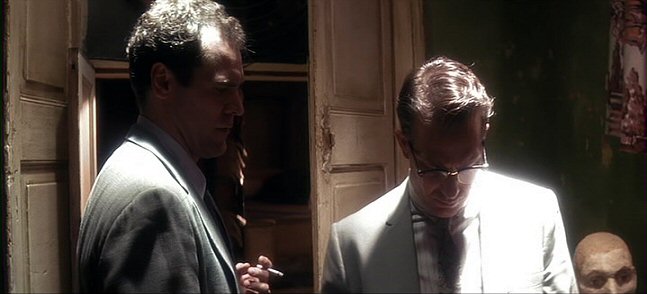
I've been a huge fan of Richardson's over the years, since film school, so I've watched his movies many times over and over, particularly "JFK" and "Snow Falling on Cedars". So it's been a mix of reading articles, watching the movies, and practicing. For example, look at these frames from "JFK":

jfk6.jpg


jfk7.jpg


jfk8.jpg


I may have heard from some electrician years ago that he liked PARCAN's, I don't know, I don't recall a specific article from the 1990's where it was mentioned. I remember on my second feature in 1993, I wanted that hot top light effect and tried it with an overhead tweenie pointed straight down and overexposed two-stops. This was one of my first and last movies to have film dailies, and I recall watching the results and being underwhelmed, I didn't get that nuclear "glow"... and then the producer turned to me and said "that looks a little bright, can we print it down in post?" -- when my reaction was that I didn't go far enough!

Then on my next film, I had a flashback or something where I felt more confident that I could get away with a stylized effect... it was a shot of two doctors huddled over a patient on an operating table and I wanted that super-hot top backlight, so I tried a 1.2K VSPN "firestarter" PARCAN and instead of metering the hot spot, I metered the bounceback into the shadow side and picked how much underexposed I wanted it, rather than how overexposed to make the back-top light. I also put a #1/2 ProMist on the camera and (being a Super-16 feature) I switched to 100 ASA film just in case the diffusion made the image look too grainy. Turns out I had plenty of stop with the PARCAN even at 100 ASA, which explains how Richardson was able to shoot most of "JFK" on that stock. The final effect came out exactly like how I wanted it to look, though the actors complained that the hot spot of the PAR was too hot to stand under for very long -- so I tried it myself and they were right, it was like being cooked by a laser.

Anyway, over the years I've gotten the effect with other spotted lights, from little Dedos for a tight shot to spotted Tweenies or 1K's, or HMI's, etc. Or spot PAR globes for screw-in lightbulbs. The main thing is that you want a very hot center that you basically don't even bother metering because the idea is to let things burn out in the center of the beam -- so you meter the fringes of the beam or the bounce back into the shadows. And a little diffusion on the lens will extend the halation further. And making the top light come in from more of a backlit angle helps keep the burn-out effect from being too obnoxious because it's mostly the hair and shoulders that get burned up, not the face, which is more lit by the bounce of the backlight up into the faces.
 
the west wing has this look also. i've noticed a lot of overhead backlights that blowout as the actors move. i like the look of this show. must be hard to light with all that glass (reflections) and camera movement.
 
"West Wing" didn't use PARCAN's in the hallway but smaller spotty lightbulbs hung in regular intervals in the hallway.

I usually carry some 50w or 75w NSP lightbulbs for bar scenes and whatnot, you can get a lot of intensity from these little bulbs.
 
I'm really enjoying this thread. I hope to get to experiment with these techniques soon.
 
If you are willing to let it burn out to white on film, I don't see why you wouldn't do the same on digital -- it's really more of an issue of how large an area do you want to burn out, you may want to limit it a bit more on digital for control in post, but I wouldn't go so far as to not let any of it get very hot... otherwise you won't get the halation effect. But I'd pay more attention to the actual clipping point, which is easy since you can see it on the monitor, and control the exposure so that it doesn't get obnoxious. But I think the point of the visual effect is a small burned-out area that is halating so you don't want to be too conservative either.
 
David,

Those JFK examples are great.

I really liked the style in that film. It was a period mystery. It almost feels like the look is born out of the Zapruder film, not in terms of grain, but in terms of the contrasy quality of Super 8 film and how it reacts to bright spotlights, etc. With that idea applied to 35mm, it's like you get this "new art".

Plus it has kind of a documentary feel that the film carries. There are great "table scenes" in JFK with Jim Garrison and his colleagues and John Candy has a wonderful cameo as well.

This film is a striking example of what feels to me like Richardson style. Then the UMA Kill Bill shot earlier in the thread is wonderful.

Thanks for contributing.

The examples posted in this thread is probably the best place on the web to see a collection of Rob Richardson images. Seriously.

I'd love to see what those histograms look like. I think some people would never "go there" with a digital sensor, but I hope people do because you can not really get that in post.


David
 
Back
Top