Welcome to our community

Be a part of something great, join today!

  • Hey all, just changed over the backend after 15 years I figured time to give it a bit of an update, its probably gonna be a bit weird for most of you and i am sure there is a few bugs to work out but it should kinda work the same as before... hopefully :)

RED's home 4k Projector under 10k, Sony's home 4k Projector over 20k!!

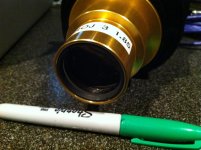
There's no way that you would want to use a RPP or any other type of cinema lens on a projector. The lenses are typically designed for projecting an image on a projector. I've attached a picture of the rear element of a projector lens with a pen to use as size reference.


Personally I think the projector that RED had out in the case was just to give people an idea. Not what they actually used to project the images.
RED-Projector-1-616x410.jpg
 

Attachments

  • Photo1Web.jpg
    Photo1Web.jpg
    65.9 KB · Views: 0
There's no way that you would want to use a RPP or any other type of cinema lens on a projector. The lenses are typically designed for projecting an image on a projector. I've attached a picture of the rear element of a projector lens with a pen to use as size reference.


Personally I think the projector that RED had out in the case was just to give people an idea. Not what they actually used to project the images.
RED-Projector-1-616x410.jpg

Not to mention cost! So much of the cost of an RPP is mechanics & build for on set operating, which we dont need at all on a projector lens.
 
As noted there are more aspects to consider than the projector engine itself. I also doubt that a PL mount "taking" lens will be the solution in the shipping product.

If the Sony ES1000 had a viable upgrade path to wider bandwidth input and higher refresh rates then I, and many others I'd wager, could justify the purchase. With a built in "spoilage" date, it just doesn't make sense.

Cheers - #19

Okay this is were you realize how one of Jarred's recent post might be more then close to the truth of things, about inflated cost of goods by other companies to cover the insanely expensive advertising that they do.

RED announces their 4K home RedRay Laser Home Projector, and now Sony is releasing ahed of schedule their Home 4k Projector... http://www.pocket-lint.com/news/42369/sony-vpl-vw1000es-hands-on but wait, RED's is under 10k, and Sony's? Well around double that, 20k!!


The real issue for Sony in designing the VW1000 was the HDMI 1.4a standard (and available HDMI chips) only supports 4K at 24 Hz and does not support 3D at 4K resolution. The Sony representative I talked to last September (when they introduced the VW1000) stated they do anticipate a future upgrade being available for VW1000 owners after the Blu-ray 4K standards (and the next generation HDMI) are complete. I have heard these standards will be completed by perhaps late 2012 or during 2013. Such an upgrade from Sony will probably mean sending the projector back to Sony for a board swap (at least the board with the HDMI ports/chipset) plus a new firmware update. Also it's likely that Sony's next generation consumer 4K projector will be shipping in the same timeframe as the Red projector, so it is that next generation of Sony 4K projector that Red will need to compete against and not the VW1000 (which came out about a year earlier than the most optimistic release date I have heard for the Red projector). The idea in Post #1 of this thread that Sony released the VW1000 ahead of schedule due to the upcoming Red projector is nonsense.

It would be great if Red would show their projector at the CEDIA Expo in Sept., but I doubt it since that trade show is aimed at dealers and custom installers and since Red will be doing a direct sell to the consumer the dealer/installer aspect of that show may not be a good fit. However the consumer electronics press is well represented at CEDIA Expo (I attend representing Projector Reviews) and since this is THE SHOW for home theater projectors (much more so than CES), CEDIA Expo would be a good opportunity for Red to get press coverage for their projector, especially if they have a near production ready unit available to demo.

While the idea of a laser light source with dual imaging engines (for passive 3D) sounds very interesting, I really want to see if Red can get the black level and contrast ratio at least competitive with the better consumer 1080p projectors in the $3K to $7K price range. Reports on the recent showing of the prototype Red projector indicate it was not very good for these characteristics. Also if the reports (perhaps widespread speculation is a better term) are correct that the Red projector is sequentially flashing the primary colors and using a single display chip (perhaps LCoS) then that brings up the potential for rainbow effect, as is present with single chip DLP projectors. If the imaging chip is in fact LCoS (nothing officical yet from Red) then that technology's limited response time (much slower than DLP's DMD chips) could limit how fast the sequental red-blue-green sub-images can be displayed perhaps resulting if RBE no better than achieved with a DLP using a 4X color wheel. At least this is something to look out for when the final version of the Red projector emerges from the lab. Don't get me wrong, I would really like to see Red offer a world class consumer 4K projector in the $10K price range, but until it becomes a real production product it's not realistic to speculate how it will compare to next year's models of 4K projectors from the long established consumer electronics manufacturers (next generation Sony, plus perhaps 4K models from the likes of JVC, Epson, etc.).
 
Last edited:
Also if the reports (perhaps widespread speculation is a better term) are correct that the Red projector is sequentially flashing the primary colors and using a single display chip (perhaps LCoS) then that brings up the potential for rainbow effect, as is present with single chip DLP projectors. If the imaging chip is in fact LCoS (nothing officical yet from Red) then that technology's limited response time (much slower than DLP's DMD chips) could limit how fast the sequental red-blue-green sub-images can be displayed perhaps resulting if RBE no better than achieved with a DLP using a 4X color wheel. .

I seriously doubt they'd be doing that. The colour wheel is a nice cheap solution when you have a single white light source because it does away with the need for dichroic colour separation mirrors or prisms. With the lasers, the colours are already separated, and you'd actually need a similar dichroic setup to "assemble" them into a single white source anyway.

Sequential RGB is such a crap solution that I'd be VERY surprised if they did that. The bottom line is, most of the cost is going to be in the lasers anyway, so it just wouldn't make any economic sense.
Oddly enough, tonight I've actually brought a sequential RGB projector home from the Test Lab where I work to see how it stands up in a home environment. It is only a cheapo model, but God, is it painful to watch. If you move your head too fast, or crunch on potato chips, it's Apollo14 all over again :emote_hippie::emote_hippie:
 
If they are using the HDI technology they bought a while back (and it seems they are), it would appear this is indeed what they are doing. Not a color wheel, but sequential RGB.


-sc
 
I seriously doubt they'd be doing that. The colour wheel is a nice cheap solution when you have a single white light source because it does away with the need for dichroic colour separation mirrors or prisms. With the lasers, the colours are already separated, and you'd actually need a similar dichroic setup to "assemble" them into a single white source anyway.

Sequential RGB is such a crap solution that I'd be VERY surprised if they did that. The bottom line is, most of the cost is going to be in the lasers anyway, so it just wouldn't make any economic sense.
Oddly enough, tonight I've actually brought a sequential RGB projector home from the Test Lab where I work to see how it stands up in a home environment. It is only a cheapo model, but God, is it painful to watch. If you move your head too fast, or crunch on potato chips, it's Apollo14 all over again :emote_hippie::emote_hippie:

I suspect that no one outside of Red knows what's really going on inside their projector. IF they are using sequential RGB AND IF they are using LCoS for the imaging chip (as is rumored on various web sites), THEN visible rainbow effect (RBE) is something we will need to look out for with the final product. When RGB LED or Laser light sources are used with single chip DLP projectors that do not use a color wheel, the DMD imaging chips are fast enough to switch between the RGB sub-images at the equivalent rate of a 48X color wheel (this was done by Samsung a few years ago for their LED based DLP rear projection TVs - RPTV). Most viewers will not observe objectionable RBE once you get up to the equivalent of a 6X speed while a very few claim be able to still see RBE with the 48X Samsung RPTVs. LCoS and LCD imaging chips have a response time limitation that will not permit such rapid switching between the sub-images and IF that is the direction Red is actually going for their projector then there may be potentially be visible RBE. IF Red is doing sequental RGB I would assume it is to keep costs down, as compared to using dual three chip imaging engines.

Note that I am providing emphasis above to the various "IF" statements above since we don't know that this is the approach Red is taking with their projector.
 
Last edited:
They may have a faster refreshing time do to the low contrast ratio.
 
I suspect that no one outside of Red knows what's really going on inside their projector. IF they are using sequential RGB AND IF they are using LCoS for the imaging chip (as is rumored on various web sites), THEN visible rainbow effect (RBE) is something we will need to look out for with the final product. When RGB LED or Laser light sources are used with single chip DLP projectors that do not use color wheel, the DMD imaging chips are fast enough to switch between the RGB sub-images at the equivalent rate of a 48X color wheel (this was done by Samsung a few years ago for their LED based DLP rear projection TVs - RPTV). Most viewers will not observe objectionable RBE once you get up to the equivalent of a 6X speed while a very few claim be able to still see RBE with the 48X Samsung RPTVs. LCoS and LCD imaging chips have a response time limitation that will not permit such rapid switching between the sub-images and IF that is the direction Red is actually going for their projector then there may be potentially be visible RBE. IF Red is doing sequental RGB I would assume it is to keep costs down, as compared to using dual three chip imaging engines.

Note that I am providing emphasis above to the various "IF" statements above since we don't know that this is the approach Red is taking with their projector.


I have to admit that if you keep your head reasonably still, I suppose the projector I had wasn't all that bad. I mean it was pretty impressive considering its size and the fact that it only draws about 25 Watts. More of an indication of what the future holds I guess.

It uses an RGB LED module for a light source which alternately flashes between red, green and blue. Actually it appears to go red-green-green-blue-green-green-red-green-green etc.
You tend to notice the Rainbow effect more out of the corner of your eye than when you're looking directly at it.
Some kids who came over thought it was the single coolest gadget they'd ever seen! It has a built-in DVD player and in total darkness you can project a perfectly watchable wall-sized image with it. You also tend to not see the Rainbow so much with the dimmer image. The only real problem was that a DVD doesn't look all that crash-hot blown up that big; the startup menu is quite crisp, so it should be able to do better. It does have an HDMI input, but my Blu Ray player refused to talk to it and it doesn't have YUV inputs. Also the internal speaker tended to be drowned out by the fan, but it does come with an optional separate sound system.

Again, for what it is.....
 
I want one now maybe 2.
One for moves other one for my mom who needs a projector for stills as a template on a canvas.
My mom uses kodak slide projector now but they stop making them and less and less places develop slides.
And the image is not the best. So I got her a epson projector from costco 1080p and use a mac mini but still see pixels even with using a nikon D70,D700 & D7000.

What do you all think about using it for stills as I just talked about?

Thanks
James Peach
jpneedsmd@aol.com
gofastjames69@gmail.com
 
No new posts in this thread for 5 months. Has everyone lost interest in a Red projector? The last I heard (from the NAB show) the Red projector design was supposed to be completed and the first production projectors ready by the end of 2012. Is this still the schedule or are we now looking to sometime in 2013?
 
Last edited:
Availability will be clarified towards the end of the year, but the current track says Spring 2013.
 
Sony's 4K Home theater projector is limited by HDMI 1.4a, but they have promised an upgrade path, as Blair mentioned. Odds are it takes more than just a firmware upgrade. I don't think there was any promise of it being free.

There is a new pro version of the 1000ES recently introduced, the VPL-GT100, which sells for $49K. It is designed primarily for simulator applications. But it adds portrait mode (standing on one side), 2 DisplayPorts, 60 Hz 4k via the 2 ports, only 1 HDMI, and random direction of 3D polarization.

As a former employee of Sony, I don't have a bias particularly pro or con, except the “bird in the hand” versus the unknown in the bush. (I have had my share of disappointments hoping for what's in the bush.) The 1000ES is definitely my favorite projector so far. Way better image quality than I have seen anywhere else. But most consumers will consider it pricey at $25K. I would welcome and love to see a better (difficult even for more money) projector at a lower price. Sony tends to do pretty well at image quality per dollar.

It's strong points for me are:

full 4K 4096 x 2160 (x3) panels
high level performance 4K “reality creation” processing, which even most purists will want to leave ON. More obviously crisp fine detail.
high level performance 4K lens capable of resolving 4 microns pixel pitch with good contrast in fine detail
more cinema friendly: lens memory and aspect-flexible processing quality allowing creative use of the wider 17:9 panel, using more pixels, reduced black bars, etc, no anamorphic lens required
Great black level, contrast, dynamic range
Some reviewers say it is the ideal blend of film smoothness and video crispness, which they attribute to the SXRD (LCoS) panels. I tend to agree.
They also say bluray movies look better than ever. I would have to agree here, too. The processing is pretty awesome.

The 1000ES is definitely the projector to beat IMO. But I would love to see it beat for $10K. I admire image quality. Quality for a lower price is even better.

What intrigues me about the RR laser projector:

4K at $10K
Laser potential (color purity, color gamut, calibration accuracy, stability over time, no lamp replacement, black level/contrast potential, smaller less complex optics, lots of good stuff)
Grading quality color accuracy? Pretty exciting thought, especially if it can do that at the consumer level.
As a large screen evaluation monitor, should help reveal artifacts, sharpness/detail and thus drive improved image quality industry wide. Pushing that quality envelope.
Made in USA. (Apologies to more distant neighbors, we need all the help with the economy we can get)

What I think has been announced at this point:
It appears the modular laser concept is discarded for RED's home model, but still exists for the pro version. I liked that modular concept, though. Maybe it can come back around later. High rollers can always go pro, too, and probably will. Options are always good.
It appears that lensing needs to be designed specifically for projection, as many have predicted, rather than using camera lenses.
Some number of Lens options for pro (can optimize lens design for specific distance ranges)
1 lens only for consumer model, it appears. (Challenges are that a wide lens range tends to create significant brightness differences between short and long throws when aperture changes with Zoom. Short is brighter.)

I guess we are all waiting for more details. If anybody has any more info, please share.

Rob McD.
 
Last edited:
4K at $10K
Laser potential (color purity, color gamut, calibration accuracy, stability over time, no lamp replacement, black level/contrast potential, smaller less complex optics, lots of good stuff)

I'm sold
 
Sony's 4K Home theater projector is limited by HDMI 1.4a, but they have promised an upgrade path, as Blair mentioned. Odds are it takes more than just a firmware upgrade. I don't think there was any promise of it being free.

There is a new pro version of the 1000ES recently introduced, the VPL-GT100, which sells for $49K. It is designed primarily for simulator applications. But it adds portrait mode (standing on one side), 2 DisplayPorts, 60 Hz 4k via the 2 ports, only 1 HDMI, and random direction of 3D polarization.

As a soon to be former employee of Sony, I don't have a bias particularly pro or con, except the “bird in the hand” versus the unknown in the bush. (I have had my share of disappointments hoping for what's in the bush.) The 1000ES is definitely my favorite projector so far. Way better image quality than I have seen anywhere else. But most consumers will consider it pricey at $25K. I would welcome and love to see a better (difficult even for more money) projector at a lower price. Sony tends to do pretty well at image quality per dollar.

It's strong points for me are:

full 4K 4096 x 2160 (x3) panels
high level performance 4K “reality creation” processing, which even most purists will want to leave ON. More obviously crisp fine detail.
high level performance 4K lens capable of resolving 4 microns pixel pitch with good contrast in fine detail
more cinema friendly: lens memory and aspect-flexible processing quality allowing creative use of the wider 17:9 panel, using more pixels, reduced black bars, etc, no anamorphic lens required
Great black level, contrast, dynamic range
Some reviewers say it is the ideal blend of film smoothness and video crispness, which they attribute to the SXRD (LCoS) panels. I tend to agree.
They also say bluray movies look better than ever. I would have to agree here, too. The processing is pretty awesome.

The 1000ES is definitely the projector to beat IMO. But I would love to see it beat for $10K. I admire image quality. Quality for a lower price is even better.

What intrigues me about the RR laser projector:

4K at $10K
Laser potential (color purity, color gamut, calibration accuracy, stability over time, no lamp replacement, black level/contrast potential, smaller less complex optics, lots of good stuff)
Grading quality color accuracy? Pretty exciting thought, especially if it can do that at the consumer level.
As a large screen evaluation monitor, should help reveal artifacts, sharpness/detail and thus drive improved image quality industry wide. Pushing that quality envelope.
Made in USA. (Apologies to more distant neighbors, we need all the help with the economy we can get)

What I think has been announced at this point:
It appears the modular laser concept is discarded for RED's home model, but still exists for the pro version. I liked that modular concept, though. Maybe it can come back around later. High rollers can always go pro, too, and probably will. Options are always good.
It appears that lensing needs to be designed specifically for projection, as many have predicted, rather than using camera lenses.
Some number of Lens options for pro (can optimize lens design for specific distance ranges)
1 lens only for consumer model, it appears. (Challenges are that a wide lens range tends to create significant brightness differences between short and long throws when aperture changes with Zoom. Short is brighter.)

I guess we are all waiting for more details. If anybody has any more info, please share.

Rob McD.

Rob. You will be solely missed. Are you voluntarily retiring or is this another massive layoff in what I fear is a fruitless effort to save the company. I note Sony in a desparate effort to offset massive losses, sold the Sony building in NYC. I was totally unimpressed by Sony's press conference at CESa and see nothing, no plan, no products that could seriously reverse Sony's current trend.

As to Red producing a $10K laser projector, we have seen nothing so farthat such a projector can be produced at or near that price point sold direct.

I do believe it would be possible to produce a bulb 4K projector at that price point with the ability to replace bulb illumination with laser when the cost of lasers comes down and the speckle problem can be solved' Red has one great pricing advantage in that their price for projectors can be 30 to 40% less than MSRP because they eliminate resellers.
 
Availability will be clarified towards the end of the year, but the current track says Spring 2013.

ted said at CES that the projector was still 4 to 6 months off. And Red has stated that the commercial theater models will come first. No reasons have been given as to why the delay, why commercial product first, and the haunting question of procuring lasers at a cost that would allow a target of $10K for consumer being reached. No discussion of a solution for speckeling either. Further unlike a camera, a laser projector of the light classes under discussion will require substantial governments (plural) approval for safety. EU and US. These alone could delay introduction substantially. Call me skeptical, but I just don't see a consumer laser projector from Red within the next two years and if lasered powered, I would bet on the price being closer to $15K, not $10K.
 
Last edited:
I have high hopes for the Red projector/RedRay. It will be interesting to see if the proprietary codec becomes an advantage or a hindrance.
 
Last edited:
Thank you, Mark. The bean counters won. My team lost. Probably makes sense on paper. It wasn't my choice, initially, but may work out for the best.

Regarding the RR laser projector, I am hopeful. I can see how laser advantages could substantially reduce optical block size and costs. And I see progress with laser projectors being re-classified differently than other lasers, which makes more sense, and should open things up.
 
ted said at CES that the projector was still 4 to 6 months off. And Red has stated that the commercial theater models will come first. No reasons have been given as to why the delay, why commercial product first, and the haunting question of procuring lasers at a cost that would allow a target of $10K for consumer being reached. No discussion of a solution for speckeling either. Further unlike a camera, a laser projector of the light classes under discussion will require substantial governments (plural) approval for safety. EU and US. These alone could delay introduction substantially. Call me skeptical, but I just don't see a consumer laser projector from Red within the next two years and if lasered powered, I would bet on the price being closer to $15K, not $10K.

Well, eager to hear news from Red about it all. The projector is something I'm more hyped about then Dragon or anthing else that Red announced over the years.
 
Back
Top