

- Moderator
- #1

- Joined
- Apr 19, 2007
- Messages
- 13,392
- Reaction score
- 796
- Points
- 113
- Location
- Los Angeles
- Website
- www.phfx.com
There's been a bit of talk and curiosity about Dragon's low light performance and I thought I'd put together a couple of quick tests and share some quick notes.
In the spirit of other tests online that are designed to "break cameras" I shot these with a White Balance 2800K, so this would be considered a stress test. The White Balance will also show one of the ways Dragon separates itself from Mysterium-X. Both tests were shot at 6K HD at 5:1 REDCODE RAW and both exhibit the ISO range of ISO 800, 2000, 3200, and 5000.
Epic Dragon Candle Test

- 6K HD JPG Still
- Vimeo Preview Link
- ProRes4444 1080p Download Link (3.1GB)
*notes: Shot at 35mm T2.1 using straight REDcolor3/REDgamma3 with no additional curve or noise reduction. The light meter is set to 23.976fps w/180 degree shutter at ISO 3200 if you're curious.
Epic Dragon Match Test
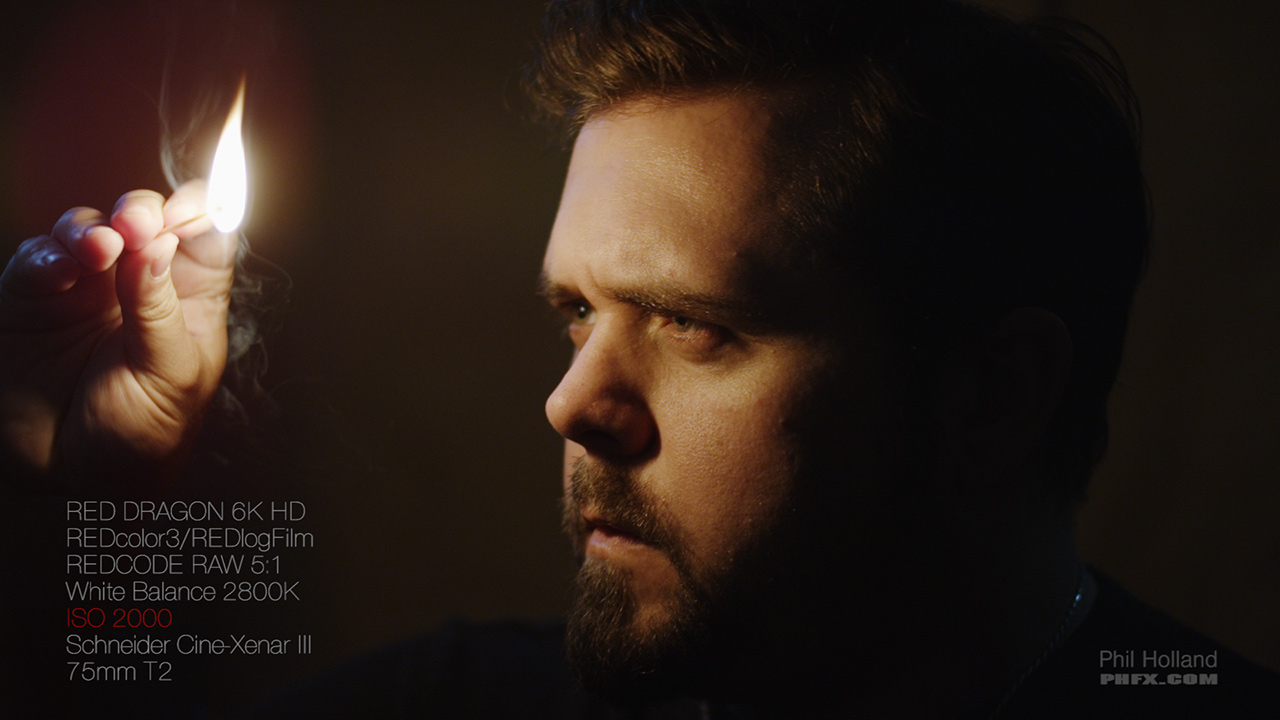
- 6K HD JPG Still
- Vimeo Preview Link
- ProRes4444 1080p Download Link (2.4GB)
- 6K HD .R3D Download (1.4GB)
*notes: Shot at 75mm T2 using REDcolor3/REDlogFilm with a fairly standard S-curve to create a pleasing look. At the end there is an additional ISO 5000 sample that I exported with Neat Video to show what that can do to eliminate visible noise at that high ISO.
My thoughts
First up I'm not as handsome as Leo and I didn't use T1.3 Masters, however, this gets the thought across and shows what's going on with Dragon in low light. However, as noted with the Leo/Fincher/Match/Cigar Test ProRes actually falls apart a bit here and the 16bit DPX frames tell the best story, but ProRes4444 is the highest quality I can reasonably get you guys at the moment.
Dragon's specs state "improved low-light capabilities let you shoot at ISO 2000 and still produce a clean image fit for theatres or publication" and that's pretty much what I see here. The theatrical quality range on Dragon to me is ISO 250-2000. If you can handle a bit of texture and you aren't going nuts in post, ISO 3200-5000 is pretty darn usable straight away as well. However, if you are shooting for theatrical purposes and have to stretch that far and want a "clean image" noise reduction is a viable option at those top tier ISOs.
These tests were produced at a White Balance of 2800K, which strays away from the native sensor White Balance of around 5000K. However, it's performing very nicely while pushing the material this far and even further to 1800K, which is not shown here. Side Note. It's good to know the controls in Redcine-X Pro. There is an option in there to "denoise" that will eliminate some color noise when utilized, I mention this as I've met people "who don't know what that does". It's useful for shooting low light and pushing the White Balance around. The older Mysterium-X practices of using a CTB filter still can be employed, but there's far less of a reason to do so with Dragon. This is a good thing.
The key to working with Red cameras (and other digital cinema cameras for that matter) is understanding that there is a noise floor and once you hit it with your exposure rating it's best not to lift anything out of that darkness. The ISO 5000 samples show the extreme of dipping into that dark bucket and bringing out the noise. Dragon does in fact see quite a bit into the darkness and the current calibration shows that. There's nice clear tonal separation at the bottom end and that's going to be fun to explore.
Another note a bit away from low light shooting. I've been stress testing the camera over the holiday and something that is very interesting with Dragon is on well lit and well exposed images that live above the noise floor you have rather insane flexibility in post. Pushing and pulling both luminance and chrominance 4 or 5 stops is totally doable. Especially if you have scenes that benefit from exposing to the right of the histogram. If you have an exposure that lives above the noise floor you can push and pull the ISO a lot. So keep that in mind.
I'd be curious to see if there's potential room for improvement with newer color science optimized for Dragon. I'm already damn impressed by the color straight out of the camera, but since DRAGONcolor and DRAGONgamma were hinted at it's certainly making me wonder where we can go from here.
How does it compare to other cameras on the market? I don't know exactly yet, but based on the ISO 3200 samples from my previous testing and what's been posted elsewhere I can say Dragon looks better than that at the same ISO. Likely when the world starts spinning again after the new year I'll test it out against the usual suspects. It's not a really needed test, but curiosity will likely get the best of me at some point. I know it will bite others who want to see what's going on exactly.
How am I shooting and exposing with Dragon so far? I'm pretty much working within ISO 250-800. 2000 here and there, but I tend to like the balance and distribution of tones around ISO 500-800 the most. Just a trend I noticed myself doing after a few weeks with the camera. One thing I will point out and I've written about it before, is just how nice Dragon handles overexposure and highlight roll-off. It clips, but to me you can feel and see it "burning out" in an organic/analog sort of way. I'm describing this at the moment as a minimal digital footprint. It's such a nice touch and really separates Dragon from not only Mysterium-X, but also other digital cinema cameras.
That's what I got for now.
Here's a rainbow to finish out the year

In the spirit of other tests online that are designed to "break cameras" I shot these with a White Balance 2800K, so this would be considered a stress test. The White Balance will also show one of the ways Dragon separates itself from Mysterium-X. Both tests were shot at 6K HD at 5:1 REDCODE RAW and both exhibit the ISO range of ISO 800, 2000, 3200, and 5000.
Epic Dragon Candle Test

- 6K HD JPG Still
- Vimeo Preview Link
- ProRes4444 1080p Download Link (3.1GB)
*notes: Shot at 35mm T2.1 using straight REDcolor3/REDgamma3 with no additional curve or noise reduction. The light meter is set to 23.976fps w/180 degree shutter at ISO 3200 if you're curious.
Epic Dragon Match Test

- 6K HD JPG Still
- Vimeo Preview Link
- ProRes4444 1080p Download Link (2.4GB)
- 6K HD .R3D Download (1.4GB)
*notes: Shot at 75mm T2 using REDcolor3/REDlogFilm with a fairly standard S-curve to create a pleasing look. At the end there is an additional ISO 5000 sample that I exported with Neat Video to show what that can do to eliminate visible noise at that high ISO.
My thoughts
First up I'm not as handsome as Leo and I didn't use T1.3 Masters, however, this gets the thought across and shows what's going on with Dragon in low light. However, as noted with the Leo/Fincher/Match/Cigar Test ProRes actually falls apart a bit here and the 16bit DPX frames tell the best story, but ProRes4444 is the highest quality I can reasonably get you guys at the moment.
Dragon's specs state "improved low-light capabilities let you shoot at ISO 2000 and still produce a clean image fit for theatres or publication" and that's pretty much what I see here. The theatrical quality range on Dragon to me is ISO 250-2000. If you can handle a bit of texture and you aren't going nuts in post, ISO 3200-5000 is pretty darn usable straight away as well. However, if you are shooting for theatrical purposes and have to stretch that far and want a "clean image" noise reduction is a viable option at those top tier ISOs.
These tests were produced at a White Balance of 2800K, which strays away from the native sensor White Balance of around 5000K. However, it's performing very nicely while pushing the material this far and even further to 1800K, which is not shown here. Side Note. It's good to know the controls in Redcine-X Pro. There is an option in there to "denoise" that will eliminate some color noise when utilized, I mention this as I've met people "who don't know what that does". It's useful for shooting low light and pushing the White Balance around. The older Mysterium-X practices of using a CTB filter still can be employed, but there's far less of a reason to do so with Dragon. This is a good thing.
The key to working with Red cameras (and other digital cinema cameras for that matter) is understanding that there is a noise floor and once you hit it with your exposure rating it's best not to lift anything out of that darkness. The ISO 5000 samples show the extreme of dipping into that dark bucket and bringing out the noise. Dragon does in fact see quite a bit into the darkness and the current calibration shows that. There's nice clear tonal separation at the bottom end and that's going to be fun to explore.
Another note a bit away from low light shooting. I've been stress testing the camera over the holiday and something that is very interesting with Dragon is on well lit and well exposed images that live above the noise floor you have rather insane flexibility in post. Pushing and pulling both luminance and chrominance 4 or 5 stops is totally doable. Especially if you have scenes that benefit from exposing to the right of the histogram. If you have an exposure that lives above the noise floor you can push and pull the ISO a lot. So keep that in mind.
I'd be curious to see if there's potential room for improvement with newer color science optimized for Dragon. I'm already damn impressed by the color straight out of the camera, but since DRAGONcolor and DRAGONgamma were hinted at it's certainly making me wonder where we can go from here.
How does it compare to other cameras on the market? I don't know exactly yet, but based on the ISO 3200 samples from my previous testing and what's been posted elsewhere I can say Dragon looks better than that at the same ISO. Likely when the world starts spinning again after the new year I'll test it out against the usual suspects. It's not a really needed test, but curiosity will likely get the best of me at some point. I know it will bite others who want to see what's going on exactly.
How am I shooting and exposing with Dragon so far? I'm pretty much working within ISO 250-800. 2000 here and there, but I tend to like the balance and distribution of tones around ISO 500-800 the most. Just a trend I noticed myself doing after a few weeks with the camera. One thing I will point out and I've written about it before, is just how nice Dragon handles overexposure and highlight roll-off. It clips, but to me you can feel and see it "burning out" in an organic/analog sort of way. I'm describing this at the moment as a minimal digital footprint. It's such a nice touch and really separates Dragon from not only Mysterium-X, but also other digital cinema cameras.
That's what I got for now.
Here's a rainbow to finish out the year
Last edited:


