Welcome to our community

Be a part of something great, join today!

  • Hey all, just changed over the backend after 15 years I figured time to give it a bit of an update, its probably gonna be a bit weird for most of you and i am sure there is a few bugs to work out but it should kinda work the same as before... hopefully :)

Panasonic LUMIX S1H Full Overview 6K Test Footage and System Review First Look

Lumix S1H “Awakening” (UHD-HDR)


By Matthias Bolliger


directing DoP: Matthias Bolliger
matthias-bolliger.de


Lumix S1H “Awakening” (UHD-SDR)


By Matthias Bolliger


Quick Auto Focus Test of the Panasonic Lumix S1H | 4K


By Darryl Carey


A little bit of fun with the Panasonic Lumix S1H and the Panasonic Lumix 24-105mm f/4, 70-200mm f/4 and the Lumix S-Pro 50mm f/1.4
 
Not to go too off topic, but it certainly makes one wonder if DSMC3 will have an L Mount option.

The one thing that Leica has done better than anyone else since the M3 is lens mounts. Prepare for hyperbole: F is a disaster, EF is committee designed '80s industrial design junk, Z and RF are not bad but not the best, either. FE is awesome but is limited to VistaVision, which L is not (:emote_couch:). Micro 4/3 is very much suited to its task - it is the most limited but it doesn't pretend.

PL is way to long, and a film hangover, but you need it for older lenses. You can't get around that, unless you want to mess with the rear elements of your Super Speeds. (Can you do that?).

If RED goes the full 645... I wonder if they will have to invent a new mount for that, or if they can use the Fuji or Hasselblad mounts.
 
lens mounts

Sitting across from me right this very second are around 20 of the approximate 50 lens mounts from over the years. All created for different purposes, formats, etc. Before the internet, DSLRs, and the proliferation of inexpensive mount adapters using different mount lens on other mounts was a very uncommon thing. Though I suspect somewhere likely in the 50s or so cinematographers were looking for creative solutions on the optics front.

I would guess that every manufacturer wasn't exactly focused on making their mounts compatible with other's. In fact, likely the polar opposite intention was used to keep you buying within a specific ecosystem.

Canon EF and Nikon F sort of became the most widely adopted mainly due to the popularity of the cameras. Once people started mainly sharing their thoughts online about lens adaption and modification it became apparent to large audiences that you could adapt a whole lot of glass to Canon EF Mount, even vintage Nikon F. It became a sort of universally popular mount for the lens tinkerers out there because of it's broad compatibility with only a few hang ups. Much like many feel about the mirrorless shorter flange distances these days.

In terms of diameter of the mount and flange distance, there's always going to be some concessions made about exactly what you can do for a specific format size. As you mention, PL's longer flange distance was mainly due to film's need for space for the shutter and gate related mischief. Though some will view it as bulky, this length allows for other things like behind the lens ND, speed boosters, and easy adaption to many systems. Also you can design lenses fairly easily with the exit pupil that can cover a generously large image circle without absolutely torturing the light rays and image quality in the process.

Interestingly the shorter flange distances allow for other potential gains. Smaller optics, potentially more compact lenses, possibly higher speed optical designs, easier to correct optics particularly on the wide angle side of things, and a benefit to manufacturers is generally speaking a lower core material cost.

There's a fairly large usage gap between lenses made for all formats on the still side of things versus for motion. Namely how we work with them and the core goal of producing a still image versus motion pictures. Mainly of the still mounts were focused on speedy changes when out shooting as well as keeping the mechanism simple and lightweight. Bayonet with pin registration with a button or lever release was a nice solution for many. Though we've learned quickly that the addition of a locking collar can greatly improve these often thinner metal mounts performance for motion picture use.

For cinema the one true standard of PL (thus far) rose to the top expanding on that reason. Robustness. A good PL mount lens uses likely steal and not aluminum. The pin registration and locking collar can handle a lot of torque and weight without rod support. We've seen this manifest in lens manufacturers who do offer multiple mount lenses include rod support even on shorter primes as something like a follow focus could possible move the lens within the mount, whereas on a thicker secure PL mount you traditionally don't even need lens support until a lens is fairly long and heavy. Strangely that weird moment where the older bulkier solution might actually save time and bulk in some other directions for those focused on image quality.

Until digital cinema cameras "all get there", which will eventually happen within the next few years I think, the need for a shorter PL-like standard won't truly be needed. And this will be a dance of not going to short, but also coming up with a reasonable diameter to support various formats. LPL for instance is mainly due to the unique properties of the Signature Series Primes (specifically a few of the wider designs) to keep the physical lenses shorter and not wider diameter than the rest of the series, it is in fact more or less the same distance as Canon's EF Mount. This is despite many of us understanding that there's obviously a host of other high quality optics that cover FF35, VV, LF and larger even with longer flange distance mounts.


Circling this back around and on topic. The L-Series Alliance was birthed for a variety of reasons from my perspective. As I mentioned, manufacturers want to lock you into a mount and even when exploring other company's mount technology sometimes requires licensing agreements and fees. L was first introduced by Leica in 2014 and though a popular brand, alone in it's ecosystem and compatibility. Looking forward to 2018 when the L Alliance formed the changing landscape of the industry became pretty clear. With Sony as a growing brand in stills and motion and also influencing the path of several other well known brands of cameras and lenses as well as Canon's own future intentions with RF Mount; it was clear Leica and Panasonic who both make cameras, but also make up a smaller segment wanted to not play ball with two of the large and main competitors in this space. Sigma was the X factor there as their cameras faced a similar problem, but at the same time Sigma's rise is purely due to them making optics for other's mounts. And in recent years their heavy investment in making lower cost, high quality optics has been commercially very well received. When they joined the L Alliance it was pretty clear that a camera would soon follow as it would allow them to break free from competitors by working with other likely eventual competitors in an effort to build.

Strategically I think this is a great move for the immediate future to help all three brands build in the face of juggernauts in this arena. Cross compatibility between Panasonic, Leica, and Sigma cameras with the same glass will be a nice thing. I also think that since L-Mount is the same flange distance as RF and you can design on the lens interchangeable mounts to play nicely with that mount without major issues and also through a rather thin adapter or even a different mount on the lens also potentially work with E-Mount and if the desire is there, Z-Mount.

It's still really early on in the shorter flange stuff, a lot of new glass is incoming as well as cameras.


Side note, I wrote this post while eating an avocado with pepper and salt while staring at many lenses. Sorry for the long winded reply. It's pretty relevant stuff in the world of smaller cameras and what's coming from Panasonic, Sigma, and we'll see whatever Leica does in this space.
 
Phil,

I'm just waiting for you to write your definitive book on the history of digital filmography ," The Evolution of Resolution". And I'm sure it will be a very good read.
 
Panasonic S1H 6K Full Frame Camera has everything you want for video shooting! Hands-on Review


By Lok Cheung


Phil,

I'm just waiting for you to write your definitive book on the history of digital filmography ," The Evolution of Resolution". And I'm sure it will be a very good read.

Heh. One day. I was extremely fortunate to break into this industry in my late teens in the late 90s and be surrounded by a large amount of industry professionals with 30-50 years experience. Some of whom built some of the core foundation of motion picture production today. I was all ears and eyes with a good set of hands back then. Learned more during that first decade on features than I imagine I could of in any other avenue. A very unique and special experience.

It freaks me out sometimes because I remember when the old studio hit 4TB of storage facility wide which was a huge deal and I stare at the 2+ petabytes around me. Not to mention the extreme lack of film archives in my life these days. I do sort of miss the quiet of cutting color wedges in the vault, but don't miss the tedious nature of that work for sure.
 
Phil,


But seriously, with your unique experience if not a book, perhaps you would consider a few paid downloadable webinars about different aspects of modern digital film cameras and other relative topics. Just a thought.
 
Panasonic S1H Preview - Full Frame Mirrorless with Unlimited 6K Recording


By TheCameraStoreTV


The Panasonic S1H is the third full-frame camera in Panasonic's Lumix S-Series line-up. The TCSTV team had the opportunity to briefly preview a pre-production sample of the camera to test it's 6K unlimited recording capabilities along with all the new tools and features built for video capture. Who is this camera made for? Watch to find out.

Innercity Brewing
https://www.innercitybrewing.ca

Videography by Brendan Schmidt
https://www.brendan-schmidt.com

Shot on the Panasonic S1H & GH5
 
I'm a big Panasonic fan, from both the stills and video world. The GX9 is my pocket travel camera, and their pana Leica glass is wonderful. Having said that, I was always tempted to the S1 series cameras, having a 1DX Mark II for pro stills ( and some B roll video) . However, seeing Komodo is right around the corner...

Why would one get an S1H instead of a Komodo, IF Komodo is full frame?
 
Panasonic S1H - In Depth Review


By CVP


This video was a whole bunch of work and this camera is an absolute beast. Let us know what you think of the S1H down in the comments below!

Thank you to the London Fire Spinners for letting us shoot with them, check them out here - https://www.facebook.com/groups/londo...

S1H Pre-Order Here - https://cvp.com/product/panasonic-s1h...
 
[NEW] LUMIX S1H Short Film “Live Your Play” shot by David C. Smith HDR


By Panasonic LUMIX


This film is shot by David C. Smith with LUMIX S1H.
“ ‘Live Your Play’ is a short visual concept film exploring one girl's path to live the life she dreamed of as she played as a child.”
More films shot with S1H are available at
panasonic.com/global/consumer/lumix/s/s1h.html
 
The Mixup


By Nick Dabas


Panasonic Lumix s1H promo

Director of photography. Nick Dabas
 
Resonance | Shot with LUMIX S PRO 24-70mm F2.8 Lens S-E2470


By Panasonic Australia


See the versatility of the S-E2470 LUMIX S Pro 24-700mm F2.8 lens in action in the above film 'Resonance', shot on a single lens.

Find out more...
LUMIX S-E2470 Lens: bit.ly/lumix-s-e2470
LUMIX S1H: http://bit.ly/lumix-s1h
 
The Unit


By Nick Dabas


Adorama BTS: youtu.be/kr3e4CM84WU

Shot on Panasonic Lumix S1H w/ Leica cinema lens

Adorama presents

Director Tony Dabas
Director of photography Nick Dabas
 
I'm a big Panasonic fan, from both the stills and video world. The GX9 is my pocket travel camera, and their pana Leica glass is wonderful. Having said that, I was always tempted to the S1 series cameras, having a 1DX Mark II for pro stills ( and some B roll video) . However, seeing Komodo is right around the corner...

Why would one get an S1H instead of a Komodo, IF Komodo is full frame?


I don't think Komodo will be Full Frame. Would be nice to be proven wrong though...

But for me what got my attention was the colors from the exemples and the DR. The colors feel a little like my Helium from what I could tell (we can clearly see the Varicam sauce into it).

The differences to Komodo, from what we know, is: smaller and lighter form factor, smaller battery, IBIS, being splash/dust proof, built in monitor, with this smaller size it can be easily taken to places without calling attention and lower price point (at least ~1k? from those who have Hydrogen). A ready to shoot Komodo will probably be 50%+ more expensive than this one (Cfast, Monitor, Cage, Batteries etc). Also the talk about a potential RAW recording to an Atomos is really nice.

I'm on the market for a B cam and will be waiting the reveal/samples from Komodo to decide. But so far this one and the Pocket 6K are looking great!
 
Atlas for the planet & Blackwing 7 for the earth stuff.

Brandon,


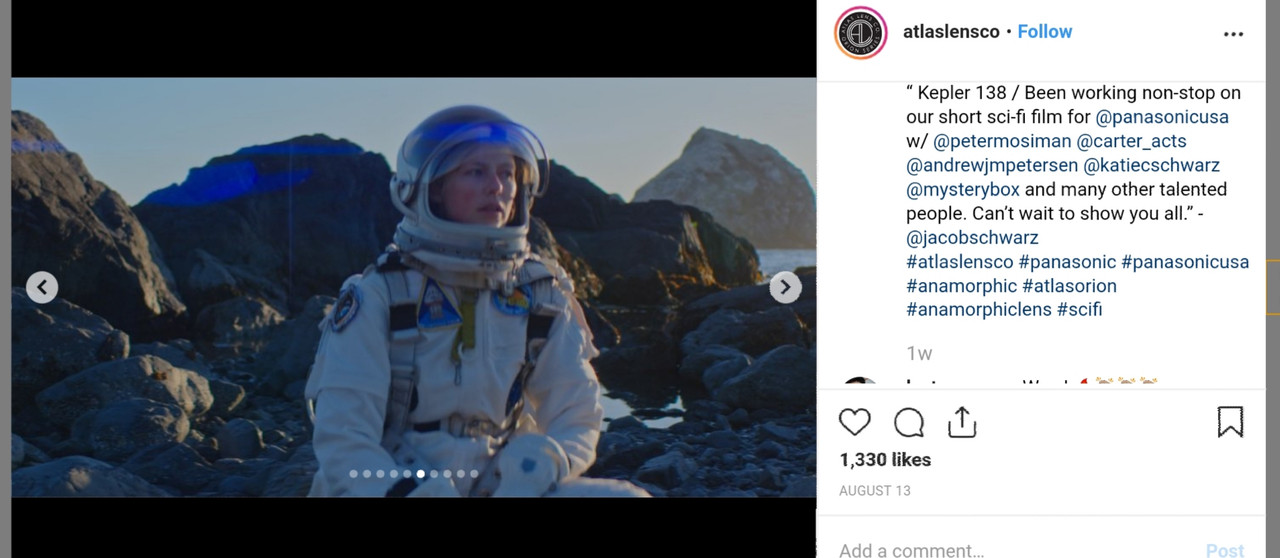
Yeah, I liked both "Kepler 138" and "Alive" on the previous page both I believe were shot with Atlas Anamorphic Lenses.


20190827-173552.jpg


20190827-173631.jpg
 
Atlas for the planet & Blackwing 7 for the earth stuff.

Hey just saw that you worked on one of the short that used the S1H. Great work BTW. I think it was the best of the ones released so far.

Care to share your thoughts about the camera/image quality/DR/post? And also compared to the high end cameras that you've used?
 
Back
Top