Welcome to our community

Be a part of something great, join today!

  • Hey all, just changed over the backend after 15 years I figured time to give it a bit of an update, its probably gonna be a bit weird for most of you and i am sure there is a few bugs to work out but it should kinda work the same as before... hopefully :)

Open Letter to Variety - Warning: this is not a short 3 line posting

TedRed

"The Mouth"
Joined
Dec 30, 2007
Messages
394
Reaction score
0
Points
0
Open letter to Variety from RED Digital Cinema.

Hopefully this will spark some spirited and interested commentary from those that frequent this forum. Please feel free to forward this to those you work with in the production and post biz that do not spend a lot of time on the forum, as it is a constant point of discussion from what I gather.

+ Ted

---

There was a recent article in Variety regarding the confusion on if it's really cheaper to shoot in Digital as compared to film.

here is the web link to the original article from a few weeks ago:

http://www.variety.com/article/VR1118008522.html?categoryid=13&cs=1

While the article was interesting to read, I think it just added to the confusion and did not offer any data or assistance on how to make the best choice regarding shooting Digital or Film as it relates to the financials.

I believe that we do a service to the entertainment community by making our best efforts to be logical and factual about the process and associated costs of shooting digital vs. shooting film.* Mentioning in the article that it is confusing and difficult to figure out I believe does not accomplish anything positive.

In our specialized RED education classes that we have been teaching in Los Angeles, we cover this in depth, and I wanted to share our findings.

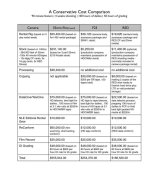
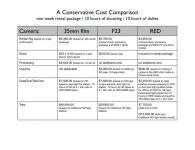
attached are two PDF cost matrix charts based on 3 perf 35mm film shooting, vs. HD tape shooting on F23 vs. Digital Data shooting on RED.

This is not meant to be a comprehensive budgeting exercise, just an overview of costs based on conservative numbers from local labs and rental companies in LA, and current film stock, digital stock, processing, data copying and prep, camera rental costs and post production costs.* There are no doubt variances in these figures based on special deals that savvy producers can cut with rental houses, labs and post facilities. *This is a starting point, based on factual data.* It clearly shows the general cost matrix of the different formats, and is a good starting point for creating a comparison of film vs. digital budget in a logical, comprehensive manner.

Note that our budget reflects using 3 perf 35mm for shooting, as this appears to be the most popular choice currently for TV and a fair amount of feature film work.* If you prefer to budget for 2 perf 35mm, then subtract 25% to the film stock and processing costs in the chart.* If you prefer to budget for 4 perf 35mm, then add 25% to those costs. *

Note that we used an average rental rate for an F23 camera package in our cost matrix as well as an average rate for both 35mm and RED camera packages.* For F35, you would budget higher for the rental, as that camera typically rents for more than the F23. The Genesis Rental rates and F23 rental rates I've been told are comparable based on current rental numbers. You can of course check with your preferred rental house for proper budgeting on 35mm film cameras, HD video cameras and RED cameras for a true comparison based on your project parameters. You will find rental rates all over the map for cameras, usually based on how the gear is maintained, the level of rental expertise, and the level of customer service provided.

Note that the charge for shooting stock of the RED camera is included in the camera rental cost in one chart, and as a line item for production to own their own media assets in the other chart. Since RED the media is re-usable, the cost of renting the appropriate amount of RED media for a one week shoot is typically very low and usually included in the rental cost of the camera equipment.

We find, and you can get many Producers, Directors and DPs that shoot RED on a regular basis to attest to the fact that it takes no longer to prep for a RED shoot than a 35mm or high end HD video shoot, and shooting style of RED is cable free if desired, just like shooting film. The RED does not require a video village tent or traditional DIT role, just like shooting film. *The RED stock and the film stock live directly on the camera body, *and RED can be shot just as quick or quicker than a film shoot. * We do recommend the modern version of a 2nd AC on RED shoots, the First AC job of focus pulling remains the same as film. * If the project is large enough, we recommend on set Data Manager, since you have the ability to take portions of the lab processing and file prep for editorial steps onto the set, or into offline editorial, as they are all data functions, requiring off the shelf computer gear.

In addition, you can take the same post pathways with RED that you do for 35mm with the exception that you replace the expensive telecine to HD tape step with a more cost effective data prep step. You can also use a modern approach to tapeless post production, end to end, for both TV delivery and theatrical delivery, *and find extraordinary cost savings over traditional methods.

We at RED believe that all these shooting mediums are all viable and good choices for high end production.* This is not meant to be a value judgement on what camera to shoot for your production, just cost matrix data and some workflow logic for budgeting.

If there are any questions, comments, thoughts regarding this.* please direct them to my email: ted@red.com. We are always happy to assist, discuss and debate for the purpose of allowing Producers and Productions to make well educated decisions.


Ted Schilowitz
RED Digital Cinema
ted@red.com
 

Attachments

  • jpeg export_cost comparison film:hd:red.jpg
    jpeg export_cost comparison film:hd:red.jpg
    88.8 KB · Views: 0
  • jpeg export_ cost comparison_ feature film.jpg
    jpeg export_ cost comparison_ feature film.jpg
    98.2 KB · Views: 0
The additional footnotes were apparently too long to all go into one single posting (it's a lot of info) So here is that info for those that are interested in even more data on the subject:

---

Some notes on the included charts for reference for those that want more information:

- Camera rental rates are based on book rates for Los Angeles based Camera rental houses. These rates are typically negotiated based on the length of the shoot, the amount of cameras, the amount of lenses and other peripheral gear included.

- Lenses are not included in this budget, as those costs can vary drastically depending on the lenses choices of the DP's and are generally a relatively similar cost between shooting any of these cameras. In many cases the lens rental budget for a feature is a significant cost, so check with your rental resource on lensing options.

- Post Production rates are based on better than book rates for services from well established Post Production houses with high end post services gear and staff for prepping dallies, doing conforms, film- outs, TeleCine and DataCine etc. These rates are highly negotiable, and rates can move drastically based on the the market the work is being done in, the type of gear and staff doing the work and other factors.

- Film Stock, Tape Stock and Film Processing Rates are based on book rates from local Los Angeles based film and tape resellers, these rates are also typically negotiated to some degree based on the amount of stock purchased.

- Hours budgeted for DI for a feature film are based on 80 hours, at $600 per hour in a high end grading theater, a good negotiated rate from book rate. DI capabilities, rates per hour and hours budgeted for a feature can vary widely. You will see quotes from 30 hours to well over 100 hours based on the style and complexity of the project, and can be preformed on DI graded gear of vastly different capabilities and price points.

- The included charge for RED media as a separate line item is an option, most rental packages at the price point we have in the cost matrix chart will include the appropriate amount of RED shooting media as part of the rental.

- NLE rental costs are a general budget number for renting a middle of the road HD capable FCP or AVID system for one month. These rates can vary quite a bit of course, and many editors own their own editing equipment and strike a package deal.

- Conforming a feature shot on 35mm film, F23 or RED demonstrates a big cost savings area between shooting film and digital. Since the film has to be re-scanned and dust busted, for the final conform. These costs do not exist when shooting digitally.

-The conform process itself can vary in cost depending on the equipment used, and many other factors. You can find conform rates for a feature film for anywhere between $7,000 and $15,000 depending on the complexity of the project and gear used.

- projects originated on 35mm film, F23 or RED can all be shot out to a 35mm film print for exhibition, this charge will usually include a negative to make the prints from, negative optical sound track, and one check print - costs are typically the same for this step, regardless of the shooting medium.

- For digital delivery for projects that do not need to go back to film for exhibition. 35mm film, F23 or RED can all be finished as an HD project and delivered on HD tape at 1080p resolution or as a Digital file for playback at either 1080p, 2k or 4k resolution. In the case of the f23, f35 or Genesis, since the recorded image is HD resolution, you would be scaling the image up to either 2k or 4k for those deliverables.

- In the case of the 35mm and RED you can deliver 4k, 2k and 1080p from the original source files, depending on how the post process was handled. Most 35mm and RED shot feature films choose a working resolution of 2k and a finishing resolution of 2k, since that is most cost effective today, and most Digital Delivery and Projection worldwide is 2k resolution. Regardless of if the theaters have 4k or 2k Digital projection installed, most DCP players are playing 2k today, although we are seeing some movement towards true 4k delivery for theaters.

As I continued to do more research on rates - here is another viewing point to compare rental rates.
(note that in this comparison, the Genesis and F35 are at a comparable rental price point, whereas I have different information on Genesis and F23 being at a comparable rental price point from another source - proving what I've been mentioning all along, that rates are highly negotiable, and there will be variances - but overall the numbers are clearly proving the price points of the various systems.

Arri 435 body only - rate $1,300.00 per day
(435 accessories, Viewfinder, Film Mags, etc. $460.00 per day)

RED ONE body only - rate $575.00 per day
(RED ONE accessories, shooting media, EVF and On Board LCD monitor, etc. $630.00 per day)

F23 Camera body only - rate $1,250 per day
(we anticipate a comparable accessory package for the F23 would price out about the same as the RED accessory package)

Panavision Genesis camera body - rate $2,300 per day
(we anticipate a comparable accessory package for the Panavision Genesis would price out about the same as the RED accessory package)

F35 Camera body only - rate $2,000.00 per day
(we anticipate a comparable accessory package for the F35 would price out about the same as the RED accessory package)

D21 Camera body only - rate $1,500.00 per day
(we anticipate a comparable accessory package for the D21 would price out about the same as the RED accessory package)


note that the F23, Panavision Genesis, F35 and D21 all require an HD recording device that is not included in their camera package rental rate. The options are either the SRW-1 deck at between $1,250 and $1,500 per day, the Solid State recorder is $400 per day including 2 digimags, and the OB1 Flash Module for F23 & F35 is $900 per day plus $100 per day for each DigiMag - so these devices increase the cost of the rental budget of these HD cameras drastically.
 
One flaw here Ted, The Arri 435 is an MOS camera. Not conducive to shooting sound. Better example for Arri would be an Arricam ST which is $1650.00 per day in 3 perf mode.
 
Good catch Alex, (and thanks for the fast response) - I thought of going with Arricam instead of the 435. Kind of a balance between lots of commercial work using the 435 or RED I guess, so that's what I went with for reference. For those that do not know Alex works at one of the most respected, major rental houses in LA, so very cool that he weighed in here. For episodic and feature sync work Arricam would be the more logical choice.

+ Ted
 
Ted, This says there is no need for a DIT. If you are shooting a feature film wouldn't it be a very key role maintaining data and image integrity? A 2nd AC is running lenses, slating and taking camera notes. I think it would be a huge mistake only having a part time data manager, such as a 2nd.

In the feature/episode world there should be a person who's only job is to backup data. Also, having a DIT allows the DP to maintain control over the image by discussing what look he is trying to achieve.

This is just my thought, but in my mind it is a key role in having a smooth Red shoot. If you tell producers they don't need it, then they won't get it.

Since most features are union data manager = DIT, right?

Brook goes into more detail about this issue on another thread.
http://www.reduser.net/forum/showthread.php?p=443603
 
I think the one line version is just pointing out that film stock and processing is a very, very expensive line item and when you remove that you'll save $60k to $200k or more depending on your shoot.

One workflow note on your 2nd pdf. With the RED, why would someone film out and then DI at 2k on film vs. do the DI at 4k digitally (and probably much less expensively) and then film out and do a one light?
 
Hi Curtis,

I'm glad you brought up the DIT role - as it requires some clarity. Since the RED shoots RAW, you have the ability to work and shoot very similar to shooting film (DP sets exposure and framing, and since any color and on set monitoring is just meta-data that lives on top of the file, totally non-destructive - the traditional DIT role used on HD cameras is only relevant if the production wants that slower, bulkier shooting style with a DIT cart, a tent to watch a calibrated monitor, etc.

In my opinion, the RED works at it most effective and efficient, when you treat it like a film camera, and use the on board and off board monitoring like the video assist of a film camera. So the DIT role changes to what I call a DT role (we take the "imaging" part out as that's the role of the DP with film and RED) The DT, Digital Tech, is also commonly known as a Data Manager, or Data Wrangler. Their responsibilities vary based on the size and complexity of the shoot, and in some cases on really big jobs, you want to have more than one of this crew position. The basic DT role is to manage the camera itself, and make the data backups of the RED media, and in some cases to do some simple on set color grading to show the DP and Director how their files will look when they get into post production.

+ Ted
 
Really useful comparison. Great post.
 
Hi,

I have never had the budget to shoot 10 hours of film in a week, however I shoot many days on film, tomorrow looks like it will be a record in economy, I am going to load 110' short end but don't expect to use it all!

Stephen
 
If I understand this correctly Ted, in your 4 week shoot we are shooting around 4 hours of footage per shooting day with one camera. And the shooting ratio is above 60:1.

If possible, just to see the other extreme, and how the numbers scale, I'd be interested to see the same spreadsheet run on a 10:1 ratio, which would be, I think, 15 hours of dailies.

Cheers,
Ian
 
On big budget, the savings don't seem high enough. A producer won't get excited to save a couple hundred grand on 25 million. They like to save money, but they hate risk just as much. The decision would need to be driven by the director for some creative reason.

On low budget indie, these numbers are no where close. You could rent a film camera cheaper then any HD camera-easy! You would never shoot 60:1, and you'd cut a deal on telecine, conform, etc. I personally would still shoot Red, but as a black & white argument, the numbers would end up being somewhat grey.

CHris
 
Love the avatar, Ted. Glad to see you back around these parts.

You can probably guess my feelings with regards to the lack of DIT and appropriate equipment rentals on the sheet, so I wont' go into much detail. I'm obviously a very pro-DIT individual... since it's what pays my mortgage. :)

I also generally insist on a significantly higher quantity of CF cards as the studios I've worked with have all insisted on maintaining the original negative for two days after exposure [in addition to a RAID 6 backup on at least 2 locations and an LTO-4 backup].

Since most larger shows seem to approach their post from the same perspective that they approach it with film, most of the saved post costs are eliminated. Somebody still has to sync and generate dailies, color correct the footage and provide coffee for those that need it.

In my experience [granted, more TV than features with the RED], the average cost savings appears to be about $50,000 per 8-day episode. All of those shows picked up an additional RED ONE camera body [a 2-camera film show becomes a 3-camera RED show], a DIT, DIT equipment rental and a lightly modified post workflow. Most of the savings came from film stock with only a little from processing [since a post house is still processing the footage into an Avid- or FCP-acceptable format].

Your statements are 110% true when it comes to building a post workflow from the ground up based around the RED. But when studios are already comfortable with a particular workflow and want to bend the RED to fit their post process... that's where the cost comes from. So when people make the statement that digital [RED] costs just as much as film, that's where all the dollar signs come from.

But the truth is that producers and studios love cost savings, no matter where they come from. The RED has proven itself as a viable option for large-budget commercials, television and feature films at this point. Most producers will do anything to save a buck, whether their budget is $1,000,000 or $50,000,000. I just gave a $30,000,000 feature a healthy discount on my equipment package. One of the TV shows I've worked on [per the contract] paid below scale. It is the nature of the beast. We will be forever doomed to quote high just to get paid our minimum.

Is digital cheaper? Yep. Is digital more expensive? Yep. Choose your own adventure.
 
In my experience [granted, more TV than features with the RED], the average cost savings appears to be about $50,000 per 8-day episode. All of those shows picked up an additional RED ONE camera body [a 2-camera film show becomes a 3-camera RED show], a DIT, DIT equipment rental and a lightly modified post workflow. Most of the savings came from film stock with only a little from processing [since a post house is still processing the footage into an Avid- or FCP-acceptable format].

That sounds about right to me, about $6000 per day. If you look at that as being represented by film and lab, that's about 10,000 feet per day (very rough number), not out of the ordinary.

Your statements are 110% true when it comes to building a post workflow from the ground up based around the RED. But when studios are already comfortable with a particular workflow and want to bend the RED to fit their post process... that's where the cost comes from. So when people make the statement that digital [RED] costs just as much as film, that's where all the dollar signs come from.

I would add to that some of the realities of high end television production. First, the notion that the monitors can be treated like film video taps is not realistic. When producers and crews know they are shooting with an electronic camera, the look of the monitor takes on greater importance, whether justified or not. Not to mention that a number of cameramen happen to like using the monitor to aid in last minute lighting tweaks. So by virtue of the fact that Red is an electronic camera, it carries a bit of baggage, intentional and necessary or not. I would also add that at this level of production, dailies are rather critical to the director of photography's well being, so some degree of control is necessary. Some shows do that by sending the material through a "traditional" facility based dailies process, and some do it by having the DIT supply post production with LUTs to either supplant or aid that process. You are also right on the money with your comments about double system sound. No matter how much Red and a lot of the posters here think it's "simple" to record sound on the camera, that is not the "standard" way of doing things in our (yours and mine) world, and is not easily accepted. It is simply faster for production to record strictly double system and have post production do the synching, and as you mentioned, this usually leads back to having a facility prep the dailies.

I would add one comment of my own. The statement that it doesn't take any longer to shoot with Red than film is optimistic at best, and wrong in many cases. It all depends on the specific production conditions, the cameraman's choices, and the desired results. Under controlled, stage conditions, film is usually shot at 500ASA or thereabouts, with Genesis and F35 achieving similar speeds. Red is not quite at that level, and this in turn, depending once again on lighting style, can lead to a need for more filling of shadows, and that in turn can become a time issue. On a day exterior, I would agree that they are relatively equal. But in controlled conditions, that is a questionable assumption.
 
Ted

Good work. You did forget dustbusting and scanning which adds another $30K to it. Not to mention the time and headache of dustbusting.

Doyle
 
I would also add that at this level of production, dailies are rather critical to the director of photography's well being, so some degree of control is necessary. Some shows do that by sending the material through a "traditional" facility based dailies process, and some do it by having the DIT supply post production with LUTs to either supplant or aid that process. You are also right on the money with your comments about double system sound. No matter how much Red and a lot of the posters here think it's "simple" to record sound on the camera, that is not the "standard" way of doing things in our (yours and mine) world, and is not easily accepted. It is simply faster for production to record strictly double system and have post production do the synching, and as you mentioned, this usually leads back to having a facility prep the dailies.

The "traditional" facility based dailies process is going bye-bye FAST.

I would add one comment of my own. The statement that it doesn't take any longer to shoot with Red than film is optimistic at best, and wrong in many cases. It all depends on the specific production conditions, the cameraman's choices, and the desired results. Under controlled, stage conditions, film is usually shot at 500ASA or thereabouts, with Genesis and F35 achieving similar speeds. Red is not quite at that level, and this in turn, depending once again on lighting style, can lead to a need for more filling of shadows, and that in turn can become a time issue. On a day exterior, I would agree that they are relatively equal. But in controlled conditions, that is a questionable assumption.

I'm gonna have to disagree on this one. I was a production manager and line producer for over a decade before I started Offhollywood. Every single film I worked on was shot on film - 35mm with a couple Super-16mm films as well. So, I know very well how fast you move on a "day to day" basis with film. I've also been on more sets shooting RED than I could count - and we've done films with DPs that shoot very different styles on RED including some ASC members and I don't think any of them would agree with your statement "it doesn't take any longer to shoot with Red than film is optimistic at best, and wrong in many cases". These films all shot the same page count in the same hours I've seen for years on film shoots - and most shot a significantly higher shooting ratio of the same or better than average page count in the same hours.

With respect to Genesis ... ANY DAY OF THE WEEK ... you can move and shoot faster with RED. That's a no brainer.
 
Good to see you back around and pumping :) absolutely LOVE the Avatar at some point I tough of exactly something like it, but with an electrical shock wave going across in symbol of when I was brought back to life by Defillibration.


Totally agreed with you Ted, I have been around quite a bit this days in wide talks about the current Sony conversion deals with Regal and AMC to convert over 11,000 Screens to 4K and the play that Digital cameras such RED and EPIC will make to this new evolution to Digital Cinemas and more then once the fact of cost came up, and I was argued the fact of the considerable savings when shooting RED, the fact of the workflow was off course also argued, but I do believe that many are truly understanding its potential and are in the road of full adaptation as Digital is the feature of Cinema and the multi Billion dollar agreements taking place among the Largest players shows surely full support to this unstoppable change, of which RED is and will continue to be a Valuable partner.


Thanks for posting it.
 
The "traditional" facility based dailies process is going bye-bye FAST.

We'll have to agree to disagree on that one. In the independent feature world, I'm sure you're right. In the L.A. based studio world - especially in television - that's just not the case. And even in the case of producers that attempt to change that, the studio will often nix it, or the circumstances of production will force the issue. Part of that is because the infrastructure here is so built up, so well known, and so efficient that changing it is considered more trouble than its worth for what amounts to a rather minor financial gain. If you don't believe me, talk to Brook.

...we've done films with DPs that shoot very different styles on RED including some ASC members and I don't think any of them would agree with your statement "it doesn't take any longer to shoot with Red than film is optimistic at best, and wrong in many cases". These films all shot the same page count in the same hours I've seen for years on film shoots - and most shot a significantly higher shooting ratio of the same or better than average page count in the same hours. With respect to Genesis ... ANY DAY OF THE WEEK ... you can move and shoot faster with RED. That's a no brainer.

Once again, all of these things are opinions. I can tell you that a number of cameramen I've talked to feel differently, and their issues are exactly what I said they were. In fact, the slower speed of Red is one of the primary factors that stopped a few shows that were considering using it from going in that direction - although I will confess that there are more than a few shows using the D21, which most shooters consider even slower than Red, so go figure. Which brings me back to my first statement....
 
Back
Top