Welcome to our community

Be a part of something great, join today!

  • Hey all, just changed over the backend after 15 years I figured time to give it a bit of an update, its probably gonna be a bit weird for most of you and i am sure there is a few bugs to work out but it should kinda work the same as before... hopefully :)

New MacPro predictions? Hopes? Fears?

Well Jarred still has love and hope for the Mac!

https://www.facebook.com/jarred.land/posts/10154583869195415

18011156_10154583868090415_8592741066288381004_n.jpg
 
You can cut off one of the 'cylinders', and lay it on its side: Closer (conceptually) to this:

https://www.dan-cases.com/

Cpu(s?) on top, gpu's underneath.

Apple will still go for most compact, even with (2) removable GPU's.

Put them side by side, maximise straight venting to the atmosphere?
 
Jarred likes what he knows so far it seems...

Though some sources still suggest no pci slots or dual processors...
 

Attachments

  • Screen Shot 2017-05-21 at 11.20.49 PM.jpg
    Screen Shot 2017-05-21 at 11.20.49 PM.jpg
    9.2 KB · Views: 0
Jarred likes what he knows so far it seems...

Though some sources still suggest no pci slots or dual processors...

For myself, I have no use for one.

Maybe a poll is in order?
 
Ok, so with the iMac Pro revealed...what do we think is in store for the MacPro? You'd think it would need to be substantially more powerful than the iMac Pro to even make sense right?

I think my biggest questions are if we'll have a dual processor option or PCI slots, and if so, how many?
 
I think it's a great question - partly because throwing lots of state-of-the-art technology isn't going to make system magically perform N times faster.

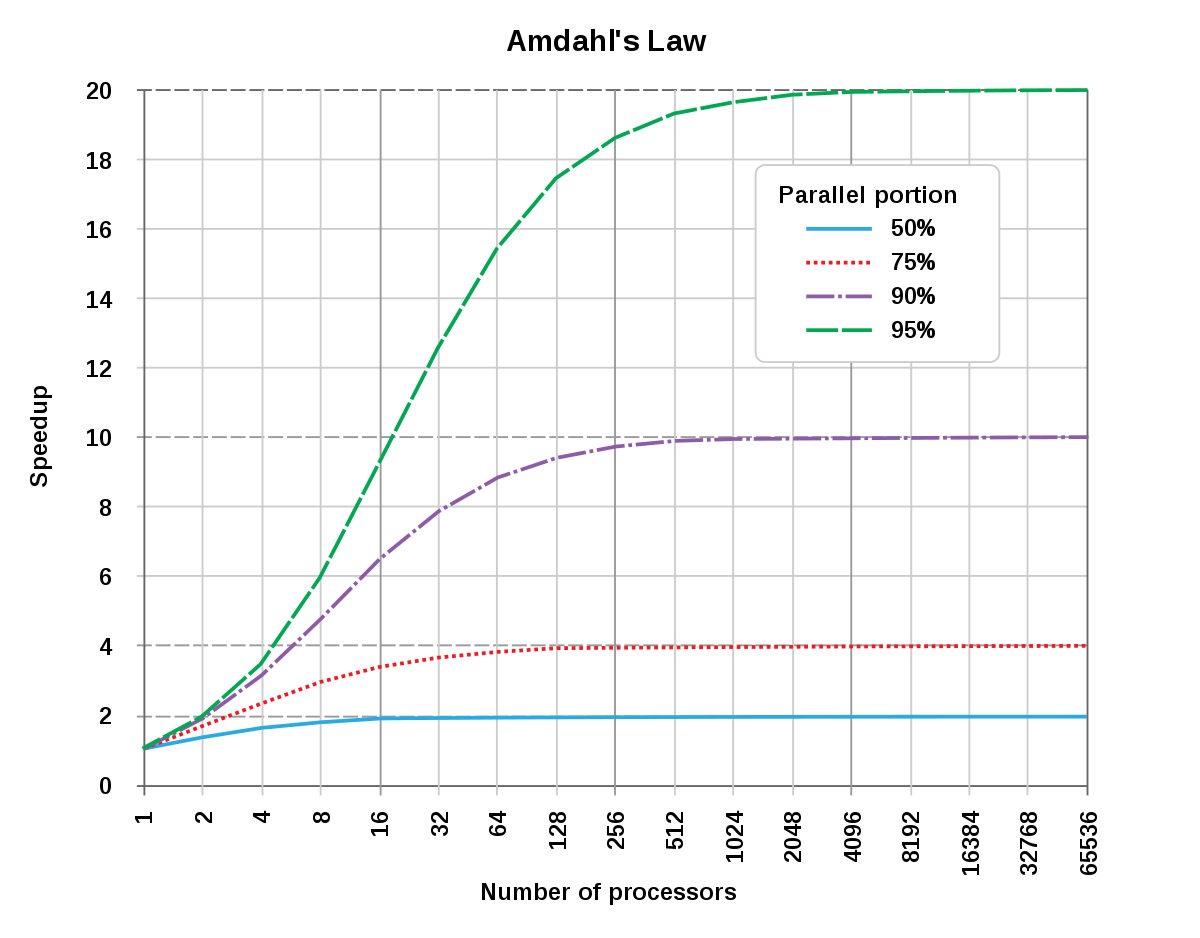
CPU cores - AMDAHLs law

+) (hypothetically) Lets say the iMac Pro had an Intel chip with 16 cores : And those cores were able to work absolutely flat out.
---> What would we expected if 32, 64 or 128 core CPU was used in its place (also able to work flat out)?

In the graph below we could expect the speed could jump from:
+) 16 cores : 'x9'
+) 32 cores : 'x13'
+) 64 cores : 'x15'
+) 128 cores : 'x17'

Or to put it another way, if there were no other bottlenecks, moving from a 16 core machine to a 128 core machine would likely only DOUBLE the speed of CPU code (ie 95% of the code was parallelizable) .

1200px-AmdahlsLaw.svg.png


CPU Frequency

When an Intel CPU reduces its base frequency from 4 GHz to 2 GHz (eg due to 'overheating') -> the performance of each core halves.

Very (very) roughly this could mean - that for average code whose ability to be parallelised was in the 95% mark:

+) A 16 core CPU running at 4 GHz - would run the code about the same speed ast a 128 core machine running at 2 GHz.

AJ
 
MacPro (2018/2019) : Answering your question with respect to 'what do we want in terms of CPU'

+) We want CPU that is able to run around 4GHz without melting
+) We probably don't need more than 32 cores (due to Amdahl law of diminishing returns).

With Intel's core design - I don't see this happening at 14nm, as too much heat is produced.

I think therefore - that if Apple stay with Intel for the next Mac Pro - we need an Intel 10nm solution - so that we can a 1 or 2 socket solution that has all cores working at 4GHz.

If Intel offers a Core-to-core (technology based on Knights Landing '14) that is a Mesh (ie just like the direction ARM are heading in the CMN-600) rather 3 big rings - this would reduce the number of 'hops', and allow regular software to worked more efficiently in a parallel fashion (for large core counts).

With AMD's design : N x Zepplin's = N x 8 Zen cores (glued together) using GloFlo 14nm technology.

Many computer science folks would say that 8 cores is the 'sweet spot' (look at the change in gradient of the Amdahl graph), and so this solution is not as crazy as it might appear.

However the parallel utilisation of these cores is reduced due to the latency inter-Zeppelin (ie doesn't scale as perfectly as if all the cores were on one SoC). With smaller SOCs however, AMD are finding it easier to drive them nearer 4GHz.

If AMD is able to justify using the DOE's exascale investment towards bringing their 7nm rollout - Forward - they may just have something that we 'want' in the tail end of 2018.

+) Gloflo 7nm : Risk production (ie test chips) : 2018 H1
+) Gloflo 7nm : Is roughly the same as Intel 10nm (this is a HUGE jump for AMD)
+) 60% less wattage.


This alone would allow AMD to release the Same design - but running absolutely all the cores Flat out (if they wanted)
But armed with this Extra SOC area .. AMD could now add value to their Zeppelin design.

+) Zen2 core : With more area - AMD could now add the missing hardware acceleration that had to hit the chopping block.
+) PCIe 4 : TWICE the inter-SoC bandwidth (which mean half the intersoc latency / and probably dissolves the Intel advantage of 'All on one SOC solution')
+) And .... even 16 cores on one SoC (speculation)
+) 128 x PCIe 4 channels. (speculation)


Which CPU?

At this point in time - I would rather upgrade to an Affordable 32 core 2 socket AMD solution based on 7nm than a Intel 10nm solution.

128 PCIe 4 lanes would be a monumental jump, enough to satisfy a boat load of GPU and external connectivity.

AJ
 
Last edited:
Seems to be the stackable blade system I suggested last year. Jeff probably knows, he's under NDA, used to Luke the z1 except the processors.

I wouldn't mind trying to do a small cube system like the 1kw Mac Mini like suggestion I made before.

I've got a very good idea firming in my head. Put the card slits under the main board, upside down. Out a massive heat sink across the main board, directly on top, and put as many cores as you like on the board, underneath the cards are cooled conventionally. Would allow higher speeds. Now, put a liquid cooling tank between the main board and a card board suspended under it, to give two sided cooling. More speed. But why not just ha e a massive flat horizontal GPU board to match the main board size above, why not liquid cool in between. Why not extend the length of the board put the cards there, and heat sink or liquid cool the lot. In a long thin case with heat sink, this might lay across a table and deliver heaps of performance compared to the macpro existing, if it could receive the top CPU and GPU available. We are talking 4 CPU's+ and 4 GPU+, with possibly direct fabric between CPU GPU and memory group, between groups and between each other on a board the length of a full length GPU card by 15 or 20 cm, or twice the size on a side by side combined card. Now better coming again can be used as outlined previously.
 
This is all interesting conjecture but Apple will never ship a Mac Pro that does not have Thunderbolt.

They will choose 3 or 4 chips from the Xeon v5 range and that will be it.

I hope they will offer in in 2P configurations but I wouldn't be surprised if they didn't.
 
Nice charts AJ, but it doesn't cover what can be done to customise the cods, or in data sets, like ours, where far more parallel cores are possible than normal. Also, maintaining the same speed over large core counts.
 
Last edited:
My Hope for a Mac Pro 2018/19:

+) 32 GB HBM2 : VEGA 20 card : 25 TF FP32 (Ie Navi 7nm)
+) 2 Socket : AMD ROME (7nm) @ 5GHz
+) 128 Lanes of PCIe 4
+) Ability to connect 4 GPU cards (AMD or NVIDIA)
+) 8 x Memory channels
+) 256 GB RAM
+) 8 TB SSD

... $20,000


As DJ mentions - TB3 would present a headache for Apple. Perhaps Apple 'required' that Intel licensed out TB to overcome this? (rampant speculation).

If Apple go the Intel CPU route, we might end up with a PC that cost more than the camera!

AJ
 
PCI 4 has been released in the last week or so, and pci 5 announced fast tracked to 2019 or 2020, I forget. So, the next few TB are probably on their way. Still, where is the 100Gb/s we were promised years and years ago.
 
As AMD underpins the Infinity fabric with PCIe - they need to make sure that products using v3 will play ball with the Zen2 cores (on PCIe 4) coming in 2018.

+) 2017 on price & perf : AMD are going to turn heads.
+) 2018 with GF 7nm 5GHz : AMD are going to bite into Intel profits.
+) 2020 HVM (high vol manufacturing) on 5nm (IBM) at GF : Moore law hick-up : Punters may will be looking for 'AMD inside' stickers.

AJ
 
Moore’s Law hiccup (hick-up)?

You mean the “law” that’s been re-written and re-interpreted and re-represented over the years? Moore’s Law is not an actual law or physical constraint or any such thing. It’s a business model. Always has been, always will be.

IMO, I think the PCIe based Infinity Fabric is a mistake. It simplifies a great many aspects of interconnecting CPU modules and leads to a quicker scaling up of core count, but will not provide the same level of interconnect throughput. For now it’s a solution. It’s not going to be a great solution by the time we move past 64 cores. Or perhaps it will be if you subscribe to Amdahl’s – which is an apologists’ excuse which approximates the shortcomings in common code parallelism and throughput inefficiencies as applied to current and known designs on the x86 platform. Once again not any physically binding law or constraint.

So far, all the new AMD products I’ve got my hands on have proven to be a great performance alternative for the money. They’re not beating Intel at the top offerings levels yet, and probably won’t in the foreseeable future. Yet from what I saw of the 16 core ThreadRipper, it seems to deliver 80~85% of the performance of Intel’s top 16 core offering for half the price. That’s significant. My 8-core Ryzen build is underwhelming. Only money saved was on CPU cost. All other components remain the same, so total savings on the full build was less than 3% vs. Intel. They’re not changing any part of the game on that end of the field, just offering up an alternative. Cost savings for lesser builds could be a lot higher by percentage, but still not industry shattering by any means.
 
Competition is good. Intel needs a good kick in the ass.
 
Moore’s Law hiccup (hick-up)?

You mean the “law” that’s been re-written and re-interpreted and re-represented over the years? Moore’s Law is not an actual law or physical constraint or any such thing. It’s a business model. Always has been, always will be.

IMO, I think the PCIe based Infinity Fabric is a mistake. It simplifies a great many aspects of interconnecting CPU modules and leads to a quicker scaling up of core count, but will not provide the same level of interconnect throughput. For now it’s a solution. It’s not going to be a great solution by the time we move past 64 cores. Or perhaps it will be if you subscribe to Amdahl’s – which is an apologists’ excuse which approximates the shortcomings in common code parallelism and throughput inefficiencies as applied to current and known designs on the x86 platform. Once again not any physically binding law or constraint.

So far, all the new AMD products I’ve got my hands on have proven to be a great performance alternative for the money. They’re not beating Intel at the top offerings levels yet, and probably won’t in the foreseeable future. Yet from what I saw of the 16 core ThreadRipper, it seems to deliver 80~85% of the performance of Intel’s top 16 core offering for half the price. That’s significant. My 8-core Ryzen build is underwhelming. Only money saved was on CPU cost. All other components remain the same, so total savings on the full build was less than 3% vs. Intel. They’re not changing any part of the game on that end of the field, just offering up an alternative. Cost savings for lesser builds could be a lot higher by percentage, but still not industry shattering by any means.


What is it what you don't like about Infinity Fabric it scales nice with the speed of the RAM DDR 2133..3200 (4000 work in progress) so 16 x (3200/2) x2= 51,2 GB/s bi-dir?
When do you expect 64 core CPU's?
Which intel Xeon is faster then amd's EPYC 7601.
I haven't seen Threadripper yet but the fastest 16 core intel i've seen is the Intel® Xeon® Processor E5-2697A v4 at 2,6 GHz baseclock 3,6 MHz max Turbo at around $ 2.800,-
Ryzen 8 core is a consumer processor that compets with intel dual channel memory processors up to i7-7740k
 
64 cores are not a high core count, just for complex processors like x86.

Jeff, but the cost savings on an 32 core Intel xeon to 32 core and..

But the what about the supercomputer node version? I think it aims only at 10 tflop per node with GPU and that cube memory die architecture. However, it maybe no bottlenecks there, lead to a significant speed up compared to a normal version.
 
Back
Top