


david farland
Well-known member
Lovely (second) shot of Jendra's where she's metered/shot very well: http://www.floatingcamera.com/RED/redSpain_L.asp
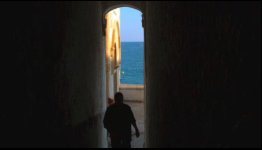
couple of things thou.....
- Seems like the light/dark limits have a large dynamic difference but do you think you could see 11 individual stops through the complete range of this shot?
I believe the Red sensor can differentiate 11.3 stops or 30 something 1/3 stops on a Stouffer grey scale chip chart when the white point is known and you're looking from black to white (down the middle of your 3D color gamut. But what happens when colour is required?
When Dop's say the Red camera has 7,8,9 stops of usable range and 'scientists' (sorry Graeme) say it has >11 stops, what accounts for the difference?
Is it the introduction of colour?
How many luminance stops have you got when you move off your image white point, to a saturated colour, say to a dark/saturated Red or Blue ?
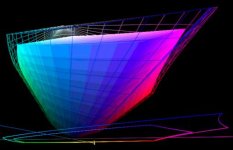
They're all different ranges. See example 3D color gamut here.
Say a section of the bayer filter now has to define light/dark within a colour... say its red.
This is gotta limit the effectivness of the green and blue pixels and introduce noise/loss of resolution/loss of neighbouring pixels to help resolve fractions of tone.
- Or am I completely wrong.....is chrominance completely independent of luminous dynamic range? Say I have a 4x4 pixel grid. Out of the 16 pixels, 8 are green, 4 are red and 4 are blue. I move it down a Stouffer strip & can resolve 11.3 stops of them. Now I colour those grey squares to red. Will I be able to resolve as many individual squares?
Dave
couple of things thou.....
- Seems like the light/dark limits have a large dynamic difference but do you think you could see 11 individual stops through the complete range of this shot?
I believe the Red sensor can differentiate 11.3 stops or 30 something 1/3 stops on a Stouffer grey scale chip chart when the white point is known and you're looking from black to white (down the middle of your 3D color gamut. But what happens when colour is required?
When Dop's say the Red camera has 7,8,9 stops of usable range and 'scientists' (sorry Graeme) say it has >11 stops, what accounts for the difference?
Is it the introduction of colour?
How many luminance stops have you got when you move off your image white point, to a saturated colour, say to a dark/saturated Red or Blue ?
They're all different ranges. See example 3D color gamut here.
Say a section of the bayer filter now has to define light/dark within a colour... say its red.
This is gotta limit the effectivness of the green and blue pixels and introduce noise/loss of resolution/loss of neighbouring pixels to help resolve fractions of tone.
- Or am I completely wrong.....is chrominance completely independent of luminous dynamic range? Say I have a 4x4 pixel grid. Out of the 16 pixels, 8 are green, 4 are red and 4 are blue. I move it down a Stouffer strip & can resolve 11.3 stops of them. Now I colour those grey squares to red. Will I be able to resolve as many individual squares?
Dave
Last edited:


