Welcome to our community

Be a part of something great, join today!

  • Hey all, just changed over the backend after 15 years I figured time to give it a bit of an update, its probably gonna be a bit weird for most of you and i am sure there is a few bugs to work out but it should kinda work the same as before... hopefully :)

Mysterium's dynamic range

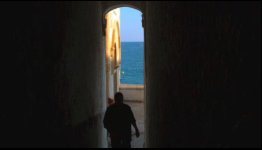
Lovely (second) shot of Jendra's where she's metered/shot very well: http://www.floatingcamera.com/RED/redSpain_L.asp
jendra.jpg
couple of things thou.....
- Seems like the light/dark limits have a large dynamic difference but do you think you could see 11 individual stops through the complete range of this shot?

I believe the Red sensor can differentiate 11.3 stops or 30 something 1/3 stops on a Stouffer grey scale chip chart when the white point is known and you're looking from black to white (down the middle of your 3D color gamut. But what happens when colour is required?
When Dop's say the Red camera has 7,8,9 stops of usable range and 'scientists' (sorry Graeme) say it has >11 stops, what accounts for the difference?
Is it the introduction of colour?
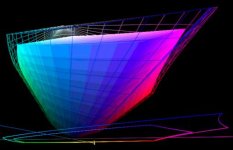
How many luminance stops have you got when you move off your image white point, to a saturated colour, say to a dark/saturated Red or Blue ?
They're all different ranges. See example 3D color gamut here.
3D colour.jpg
Say a section of the bayer filter now has to define light/dark within a colour... say its red.
This is gotta limit the effectivness of the green and blue pixels and introduce noise/loss of resolution/loss of neighbouring pixels to help resolve fractions of tone.

- Or am I completely wrong.....is chrominance completely independent of luminous dynamic range? Say I have a 4x4 pixel grid. Out of the 16 pixels, 8 are green, 4 are red and 4 are blue. I move it down a Stouffer strip & can resolve 11.3 stops of them. Now I colour those grey squares to red. Will I be able to resolve as many individual squares?
Dave
 
Last edited:
What accounts for the difference - noise tolerance and grading decisions. Jendra's lovely shot has all the tones in it, from dark through to bright. No clipping at the top, and there's detail right down at the bottom. But it's graded so that dark things stay dark. Grade it up so that you can see every detail on the stone walls and the guy's face is as bright as day and it looks noisy. But for the intended use of the shot, the given grade, there's detail from top to bottom and no distracting noise. You can even brighten up the shadows a bit more to see a bit more detail there and still have the image more than acceptably noise free.

Graeme
 
Would love to see a 3D color/luma plot of R1's sensor!!
Dave

ps: what I'd really love to see is a 3D color plot (as above) of film (log) versus a digital sensor (linear)
 
I am a still shooter and would like to know how the Scarlett dynamic range compares to Canon or Nikons pro DSLRs.

Thank you.
 
What accounts for the difference - noise tolerance and grading decisions. Jendra's lovely shot has all the tones in it, from dark through to bright. No clipping at the top, and there's detail right down at the bottom. But it's graded so that dark things stay dark. Grade it up so that you can see every detail on the stone walls and the guy's face is as bright as day and it looks noisy. But for the intended use of the shot, the given grade, there's detail from top to bottom and no distracting noise. You can even brighten up the shadows a bit more to see a bit more detail there and still have the image more than acceptably noise free.

Graeme


Hey everyone, I just found this thread. Haven't been around Red User in awhile. To answer some questions and interpretation.

1) It was just an extreme contrast situation. I used no special filters (maybe an overall ND?) and this was shot on Build 8! It is as extreme an exposure situation as you can get. Direct sun on a white stone building at the end of the tunnel, and no direct light inside the tunnel.

2) The shot as graded in my demo that you guys are referring to has a lot of contrast added in the grade. There's probably 7 stops or less of range in there now.

3) The important thing everyone is talking about is the difference between scientifically measured stops and usable stops. I have conservative taste when it comes to noise and I usually only find 7-8 stops usable to my taste (depending on intended screen size and subject matter) So yes, in my test shot you can technically read deeper and deeper into the shadows, but I would never USE picture information that is getting as noisy as we are talking about here.

That said, I graded it how I liked it to look: dark and dramatic. I could have graded the shadows much lighter than you see here without them being noisy.
 
3) The important thing everyone is talking about is the difference between scientifically measured stops and usable stops. I have conservative taste when it comes to noise and I usually only find 7-8 stops usable to my taste (depending on intended screen size and subject matter) So yes, in my test shot you can technically read deeper and deeper into the shadows, but I would never USE picture information that is getting as noisy as we are talking about here.

Yes, that's the main issue, it's a matter of personal taste and artistic intent just how many stops in the bottom range you want to actually use and see detail in. Many of us like deep, rich blacks and are willing to bury some information near the noise floor to get there, but this means that we are not using the full dynamic range of the sensor for visible picture detail.

Same goes for shooting film negative too, you rarely see all 14+ stops of dynamic range, either for creative reasons or because you want to bury the bottom end to get deeper blacks. No one really expects to pull-up shadow detail off of a film negative that is six or more stops underexposed, even if it's there, because the grain would become too visible.

But if you don't have a wide dynamic range to begin with, you have less flexibility in color-correcting in order to get an image that looks simultaneously rich and contrasty, with deep blacks... and yet does not appear tonally-limited and crushed-looking.
 
What accounts for the difference in my mind is the placement of 18% in LUTs (or whatever they're called...). The red may very well have 11 full stops of dynamic range (depending on how you measure), but I'd wager that 6-7 of those stops are below middle gray with 3-4 above. Whereas with 5219, you might get something more evenly divided, with half above and half below. The problem is, most people like highlights soft and shadows inky, which means in many cases you lose all but a few stops stops below 18% gray once you grade, at which point the red is 3-4 stops above that and negative film might have 6-7 stops above that or something. The other problem is that CMOS noise looks much, much worse than film grain, so while it looks fine having shadows on film go into grain, if your red footage is that noisy it does not really look acceptable. This makes the value of the darkest couple stops very questionable.

Of course, you could rate red at 800-1000ISO and redistribute a stop or two of dynamic range into the highlights. (Though you'd have to actually rate at 250ISO (even if you meter higher) when developing and use a curve since Redaltert throws out potential highlight data unless you do this.) But then you get posterization and poor color rendition because you're putting such a huge vast majority of your linear data above skintone. This is something of an issue for all digital cameras, however, although the highest end cameras and particularly the Genesis do something about it (via selectively ND'ed photosites and the panalog format, etc.).

It's not that bad, though. The red has good dynamic range, the best antimoire I've seen, and nice highlight rolloff, just nowhere near 5219 or something yet.
 
Last edited:
The other problem is that CMOS noise looks much, much worse than film grain, so while it looks fine having shadows on film go into grain, if your red footage is that noisy it does not really look acceptable.

There are many types of noise. Some of them affect the raw data itself and are very ugly, like pattern noise and speckle noise. But many CMOS sensors are so well engineered that they don't have any pattern noise or speckle noise whatsoever, even when you use all the dynamic range. All they have is nice, clean, random noise (often follows a 1/f or Gaussian distribution). One example is the $500 LX3 digicam, whose noise is nice and beautiful even when you use a full 10.6 stops of dynamic range.

But most people never see that true raw CMOS noise, only the compressed and post-processed image, which can turn nice, random noise into clumpy, ugly noise.

My point is that it's possible to have beautiful, random CMOS noise.

Of course, you could rate red at 800-1000ISO... But then you get posterization and poor color rendition because you're putting such a huge vast majority of your linear data above skintone.

That does not cause posterization if the post processing is setup for it (e.g. proper dithering in a 10-bit log format, or just upping to 16-bit linear). It doesn't have to affect color rendition either, but it will unless the post processing is designed to handle it.
 
That's true that CMOS noise varies in degree and is exacerbated seriously by compression, but even the best-engineered sensors exhibit some fixed-pattern noise--and weird artifacts and clumps or hot pixels, sometimes even just by virtue of debayering artifacts. I've seen this on the red, but it's not too bad. Silver crystals on film are neither fixed in size nor position, so just by virtue of that film grain is more random and more pleasant than digital noise on any sensor, CMOS or CCD.

Pushing red footage to 800ISO may not cause substantial posterization around 18% gray, but push it much further and it will get bad. The camera, like most digital cameras (excepting the Genesis, Fuji SuperCCD, etc.) records linear data then applies a curve to bring it closer to a logarithmic response. So, by virtue of that, each stop brighter has an order of two more raw information than the last. (I may be mistaken about this and I know it's not precisely like this.) This is why digital photographers emphasize "expose to the right." When captured raw (linear light), the brightest stop has effectively twice the information of the second brightest, and so on and so forth. I've seen dark walls posterize quite quickly on the red around 1000ISO (unless you crush the blacks). And posterized noise is just the worst.
 
That's true that CMOS noise varies in degree and is exacerbated seriously by compression, but even the best-engineered sensors exhibit some fixed-pattern noise--

Not at all. I can send you a stack of raw files from a variety of cameras with absolutely no pattern noise what so ever (fixed or variable). I already mentioned the LX3, which is a mere $500 digicam. Check out the LX3FARI0080.RW2 raw file on imaging resource: no pattern noise anywhere, even the deepest shadows. As I said, you can go 10.6 stops into the shadows without even a hint of pattern noise. There's also the G10. Here is the raw data of a bias frame before black clip, with the range of 40 values stretched to 0-255 for noise evaluation:

G10readnoise.png


Looks nice and random to me. The D3X is another camera with no pattern noise, and it can do 14 stops of dynamic range at normal print sizes.

So, by virtue of that, each stop brighter has an order of two more raw information than the last. (I may be mistaken about this and I know it's not precisely like this.) This is why digital photographers emphasize "expose to the right." When captured raw (linear light), the brightest stop has effectively twice the information of the second brightest, and so on and so forth. I've seen dark walls posterize quite quickly on the red around 1000ISO (unless you crush the blacks). And posterized noise is just the worst.

None of that is correct. May I kindly suggest that you read the following thread starting at post #197?

How linear systems relate to posterization.

It explains why much of the common "wisdom" is incorrect.
 
That noise looks convincingly random, even if I've never seen a motion picture camera produce anything like that. (And personally, I still find film grain more aesthetic since you've got multiple scales of texture introduced by the variable size of crystals in the emulsion, but that's a moot point.) Honest question: could you get that random capturing 24fps, though, or would you introduce a fixed pattern at some point?

Your argument that the noise threshold makes the bit depth irrelevant is convincing to a point, but I've brought red files up to 1000ISO and seen obvious posterization that looks a lot like the 8-bit or even 7-bit files posted at the other thread. Sure, that's anecdotal, but the look was pretty hard to mistake. I haven't done the math, but the combination of pushing an exposure two stops purely from metadata and going deep into the shadows visibly introduces posterized noise. As it should; 12 bit linear light two stops underexposed is effectively captured at 3 bits. Admittedly, those areas of the image are probably far enough into black that there would be little detail there irrespective of bit depth, proving your point that photon noise exceeds quantization error, but smooth noise still looks better than posterized noise.

Furthermore, the red is noisy enough, compresses semi-uniform areas enough, and introduces enough artifacts from debayering or LUTs (or whatever) that you can't cite perfect theory to back it up. Even if the theoretically perfect camera results in undithered, random noise even when you dig that far into underexposure, the red just doesn't.
 
could you get that random capturing 24fps, though, or would you introduce a fixed pattern at some point?

Getting nice, random noise at 24fps is certainly more difficult, but possible.

Your argument that the noise threshold makes the bit depth irrelevant is convincing to a point, but I've brought red files up to 1000ISO and seen obvious posterization that looks a lot like the 8-bit or even 7-bit files posted at the other thread. Sure, that's anecdotal, but the look was pretty hard to mistake.

If that's true, then there are only two possibilities: the first is that the particular RED ONE sensor used in that shot had much, much less noise than most of them, and therefore needed far more than 12 bits, and therefore hit quantization limits.

The second and more likely cause is that the REDCODE compression caused the posterization.

But without seeing the R3D file myself I would sooner suspect the posterization is caused by post processing (e.g. applying noise reduction or using 10-bit log instead of 16-bit int, etc.) or the display itself.

Furthermore, the red is noisy enough, compresses semi-uniform areas enough, and introduces enough artifacts from debayering or LUTs (or whatever) that you can't cite perfect theory to back it up. Even if the theoretically perfect camera results in undithered, random noise even when you dig that far into underexposure, the red just doesn't.

Agreed, but I was responding to your comments about "CMOS noise", so my comments were about sensors in general, not just the RED ONE.
 
You're almost certainly right that the posterization I saw was related to compression or post-processing, not bit depth alone. (Though it could possibly have been exacerbated by a blue channel pushed really hard, since it was 3200K footage under an older build.) And my entire knowledge of CMOS is from just what I've read about it and using the red, the ex1, Canon's dSLRs, the d90, the hv30, etc., none of which perform at theoretical perfection (though they're all great cameras).

Anyhow, you know so much more about this than I do that it's almost pointless for me to argue, anyway, and thanks for the link on photon noise vs. quantization precision; that's interesting and surprising.

My point about the red's dynamic range (when developed traditionally) being mostly in shadows and film's being mostly in highlights still stands, I think, but maybe my reasoning is flawed and it's not the big problem I thought. It certainly seems like there will be better solutions than Panavision's selectively NDed photosites forthcoming.
 
All traditional image sensors, all being clip-limited at the bright end of things have all their DR in the shadows. RED is no different from any of them in this regard. Film has three regions in it's DR, a toe where shadows are compressed, a linear section, and a knee where highlights are compressed. Traditional sensors just have the linear section. If you look at the curve for film, most of it's DR is in the linear section though.

For what it's worth, I've never seen posterization artifacts in R3D footage. I've stretched and manipulated the data more than practically anyone else, and you just don't see it.

Graeme
 
Here is the raw data of a bias frame before black clip, with the range of 40 values stretched to 0-255 for noise evaluation:

G10readnoise.png


Looks nice and random to me.

Looks a bit clumpy towards the upper middle going to the right then down the right side, then across the bottom then up the left side, getting less and less darkish clumps as you go along reemerging on the upper middle left side, and a few other things less noticeable (like the slight banding from dark to light to dark to light top to bottom, wherever this is a function of exposure or noise grouping I didn't examine).
 
Back
Top