Welcome to our community

Be a part of something great, join today!

  • Hey all, just changed over the backend after 15 years I figured time to give it a bit of an update, its probably gonna be a bit weird for most of you and i am sure there is a few bugs to work out but it should kinda work the same as before... hopefully :)

Mysterium's dynamic range

.......The Mysterium sensor uses 12bit analogue to digital converters, so the practical and theoretical limit is somewhere between 11 and less than 12 stops.
Graeme
Can someone show me to some footage or still, that exhibits 11 stops thru the range?

Dave,
 
Jendra Jarnagin sent me some test footage that she'd metered at 12+ stops range from highlight to shadow, and I could still see detail in the shadows. Now, that's impossible on a RED One, but non-the-less I could see it.

Graeme
 
I'd be humbly gracious for 12, 11, 10 stops of anything.

Here is John Beale's R3D file from his RED ONE dynamic range tests.

If you want a less scientific test, I would suggest Jim's demonstration that 9.5 stops are usable, except that the pictures are gone now (due to the great forum heart attack).

Here is another factor to keep in mind: it's possible to trade resolution for dynamic range. That is, display size and resolution greatly affect dynamic range. The normal assumption is very large displays at full resolution (4K). But it should be said that for every factor of two decrease in resolution, dynamic range goes up 1 stop.

If you downsample to Youtube sizes (256x144) or show it on a mobile phone, the noise (and detail, of course) will be so much lower that the "engineering" dynamic range is four stops higher: 15.3 stops instead of 11.3 stops. If your personal tolerance for noise results in rating the RED ONE for only 9.3 stops of dynamic range at 4K, then you will consider the Youtube version to be 13.3 stops of dynamic range.

Of course for most folks none of that matters because they would rather keep 4K resolution than trade it for dynamic range.
 
Jendra Jarnagin sent me some test footage that she'd metered at 12+ stops range from highlight to shadow, and I could still see detail in the shadows. Now, that's impossible on a RED One, but non-the-less I could see it.

Graeme

I've always wondered about that shot... I assume it's the one from Spain if memory serves... looking down a dark corridor out to the sea?

I've often wondered if the 12th stop of apparent DR was a result of something else... a noise pattern that happened to match the makeup of the bricks. Something like that. I wish I could replicate that shot.

My personal tests resolve a max of 11 to 11.3 stops of theoretical range in daylight... though the darker stops are as noisy as one might expect.

The mystery of that shot lives on... ;)

I've got the R3D laying around here somewhere...
 
Yes, it's the second shot in. There are no clipped highlights in the shot, and the side of the bright building is about 12 stops brighter than the darkest shadow nearest us. Brighten that up and you can see the texture on the rough wall (no bricks) right down there. It's quite incredible, really. Lovely shot. I use it all the time when I need a shot that has good detail over the full range and is not boring like a stouffer wedge.

Graeme
 
So what do you think contributed to such a wide dynamic range? Because this is obviously a "usable" shot, this isn't something in a lab shooting a chart, and from what I understand the dynamic range isn't just coming from being downsampled.

I mean, I am not claiming she's "cheating" but could she have used a gradated ND filter or something? Just like some filter that would dampen the highlights in the center, while not effecting the shadow areas?

Or shooting the hallway alone, exposing for it, then exposing for the highlights, shooting again, and letting him walk in, then cutting out a matte and compositing them together?

It's just if it's supposed to be impossible with the camera by itself, what could she have done to gotten that wide a dynamic range?
 
I wouldn't put too much store by my Stouffer chart test just because that was build 12, and the camera has come a long way since then, so I'm told. Shortly after that test, my daughter was born and I've been too busy to find another generous camera owner to loan test time.
 
Dynamic Range and other eternal questions

Dynamic Range and other eternal questions

It's just if it's supposed to be impossible with the camera by itself, what could she have done to gotten that wide a dynamic range?

I think for many users of this camera, the "real world" tests are the ones that matter, and if the pictures look good then they are good.

However, if you are interested in theory, you might consider that the Red One has some non-negligible IR sensitivity. Sunlight does have significant IR content and that can throw off meter readings if your meter does not have exactly the same IR response as the sensor.

Lenses and optical surfaces are another interesting question: when you consider something approaching 12 stops of intensity, even very subtle diffusion, lens flares and stray reflections can contribute to the texture of the darkest parts of the image. These effects would not reveal true image information, but they might suggest shapes in the dark noise pattern which have the appearance of real detail.

I'm leaving aside all the HDR techniques like multiple exposures, etc. which do of course permit much greater "true" DR in the final output.
 
If Mysterium is aroung 11.5 stops, then Mysterium X will be 12.5 and Monstro 13.5 stops?
 
I don't know if it's a linear increase like that.

With some of the sensors they are going to have an increased bit depth, larger sensors, and more photosites. So with a 6K FF35 Scarlet, it should have an increase in dynamic range, and THEN when you downsampling that to a 4 or 2K output, that is an additional increase.

So I don't know how much of a dynamic range increase we're going to see, but it can be assumed that it will be a decent amount at the very least.
 
Don't forget that currently raw files are encoded as 12-bit linear, so impose an absolute 12-stop dynamic range anyway, regardless of what the sensor can capture (which is significantly less than 12 stops, as previously pointed out).

Linearly bits and stops should match, but you could have four stops per bit (or 1.25 or a million, though you would probably be fried before you got to the first bit) that breaks the relationship, but that is also what various real world external filming techniques can achieve. Film, and our eyes, also uses a non-linear response, and you can fit your 16 stops into twelve this way. A linear response looks unnatural. You also get the problem of where the blacks are chopped (it can theoretically start at any stop but the visible stops be based on real world stops rather than each other, giving nonlinearity between them, such as if you cut off the bottom to rid some noise).

I'm leaving aside all the HDR techniques like multiple exposures, etc. which do of course permit much greater "true" DR in the final output.

Yes, multi-slope is like this, would be handy for scarlet fixed lens in video use.

On sensor pixel binning (multiple pixels can be electronically linked up for lower resolutions) can increase latitude to. So, the basic scarlet (I assume) would become useful for 720p (maybe one stop) with larger sensors 1080p could get a number of extra stops.
 
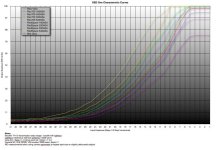
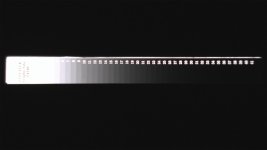
I did a DR test on build 17 a while ago, using a stouffer backlit step wedge. This provides 13 2/3 stops scene dynamic range to the camera, and the camera captured 8 1/3 stops of that. See attachments for all data.

Film, and our eyes, also uses a non-linear response, and you can fit your 16 stops into twelve this way.

Can you explain how I could have fitted all 13 2/3 stops of scene DR into the 8 1/3 stops captured?
 

Attachments

  • Red_T4110_curves.jpg
    Red_T4110_curves.jpg
    92.5 KB · Views: 0
  • Red_T4110_still.jpg
    Red_T4110_still.jpg
    67.1 KB · Views: 0
I did a DR test on build 17 a while ago, using a stouffer backlit step wedge. This provides 13 2/3 stops scene dynamic range to the camera, and the camera captured 8 1/3 stops of that.

Long time ago there were tests like yours (with the stouffer chart) before build 16 was released and we could measure a little bit more than 10 stops (some of them grainy as you can imagine). I can't remember which thread it was but it had photos too like the one you posted.

The R3D development in post is very important in maximizing RED's dynamic range. I think it's an art by itself. :-)
 
Jendra's shot is a great example. I'd be curious to see it in full resolution, and I'm also interested to know how it was shot (any filtration, etc.). One of the things I have been skeptical about is seeing small resolution compressed clips when trying to determine DR or latitude as that tends to hide things that I may find objectionable to my taste.
 
Noise tolerance is subjective, therefore the DR numbers are hard to pin down. In my real world experience, 8 is conservative and 11 is a bit optimistic.

In practical use I tend to use a bit more fill and "print down" to get quieter blacks. I like that look.

Evin prefers more "texture" and on most material he shoots he uses small amounts of noise the way one might use grain.

In the immortal words of Sean Fairburn: test, test, test.

Cheers - #19
 
Can you explain how I could have fitted all 13 2/3 stops of scene DR into the 8 1/3 stops captured?

Just reviewing what I wrote, and I am starting to mix-up my bits and stops here.

There are two ways here. If you have 16 linear bits (16 stops), you can squeeze those bits down to match 12bit values (obviously dropping and/or interpolating some to match the 12 bit values), usually you produce an artificial non linear response curve (like film, or our eyes do). If you do it linearly straight, then the bottom four or top four bits will disappear into either the bottom or top bit of the twelve bits respectively. But basically, the sensor has to capture the stops in the first place, and the cameras capture process has to perform the conversion (and the post process has to be setup to handle it). It is not the stops in the scene, but the stops the sensor is capable fo capturing that sets the limits.

The second way, is to adjust the light coming in from the scene so you squeeze it into the sensor's available stops (still realising that the lower or upper captured bit will loose some). Again, likely in a non-linear response curve. A density filter could do this. I am yet to do some investigation into how density filters can be made to interact with light over it's range of stops (you don't want a purely linear relationship as the lower and upper bits will suck up the extra stops). I do have some other priority design ideas, but these are confidential.

Multiple exposure is another option, you set the sensor to capture a long and then immediately after a short exposure (for example), you then combine these two images into an increased bit depth image that then is captured to storage. You might be able to get 16 bits this way, and might be able to get the heads capable fo high frame rates to do this (but the two exposures would need to happen within the desired shutter period to reduce image problems). It is not without problems though. You can probably expect color constancy shift between the short and long exposures (but it should be predictable, so I don't know why they just don't adjust the color matrix for each also using the two images to verify and correct color).
 
Back
Top