Welcome to our community

Be a part of something great, join today!

  • Hey all, just changed over the backend after 15 years I figured time to give it a bit of an update, its probably gonna be a bit weird for most of you and i am sure there is a few bugs to work out but it should kinda work the same as before... hopefully :)

MONSTRO FAN

Antony Newman

Well-known member
Joined
Mar 7, 2012
Messages
1,805
Reaction score
6
Points
38
Location
London, UK.
In earlier Monstro sensor testing, SENSOR NOISE vs SENSOR TEMP was compared :

+) The MONSTRO sensor has minimal noise AT or HOTTER than the Target Temperature that the sensor was Calibrated at.

05 - 43 44 45 46 - 1024 pix

+) Of the ADAPTIVE FAN algorithms currently on offer - 'ADAPTIVE' is the only option that is stable (the other options often have a mind of their own and should be avoided).

+) The 'ADAPTIVE' algorithm 'wakes up' as it PASSES through a specific temperature.
If your target temperature is 44 deg C -> this means that Calibration temperature will fluctuate AROUND 44 deg C.

The problem with this:
+) 1 deg BELOW Calibration (43c) - there is NOISE
+) 1 deg ABOVE Calibration (45c) - there is NO Noise.

To MINIMISE NOISE (for my sensor)
+) Calibrate the sensor at 43,44 or (for Audio) 46 deg C - using 'Adaptive' Fan Mode
+) Change the Target Temperature to 44,45 , or (For Audio) 47 deg <- ie 1 deg C hotter.

AJ
 
Last edited:
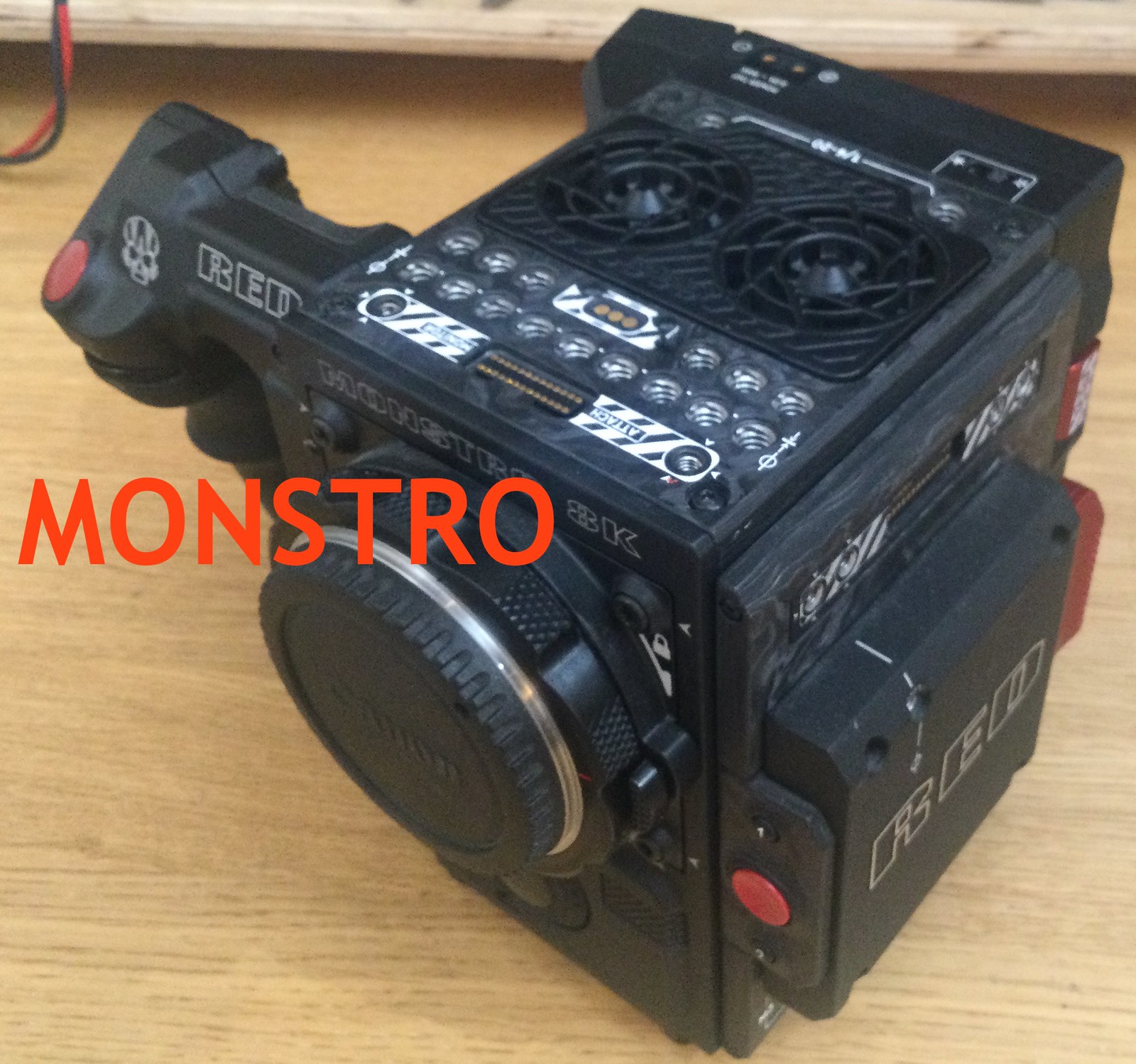
Even with the Monstro SENSOR CALIBRATED to 46 deg C - fan noise was AUDIBLE when the camera was NEAR the subject.

+) In ADAPTIVE mode - a rapid ramp up to 30-40% would usually 'mess up' the sound.
+) In MANUAL mode at 20% - the sensor slowly ramp up in temp introducing an unwanted time limit (before thermal runaway / unwanted image changes)

Listing to the actual type of NOISE sound coming from the camera with the Fan set at 20-30%:
+) The was a high pitched whistle / resonance (like a blade of grass under tension when blown over) - LOW LEVEL
+) There was a super high pitch frequency that was BEAMING (ie as the microphone moves, it seemed to come in an out of focus) - LOW LEVEL
+) There seems to be resonances sounds (ie stored energy) coming from the IN FRONT, TOP, RIGHT AND REVERSE sides of the camera - MID LEVEL
+) There were electrical TRANSFORMER like sounds that came up through the FAN holes on the top, and through the EXHAUST ports. - MID LEVEL
+) There is the sound of rushing air through the FANs on top - LOW LEVEL
+) There was the sound of TURBULENT air coming from the EXHAUST vents - LOW LEVEL (but louder than the TOP FAN holes).

00 - Monstro - Bare

AJ
 
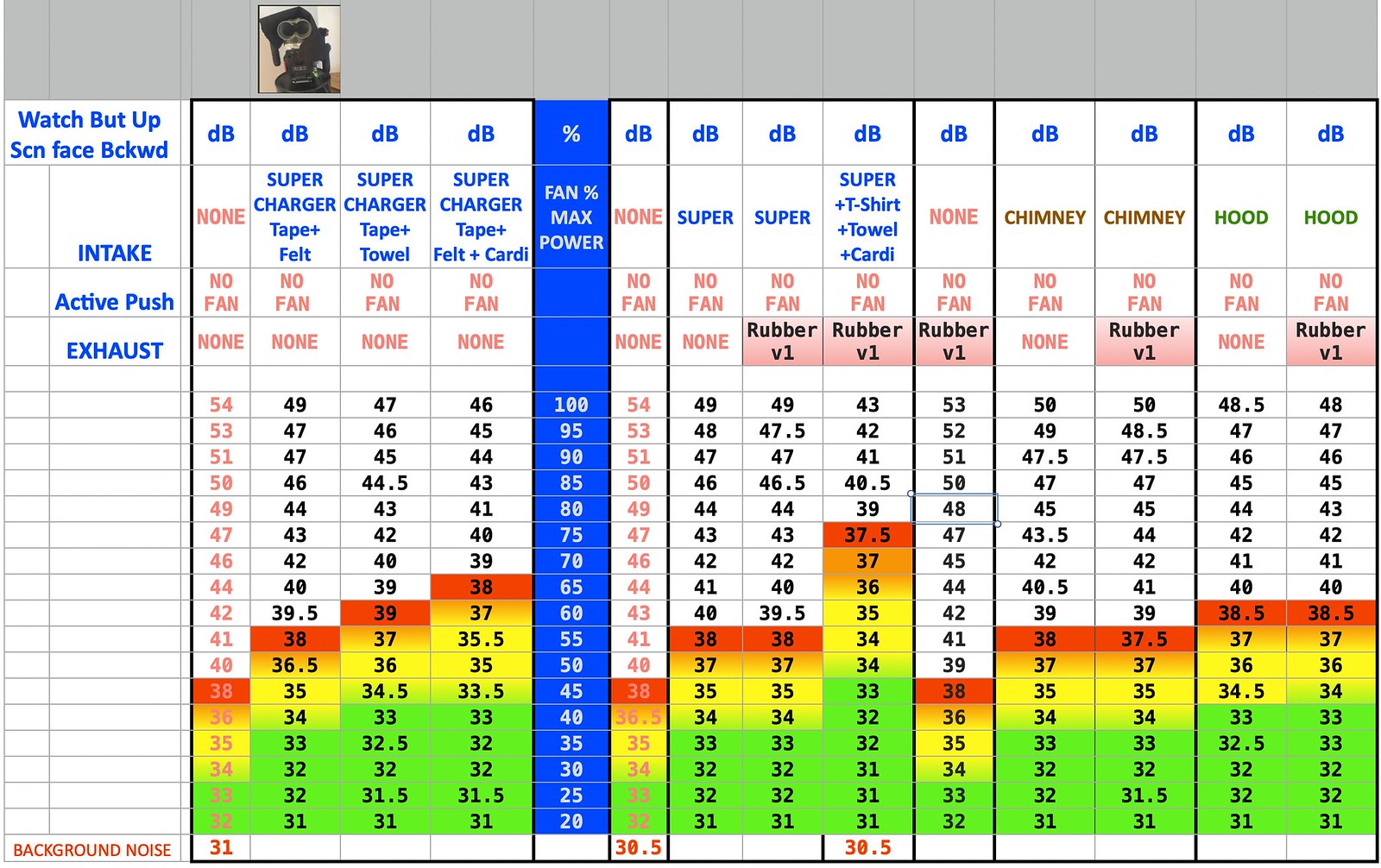
To investigate the root cause of the FAN NOISE, a few random attachments were created to to attach to FAN INTAKE holes - to SUCK the air away from the camera.

+) CHIMNEY PIPE - Suck un air from LEFT of the Camera. Made from light weight foam.

+) FLAT HOOD - Suck in air STRAIGHT BACK from the Camera. Made with a Heavy Duty Noise isolation material.

+) SUPER CHARGER - Suck air un a streamlined shape (PTFE piping) encased in Heavy Duty Noise isolation material

03 - Early Assortments

AJ
 
Hello Anthony,

I would investigate tonal response and DR in relationship to your findings because mostly what is going on is throwing the ISO rating out of whack and moving the black point and likely all the tones subsequently. I do believe what you think is "no noise" is actually lowering the black point.

A valid and important test to do here is to look at a grayscale ramp and compare the patches both in noise character and measured value and consistency.

To the tune of the fan noise when filming tight interiors a simple box atop with thin sound dampening panels and course air passthrough foam works a treat. I haven't had to use mine in about 2 years, but in a 6x6 room it snuffed out a bunch of sound. Pretty similar to your concept sans the tubing.

Interestingly Komodo is alarmingly quite, so there's clearly been some evolution and R&D since DSMC2 was created on this front. Which really makes Komodo and future cameras exciting for live action sound applications.
 
Wondering where you are going but I'm really interested.
I've also done a fan hood to prevent the noise of the fans to be heard. But it has to be really small not to prevent the air from flowing and so augmenting the fan noise.

I still wonder why the engeneers decided :
- to invert the heat flow from top to bottom of the camera?
- to use 2 small fans instead of a bigger one?

I callibrated my sensor to 48c.
Unfortunately the callbiration temperature does determine the fan speed. If you want to have a different fanspeed tnan the cal map. You have to reset it manually at every startup.

Pat
 
My thoughts (Speculations) at this point were:

+) MONSTRO EXAUST : The TURBULENT sound where the AIR comes out of the MONSTRO exhaust - is likely caused by a RIGHT ANGLE in the AIR PASSAGE immediately before exiting.
[Adding a CURVE to right angle bend would IMPROVE air flow / reduce noise]
+) MONSTRO EXAUST : The multiple narrow slots directing the downwards would like benefit from thicker wider slots.
[Ie same was when designing loudspeaker ports]

+) The VERY HIGH Pitched sounds : Did not Change - and eventually determined to emanate from the OLED side of the Touch Screen.
[Putting material in front of the screen stopped this sound]

+) The High Pitched fluting sounds - was transported through the Attachment (and could therefore be directed away from the Talent)
[My current theory is that this sounds is cause by the Grill placed over the two fans.

+) The Stored Energy Resonances : Interestingly, the FLAT HOOD managed to reduce this better than the SUPER CHARGER.
[Which lead me to believe the FANS inside the Camera were conducting sound into the TOP surface of the camera]

+) The TRANSFORMER sounds : These seemed to come directly from the fans, rather than a power supply elsewhere in the brain.
This sound is mostly piped through the mounted attachments (with a small amount through Exhaust - possibly due to the aforementioned right angle bouncing the sound back)

+) The 'rushing air sound' was mostly able to be suppressed, allowing a higher FAN speed before this became invasive.


.. and finally Doing this by hand takes ages by hand!

AJ
 
.. And so rather than spend hours trying to manually setup each fan speed, measure the response, collect, tabulated and put into Numbers, I created a Fan Noise testing harness so that everyone (myself included!) can actually put that mind at rest (or not) to compare Monstro Fan Noise.

Here is a GRAPH that compares MONSTRO with 'nothing' attached vs the 'hood' made from noise isolating material in the picture above:

RED : This is the Bare Camera
ORANGE : This is Camera with Hood.

Left of screen = Fan at 20%
Right of screen = Fan at 100%
Vertical axis = Noise in dB (this is comparative not absolute level)

05 - Bare Monstro

AJ
 
To directly compare improvements there is a 'Baseline' mode. The Bare camera is plotted on the X axis, and the Y axis compares noise levels.

What can be seen by the following is that the MONSTRO FANS transmit 6dB more noise through the TOP and FRONT of the camera when the FANs are at 20% - compared with when a the Noise Isolating HOOD is used.

06 - Base Baseline

+) The sound was measured with a Rode shotgun in front and to the right of the camera facing forward in both cases.
+) Camera was about 5ft from the ground / standard UK ceiling height of 8ft.

AJ
 
Thanks for the insight on hush boxes and suggest colour investigations Phil.

+) In your own testing - did you reach an ideal temperature for your camera's sensor?

+) Quiet Komodo : That's great news (I'll be joining the Komodo band wagon in 2021).

Depends largely on the conditions I'm in, but 43C is about what it is at all times. I religiously utilize Adaptive Fan due to the algorithm and how it works. Image noise is rarely an issue for me. I barely use noise reduction software even, though lately for some clients with demanding HDR grades it's come back a bit. Ideally it's more important for me to get expected tonal performance given the calibration. I think Graeme posted here long ago about what this might do to the general DR as you are "tricking things" really. I mainly care about predictable and consistent results that can be tied to meters, across cameras, and maintain consistent crush and clip points.

In terms of Sensor Calibration, I always run Manual on Monstro, which now RED even has updated in the firmware to make that more apparent, actually tells you what you should do for each sensor now. It gives you a very large useful shutter range and only takes about 8 minutes for the entire 8K sensor calibration. Depending on what I'm doing I run it once a day, once a week, or even once a month if I'm daring. About a minute per K if you think about it on all the bodies I believe.

Komodo is significantly faster on the sensor cal front as well and I have to investigate all of that. I suspect future more powerful bodies will provide even more opportunity to refine that. RED does crazy things now including utilizing heaters on the sensor to ensure stable temp and quickly getting shooting temp close to boot. Komodo even has more temp readouts even across the camera.

My general perspective, don't trick the fans or anything as you are changing the image and not doing anything meaningful in terms of lower noise when looking at the full exposure range.

As for camera operation sound, I think we've been blimping cameras for about 100 years now. My Jacobson blimps used for stills on set back when I used to do that to snuff the mirror in slap used layered neoprene with an aluminum shell. More or less my chute is thicker neoprene curved out the rear of the body with a capping filter to not obstruct airflow, but rather diffuse sound. Just building that out of the top fan area provided a significant drop in dB and worked well.
 
Pat,

My guess is that majority of fan companies do not prioritize silence at low speed, and are only interested in air movement and pressure.

Eg : The Blacknoise PM2 is a 40x40x20 mm fan vs the Delta Electronics AFB0412VHB-TP29 which is 40x40x15mm.

+) Delta fan : Is 5mm thinner : 36.5dB max : Can move 11.7 m^3 / hr
+) Blacknoise fan : 17.7dB Max : Can move 9.2 m^3 / hr

The Blacknoise is almost inaudible at low speed - with a maximum sound level of 18.8 dB LOWER than the Delta at full speed.
Just of 'fun' I bought 4 different Blacknoise fans. The amount of sound energy conducted through flimsy plastic was almost ZERO.

<snip> I still wonder why the engineers decided : <snip> - to use 2 small fans instead of a bigger one? <snip>
Pat

02 - Monstro - Hood - Fan

AJ

EDIT 1 : Clarification : I was suggesting that Red could consider upgrading the (Speculation) Delta fans with ones that are almost silent.
The picture of the 'Chimney' attachment in Red is a larger single 80mm NB fan.

EDIT 2 : The Delta Fan (which I speculate is in the Monstro) is actually 5mm thinner than the Blacknoise fan.
 
Last edited:
Here is the comparison of:

+) RED : Monstro with no attachments
+) YELLOW : Monstro + HOOD + CHIMNEY
+) GREEN : Monstro + HOOD + CHIMNEY + BlackNoise_FAN at Max Speed

What is impressive with the 80mm BLACKNOISE FAN at its top speed are almost inaudible.

07 - Chimney

AJ
 
I still wonder why the engeneers decided :
- to invert the heat flow from top to bottom of the camera?
- to use 2 small fans instead of a bigger one?

Jarred mentioned way, way long back that the inverted air flow worked better after a lot of testing in DSMC2's case.

I suspect the 2nd question is more obvious than not. Especially with DXL and Ranger on the market now. DSMC2 was designed to be small. Much like Komodo which also has two fans. Ranger and DXL use bigger fans because well they are bigger.

On narrative shoots fan noise really hasn't been an issue minus the occasional real tight space, similar to the other two main production brands out there really. Which is why I had to blimp. In that small 6x6' space I think I had camera about 3 feet from subject with the shotgun about 1 foot above her head. In that case with that room and all that, really needed to blimp it. On any other narrative work I've done I haven't needed it.

But yes, I'm all for a silent camera. Which is why I was doing a double take on Komodo, because I wasn't expecting it to be quiet.
 
The following was a test without (RED) and with (GREEN) 80mm NB-1 fan at 12V and the internal Monstro FANs at 20%.

In a nutshell :
+) With just the Monstro fans at 20% - the sensor temp creeped up to 51 deg C in 12 minutes.
+) With the Monstro fans at 20% - and the NB-1 Fan switched on, the camera settled at 44 deg C.

08 - Blacknoise

AJ
 
How would it work with a frozen cooling block on top. I guess then the fans would not need to run more than a fraction of normal speed.
 
How would it work with a frozen cooling block on top. I guess then the fans would not need to run more than a fraction of normal speed.

Biggest hurdle with cooling like that is condensation building up inside the camera or around the fan motors.
 
Pat,

When looking at the way the ADAPTIVE algorithm elects to play table tennis with the FAN SPEED - it looks like RED Very Rapidly slow the fan speed when the SENSOR is BELOW the TARGET TEMP. Conversely, when the SENSOR TEMP is the Same or Above the TARGET TEMP, they SLOWLY ramp up the fan speed.

This 'avoiding' of the Sensor being below the TARGET TEMP would mirror descriptions of the MONSTRO preferring to be Hot than Cold.

Unless I am mistaken - it is possible to set a TARGET TEMP for a calibration - and then MANUALLY set Fan speed throughout the calibration process (ie with a DIFFERENT SENSOR TEMP than the TARGET TEMP).
In use, the BRAIN then aims for the TARGET TEMP that was set during calibration - allowing you to deliberately calibrate the Sensor for a temperature that is Just Below (say by 0.25 degrees C Below the TARGET TEMP).

My strategy of getting the cleanest BlackShade is as follows:

1) Choose a TARGET TEMP 'T' with the cleanest Min-Noise-at-high-ISO-test (ie non-sophisticated test)
2) Use ADAPTIVE with TARGET TEMP = T for 15 mins -> Record Fan Speed
3) Use ADAPTIVE with TARGET TEMP = T - 1 deg c for 15 mins -> Record Fan Speed
4) Set ADAPTIVE TARGET TEMP to T
5) Set MANUAL FAN speed (between (1) and (2)) to a point that Just causes the Sensor temp to dip into T-1 deg C
6) Perform Calibration.

This Calibration profile in ADAPTIVE will then ALMOST NEVER go below the actual SENSOR temp that the Calibration was performed.

--

In my cameras case, my (simple) noise test gave 43c and 44c as having minimum noise (at that temp and just above).
I use a TARGET TEMP of 44c, and then manually set the Fan Speed during calibration that the SENSOR temp is approx 43.7 c.
When recording in ADAPTIVE the camera does dip into '43c' - but only briefly, and likely not below 43.7c.

As the Fan speed was set manually and a FIXED speed for the entire calibration (and I use a calibrated thermometer for the room to make sure the room has remained at exactly the same temp too) - My gut feeling is that this also creates a more 'perfect' black shade that when the Adaptive allows the Sensor temp to Drift during the calibration.

AJ

Edit : Also 46c calibration was my compromise temp (for audio) - as calibrations from 47c and above seem to loose colour details (density and hue).
And 46c calibration still had a consistent set of results at 46-49c.


<snip>

I calibrated my sensor to 48c.
Unfortunately the calibration temperature does determine the fan speed. If you want to have a different fan speed than the cal map. You have to reset it manually at every startup.

Pat
 
Last edited:
Thanks Phil,

It sounds like a Blimp is the established way of dealing with unwanted sound (and something I will definitely consider).

I was hoping to develop a portable compact (metamaterial) labyrinth to absorb the monstro fan noise (with only marginal impact on air flow).

What I had not expected was the majority of sound that Monstro fans create (at 20%) is conducted through the cameras body - and radiated as resonances.

+) For those interested in an example of a metal material 'plug' (at 00:14) :

+) KEF are branching in to HF metamaterial sound absorbers :
KEF

+) And here is a look at (Fusion 360) model under the bitumen noise isolation material that I was testing with:
09 - Chimney

+) Airflow Turbulence Modelling : You can do a 1000 hr simulation of Fusion 360 model at 'Sim Scale' (and there is a free Fusion 360 extension).

AJ

Depends largely on the conditions I'm in, but 43C is about what it is at all times. <snip>
In terms of Sensor Calibration, I always run Manual on Monstro <snip>
RED does crazy things now including utilizing heaters on the sensor <snip>

As for camera operation sound, I think we've been blimping cameras for about 100 years now. <snip>
More or less my chute is thicker neoprene curved out the rear of the body with a capping filter to not obstruct airflow, but rather diffuse sound.
Just building that out of the top fan area provided a significant drop in dB and worked well.
 
Back
Top