Welcome to our community

Be a part of something great, join today!

  • Hey all, just changed over the backend after 15 years I figured time to give it a bit of an update, its probably gonna be a bit weird for most of you and i am sure there is a few bugs to work out but it should kinda work the same as before... hopefully :)

Modular Dragon OLPF sneak peak

Yeah I'm a perpetual tweaker as well but this is all with regard to Dragon getting more serious market share. Epic still suffers in markets from people having trouble with very early firmware revisions and never going back. Dragon is already turning some people off, which is a real shame because it is quite obviously a very special camera.
 
Last edited:
Yeah I'm a perpetual tweaker as well but this is all with regard to Dragon getting more serious market share. Epic still suffers in markets from people having trouble with very early firmware revisions and never going back. Dragon is already turning some people off, which is a real shame because it is quite obviously a very special camera.

And I guess that is important to people who rent their cameras. I guess you just gotta make a reel and address their concerns with pictures.

For me, RED's marketshare is important in that they keep selling cameras and acquiring the funds to finance R&D, but otherwise I just leave that important function in the hands of management.

As it stands, there's a waiting list to get the sensor upgrades and I'm sure the Scarlet-Dragon, M-Dragon and CF-Dragon sales are substantial, so I'm guessing the world-wide acceptance of the Dragon will keep the R&D engine churning.

Being confident in that, I am now free to concentrate on MY cameras. And I must say, I am enjoying doing that immensely.
 
Last edited:
for the swappable OLPF, is this something that could eventually be done digitally? for example in the moition mount as a setting or am I crazy? that way it's a simple setting rather than opening the camera. just a thought.
 
So what is the farthest you can push the ISO and get a clean image with the new OLPF? I never push the MX past 1000. I know that the old OLPF stated 2000 as base ISO...what is the current base ISO of the new version?

thanks,
Dave
 
Last edited:
So what is the farthest you can push the ISO and get a clean image with the new OPLF? I never push the MX past 1000. I know that the old OPLF stated 2000 as base ISO...what is the current base ISO of the new version?

Define Clean? What are you finishing for, viewing on, and what format are you capturing in?

It's never been written anywhere that the base ISO was 2000. Dragon "is" based around ISO 800 for RAW View overall for both OLPFs. The concept of base ISO is wrong in reality. People need to start thinking radically differently about that concept. It's recommended usable range is ISO 250-2000. 250 is mighty clean. I would say 500 is too in most cases. 800 has texture. So on and so forth. 800 tends to provide a very "film-like" image as that's the approximate place where equal tones above and below middle gray exist.


**edit. I'll add. It's possible to have clean higher ISO material if there's enough light there to support it. If the exposure is just reaching into the noise floor and it's being lifted out via ISO what you will see is noise.
 
I'm digging the concept Phil.

To to put it another way, from my testing if you have a decent base exposure or get enough light on the sensor, then pushing the exposure (up to 2000iso) is just fine. If you are trying to pull images out from shots with no metered measurable light, well, you are starting with not much and digging up a poor image.

You are correct. You want grain/texture you can rate from 800 up, but you gotta know that less light hitting the photo sites means noise or a more textured image.

Basically, its about getting measurable light on a scene. My experience has been that even if you have metered levels at f1.0 you'll get decent results, but when you start getting below measurable light, the images take a hit and this is where I think people are expecting better results, when there is no measurable light.

With the new OLPF, you there is room to ride the exposure near the edge without clipping, that is where you end up with nice results and flexibility (elastic image).

battistella
 
I do too agree with Marcos... although OLPF swap is not for the rentals , but for the technical studied and willing people. In the Brazilian market RED has a hard reputation that i do too try to bring to the reality that Digital cinema is a complex form of art. in film Era ACs had to know how to maintain, clean, and solve physical problems with the cameras. Creative DoPs used gels, nets and others forms of "filters".... evolution might mean there is more choices for the ones willing to experiment.
As long as the official OLPF is considered so, go RED, break more boundaries!


I have to g
My creative side likes the artistic opportunities different OLPFs will bring to the table, and applauds the thinking behind it.

However, for many of the reasons already posted, I don't think it's the right direction for RED to take, especially given it's already "complicated workflow" reputation (warranted or not) among the industry. Let Graeme continue do his thing with REDCINE-X post tweaks (granted I prefer in-camera options for some of these); it's much more desirable not to have to change hardware. Many people complain about changing lens mounts, can you imagine "swapping OLPFs"?

RED, please keep it simple- develop another OLPF if you must, or give us the variety and options via REDCINE-X to push this v2 to its limits. Done.
 
What would really rock is if you could make an OLPF out of nano crystals that could have their pitch adjusted manually - preferably while I'm looking at a real time MTF readout… :001_cool:

Cheers - #19


Somebody's got a brain Blair. ;)

If you look up nano crystal display technology you might find some techniques useful for this.

There are other things, such as applying electricity to crystals changes shape, but you probably should look at electro-wetting instead to give more shape change. Now, Red would virtually never have been able to consider it without knowing that.
 
I think, first olpf was great... then a bit late unfortunately the olpf flare was discovered... cameras where already out and to send them all back to LA for a swap was a hassle for everyone involved. Then also in quite a rush the second / new olpf was produced it solved the problem but was also getting out on cameras a bit early, no offence I like red for doing it that way. I like to see the development and take the benefits of getting the new tech early even though it does come with some bumps on the road. Then now the third solution, swappable olpf... I think actually there will be a third option that has both the highlight benefit of #2 and the lowlight capabilities of #1... and if that is retailing for reasonable cost then that's what everyone will go for.

I think having a little set of olpf's and have one in camera during the day and then swap at sunset and so on is not really what anyone wants. Then of course there will be home made olpfs 3rd party olpfs and so on but I think the majority of us will use what ever Red comes up with maybe not on the first version of swappable as that one needs to be stressed out as well but possibly the 4th version when they got a bit less people screaming about the "issue" (which I actually think it's not) then we can probably have a solution that suites both highlight and lowlight as I see no reason why such olpf could not be invented and the good thing then is that we can just order it and swap it at home... So for that reason I find the swappable olfp as a great invention. Our camera was away for a month for the swap and I don't want that scenario again.

But thats just me guessing / hoping. :)


Of topic: dragon sensor is great, here is a frame from yesterday. 6K FF 2x ana with hawk 75mm : https://www.facebook.com/photo.php?....493340558042.274638.543523042&type=1&theater
 
I think, first olpf was great... then a bit late unfortunately the olpf flare was discovered... cameras where already out and to send them all back to LA for a swap was a hassle for everyone involved. Then also in quite a rush the second / new olpf was produced it solved the problem but was also getting out on cameras a bit early, no offence I like red for doing it that way.
Agreed - the 2nd OLPF was created in less than ideal circumstances, so its understandable why people find it less than ideal.

Then now the third solution, swappable olpf... I think actually there will be a third option that has both the highlight benefit of #2 and the lowlight capabilities of #1... and if that is retailing for reasonable cost then that's what everyone will go for.

Totally - a third option OLPF created by Red while they are not rushed is what I am after. And like you, this will remain in my camera full time.
 
End User Emulation "look"

End User Emulation "look"

I'd like to send my heartfelt condolences to Graeme and his family for the workload that will come along with the "Swappable Era". Each OLPF implementation will require a matched decoding scheme and there is a ton of math in those algorithms. Moreover, no matter how sophisticated your approach is scientifically, each iteration will require boatloads of testing.

I'm not sure what's holding up the public beta of RCX-P with DEB (acronym phobia?… ;-D) but if it controls the red/orange chroma noise as well as early tests suggest I think a lot of folks are going to start to really dig Dragon OLPF V2 for its flare control and color purity.

I understand the reasoning behind having DEB in RCX-P and the SDK, but not in camera, so improvements could be rolled into the ecosystem more easily. That said, a lot of my gigs have clients in video village who pay my bills - so - perhaps RED could offer an option in the on board RGB monitoring pathways called "End User Emulator" (or some such) that clamped the black level near the noise threshold, added a slight "S" to the gamma curve and boosted the saturation a notch. To be really useful the camera would have to be able to send a more technically precise image to the operator and crew simultaneously, a configuration that may exceed the available compute power on board. The FujiCC mini (an a few other things) could serve this function upstream from the client monitor… if you have the budget/crew to implement...

My point is that I'd rather not complicate my life on set trying to eradicate every last bit of shadow noise in the client monitor when it will never be seen by the intended audience. It's essentially a built in viewing emulation LUT targeted for "regular" consumer displays. If your project is going to be released theatrically or has other "high quality exhibition" goals (large venue, pre-show, installation, etc) that's a different discussion. Now, back to tweaking the client monitor by hand ;-)

Cheers - #19
 
I'm not sure what's holding up the public beta of RCX-P with DEB (acronym phobia?… ;-D) but if it controls the red/orange chroma noise as well as early tests suggest I think a lot of folks are going to start to really dig Dragon OLPF V2 for its flare control and color purity.

Agreed. Once DEB is rolled into RCX, Resolve, Premiere, etc...I think people may start to reconsider their misgivings about the new OLPF. Having it's superb highlights, gorgeous colors, and most of the noise penalty removed....could be just the thing people are looking for.

Also agree that having some form of DEB or noise reducer IN CAMERA would be...a break through.

best.
 
What I think is really ironic is the new posts cropping up on CML about what a "bad idea" swappable OLPF filters is - and what "chaos" it will cause.

I remember when a cinematographer got to choose his/her film stock, lenses, filters, camera, camera vendor, lab, etc. etc. - today ... many cinematographers only get to choose the lenses - as they are told what camera system will be used on the job, etc. etc. etc.

They complain that their choices are being taken away ... now they seem to complain when they get more choices.

Go figure.

Personally, I think it's insane to sugget that RED should not give cinematographers more choices. Sure it might be new and different - and sure - there will be a ton of mis-information and some confusion - but I have a hard time with people wanting things to be more simple and limited.

There are PLENTY of simple, limited camera systems out there. RED does NOT need to be one.

im all for this. No need to over simplify.

Battistella
 
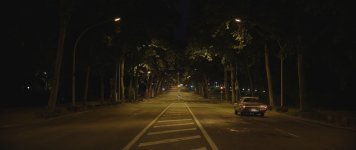
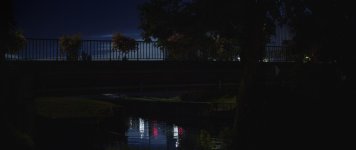
i am testing a lot of night stuff at the moment as there is maybe a feature film end of year to shoot with dark atmosphere film noir, ---
you can use the tools Red delivers, ... or not.

sorry, i am on the road and can only send this fast grabs here out of macbook pro, but the native stuff looks great.
the bridge scene was, in real, really VERY dark for human eye, and yes, the bridge is supported with ADD, but where is the problem to use it in such a scene ? it´s a tool, and i use it as it delivers an deluxe 5stars 4K output at the end in such a ultra low light situations.
i will post comparison shot without ADD when we are allowed to post DEB footage. With a standard NR it is useable without headache to get this film nor atmosphere. if this would be a set of a movie, i would just add 2-3 backlights for giving shapes, done. if you want to push this to daylight, it´s noisy. not really suprising.

the street is out of box, redlogfilm, light curve. i love this frame - the colors and dynamic in the street view is simply great. on 4K screen i looks like an classicfilmstock from the 60´s.

the DEB images look even better as said.

we shot lot of footage last night, when i am back in office i start to check them ...
 

Attachments

  • STR3.jpg
    STR3.jpg
    59.6 KB · Views: 0
  • STR2.jpg
    STR2.jpg
    70.2 KB · Views: 0
  • BRIDGE +1.jpg
    BRIDGE +1.jpg
    44.7 KB · Views: 0
+1 agreed
 
Truth of the matter is, RED is already one of the easiest (simple) cameras to operate. ETTR, RedLog Film in post, curve... export!
 
Back
Top