Welcome to our community

Be a part of something great, join today!

  • Hey all, just changed over the backend after 15 years I figured time to give it a bit of an update, its probably gonna be a bit weird for most of you and i am sure there is a few bugs to work out but it should kinda work the same as before... hopefully :)

Leo and REDlogFilm...

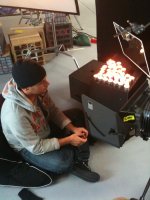
Butane cans flames

Butane cans flames

How's this shot?

Or all about the flame sequence in "Shutter Island"

was described pretty good in American Cinematographer,

issue March 2010 in the article "Mind Games" by Patricia Thompson (pages 30-47).

shutter_island-03.jpg

"Shutter Island", American Cinematographer, March 2010 in the article "Mind Games" by Patricia Thompson (pages 30-47).

What does it mean?

If we compare with film that means

RED1-MX is pretty good in any lowlight or available light situation.

It's just a question to know well how you can use or adjust it properly.
 
Rarely do we see real blacks in the real world so no real black is at least one of the options.

So true!
Pure black is more or less a cultural agreement acquired in cinema – our eye/brain system perceives pure black only in very rare circumstances. Even our retina produces some noise…
While the S-curve of analog film is close to our perception in the highlights, it's very different at the lower end.
I wonder how films in theaters will look like 10 years from now.

Here's another question... at the point where shadow regions no longer contain any information (image detail) would you choose to render that region of the histogram as pure black even if the camera records it as, say really dark grey? I know this becomes purely subjective, but I've always been inclined to map my histogram to extend across the full tonal range for rich images. Naturally this wouldn't apply to a snowy day or a foggy night.... but in general I like a toothy image.

Yada yada ya,
CB

I'm probably in the minority, but I don't like how everything looks "movified" these days. If you watch some older movies (70's or so), I like how scenes with lower contrast aren't artificially curved into black-to-white extremes. I handle still images the same way and try to maintain realism and consistency rather than going for a certain aesthetic across every shot/scene. But that's just me and I'm a bit of a weirdo. :biggrin:
 
It also just occurred to me that when a film is projected on the screen there are never any true blacks... hence the "filmic" look?

This is partly an issue with the presentation end of things. Film and DLP technology can only get so black. True blacks you get only with CRT and OLED displays.
The achievable black levels in commercial projection systems are pretty much a case of good enough, no one has ever managed to completely block out the light coming from the projector-lamp. In DLP-systems for example some light always falls between the micro mirrors and gets reflected by the chip-substrate. And release print film stock can only reach some maximal density, it's just a very, very dark pair of sunglasses in front of a 7kW xenon lamp, go figure.
The only way that i can imagine to solve this issue in large venue projection systems is by using laser technology, which has been talked about for more than a decade now, but never came to fruition. RedLaser4k anyone?

Sorry, this got quite OT, but i worked for Barco for some time, so i thought i could contribute something useful.

On topic:
Leo never looked this good though. How deep into the shadows i now see, and them curves are sooo smooth,... But wait, hey, this is not the same take that we saw in February, the light on the wall to the left is different... Anyone else noticed that?

And BTW, looking at those SJ-screengrabs from Shutter Island: It's quite remarkable how much more realistic the MX-cigar-footage with Leo looks - those top/back/hair lights in SI just come out of nowhere, and the light supposed to come from his match is way too soft, it's an impressive feat of fakery though, and it didn't trip me up while watching the movie, but still.
 
And BTW, looking at those SJ-screengrabs from Shutter Island: It's quite remarkable how much more realistic the MX-cigar-footage with Leo looks - those top/back/hair lights in SI just come out of nowhere, and the light supposed to come from his match is way too soft, it's an impressive feat of fakery though, and it didn't trip me up while watching the movie, but still.

That's one of the things I love most about the increasing sensitivity of sensors. As the required light levels drop, we are able to use light in a much more realistic way. Scenes will become more authentic, and that will be a good thing.
 
Leo never looked this good though. How deep into the shadows i now see, and them curves are sooo smooth,...

I couldn't agree more. The capability of EPIC-X is astounding. And I'm confident that EPIC image quality will get better and better, with improved color science and firmware updates to tweak and get the most from the camera.


But wait, hey, this is not the same take that we saw in February, the light on the wall to the left is different... Anyone else noticed that?

Jim did say in his post this is another take from that shoot.


And BTW, looking at those SJ-screengrabs from Shutter Island: It's quite remarkable how much more realistic the MX-cigar-footage with Leo looks

Again, I agree wholeheartedly. The implications of your statement are, in my opinion, far reaching. Imagine what you'll be able to do with this camera.
 
I'm probably in the minority, but I don't like how everything looks "movified" these days. If you watch some older movies (70's or so), I like how scenes with lower contrast aren't artificially curved into black-to-white extremes. I handle still images the same way and try to maintain realism and consistency rather than going for a certain aesthetic across every shot/scene. But that's just me and I'm a bit of a weirdo. :biggrin:


I couldn't agree with you MORE. In the end it's all subjective, and everyone will have their preference. But as I get older and learn more about the masters of cinematography, the more I appreciate an image that doesn't feel over saturated or contrasted to death. It's the subtle color correction I appreciate the most. And this RC2 RLFilm image is stunning to me.
 
I'm probably in the minority, but I don't like how everything looks "movified" these days. If you watch some older movies (70's or so), I like how scenes with lower contrast aren't artificially curved into black-to-white extremes. I handle still images the same way and try to maintain realism and consistency rather than going for a certain aesthetic across every shot/scene. But that's just me and I'm a bit of a weirdo. :biggrin:

I'll get vilified for saying this but I find 70s films look really ugly and depressing. It's the one decade I really don't often enjoy watching. I love 1940s, 50s, 60s, and then I'm back for the 80s.

Here in Canada many directors make their fiction features look like low-budget documentaries, and I find them equally hard to watch.

If I wanted to film "reality" I would have become a journalist. Besides, my life does not look anything like what is sold as "real".

You hated the 70's really? What about Star Wars, Taxi Driver, Close Encounters, Apocalypse Now, Scarface and Jaws, did you not like? Story trumps look 1000 percent of the time
 
If I wanted to film "reality" I would have become a journalist. Besides, my life does not look anything like what is sold as "real".

Hopefully RED will let me get rid of those quotation marks, because I agree that "real" doesn't look real (but I still like that 70's look).
 
Last edited:
You hated the 70's really? What about Star Wars, Taxi Driver, Close Encounters, Apocalypse Now, Scarface and Jaws, did you not like? Story trumps look 1000 percent of the time

I don't hate the stories, I hate the visual look. Taste is taste.
 
CC

CC

I'll get vilified for saying this but I find 70s films look really ugly and depressing. It's the one decade I really don't often enjoy watching. I love 1940s, 50s, 60s, and then I'm back for the 80s.

Here in Canada many directors make their fiction features look like low-budget documentaries, and I find them equally hard to watch.

If I wanted to film "reality" I would have become a journalist. Besides, my life does not look anything like what is sold as "real".

I know what you're talking about. There is a definite look to films in the 70s that instantly dates it for me, too. But I think you should take the image in, as a viewer, more holistically. I would take the look of A Clockwork Orange, The Exorcist, or The Godfather to any color corrected film these days...IE Transformers (unfair comparison, I know), because of the cinematographic genius behind the lens.

Basically color correction, to me, shouldn't be more important than the composition. It should improve the image, yes, getting closer to the director or cinematographer's vision. But it shouldn't be employed as a last ditch effort to save unoriginal composition. If you watch the shot by shot progression of Rosemary's Baby, or Taxi Driver you marvel at its brilliance. The look of the film is secondary, the same way a person's personality should overshadow their appearance. Obviously that's not the way it works in the world on a surface level. At least not until you put the time in to get to know someone. Anyway, interesting discussion. And just my two cents.
 
It may be the .jpg format, but it looks noisy to my eye. Has anyone tried using the neatvideo spatial and temporal noise filters on this to see if the flat areas could be cleaned up a bit? I know some of you think noise mimics grain and like it. I think it would be so awesome if the could use the power of the image processing optimized ASICs in an Epic or Scarlet in an off-line mode to run noise reduction filters on the recorded video. 30 minutes of 720p takes over night to run the neatvideo filters on a 2008 vintage Athlon. I'm guessing 1080p would take as long on a modern I7.
 
Back
Top