Welcome to our community

Be a part of something great, join today!

  • Hey all, just changed over the backend after 15 years I figured time to give it a bit of an update, its probably gonna be a bit weird for most of you and i am sure there is a few bugs to work out but it should kinda work the same as before... hopefully :)

KOMODO....

Status
Not open for further replies.
On an infinite timeline, sure, things will level off from a picture quality standpoint, but that is a looong way off.

I'll be happy when i can get a medium format 64k (oversample for 16k displays and crop) that captures 25 stops in a 32 bit+ floating point raw format at 1000 fps, has a milimeter accurate per pixel depth information embedded in the footage, and runs on a slim battery for 6 hours. All for $5K

Forget the camera and or the glass at that point. Just put on your hat and glasses that can project you into any photo real virtual environment with any actors you want and any script you feed it and hit record and you can capture the entire scene in one go from any imaginable angle with any direction you feed it, stunts, blocking etc. Then let the AI make intelligent edit decisions for you with minor direction you choose to manipulate story, change any performance after the fact or even any actor you want on the fly, pick / change / adjust your final color palette and sound design all intelligently processed for you and available to you via AI and send direct to any distribution platform you can attract. Best idea/taste wins, not best execution based on any limitations. That’s immersive and that will one day be the future.
 
My question, the one I'm entertaining here, is: How do you think the camera market will be, both high and low in two years time?

Okay ...

competition forces prices down and forces companies to innovate more to provide a "competitive advantage". Companies that find competitive advantages other than just lower their offering's price lower than the market - make more profits and also have an easier time investing more $$ into R&D. That said - competition always drives prices down.

The cameras being announced and released NOW have been in development for a LONG time. The NEXT GEN cameras that will emerge next year are already in very active development.

What you can buy TODAY - in the under $50K space - will be at least 40% less in two years time. So .... $10,000 camera today - for the same specs - less than $6,000 in two years. $25,000 camera today will be $15,000, etc. The second hand market will be even MORE aggressive.

We are not even CLOSE to diminishing returns on image fidelity. We can discuss that when we have 100MP motion (12K+) and 2 stops more into the shadows over GEMINI with no noise - and we will certainly see those things (not sure when - but they are certainly coming). And yes, that is the very high end market. I actually think we are going to see MORE EXPENSIVE high-end cameras - $140,000 + price points, etc.

When HD cameras started to get adopted for episodic narrative - only the bigger budget show stayed on film. So film was features and "big budget shows". Until the digital cameras got better. You will start to see that separation within the digital cinema camera market with respect to what will cost $25K and under cameras - which will shoot a majority of episodic narrative - but the bigger budget shows and features will be on cameras that cost over $100,000. I expect at least 3 options on the very high end. I expect ARRI and RED to both have offerings in that segment.

Regardless ... ANY camera you buy from today forward you need to fully depreciate in 24 months or less. The resale market is going to get much more aggressive and cameras will NOT hold their resale value like they have been.

In 3 years the $2,500 to $6,000 space will be very crowded - but on par with what costs $12,000+ today. iPhone will tale a hearty chunk of $1000 and under options and even eat into DSLR sales.

But yeah ... exciting times for sure!!!

PS - all of this assumes we resolve our Trade War with China.
 
Last edited:
(snip) Regardless ... ANY camera you buy from today forward you need to fully depreciate in 24 months or less. The resale market is going to get much more aggressive and cameras will NOT hold their resale value like they have been. (snip)

Couldn't agree more.

Cheers - #19
 
Okay ...

We are not even CLOSE to diminishing returns on image fidelity. We can discuss that when we have 100MP motion (12K+) and 2 stops more into the shadows over GEMINI with no noise - and we will certainly see those things (not sure when - but they are certainly coming). And yes, that is the very high end market. I actually think we are going to see MORE EXPENSIVE high-end cameras - $140,000 + price points, etc.

Definitely agree with all of this. Either a big jump forward in sensor design, so we have a full on 8k sensor with RGB sub pixels for each pixel, or even higher res sensors to downsample from. There is still a ton of room for improvement in dynamic range and lowlight as well. We can talk diminishing returns when we have cameras and displays capable of fully capturing and displaying what we can see with our eyes in terms of color gamut and dynamic range. If anything the target should be beyond what the eye is capable of discerning.
 
If only anyone could clearly understand any point you are trying make ... help me out here.

I'm talking about less expensive cameras catching up to high-end system and how that will affect the camera market. What is unclear?


We are not even CLOSE to diminishing returns on image fidelity. We can discuss that when we have 100MP motion (12K+) and 2 stops more into the shadows over GEMINI with no noise - and we will certainly see those things (not sure when - but they are certainly coming). And yes, that is the very high end market. I actually think we are going to see MORE EXPENSIVE high-end cameras - $140,000 + price points, etc.
.

I agree that we still have K's and stops to add, that there are still more improvements to be made in order to give more options in post-production. But to say that we aren't close to a diminishing returns for the perceivable result we actually deliver to the world is such a binary response. While I don't agree with everything Steve Yedlin is saying about cameras today, mainly the possibilities that certain things like high K numbers give you in post, he still has a point in arguing that the perceivable difference in delivery quality is so low across most high-end cameras today that pushing further is somewhat irrational. While I agree with you that there's more to come, he is still right and is proving my point far better than I can do here. He is actually talking about the diminishing returns I speak of. And on top of that, I'll add that less expensive cameras are starting to catch up.

Because when you have a 100MP 12K+ camera with two more stops with no noise at all, how would that actually create different images for the end result compared to what we have today? I agree that they will give a lot of options in post, but it won't really change the perceivable differences on the end result to such a degree that there's a radical difference compared to today. Film and TV do not have the same need for 100MP like still photography where you create big prints using dots per inch rather than pixels. On top of that we have the whole deal with how to handle all that data, how to utilize it with computation for VFX etc. Even today, on big productions like Avengers Endgame, they still do VFX in 2K. Computers and processors get closer and closer to nanometer hell and a jump to handling 100MP data in moving images is so irrational for motion pictures of any scale. Not to mention the resolution that the actual optical elements have towards the captured image and how going past that is also a diminishing return.

Steve Yedlin has a point here and it becomes rather irrational to just want more more more and be fooled by camera manufacturers marketing. While we clearly can do more improvements for easier post and practical use of the cameras we use, we are in fact close to image quality diminishing returns and before someone can point out how radically different delivery images will look when shooting with a 100MP 12K+ camera with two stops more and no noise compared to a camera like the Monstro or Alexa 65 today, I see no rational argument in support of a camera market that will just keep marching on like it's done the last ten years. No one will rationally use massively expensive systems that exponentially makes an entire production more expensive compared to a lesser system that gives close to no perceivable difference in the end result.

[video]http://yedlin.net/DisplayPrepDemo/DispPrep_v2_websize_20mbps.html[/video]
 
I think your point is pretty clear Chris. We just finished putting together a high end project in 4k an no one even realized that 50% of it was shot with "lesser cheaper cameras" than the 8K Epic W... the funniest was some DPs commented on how beautiful some of the shots and praised the RED camera when in fact they were shot on a $3k Sony camera lol...
The point is lots of cheaper cameras can now deliver pretty damn good results. Granted we're not working on big Hollywood movie.... I personally am no longer a pure RED loyalist. Still a big fan but no longer as enamored as used to be with them...Still really hoping Komodo delivers bit if doesn't I have plenty of other choices :-)
 
.
We are not even CLOSE to diminishing returns on image fidelity. We can discuss that when we have 100MP motion (12K+) and 2 stops more into the shadows over GEMINI with no noise - and we will certainly see those things (not sure when - but they are certainly coming) .

2 stops more into the shadows does nothing to real world scenario unless you shoot in the dark with no lights or intend to push the shadows up, in which case bye bye shadow richness and 16 bit fidelity, for something which was not shot yet aimed to be achieved in post.

2 stops more in the shadows does NOT compensate the highlight range, lack of noise does not compensate tonal depth and consistency and increase in pixel resolution does not compensate for the frequency-dependent high compression splotchfest. Which does exaclty the opposite to "resolution". Variably throughout the frame.

For the same bitrate, the higher the pixel count, the reduced tonal depth and/or texure consistency and organicity.

Gemini @ 2:1 is wonderful and doesn't miss any stops in shadows to be able to achieve fantastic, deep, shadow rich cinematic imagery.
 
In 2 years time, tools will be more prevalent to more readily replace today’s dedicated separate CPU, DSP, FPGA & ASICs, interconnects and memory with dedicated package with local (or in chip) HBM memory.

If today’s delving into wafer scale integration are indication - this reduces the power consumption by 10 times, with options of scaling up computational processing by two orders of magnitude (compared with NVidia’s top offering).

When the DSMC2’s 16 circuit boards, high power heat sinks and 2lb battery slim down the weight and size of a 5D, and can ‘switch on’ in seconds - (I predict) the world of DSLR-only stills camera will get squeezed out of existence, and three formats will blossom:

+) 5D sized bodies : For Handheld / Gimbal / Drone
+) On human body camera sensor array : eg AR glasses : For POV, image monitor and (gesture) control
+) Flat surface imaging devices

This last one (iPhone sized) could end up with a grid of fixed FLAT lenses (eg 7 Tessellated hexagons), going from super super wide to Telephoto; With an ML engine to mimic the behaviour of any desired (measured) lens.

The Multi small sensors could ultimately replace monoliths. This would be catalysed by the desire to minimise costs, to increase SNR, leverage AI NR, and software tools that expect 3D effects (rotoscoping, lights source alteration, image replacement).

When the tessellation of sensors eclipses the surface area of dedicated very HFR cameras - it seems likely that HFR will move toward that ‘radio telescope’ design - with the connection of a number of iPhone sized devices working in unison to capture HFR imagery.

Lastly : I think we will end up with wireless everything. Protocols that sync wireless mics with image in camera with Mac, and cloud.
Offloading, backup, wired image will all become driven and accessed wirelessly (5G). People will expect to be able to see and control their device through their Huawei, Apple or Google phone.

AJ

“My question, the one I'm entertaining here, is: How do you think the camera market will be, both high and low in two years time? Put on your best speculative hat and entertain the thought based on what you see all around.”
 
So, it seems that even Premiere will finally get ProRes Raw.
https://www.newsshooter.com/2019/09...oQzpPshr7kKpSHrz5q6Q3uu2d3n605k_pNEZ0rFh-PSLA

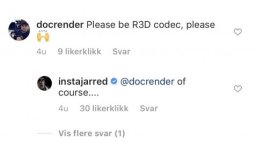
I'm starting to wonder if some here weren't right by assuming KOMODO will in fact use this codec (then it would become the first camera to record Prores Raw internally). Don't get me wrong I still don't understand, if this is true, how it would make sense for RED instead of Redcode. And I would rather prefer Redcode anyway.

Jarred confirmed on Instagram that it will shoot Redcode:)
 

Attachments

  • B2FFBCA5-3D97-4781-BC72-06C6601A650D.jpg
    B2FFBCA5-3D97-4781-BC72-06C6601A650D.jpg
    11.6 KB · Views: 0
Lightworks supports Braw in its current beta build, uncompressed CDNG, compressed CDNG, and 10bit lossless Cineon log CDNG. Be interesting to see how long it takes them to add Prores raw to the list or to be licensed for Prores export on Windows and Linux platforms.
Seems like Apple is finally opening up a bit.
 
Unless there's a theatrical release...

Unless there's a theatrical release...

Display tech will continue to improve, which means that continual improvement in capture devices has meaning.

Currently, the laggard is bandwidth limitations that lead to over compression and bit depth decimation.

How long will it take before >100mb/s sustained feeds will be common amongst the mass market? How much bandwidth would be required, assuming advancements in compression of 4x are attainable over the next decade, to reach the (nominal) limits of the wetware?

How far in the future is a 16K, 120fps, 14 stop, 16bit color, 120" diagonal display? Will 2D RGB displays even matter in a VR/AR/MR future?

All interesting issues, but in a marketplace where a camera has to pay for itself in 24 months (or so) does it matter?

Cheers - #19

Do any of you guys shoot hires footage for digital signage and videowall markets?
 
Display tech will continue to improve, which means that continual improvement in capture devices has meaning.

Currently, the laggard is bandwidth limitations that lead to over compression and bit depth decimation.

How long will it take before >100mb/s sustained feeds will be common amongst the mass market? How much bandwidth would be required, assuming advancements in compression of 4x are attainable over the next decade, to reach the (nominal) limits of the wetware?

How far in the future is a 16K, 120fps, 14 stop, 16bit color, 120" diagonal display? Will 2D RGB displays even matter in a VR/AR/MR future?

All interesting issues, but in a marketplace where a camera has to pay for itself in 24 months (or so) does it matter?

Cheers - #19

I agree,

Bandwidth, processor limitations (nanometer problem), server location power supply limits and so on are factors no one seem to factor in. 4K delivery is barely holding ground without drastically compress the signal and going by Yedlin's argument we would be better off improving that 4K quality than upping the resolution. A 4K stream where the grain/noise of 35mm films is clearly displayed without compression artifacts needs to be a thing way before we even think about upping the resolution to 8K. The diminishing returns of perceivable viewing resolutions on normal TV's at normal distances just make 8K TV's reek of marketing jargons rather than actual improvements in real-world situations, both for the viewer experience and the content creators.

The thing is pretty simple. If we keep doing stuff with the normal Bayer-sensor technology we use today, display with the normal RGB display technology we have, using the same type of 1/0 binary computation process for handling footage, using the same kind of broadband connections etc. we will hit walls all over the place. People dream way too much about the possibilities of the future, but the only way around the limitations is if we re-invent technologies from the ground up. Displays need a new technological overhaul, sensors need to be a new type of sensor, computers need to radically increase speeds over nanometer limitations with data handled in ways beyond just 1/0 binaries, new internet bandwidth technologies for distributing all that data and so on.

When we have the possibilities of cameras with 100MP, 16K, 25 stops, 18bit and so on, we also have to factor in that real-time graphics might have reached photo-real levels. The rise of movies shot in real-time graphics in a mocap studio might eventually dominate most high-end productions since there's little to no need for expensive real-world locations and crews. If big-budget productions such as Marvel movies start doing that instead of shooting for real, then who will use the powerful future cameras? While bandwidths, server halls and computers need to deliver more and more streams of 8K material without compression artifacts.

Just thinking that the world will just march on as always with technological advancements on the tech we are using today is ignoring the limiting factors that are actually starting to take a toll on this advancement today. All while more and more people around the globe start to use more and more resources as their societies start to improve quality of life. It's impossible to just narrow down the camera market to a single POV and say that things will just keep getting bigger and better without including the whole perspective of the entire world of technology and people's wants and needs.
 
When we have the possibilities of cameras with 100MP, 16K, 25 stops, 18bit and so on, .

If we had 100Mp 25 stop 18 bit imagery some folks would fantasize about 200Mp 30 stop 20 bit imagery just because.

Unsatisfied with 100MP 25 stop 18 bit imagery.
While cinema dominates with 6MP 14 stop 12 bit image origin.

What would be the purpose of 100MP 25 stop 18 bit motion imaging btw and what do you think you would gain over what is possible today ?
 
Status
Not open for further replies.
Back
Top