Welcome to our community

Be a part of something great, join today!

  • Hey all, just changed over the backend after 15 years I figured time to give it a bit of an update, its probably gonna be a bit weird for most of you and i am sure there is a few bugs to work out but it should kinda work the same as before... hopefully :)

KOMODO....

Status
Not open for further replies.
It feels like a bit of a Catch 22. IF the demo footage of the BMPCC6K on the web is an accurate representation of it's real world IQ, the Komodo would have to be DSMC2 Dragon level to justify the estimated $4,000 price delta. Nothing inherently wrong with that, but it does create the potential for fratricide of RED's DSMC2 sales to owner ops. If Komodo is a step below DSMC2 in image quality, then the gap between it and lower priced alternatives might not be sufficient to justify the higher cost.

There are certainly plenty of shooters in the <$10K market who will base their choice on things other than initial cost, or even image quality. That said, for a lot of owner/ops, finances will lead them to the lowest cost camera that can make content clients will pay for.

I'd assume that a Geoff Boyle, Phil Holland, Art Adams, Adam Wilt, Matt Uhry, et al will do a decent shootout with the new offerings between IBC and NAB. Until then, we're really discussing past products and vendor reputation. Not sure there's a lot still unsaid on that front ;-)

Cheers - #19
 
I think even Blackmagic is now getting hard time from other brands. Before 2013, when people still used DSLR, dynamic range, codecs, color, etc. were very poor. RED made images that were well above consumer level cameras. Now, cameras have 4K+, higher dynamic range, 10-bit, slow motion, autofocus, IBIS, etc.

One day when a mirrorless camera maker decides to put RAW, Prores, or timecode in one of their cameras and Blackmagic will have a hard time.

Nikon Z series has timecode and is supposed to support Prores raw recording via HDMI to the Atomos with a future firmware release.
 
Yes it can replace XQD. No doubt about that. BUT, the only manufacturers (that I know of, hey I'm just a user I'm no insider to any part of the industry :p) other than Sony who use XQD are doing so on products that are using Sony sensors so maybe there's a relation (not technical, financial like "if you put a XQD slot you get a discount on the sensor") and there's no reason for RED to prefer using XQD (and therefore CFExpress).

Man, on the FS7, the XQD cards tale forever to format. On the C300 MKII, CFAST2.0 cards take maybe 2 seconds. Maximum. I don't know for CFEXPRESS since to my knowledge no one can buy it yet. I don't doubt it will be an awesome card tho but I do think going CFAST2.0 is cheaper for the manufacturer and is very reliable.

Looks like CFExpress is here:
https://youtu.be/dmzICrf5dbM
 
One day when a mirrorless camera maker decides to put RAW, Prores, or timecode in one of their cameras and Blackmagic will have a hard time.

One day when the car industry decides to ad wings to cars and make them fly it would put commercial airlines out of business. Lol.

Over simplifying things can sound rather ridiculous.


The motion picture industries has been utilizing cheeper cameras for specialty shots since cameras exist, GoPro's, DSLR's and so on.
In situations where it needed something small, or as back up or as a camera that could be sacrificed.

The reason they don't become industries standard is the philosophy of the companies behind.
RED / ARRI are exclusively catering to the cinema industry, dedicated and rooted into it.

They didn't start as a mass consumer camera maker or went after that market.
They didn't start by making photo cameras that could shoot compressed video like phones do.

It's not about a few features, pixel count, or recording format. Its about the mind set of the people behind it. It all trickles down from there.
 
Like you said, if they start to deliver. That sounds to me like an acknowledgement that they're not. Like I said, until such time as they do, a clear distinction exists.

If, when, whatever, grammar and linguistic irrelevance to the point really. Take a step back and view the technological advancement at this time. The "when" is not a few years from now. Five years ago, no one of the other companies could deliver what Red, Arri and other high-end brands could deliver. But during the course of less than five years, we've seen the implementation of attributes to these cameras that we before only saw in high-end equipment. The "when" is therefore just around the corner

I find it interesting that every time we have larger shifts in technology, people are always pointing out that "all of this high-end professional equipment will never be available for consumers". It's been the same thing going back all the way to the few MB-sized harddrives big as apartments in the 50's. Back then, everyone said that "these things will never be used by regular people". The same thing with 35mm cameras, people said that its quality will never reach the hands of those on a low budget. People will not buy into smartphones like iPhones, Blackberry has better keyboards. It's always the same and it's always wrong. Technology advances faster than people get used to it and what is happening now is that low-priced cameras start to use the same attributes as larger systems like Red. The next step in this chain is pretty obvious.

if they lose some people to the lure of a $2,500 camera that gets them 80% of what RED gets them

"Some people" are a larger group than the other group. It's a statistical flaw to view only what you see as the bigger group. The largest group of Red users aren't filmmakers doing big productions, it's the smaller owner-operators companies, content creators and so on. Just look at the serial numbers of Red's, there should be thousands of them all over, but most are invisible because they aren't big Hollywood productions but smaller companies all over the globe. And most of these companies don't need that extra 20 %. Up until now, no one was even close to that 80 % quality, but now it's shifting and the user-base will shift with it.


"Should I buy a Scarlet or a Canon 5DMKII with Magic Lantern RAW?" It's old, much traveled territory.

But in 2019, the lineup of cameras around the globe is not a Canon 5DMKII with magic lantern, which is the entire point I'm making here. You are talking about years ago, which is a fundamental flaw when talking about technology and how it develops. The 5D MKII was released 2008, one year after the iPhone was unveiled and everyone dismissed it as being inferior to the Blackberry. Would you consider the smartphone to be something only rich people and a small group of people uses today? And back then, 4K digital cinema was the highest end you could achieve, it was massive, is it massive now? When the Pocket 6K delivers far superior results than back then?

Just think about how technology have developed the last ten years, how disruptive some of it has been. Is it really far fetched to assume that a shift in low-priced cameras to deliver the same quality as high-end Red's is about to happen? Because it will happen, it is happening right now. In two years, the Dragon 6K will have plunged its value far more than people seem to realize, wouldn't bet on anything else. This is technology we are talking about, it's not the steady market value of gold and minerals. Betting on the long-term value of a specific technology has always been a losing game and always will.


Exactly. That's the most important thing.

So, what about the MK II or MK III of the Pocket 6K, S1H, ZCam etc.? The price of technology comes from development costs, material costs but most important through what competition it has. Intel owned the market for many years, then AMD just dropped bomb after bomb and Intel plunged because they over-priced processors. Now, AMD is taking over the server-side with their far superior processor and Intel slept through the whole thing. Intel could price and release processors in whatever way they wanted, being just above AMD and the others, but when a shift happens, the company owning the market sure as hell need to be ready for it, or they'll end up in Intels shoes, with stocks falling and AMD's stocks almost doubling... and these companies care for the shareholders, nothing else.

I'm sorry but I don't think the Pocket 6K is going to be all that disruptive

The disruption is not in that specific camera, it's in the idea that now such a camera can exist for $2500. Do you think these companies will stop delivering after they released something like that? Your argument relies on these companies not improving their cameras. How much more can Red improve their own lineup? Look back at the development from the big Red One MX to now, do you see what I see? A slow-down. The radical improvements Red has done over the years have been slowing down while other companies have caught up.


It doesn't matter why Ursa Mini Pro G2 hasn't taken off. What matters most is that it hasn't taken off.

In what area of the industry are you talking about? Large Hollywood productions? The Ursa is being used by plenty of people and up and coming people in the industry aren't so bound to brand recognition like before. I know more content creators who use Blackmagics than Arri's and Red's and there are more content creators than film productions. So what is your definition of "hasn't taken off"?

The whole point of the diminishing returns is that when technology used by people not doing film and TV start to reach a level of quality indistinguishable from digital cinema cameras, even filmmakers will start to take notice. Once again, it's a statistical flaw to only count the big productions and what they use, the world is bigger than that.


I don't think brand loyalty is that strong at these price points; not for cinema cameras (as opposed to Nikon vs. Canon back in the day) and not in 2019.

Brand loyalty with cameras is irrelevant when you hit a diminishing return in picture quality. The only reason people have brand loyalty with Nikon or Canon is because of their glass and glass is far more long-term than the technology registering the picture. If I didn't have a set of Canon lenses I would jump between all different brands of still camera developers. Canon isn't the best camera developer, but works best with their own glass, that's why I have a Canon R. It's not the best mirrorless, but that brand loyalty has nothing to do with megapixels. The noticeable difference between brands of still cameras and still photography has already hit diminishing returns. You buy what works best for you and your work and it could be within any price-point available. While the Canon R is Canon disrupting their own lineup, just as I meant Red should do. They know that the Canon R would take a hit at their own 5D market, but they also know that the 5D is used in high end still photography. Giving the same quality to a lower-performing camera would put people within their own infrastructure, which is more important than specific sales of 5D's.

If people aren't seeing the benefits of what shooting any of the current REDs have over shooting with one of the newer, cheaper cameras, they probably weren't fully utilizing the cameras and shouldn't have bought them in the first place.

But this is how diminishing returns work; how much more types of work can you actually do that really utilize everything of a Red to the extent that you deliver something you couldn't do with anything else? The better other cameras get, the fewer situations you get in which you need a Red. An experienced cinematographer can do most things on a Pocket 6K that they can with a Dragon 6K, probably even more because of its size and weight.

If the gap between what you can and cannot do with a camera gets diminished because of technological improvements being made in the industry, then the reasons to choose a Red diminish as well. The problem you do is that you look at the current Pocket 6K and say it only does 80% of a Red. So what about the next iteration? And the next? Red cannot improve faster than others close in and when you have a Pocket 8K that delivers more or less the same as a Monstro 8K, what then? Would you still say that people don't use Red to its limits when no one is actually asking for more than what is delivered?

How many situations do you use your Red in a way no other cheaper brand as of now can deliver? Be honest, only a fraction of work would, in my opinion, be attributed to what Red can do over other brands. Most of the time it's a camera on a tripod shooting a person talking, I would say that's probably 50 % of what cameras are used for today.

You also won't have as many REDs on the used market because people bought things more in line with their budgets and/or abilities.

You think that's good for Red's business? Shareholders? What do you actually think Komodo is for? It's made for those people, to keep them within the Red infrastructure. Komodo might be the most rational decision Red's taken in recent times. If it delivers and covers the "why I sold my Red 8K!" people, that would be a large customer-base to keep.

How would losing that customer-base be a good thing for Red? Red is a business, they want to sell their gear and earn money, losing customers is not good business.
 
It's probably intended for the same uses people would look to a Z CAM for on the mid/high end. Like I said, the difference is those productions will more readily choose s RED for that purpose than a Z CAM.

Not if it doesn't deliver better than Z Cam. These owner-operators care more for what they get for the price-point than those owning a Monstro 8K. Price isn't an issue higher up because everything costs a fortune and you will earn a fortune on the work you do. Those with a smaller income plan investments based on cost versus quality and if Komodo isn't much better than Z Cam, they will just buy 2 Z Cam's instead.

budget minded-shooters who are willing to pay a little more (but not as much as they could be)

Budget-minded people with a low-budget will never buy a camera that doesn't justify it being double the price of a Pocket 6K, that's called a stupid person. A smart budget-minded person with enough budget might even buy two Pocket 6K's just to have a fail-safe on set rather than one Komodo that can fail and set them back for that day's budget. Or buy two Pockets to shoot multicam and save production time.

Why would anyone buy a Komodo if it doesn't deliver much more than a Pocket 6K? That is what I mean by Red needing to face the competition. Or else we will have even more "why I sold my Red Komodo for two Pocket 6K's" videos.

Technological advancement isn't exclusive to the low end. You talk as if RED or others won't be doing any advancing of their own.

Diminishing returns. Red's development improvements have slowed down, just as with all others doing high end cameras. I would say that improvements going forward has more to do with camera bodies that are quieter, smaller or bigger with more features. Wireless technology being more important than improvements on the sensors. But all of this is being put into cheaper options at the same time. Red isn't able to do much more really, there's a diminishing return for everything in technology.

A fridge can't do cold better than other fridges, so they compete by making smart things like displays, ice-makers, self-cleaning etc. Nothing has to do with the quality of the "cold" in the fridge.
What else do you think Red can do? Increase K's? Does that seem to be important beyond 8K for people? Increase DR? Sure, but how many utilize all stops on their Red? Lower noise in low light? Sure, like everyone else is already better at? What exactly will be the next improvement and can it be such a leap that Red keeps the crown? Diminishing returns.

I don't see this going any differently than it has in the past, given what I've seen announced recently.

How far back are you looking? We could make a long list of companies bankrupt by not applying to the advancement of technology. Blackberry had seen attempts at smartphones before the iPhone and they acted just as they've always did. Want to buy a Blackberry?

Name one camera that's popular in the rest of the world but not the states.

By popular, what do you mean? Media and internet coverage of different brands? Do you think China isn't using Kinfinity cameras? What statistics are you going by here? It's easy to be biased towards what you know, not what is.
As mentioned, there are probably far more content creators, influencers, small companies and studios than there are big Hollywood sized ones, you think all of them only use Red's and Arri's?

I'm going by a probability measurement here, not the surround I'm personally exposed to. And you know, what you are exposed to in these times are defined by algorithms which tailor your experience online, so if you see lots of Red and Arri news, that's no coincident. I'll bet that there are people in China who don't even know about Red or Arri, but who shoot with a Kinfinity.

I'm saying until they produce a serious contender to RED's lineup

But that is what is happening as we speak. Have you ever tried playing around with material from the Pocket 6K? They have RAW footage on their homepage to try out and I can only say, yes, the Dragon 6K is still better, but not by much. And that is the key to all of this... "not by much". It means that at this moment, Red is still better, but "not by much". Which is radically different from just last years global lineup of cameras. And if we count in brand loyalty, we could exclude Kinfinity, Z Cam and such, but not Blackmagic, they aren't a small company and Panasonic isn't either and Sigma isn't either.

You really think that within two years, we won't see a big change in the competition quality? I'd bet people dismissing the Pocket 6K haven't even tried checking that footage out yet.
Imagine if they released a Pocket at the price of a Komodo, based on what they do at the price of half a Komodo. Pocket 6K is already a contender, since many are, as we speak, changing from their Red to a Pocket 6K.

You freely admit it outclasses the Pocket 6K.

Only counting by the sensor. But a big heavy Epic Dragon is no match for a sub-2 lb Pocket 6K that could be used with a cheap gimbal to achieve results far beyond what you can do with that Epic Dragon. And good luck with getting side-gear to that Epic Dragon since Red doesn't sell that anymore. Buying an old Red is foolish for a business compared to alternatives today.

Anyone buying an old Red when the Pocket 6K is around, is a fool. Red One is not "more camera", not even close.

There doesn't seem to be enough sense of stability for these cameras to cause the revolution

You are mistaking revolution for disruption. A revolution is pushing people to use totally new technologies, like when we went from 35mm to digital cinema, a disruption is changing the landscape of the technology. AMD disrupted Intel for server-based processors, Sony disrupted the DSLR shooters with their mirrorless cameras and so on. Red was totally unstable when it came out, only few years into the business did they stabilize and became what they are today. BM is kinda the new kid on the block, they have had just as much of a rough start as Red did, but do you really think it will be the same going forward?

You base all your argument on the status quo. It's the same kind of thing that failing daytraders on the stock market does. Where's the wind blowing? Let go of biases and feel the breeze.

QUOTE=Brian Boyer;1868041]If BMD were truly targeting serious productions for A-cam work or B-cam gimbal/drone work with the Pocket 6K, they wouldn't have put it in a DSLR form factor with an EF-only mount.[/QUOTE]

RF is still so new that they might not have jumped onto that in time. The Pocket 6K was probably in development at the time of the RF mount announced and people bashed it at that time. When everyone went with EF mounts before that, it makes sense they had that design locked down already. You speak as if they release cameras without any development time behind it. Going by what people are saying about RF-mounts at this time and the craze of Komodo/ZCam style bodies, it might just be that the blueprint for a FF 8K small camera with RF mount is in development at the BMD R&D department.

You judge stuff by the status quo, that's not how you predict what is going to be. I'm not saying these companies disrupted the market in 2019, I'm always saying that in the coming two years, there's a very high probability that Red needs to adapt or stick with only high-end production cameras (like Arri does), since a substantial part of the user-base move over to more rational options.

This is the whole reason for Komodo's existence, it's for THAT market, the market who are about to sell their Red to get something more rationally priced for their job without cutting back too much on the quality they deliver.
 
RED, on the other hand, put Komodo in a more flexible, production friendly body with an RF mount, which can be adapted to just about any lens with relative ease. Which company sounds stuck and which one sounds forward thinking in that regard?

Red is know for trying out new concept faster than most others. That doesn't mean others aren't adapting the RF mount as well.

Think about this; Komodo is released, it matches or improves upon what the Pocket 6K delivers and is reasonable for its price-point. Then BMD releases an 8K FF with an RF mount as a way to compete.
What then? A new Komodo with an FF sensor and better processing? BMD releases the same kind of update and so on. How would that affect Red's higher lineup?

The status quo is irrelevant, the current state of the Pocket 6K is irrelevant, it's what its hinting at that is key to all of this. That's how you predict the market.

Komodo is not going to be the unbelievably spec'd camera the wishful thinking in this thread hopes it will be.

Then it will fail just as the Hydrogen did. It needs to match the competition, the Hydrogen didn't, it tried to be something disruptive with a technology no one asked for and didn't deliver on being a good phone compared to the competition. If you aim at a specific market, you need to deliver what that market wants. If you don't and you price it even higher than others, then you will fail, plain and simple. This market cares about price-points, the high end cinema market does not, since the income is so much higher. At the highest level cinema camera market, people aren't really thinking much about price, they think about what they want; do I want an Alexa? Do I want a Red? Do I want a Sony? Do I want full-frame? Do I want medium-format? Do I want high resolution? Not "Red costs this much and Arri cost this much".

However, the mid-range market of content creators, low budget filmmakers, YouTubers, and so on all look at what they get compared to its price-point. Many choose smaller lighter cameras not because of the sensor but because they can stick it to a hand-held gimbal to it and get far cooler shots than others. This is the market for the Komodo and if Red thinks that they can just release an over-priced camera spec-matched to the Pocket 6K, they will do the same thing as with the Hydrogen.

That doesn't mean RED is doomed.

That's not what I'm saying. I'm saying that if they don't do right with Komodo, they will be forced to lose the user-base of that market and become much more like Arri who only works at the highest end cinema and television market. Just look at Red's marketing videos "why Red?" almost none of them who are using Red cameras are actually just cinematographers making narrative work. They are all over the place, Red has a broader market than Arri and the Komodo is the key to keeping much of that market. Red is no way near doomed, but there's a change in winds that the Komodo is the answer to, if it succeeds.

BMD still struggles with to some extent, although they are getting better.

As mentioned earlier, have you tried playing around with the footage from the Pocket 6K? Seems like plenty of people are guessing the quality of the Pocket 6K by some compressed LUT-slapped footage online without ever even fiddling around with their RAW footage themselves. I've done so much color grading with Dragon 6K material and I have to say that the Pocket 6K quality is not to be taken lightly. Imagine if BMD beefed up the price and improved on that concept, imagine if they released a $10000 camera as a new iteration of the Pocket 6K. This is the wind I'm talking about, that the Pocket 6K is the breeze of.
 
It feels like a bit of a Catch 22. IF the demo footage of the BMPCC6K on the web is an accurate representation of it's real world IQ, the Komodo would have to be DSMC2 Dragon level to justify the estimated $4,000 price delta. Nothing inherently wrong with that, but it does create the potential for fratricide of RED's DSMC2 sales to owner ops. If Komodo is a step below DSMC2 in image quality, then the gap between it and lower priced alternatives might not be sufficient to justify the higher cost.

Which is exactly my point. And fiddling with the released RAW footage from the Pocket 6K and comparing that to my 6K Dragon sensor footage just makes me stand by that point even further. Sorry to say, but the Komodo HAVE to be a Dragon 6K equivalent. Or else it just becomes a "meh, I'll use the Pocket 6K until their MK II of that Pocket" or "I'll just get two Pocket 6K's.
 
D206A_01_main-740x493.jpg


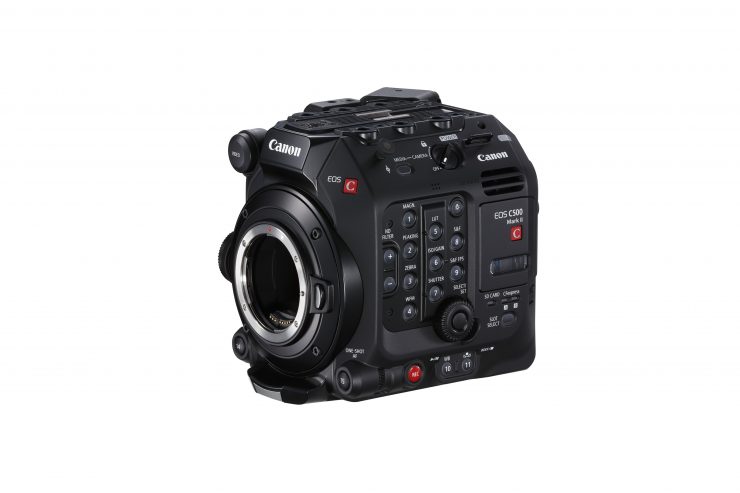
Talk about disruption...The Canon C500 mII has it all! A super feature rich camera for under $20k. I hope the Komodo can set RED in a similar path of disruption with what it offers.
 
D206A_01_main-740x493.jpg


Talk about disruption...The Canon C500 mII has it all! A super feature rich camera for under $20k. I hope the Komodo can set RED in a similar path of disruption with what it offers.

Yeah, saw the video earlier. Disruption is coming from all over and Canon is no small-time player, there are lots of people shooting on it.
 
Yeah, saw the video earlier. Disruption is coming from all over and Canon is no small-time player, there are lots of people shooting on it.
And still I don't understand why it uses CFExpress cards. Officially because their 5.9K RAW Lite @ 60fps has a bit rate of 2.5 Gb/sec but that's like 312.5 MB/sec which is still under what CFAST 2.0 can do. Am I missing something ? (like there's some kind of buffer in cards which forces your to have double your codec bitrate ?)
 
Canon camera with a not much better codec than .r3d. what does all the resolutions help if I can't edit it without problems. Wouldn't buy that plastic bomber and rather get a dragon-x or gemini.
 
Canon camera with a not much better codec than .r3d. what does all the resolutions help if I can't edit it without problems. Wouldn't buy that plastic bomber and rather get a dragon-x or gemini.

Never had any issue with Canon Raw Lite on Premiere Pro CC (but I prefer Redcode Raw anyway :p)
 
And still I don't understand why it uses CFExpress cards. Officially because their 5.9K RAW Lite @ 60fps has a bit rate of 2.5 Gb/sec but that's like 312.5 MB/sec which is still under what CFAST 2.0 can do. Am I missing something ? (like there's some kind of buffer in cards which forces your to have double your codec bitrate ?)

2.1 Gb/s actually. But I suspect more than anything that this new media type has more to do with their upcoming 8K camera needing an internal recording solution and I think the side effect is since they've now pulled the switch on licensing the hardware that both cameras will use Type B CFexpress media. Yes, the C500 MK II appears to work within the boundaries of CFast 2.0 data rates. Though maybe they'll have less compression than 3:1 or 5:1 in the future?
 
2.1 Gb/s actually. But I suspect more than anything that this new media type has more to do with their upcoming 8K camera needing an internal recording solution and I think the side effect is since they've now pulled the switch on licensing the hardware that both cameras will use Type B CFexpress media. Yes, the C500 MK II appears to work within the boundaries of CFast 2.0 data rates. Though maybe they'll have less compression than 3:1 or 5:1 in the future?

Don't know. On C700 and C700FF they rely on a Codex Recorder for the uncompressed Canon RAW.
 
They probably want to use CFExpress because it's going to (quickly?) become the defacto standard. No point holding on to CFast if the price of media is going to be the same, but CFE can do almost 3x the datarate.

Also they may want the added throughput for better offload speeds and/or multiple streams (proxies + raw)... OR maybe they plan on releasing internal uncompressed RAW in a firmware update. Who knows? I certainly think it's better (for the consumer) to have the latest media option in there though, especially if it's going to be the standard in all cameras moving forward (until ~2025+)... Isn't CFast2 almost a decade old already?
 
Status
Not open for further replies.
Back
Top