Welcome to our community

Be a part of something great, join today!

  • Hey all, just changed over the backend after 15 years I figured time to give it a bit of an update, its probably gonna be a bit weird for most of you and i am sure there is a few bugs to work out but it should kinda work the same as before... hopefully :)

KOMODO....

Status
Not open for further replies.
EB8u2nIXsAYBufY


FROM STEVEN SODERBERGHS TWITTER

Is that a Metabones Cine Speedbooster???

Why yes it is!!!!

REALLY!!!! Which one?

Its the ARRI PL Lens to Canon EFR mount T CINE Adapter (EOS R) and here is the link https://www.metabones.com/products/details/MB_PL-EFR-BT1
 
I take offense at this! I do a lot of documentation (for the California Air National Guard) inside and outside large aircraft. I need every ounce of dynamic range I can get! Many shots are needed from cockpits to boom operators refueling aircraft to flying with the cargo doors down. Some of us need the extremes.

I should have put my comment in context... I was talking about filmmaking, because that's what I mainly do, though even on mountaintops once I got access to 13-14 stops, that was enough once I got myself ND filters.

But then I'm also a bit of an oddball because I learned with Velvia on 4x5... so I got used to having a whopping THREE stops of latitude... for me even just 10 stops was miraculous ;)
 
If you mean trimming an 8K Monstro die that was rejected because of edge defects... most likely not. You'd have to account for re-routing all sorts of things like power, control, and I/O, so just trimming a sensor isn't likely to work well.

Red's probably re-using the pixel design from Helium, Monstro and Gemini... not to pretend that they're identical, but they probably all have a lot in common, because why not re-use something that works really well and costs a lot of time, effort, and money to develop?

B. They already have a mechanical platform to support it in production for Gemini, minimal development needed to fit the smaller housing.
That's also a massive oversimplification, since Gemini uses the far more power hungry DSMC2 electronics... the "minimal" part is rather unikely.

.

Not none, but certainly less -- another reason that I'd expect Red to re-use the pixel design that it developed as much as possible.


Realistically, anything over 12 stops is is plenty of dynamic range for anyone competent, but I'd be surprised if Red were satisfied with a sensor that had less than 16. :)

Tend to agree with you for the most part. Good points. Phil Holland mentioned that Monstro is a hot, power hungry beast.
Komodo needs a much lower power/thermal envelope. Nano component sized SOC fab has progressed considerably in just the last couple of years. That makes it possible.

My D16 is an honest 12 stop camera. I don’t have many situations where more is needed, but a couple more stops would improve the noise floor.
 
If you mean trimming an 8K Monstro die that was rejected because of edge defects... most likely not. You'd have to account for re-routing all sorts of things like power, control, and I/O, so just trimming a sensor isn't likely to work well.

Red's probably re-using the pixel design from Helium, Monstro and Gemini... not to pretend that they're identical, but they probably all have a lot in common, because why not re-use something that works really well and costs a lot of time, effort, and money to develop?

Tend to agree with you for the most part. Good points. Phil Holland mentioned that Monstro is a hot, power hungry beast.

Hardly a surprise... Helium and Monstro generate 35.5 megapixel images with 16-bit color... that's a HUGE amount of data. That amount of computing power is a lot of computational work...

Komodo needs a much lower power/thermal envelope. Nano component sized SOC fab has progressed considerably in just the last couple of years. That makes it possible.

Probably also some custom ASICs and a clever active cooling system.

My D16 is an honest 12 stop camera. I don’t have many situations where more is needed, but a couple more stops would improve the noise floor.

I was quite happy with the 13 stops I had on my BMCC. The 12 stops on my Cion were only pain because the Cion had a linear encoding, so the highlight cutoff was harsh as all hell. Getting a Helium was like suddenly having an infinite dynamic range available :)
 
You're probably right. I'm assuming this means it doesn't record 4k+ in ProRes in-body, but I think the existing cameras only go up to 2k.

The DSMC2 cameras can record up to 4K ProRes in camera (422, not 444). I don't do that often because 4K ProRes is as big as 8K Redcode. :)
 
It may be ProRes RAW. Atomos is incorporating it in their products.

I know but I don't see the point of that from a RED camera since it already records a better RAW format (IMHO) internaly.
BUT, the infamous Atomos/RED discussions or deal whatever is the right way to call it might have been about a way to get the raw 4K signal out of a RED body to an Atomos recorder to get it to convert it to ProRes so that the camera doesn't have to do that processing so less heat less power and so on.
I might be totally wrong here :)
 
I know it's a long shot, but I hope we still have interchangeable OLPFs. I can think of some interesting uses for a tiny IR camera.

Me too I really really hope for interchangeable OLPFs !! I don't know if it's a realistic wish but if it's feasible for them to do it and they know we want it perhaps they've done it or they'll add it in :)
 
You're probably right. I'm assuming this means it doesn't record 4k+ in ProRes in-body, but I think the existing cameras only go up to 2k.

I'm totally fine with the camera not recording ProRes in-camera as long as it can record RedCode Raw in-camera. I can't imagine Red would leave RedCode out of the camera since it's probably their biggest advantage against any of the competition, but you never know at this price point.

Knowing what we know now (CFast media, affordable batteries, RF Mount, compact size, around $6k, SDI 4k, etc), this is an instant buy for me if it has RedCode Raw, a Super35mm sensor or larger, and more than 60fps in 4K (hoping for 96fps).

Jarred confirmed on Instagram that it has RedCode built in.
 
Me too I really really hope for interchangeable OLPFs !! I don't know if it's a realistic wish but if it's feasible for them to do it and they know we want it perhaps they've done it or they'll add it in :)

I know I already said it maybe once or twice in the thread already, but since it's made a resurgence I'll throw in that this is a feature I'd love to see as well but I'm fairly doubtful that we'll get it.

Both the DSMC1 and 2 OLPF's had some fairly significant extra space around the edges that in it's current form, based on Jarred's sensor photo, just seems like there's not enough room for with the fixed mount.
Although, things like clip filters exist so maybe RED could do a similar but more secure slim-style for the OLPF than we've seen before.
 
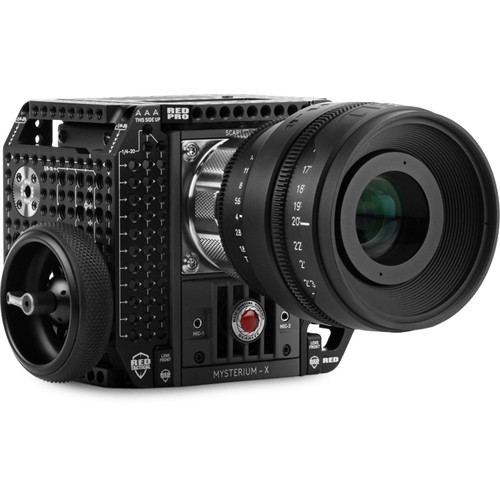
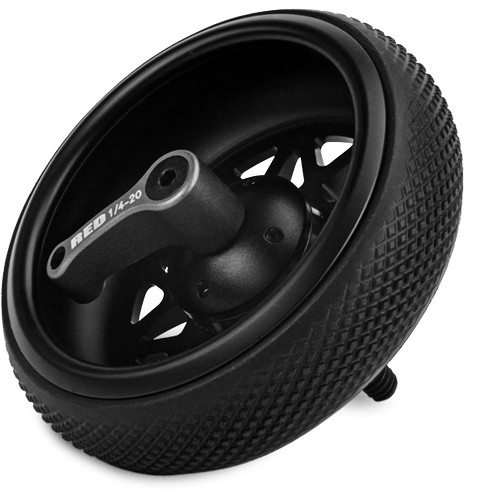
Out of sheer curiosity, what is that focus wheel looking thing on the left side?

Sorry this post wasn't about Komodo :D

Hey Andy that is a RED DIGITAL CINEMA WHEEL HANDLE which was a DSMC1 accessory.
1504023337_IMG_859589.jpg

1523606268_1347595.jpg

I really like the way it feels in hand when attached to the side of the camera body. Having it so close to the body doesn't put a lot of torque on your wrist from the weight of the camera, making it much easier to hold.
 
Last edited:
My thoughts on the RED/Atomos relationship. It may be possible that Red shared some of the color science with Atomos (IPP2) meaning that maybe the Atomos is able to handle IPP2 for monitoring. So Atomos receives the Raw signal from Komodo and is then able to read that data and give us a pleasing image with different IPP2 Luts to pick from. I could be way off though. Another thought to mention (surprised i haven't seen anyone say this yet) the form factor of the Komodo could be great for use in a 3D rig. Maybe that is what the 3rd port on the back is for?

Jordan
 
I'm totally fine with the camera not recording ProRes in-camera as long as it can record RedCode Raw in-camera. I can't imagine Red would leave RedCode out of the camera since it's probably their biggest advantage against any of the competition, but you never know at this price point.

Knowing what we know now (CFast media, affordable batteries, RF Mount, compact size, around $6k, SDI 4k, etc), this is an instant buy for me if it has RedCode Raw, a Super35mm sensor or larger, and more than 60fps in 4K (hoping for 96fps).

Agreed. If it does all those things it will be a very, very popular camera. You and I will both own one.
 
My thoughts on the RED/Atomos relationship. It may be possible that Red shared some of the color science with Atomos (IPP2) meaning that maybe the Atomos is able to handle IPP2 for monitoring. So Atomos receives the Raw signal from Komodo and is then able to read that data and give us a pleasing image with different IPP2 Luts to pick from. I could be way off though. Another thought to mention (surprised i haven't seen anyone say this yet) the form factor of the Komodo could be great for use in a 3D rig. Maybe that is what the 3rd port on the back is for?

Jordan

Speaking of LUTS are any of you using 3DLutCreator for color grading? I am just learning it, but really like the way it works. Does some amazing things much more efficiently than Resolve.
 
Speaking of LUTS are any of you using 3DLutCreator for color grading? I am just learning it, but really like the way it works. Does some amazing things much more efficiently than Resolve.

I've been starting to use Scratch for color grading, which has a color tool that is heavily inspired by 3D LutCreator, because it does make some things much easier. There are also a lot of controls that you can manipulate now by interacting with the image, which also improves their user friendliness, though at the same time reduces how much I use my Tangent panel.
 
Status
Not open for further replies.
Back
Top