Welcome to our community

Be a part of something great, join today!

  • Hey all, just changed over the backend after 15 years I figured time to give it a bit of an update, its probably gonna be a bit weird for most of you and i am sure there is a few bugs to work out but it should kinda work the same as before... hopefully :)

KOMODO....

Status
Not open for further replies.
Canon is building a complete set of 1.2 primes for this mount . So far, 24, 35, 50, 85

I'd buy that for a dollar!

...But yeah, that'll be rad. Especially if they're similar (or less!) than the cost of current 1.4 Ls. Have an almost complete set of 1.2s for <$4k is kinda of unheard of.

OR, dare I say it, if there is no autofocus, getting old/used EF 1.4s for ~$2k and focal reducing them down to ~f1.0s would arguably be even better (if low-light is your thing).
 
I think this will be a Red version of the Z Cam.

Z Cams aren’t more than 4 inches in any dimension either. I’m pretty close to preordering one simply because of what it offers in a way smaller package. I shoot a ton of high alpine content. And the Z can offers 120 at 4K which is a huge need for the shoots.

If you read the “what a Komodo isn’t” next to the Z cam... it’s pretty close. You can even use an IOS device to monitor and control the camera. I’m sure with Hydrogen Red has more in store but the similarities are pretty interesting.

Z-cams apparently have horrible rolling shutter.
 
Z cam rolling shutter is pretty standard. No problem for 99.9% of the stuff mortals shoot.

Nick
 
I'm real curious to know more about the Komodo sensor. Clearly a lot has transpired and RED hasn't ever put a sensor into such a small body and it is really hard to tell exactly how big that sensor is due to the sneaky angle Jarred snapped that shot at. Sitting on my hands, awaiting info. I got a host of glass and adapters at the ready to dig in.

Is is it unreasonable to want a 4K, VV sized sensor with great big pixels that allow for greater saturation in order to capture significantly higher luminance values?

That’s at least one way to differentiate the sensor in the existing lineup (and sensors in general) without stepping on the others’ sales, adding further value to the whole notion of swapping.

I mean, where else is there to go for their sensor tech but up in brightness capacity?
 
I seriously cannot for any second consider that a camera is going to be released that doesn't blow the Z-Cam range out of the water.
 
Is is it unreasonable to want a 4K, VV sized sensor with great big pixels that allow for greater saturation in order to capture significantly higher luminance values?

That’s at least one way to differentiate the sensor in the existing lineup (and sensors in general) without stepping on the others’ sales, adding further value to the whole notion of swapping.

I mean, where else is there to go for their sensor tech but up in brightness capacity?


There's a lot of room outside of "brightness capacity" as you call it for sensors to go, especially some of the latest stuff that's being developed that isn't in any camera yet. The unfortunate (and actually fortunate) thing regarding absolute bleeding edge sensor tech, much like a lot of the technologies that end up in motion picture cameras, is it takes a few years for them to be implemented as they need to be refined and matured. Usually between 1-5 years from initial invention and prototype, sometimes longer. Case in point, the last three extremely high resolution sensors that Canon have showcased have yet to have ended up in still or motion cameras. The 5DsR sensor took about 3-4 years to end up in a camera. The Sony A7rIV coming out this year had prototypes floating around 2017 which was somehow accidently leaked oddly via a flickr upload, which was a surprise in the face of what the A7rIII actually ended up being as well. Some likely can be said for the RED sensors. Dragon has received some love and improvements, but the newer Monstro, Gemini, and Helium sensors likely were being worked on for a good amount of time before they landed in our hands. This is more or less the process and what it takes to make good "ahead of the curve stuff" outside of just using off the shelf sensors, which I'm not saying is a bad thing.

Increasing the pixel pitch, to the size you are recommended of 10 microns is an interesting concept, but there's much more interesting tech to explore for next gen sesnors. Also a 4K VV sensor would be a frustrating world in my mind at S35 format size in the face of the current industry. Not saying it's a horrible idea, I'm sure it fits a portion of users out there. Fight even be what's going on here, but time will tell.

To the MFT format chat earlier back in this thread. Whatever is happening in Komodo, much like I prayed, hoped, and poked RED about when Scarlet-X launched ages ago, I'm hoping for a minimum S35 sensor. I mean, if you going MFT you'd likely aim to have an MFT mount on there, which it appears it is not. Though the desire for Scarlet 3K 2/3"s was certainly there, it sincerely wouldn't have been a successful camera because it was such a small sensor and 3K isn't exactly a thing outside of useful for 2K productions.

So yep, minimum guess here is at least 4K (RED pretty much "is that" at a minimum as it's part of their DNA at this point). Sensor size, well I don't think MFT. Though a cool format, I still think even though this camera is a tiny one, RED is still likely focusing on the cinema market.
 
I seriously cannot for any second consider that a camera is going to be released that doesn't blow the Z-Cam range out of the water.

Pretty sure Z-Cam's own F6 and F8 will do that.

Something about the active sensor area in the pic makes me think it's only ~m43, but 3:2 sensor. And being that RED doesn't really do 4k for 4k any more (Dragon-X and Gemini being 5k, even Raven being 4.5k), I think they'll stick with the downsampling.

EDIT: Just re-looked at the overlay image from a couple pages back and it could also be a ~1.9:1 s35 active area too... hmm.
 
There's a lot of room outside of "brightness capacity" as you call it for sensors to go, especially some of the latest stuff that's being developed that isn't in any camera yet. The unfortunate (and actually fortunate) thing regarding absolute bleeding edge sensor tech, much like a lot of the technologies that end up in motion picture cameras, is it takes a few years for them to be implemented as they need to be refined and matured. Usually between 1-5 years from initial invention and prototype, sometimes longer. Case in point, the last three extremely high resolution sensors that Canon have showcased have yet to have ended up in still or motion cameras. The 5DsR sensor took about 3-4 years to end up in a camera. The Sony A7rIV coming out this year had prototypes floating around 2017 which was somehow accidently leaked oddly via a flickr upload, which was a surprise in the face of what the A7rIII actually ended up being as well. Some likely can be said for the RED sensors. Dragon has received some love and improvements, but the newer Monstro, Gemini, and Helium sensors likely were being worked on for a good amount of time before they landed in our hands. This is more or less the process and what it takes to make good "ahead of the curve stuff" outside of just using off the shelf sensors, which I'm not saying is a bad thing.

Increasing the pixel pitch, to the size you are recommended of 10 microns is an interesting concept, but there's much more interesting tech to explore for next gen sesnors. Also a 4K VV sensor would be a frustrating world in my mind at S35 format size in the face of the current industry. Not saying it's a horrible idea, I'm sure it fits a portion of users out there. Fight even be what's going on here, but time will tell.

To the MFT format chat earlier back in this thread. Whatever is happening in Komodo, much like I prayed, hoped, and poked RED about when Scarlet-X launched ages ago, I'm hoping for a minimum S35 sensor. I mean, if you going MFT you'd likely aim to have an MFT mount on there, which it appears it is not. Though the desire for Scarlet 3K 2/3"s was certainly there, it sincerely wouldn't have been a successful camera because it was such a small sensor and 3K isn't exactly a thing outside of useful for 2K productions.

So yep, minimum guess here is at least 4K (RED pretty much "is that" at a minimum as it's part of their DNA at this point). Sensor size, well I don't think MFT. Though a cool format, I still think even though this camera is a tiny one, RED is still likely focusing on the cinema market.
I don't think I ever wanted a camera as bad as I wanted the fixed 2/3" scarlet. To this day if RED had a garage sale and sold those i'd pick one up.
 
It's going to arrive late September just in time for the beginning of the Christmas shopping season
 
There's a lot of room outside of "brightness capacity" as you call it for sensors to go, especially some of the latest stuff that's being developed that isn't in any camera yet. The unfortunate (and actually fortunate) thing regarding absolute bleeding edge sensor tech, much like a lot of the technologies that end up in motion picture cameras, is it takes a few years for them to be implemented as they need to be refined and matured. Usually between 1-5 years from initial invention and prototype, sometimes longer. Case in point, the last three extremely high resolution sensors that Canon have showcased have yet to have ended up in still or motion cameras. The 5DsR sensor took about 3-4 years to end up in a camera. The Sony A7rIV coming out this year had prototypes floating around 2017 which was somehow accidently leaked oddly via a flickr upload, which was a surprise in the face of what the A7rIII actually ended up being as well. Some likely can be said for the RED sensors. Dragon has received some love and improvements, but the newer Monstro, Gemini, and Helium sensors likely were being worked on for a good amount of time before they landed in our hands. This is more or less the process and what it takes to make good "ahead of the curve stuff" outside of just using off the shelf sensors, which I'm not saying is a bad thing.

Increasing the pixel pitch, to the size you are recommended of 10 microns is an interesting concept, but there's much more interesting tech to explore for next gen sesnors. Also a 4K VV sensor would be a frustrating world in my mind at S35 format size in the face of the current industry. Not saying it's a horrible idea, I'm sure it fits a portion of users out there. Fight even be what's going on here, but time will tell....Sensor size, well I don't think MFT. Though a cool format, I still think even though this camera is a tiny one, RED is still likely focusing on the cinema market.

I didn't mean to suggest there was nowhere else for sensor tech to go beyond "brightness capacity" in general. I'm still wondering when we'll see Panasonic's micro-prisms for every photocell, enabling full RGB data for every pixel, hit the market.

I just meant that, within a simplified description of RED's current sensor lineup, they range from 4.5K to 8K in resolution. They range from ~S35 to VV in physical size.

And they've achieved a great low light performer in Gemini. But, they haven't (nor has anyone else) tipped the other end of the luminance scale to be able to capture significantly higher values. So, in terms of balancing these ranges, substantial improvements on the highlight latitude end have gone unfulfilled.

I'd say being able to inherently capture brighter objects in a scene without clipping, at least to the level that film can, is more important to the overall image quality than resolution, and RED made their bones on resolution.

Btw, I say "brightness capacity" or "luminance values" because talking in terms of f-stops has tended to muddle my argument on this subject in the past. People start talking about rating for different ISOs and underexposing and whatnot, which is what we do and will continue to do.

My point is things are as bright as they are and they don't know or care about f-stops and middle gray. There's almost always more interesting detail to be seen in what we refer to (usually in reference to our recording medium's limitations) as highlights.

Being able to capture 2-3 times the amount of light (stops, if we must) than RED's current best highlight performer at any given ISO would do more for their images than going large format 8K did, IMO.

While there are many considerations in choosing a camera, we all know the one that gets chosen most often for TV and cinema also achieves the most highlight latitude (among the digital cams). I don't think that's a coincidence.
 
I'd say being able to inherently capture brighter objects in a scene without clipping, at least to the level that film can, is more important to the overall image quality than resolution, and RED made their bones on resolution.

From Dragon on every sensor RED has made has surpassed the Total Captured Dynamic Range of film stock.

This isn't really just a RED thing at this point as other companies have done it as well.

If you know how to shoot film you can get 13 stops out of it filling up the range. If you know how to shoot film and judiciously utilize filters and have 100% control over your lighting you can nearly get out 15 stops.

The key to digital cinema, if your hopes are achieving a more film-like range is to figure out where to rate your sensor. For me, I liked Dragon in the ISO 800-1280 range, some like up to about 1600 ISO. Alarmingly similar to how you actually work with film at a given ASA rating and if you decide to push it or pull it later on.

And just because I've been writing about this for literally years here on REDuser, have published side by side tests, and more or less had to go through this with studios for about two decades:

Modern Digital Cinema cameras have surpassed motion picture film in these categories:
- Total Captured Dynamic Range
- Light Sensitivity
- Workable Latitude
- Image Noise/Texture/Grain
- Color Accurancy
- Color Consistency

Film still has a lovely aesthetic, but we've really passed it on a per-format-size basis. i.e. Technical Merit has been surpassed. Visual Aesthetic sets it apart and makes it unique, but of course it can be lovingly emulated. It's truly one of the reasons that for those who can are exploring the additional quality gains of significantly larger formats. For a heartbeat Kodak swung back with a 10,000X scan of film compared to a 10,000 magnified image sensor to point out the individual crystals, but the scan was in black and white. Film itself has gaps between the crystals as well as a good chunk of the crystals not having any color information at all, which is why when people gripe about Bayer Pattern Sensors and Demosiacing/Debayering compared to film I shake my head because you can see it at 1000X on any neg or print.

All good. I think I'll post the last side by sides we did in 2016, 2017, or 2018.... Strangely this year nobody cared to do the film test anymore, the horse has been beaten to death and has been turned into glue, but this year studios were much more focused on 4K Delivery of the very latest digital cinema cameras around this hood.

I got my romantic nostalgia about film too, but when you look at the frames, it's hard to argue any point surrounding as to why anybody would shoot with it in 2019 outside of the general aesthetic both on the image quality side as well as the general ways of working on set.
 
You're not going to make it as a detective anytime soon :)
:blushing::laugh:

I don't think I ever wanted a camera as bad as I wanted the fixed 2/3" scarlet. To this day if RED had a garage sale and sold those i'd pick one up.

At the time I wanted one. I was actually ready to buy two of the damned things. Now... there are cameras that do more or less exactly what I want, and better. Having said that, I would have no problem using one today. If I was a commercial DP I'd probably be very happy with it.
 
From Dragon on every sensor RED has made has surpassed the Total Captured Dynamic Range of film stock.

This isn't really just a RED thing at this point as other companies have done it as well.

If you know how to shoot film you can get 13 stops out of it filling up the range. If you know how to shoot film and judiciously utilize filters and have 100% control over your lighting you can nearly get out 15 stops.

The key to digital cinema, if your hopes are achieving a more film-like range is to figure out where to rate your sensor. For me, I liked Dragon in the ISO 800-1280 range, some like up to about 1600 ISO. Alarmingly similar to how you actually work with film at a given ASA rating and if you decide to push it or pull it later on.

Doesn't film stack most of its dynamic range above middle gray? Not really being a low light performer, there can be like twice as much DR above middle gray as below, can there not?
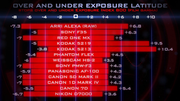
I know digital cameras have surpassed film in terms of total captured dynamic range. However, if you grab some ASA 500 film stock, rate any RED at ISO 500, and shoot the same daylight scene, you're going to get much more highlight detail from the film.

Yes, rating the camera for a higher ISO will gain you more highlight latitude. You're the expert on testing cameras but, from what I've seen, people don't usually compare cameras by rating them at different ISOs. They grab several, set them all to the same, known references (ISO/ASA), point them at the same scene and shoot.

If you test by setting each one such that it captures the highlight detail you desire by manipulating ISO and aperture, a Canon 5DMKII would seem to have the same highlight performance as Monstro does, which we all know it doesn't. The best way to do it is set them all to the same reference and see what you get.

When you do that, film wins the overexposure tests, even with 3-4 stops less total dynamic range. Doesn't it? Just because digital has clear advantages over film these days, there's no reason to throw the baby out with the bathwater. This is a trait worth saving.

Raw highlight performance might be the last trick up film's sleeve, but it's a damn good one. On second thought, one other area film excels and digital can't touch, even with rating at a higher ISO is color light sources like traffic, brake, Christmas, neon, etc. lights.

Most film stocks saturate the color before they blow out to white. Digital gives up the ghost early and usually results in a white blob with a colored halo. I'll be glad when digital expels that demon.

Interestingly, if digital manages to squeeze 3 more stops out of the highlights, it may also solve the colored light problem to boot.
 
Last edited:
I thought middle gray is ASA/ISO value where you have equal latitudes under and above. Because - middle.

I know digital cameras have surpassed film in terms of total captured dynamic range. However, if you grab some ASA 500 film stock, rate any RED at ISO 500, and shoot the same daylight scene, you're going to get much more highlight detail from the film.

What happens if you use 50 ASA film? And what with ASA 1600? Think that with 1600 ASA you'll got greater overexposure latitude? :smile5:
 
Doesn't film stack most of its dynamic range above middle gray? Not really being a low light performer, there can be like twice as much DR above middle gray as below, can there not?
Yes. From 2011:


I wonder if 5219 is really a 250 stock - or even 125. ;-)

Yes, rating the camera for a higher ISO will gain you more highlight latitude. You're the expert on testing cameras but, from what I've seen, people don't usually compare cameras by rating them at different ISOs.
I don't see the difference between a higher ISO + an ND vs the same ISO. Just IMHO. If you can get better results at a higher ISO, why not?

Raw highlight performance might be the last trick up film's sleeve, but it's a damn good one. On second thought, one other area film excels and digital can't touch, even with rating at a higher ISO is color light sources like traffic, brake, Christmas, neon, etc. lights.
Once digital can fix this, I wonder if there are any advantages left for film. It's a serious issue, too. It is what justifies shooting on film - even 8mm. Some productions which shoot on film will sometimes shoot digitally for night scenes. That's not necessarily a smart move, and I question it.
 
Šabović Adis;1863686 said:
I thought middle gray is ASA/ISO value where you have equal latitudes under and above. Because - middle.

What happens if you use 50 ASA film? And what with ASA 1600? Think that with 1600 ASA you'll got greater overexposure latitude? :smile5:

Once again, you misunderstand. We're talking about the amount of highlight latitude the medium can capture before clipping. Middle gray is always (for most of our purposes, anyway) middle gray but that doesn't mean your camera can capture a luminance value 10 stops brighter than that.

Phil, this comment is EXACTLY why I got away from using the terms "stops" and "middle gray" in favor of "brightness values" and "luminance values."
 
Last edited:
Film still has a lovely aesthetic, but we've really passed it on a per-format-size basis. i.e. Technical Merit has been surpassed. Visual Aesthetic sets it apart and makes it unique, but of course it can be lovingly emulated.
I can name at least 10 well known DP's and directors that I've worked for who would disagree with your last sentence
 
Status
Not open for further replies.
Back
Top