John Marchant
Well-known member
- Joined
- May 4, 2010
- Messages
- 2,168
- Reaction score
- 2
- Points
- 38
- Location
- Normandy, England
- Website
- www.kippertie.com
I've started shooting everything on a 45° dutch angle to increase resolution the Sony way 

Follow along with the video below to see how to install our site as a web app on your home screen.

Note: this_feature_currently_requires_accessing_site_using_safari


...
Introducing colour complexifies things..... The Bayer pattern colour filter array gives you a colour image from what would have been a monochrome sensor, but at the loss of some resolution. This was certainly an issue in the days of standard def where you have few pixels to begin with, but for digital cinema there are many advantages. We measure (on RED One M-X / Epic) around 80% of the horizontal resolution, so a 4k image would contain around 3.2k worth of image detail, with negligible aliasing. MTF is also very good with very strong contrast and detail at the 2k point and no corruption from aliasing. If you compare that to your typical 3 chip 1080p camera, they'll have visible aliasing at 1.9k (being the limit of the system) with a MTF50 much much lower. In other words, the system we use allows for a cleaner image (in terms of lack of aliasing artifacts) higher over-all resolution and higher MTF50 (which relates strongly to the human perception of sharpness / resolution).
Graeme

Where is your Flickr account? It wasn't listed on your profile page. BTW that image looked a bit soft to me. Was that due to JPEG smoothing or did you just hold back? And I noticed purple fringing in some areas. Is there no way to remove that?Just for you, an old Red One 4.5k WS still from a cheap wide angle - click
Maybe Apple optimized the debayer algorithm for skin tones. But the iPhone's sensor is indeed a Bayer array. And the rolling shutter can be as bad as a DSLR's.Lets face it, even my Iphone camera renders better skin tones. It is because those are real pixels and "what you see, is what you get???,

Great Thanks ... is great to know you guys have worked and test all this out, so I don't have to worry about itThat's nearly how I do MTF. I use my sine zone plate, then plot a scanline and derive the contrast from the swing of the sine similarly. Nice with with the zone is it gives a good visual guide to aliasing which linear sine ramps don't, but both work great for MTF.
Graeme


When you refer to "weird skin tones" are you talking about before or after any color correction? Does it matter how they were lit? Are you differentiating from people who know what they are doing with those cameras and those that don't. Honestly, when I see generalizations like that it drives me a little crazy.
Did you ever notice how those Chevy drivers swerve all over the road and practically cause accident? Must not be a very safe car!! :smiley:

Funny how one day the RED cams are denigrated for giving people 4K when all the industry really needs is 1080. Then the next day they get slammed because the way they create that 4K image isn't the most ideal way possible. WTF?
I have seen plenty of nice clean high resolution images come from Epics, F65s and 65mm negative. Each approach has strengths and weaknesses, know them and you can optimize. Full stop.
BTW, the whole skin tone issue ties back to the basic conundrum inherent in a RAW pipeline - the power to do far more good, or evil, than a typical RGB based imaging system.
Cheers - #19
I know this topic causes adverse reactions but I can prove what I said. Also, just for the record, this is a constructive criticism, as a said, I discovered something, and I am working on that to correct the problem. ( I cannot talk much about in details right now thou)
Take for instance movies shot on Red like "A Dolphin Tale", or , "Unconditional".
People behind those movies are supposed to be the best (colorist) in the world, still, I know that, they have had a hard time grading the raw files from a Red camera (I know one of them personally). I'll post one example image showing you exactly what I am talking about..
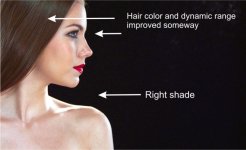
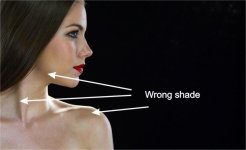
Take a look at the different shades of skin tones in the first image below.
If you haven't noticed, the light shades of the skin tones are correct (to the average people's eyes), but the dark shades, instead of going smoothly to a dark-pink kinda shade , it becomes more like a gray-charcoal kind of color , that looks unnatural, and it happens in every footage I see from the red camera, and this is before or after the color correction, and it gets worse when you try to apply contrast and saturation.. Go ahead and watch again the trailers from the movies I just mentioned and you'll see what I'm talking about.
Now, Jim Jannard states that this is a "myth", and he says that you have to color balance prior to any color correction, and also he says, that Red color science has improved lately, But for my surprise, the latest movie shot on Red "Hitchcock", shows the same problem. Don't they know how to color balance?, I don't think, that's the case, instead, I know is a problem caused by the debayering algorithm and it happens at the sensor level, so don't get me wrong, we are trying to fix things here, I am not a Red hater or something like that. I have to say also that I am surprised of the work they did with the movie "Bachelorette", still, the problem is not totally corrected. The method I am working on corrects this problem as you see in the second image. I'll post more examples later, I can even "Grade after the Grade with this method".
Post your .R3d still and I'll prove it to you.
"prove..." ?? Excactly how is this proof?
So you are pointing out a problem that few (if any) others think exists so that you can ride to the rescue with a solution? Affordable, too, I don't count. LOL
is OK no worries, is 12:52 am, and I am discovering more fascinating things about this everytime.. I guess Canon and Sony should be very interested in this..
Ugg. Here we go again. Another RED basher with an agenda to prove. Who cares...We shot this video in 2010 with a RED ONE and B-Speeds and the skin tones look GREAT. Countless movies and projects say you are wrong...Prometheus, Flight, Social Network, etc, etc, etc.
The camera is what you make it.
Some parts of the video look OK due to lighting, some others don't, like always, but I am really busy cooking something for you guys..


Thanks for the feedback. That video hit #1 on MTV.com, so I guess no one cared.