Welcome to our community

Be a part of something great, join today!

  • Hey all, just changed over the backend after 15 years I figured time to give it a bit of an update, its probably gonna be a bit weird for most of you and i am sure there is a few bugs to work out but it should kinda work the same as before... hopefully :)

Is This Real or Even Possibly Close???

SO yes, in linear sensor data there are more code values per stop in each and every brighter stop. The number of code values per stop doubles on each increase of stop brightness. However, this is NOT why we want to use the brighter stops. We use the brighter stops because sensor read noise is the predominant form of noise in the raw image that matters. Because sensor read noise is essentially a fixed value that doesn't vary with the brightness of the pixel read, read noise predominates as a source of visible noise the darker the value you're reading. Say we're talking about a sensor that has 1% read noise and we read a really bright value pixel, say one at 90%. 1% read noise out of a 90% value is not going to be noticeable. Now let's read a really dark value of 5%, and our read noise is still 1%. Now read noise is contributing to 1/5th of the signal we've read.

Unfortunately some photographers who promulgated ETTR did so for the wrong reasons. They knew about images and linear light from the sensor, and knew an ETTR exposure lead to a better image, and they correlated that to the code values per-stop. But they didn't know sensors, and didn't grok that it's read noise we're trying to avoid by exposing to the right. In other words they gave the right advice for the wrong reason.

The other source of noise is shot noise which increases as the number of photons that hit the pixel. In other words shot noise predominates at bright exposures. This means that although you have vastly more code values at brighter stops, you also have vastly more shot noise. But as shot noise scales in line with brightness, we hardly ever see it as a source of image noise as it's fairly distributed per stop. What we see is read noise when we try to look at the darker stops. Because of read noise it makes no sense to have a great bit depth on the AtoD of the sensor than is necessary. You could have a 32bit AtoD and give umpteen code values to the darkest stops, but because read noise predominates you're wasting all those extra bits and super-expensive AtoD on recording read noise! As long as the bit depth is enough so as quantization noise is lower than read noise, you need not go any further. Because most practical AtoD are linear, this leads to an over-abundance of code values in the brighter areas of the image, but again, we're not doing ETTR to use these code values, we're doing ETTR to reduce the visual appearance of read noise.

Graeme
 
All cameras tend to look pretty identical with the lens cap on.....

Graeme
 
Sensor size... Color Science... Rez... How the camera captures the images through its processor all have an impact on the image. Some not seen on all types of screens and others are. Make no mistake Epic Scarlet & Dragon are in a league of their own, and ad to that the brains that created the sensor and guts as well... The proof is in the images and the camera.
 
Graeme, thanks for the in depth answer, this is why (even though there is a lot of "noise" these days ;-) ) I still come to Reduser.
 
Two things I immediately notice - 1) purple lens flares on the BM, and 2) gritty, unrealistic tree detail.

And because of the gritty unrealistic detail (probably from inadequate optical low pass filtering and/or poor demosaic) there's an excess of compression artifacts surrounding the leaves on the trees. This will cause issues for any compression done in camera and also for any web based delivery of the image.

This is why doing digital cinema well is hard - you've got to get a whole lot of details right, and that's tricky.....

Graeme

Yes. Also, try grading secondaries on footage with problems like that, or tracking windows, or 3D tracking, or…. You'll see that bad will quickly become worse. Even simpler, try just recompressing it for delivery via broadcast or web (broadcast compression is often the very worst of all) Compression routines do not like line skipping and artifacts.
 
X vs. Y threads are so, I dunno?

I want to say boring, but it's not quite boring. I want to say dumb, but not quite dumb. It's more like, they only lead to inflammatory discussion and I have yet to see one end well or end up proving anything one way or another.

Just my .00000001 cent on bafflegab. And here I am contributing to it.

Battistella

So your advice is what? Never compare? Never learn the various strengths of each platform? Just mindlessly pick a camera "because you feel like it"? If you want "dumb" not wanting to learn information is the definition of dumb. At least you didn't chime in with the ultimate idiot post of "Its' all about the story anyway".

I know you're smarter than that.
 
Yes, 5K HD, 9:1

Well, the RED was certainly handicapped in this scenario by excessive compression. You can see that in the grass as the noise becomes a flicker instead of grain in the RED footage. In the BMCC you can also 'detect' some debayer errors. I remember when both the Epic and REDOne were launched there were checker patterns in the color channels, you can see that in the grass in the BMCC it looks like black magic is using a weak debayer to eek out some extra resolution. Makes everything nice and sharp which is what I think you're seeing, not sharpening or a weak OLPF, just its debayer option.

I agree with Ben Roper, one of my least favorite parts of RedColor is in skies. Even on a crystal clear blue sky day RED goes towards desaturated. The clouds are scientifically leaning towards true White however the result is that they have that pinkish look like in the first comparison. For REDColor4, skin tones would be my #1 request--however Skies would be a close #2. I feel like Blues in the LUT are pushed. I often try to pull them back down in secondaries.

You can see RED's advantage in dynamic range. The clouds are pretty crispy on the BMCC footage.

All in all I would say these are pretty good/fair comparisons of the two cameras (except for the fact that it's heavily compressed h264).

Graeme can you explain the desaturated blues in RED? Is that a conscious decision or is it a natural result of the sensor?
 
Graeme, thanks for the in depth answer, this is why (even though there is a lot of "noise" these days ;-) ) I still come to Reduser.

I can't do anything about read noise other than ask you to expose to the right :-) Perhaps REDUser needs an ETTR mode :-)

Graeme
 
All in all I would say these are pretty good/fair comparisons of the two cameras (except for the fact that it's heavily compressed h264).

GAVIN - That was pretty much my purpose for this post. I guess I personally, am not as interested in the technical side of what's involved with the cameras as I am with what comes out of it. When purchasing this BMPCC I didn't really know what I could expect but some of the things that I have see (while NOT as good as RED or even close) are quite impressive...

https://vimeo.com/79355285 (Skip to 0:50 "The Fly") - Wish I could see what this looks like on a RED Epic...
 
So your advice is what? Never compare? Never learn the various strengths of each platform? Just mindlessly pick a camera "because you feel like it"?

ROBERT - Exactly, though these cameras are not in the same league (EPIC is 5K and BMPCC is 1080 HD), I still think its ok to see what the strengths and weaknesses of both cameras are (i.e. this tiny BMPCC wins the Blue Sky Competition)...
 
ROBERT - Exactly, though these cameras are not in the same league (EPIC is 5K and BMPCC is 1080 HD), I still think its ok to see what the strengths and weaknesses of both cameras are (i.e. this tiny BMPCC wins the Blue Sky Competition)...

How?
The blue skies "better or worse" is quite impossible to judge on two different raw transcodes to low res vimeo... or transcoded to anything for that matter. You are looking at a captured image + grading. from two different cameras viewed after the stuff is also highly compressed to a small internet file...

For me it's impossible to judge what is and whats not.

Also cameras are fixated still, the BMCC is know to get sciatica when panning or tilting or moving slowly due to the no OLPF.

I'm not saying the BMC does not shoot nicely but judging a somebody else's comparison like this on vimeo does not mena anything to me.

I can make my Iphone look 10 times better than my epic any day. But is it?

BJORN - My Blue Sky's competition comment was totally a joke. I personally don't shoot to many blue skys so I couldn't care less. However, I do like some (NOT ALL) of what I see coming from the BMPCC, but the same goes for any camera (EPIC included). None of them are identical and none are perfect. IMO there's no reason these 2 cameras should even be being compared, a $995 12oz Pocket piece of 1080p, Super 16 Sensored plastic vs. a $40,000 20+lb. awesome hunk of 5K, S35 Sensored, Movie Making Machine, is like comparing a Honda to a Ferrari Enzo and trying to race them. Clearly the EPIC should be BETTER. It's meant to be. But I have yet to read anyone say the BMPCC is a pretty cool camera for what it is and all it should be.

If I could make my iPhone look 10 times better than Epic (EVER), I'd buy 20, save a few bucks on EPIC, and shoot Transformers 5 and The Hobbit: The Third Part and call it a career. LOL.
 
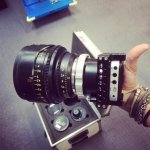
I like the BMpocket, considering its a sub 1K camera slightly bigger than an Iphone it offers neat performance, nothing compared to the EPIC but its a handy little camera for me to use on the go and on the octacopter when flying the EPIC isn't practical. I had a play with one last week before I purchased.....could resist putting an S4 prime on that baby ;)
 

Attachments

  • 1505029_3932481246217_1180850177_n.jpg
    1505029_3932481246217_1180850177_n.jpg
    57 KB · Views: 0
I like the BMpocket, considering its a sub 1K camera slightly bigger than an Iphone it offers neat performance, nothing compared to the EPIC but its a handy little camera for me to use on the go and on the octacopter when flying the EPIC isn't practical. I had a play with one last week before I purchased.....could resist putting an S4 prime on that baby ;)

Sick... I've been shooting with a Super Speed on it. I like it so far...
 
Sick... I've been shooting with a Super Speed on it. I like it so far...

for what it is, its a neat little camera. of course its no Epic, but I enjoy shooting the Blackmagic pocket more than doing video on a canon mark III.
the video that tipped me over to get one was this:


just thought this was stunning performance from such a small camera.
 
Back
Top