Welcome to our community

Be a part of something great, join today!

  • Hey all, just changed over the backend after 15 years I figured time to give it a bit of an update, its probably gonna be a bit weird for most of you and i am sure there is a few bugs to work out but it should kinda work the same as before... hopefully :)

Helium Exposure / Monitoring - continually updated starting 10/12/2016

I think i good test would be demanding moving detailed footage shot at the same overall data rate 7K vs 5K Dragon, same FOV. To see if the theory of more res, more compression works. Especially if there is less noise.

Maybe we'd find that shooting 8K or 7K when it comes down to it, at the same overall data rate is comparable or better than the dragon equivalent. I have no idea.

Personally when i get mine my focus is on edges for green screen and keying work. I probably care more about that then most.

cheers
Paul
 
Kinda busy prepping a shoot at the moment, but there may be a chance I could do some more intricate testing with shared results soon.

Dynamic Range is confusing... part of it is the Mapping of tones using Dragon or MX tone mapping.

This sensor seems to have a larger Gamut, and just sees a lot more latitude and color wise... at least that's my impression. Because it has higher native sensitivity you just need to watch clipping - if you aren't clipping in Raw, chances are you will be fine highlight wise.

Best Exposure practices feel different for sure, I would just plan on it clipping sooner in highlights since it's natively more sensitive. Whole scale moved up a couple notches...
 
Thanks for your insight, Dan.

One of the most important factors for me to upgrade to Epic-W or stick with my Scarlet-W is whether the Helium sensor has less DR in the highlights than the Dragon sensor. DR in the highlights and roll-off are more important to me than cleaner shadows so I'm curious to see some comparisons between the two sensors to help me decide.
 
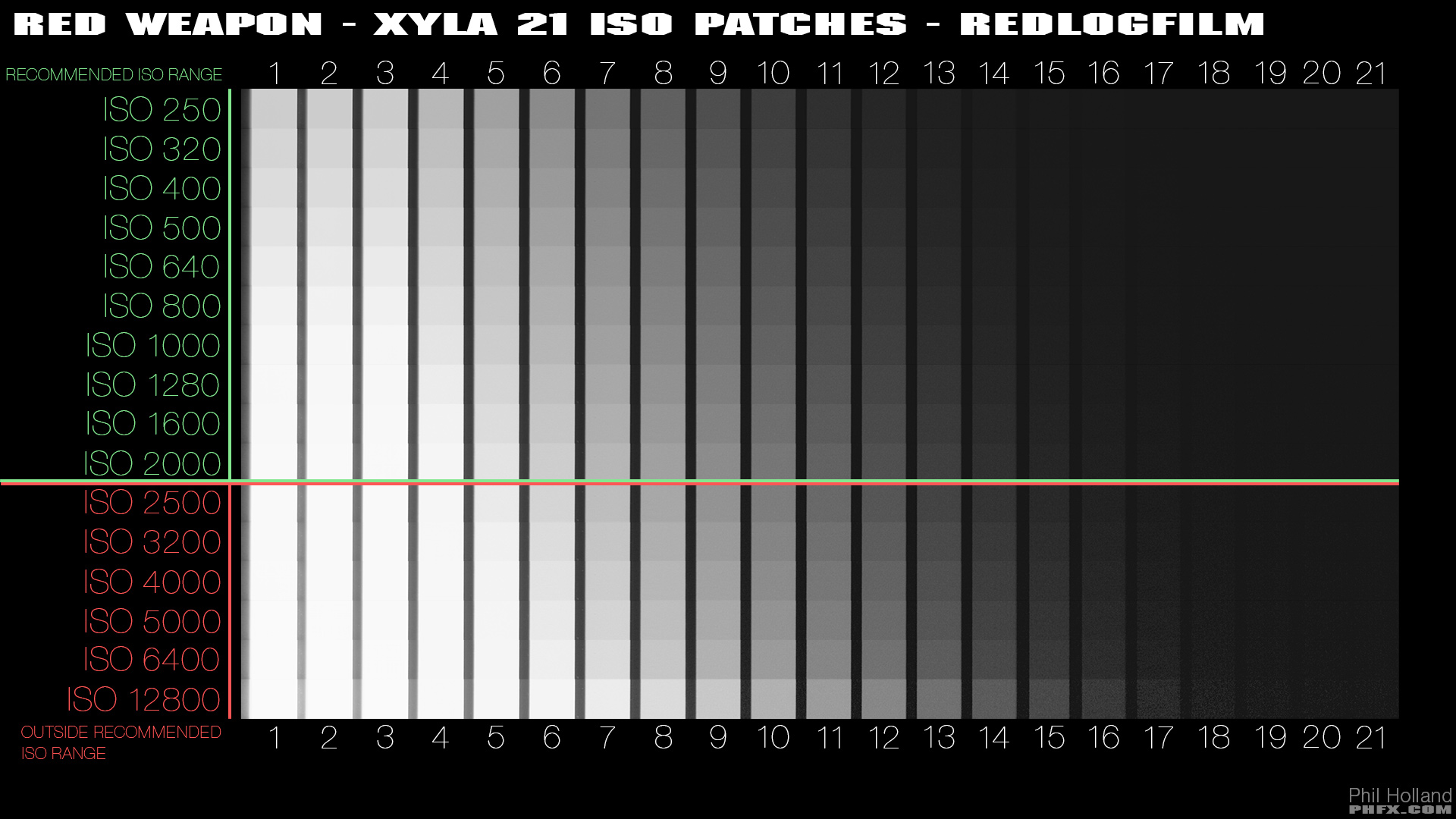
The Helium has "less" DR in the highlights is a misconception. It has less DR in the highlights at LOW ISOs. The base ISO is higher, and so the highlight protection starts at higher ISOs.

This is a Dragon chart, but imagine Helium, where the lower ISOs have even less highlight chips at low ISOs, and doesn't get coverage until you reach 1000+. It has the same amount of "chips" (16.5+ stops), but they shifted them.


phfx_REDWeaponTest2015_xyla21_ISOPatches_RLF.jpg


This is why having good NDs for Helium will be a must.
 
Last edited:
So, does anyone know what the base ISO for Helium is?

Based on my short tests so far, Helium clips sooner than Dragon (at ISO 800), using both standard OLPF.
Thus, I need to expose about 1-1.5 stop lower than I usually expose with Dragon at 800.
Does that make sense?
 
So, does anyone know what the base ISO for Helium is?

Based on my short tests so far, Helium clips sooner than Dragon (at ISO 800), using both standard OLPF.
Thus, I need to expose about 1-1.5 stop lower than I usually expose with Dragon at 800.
Does that make sense?

With my limited testing, its looking like the base iso is 1600ish. Really amazing rich images coming off of this thing.
 
So, does anyone know what the base ISO for Helium is?

Based on my short tests so far, Helium clips sooner than Dragon (at ISO 800), using both standard OLPF.
Thus, I need to expose about 1-1.5 stop lower than I usually expose with Dragon at 800.
Does that make sense?

Give ISO 1280-1600 a try "generally speaking".

I've got to do a whole write-up tamale thingy on this shortly.
 
Give ISO 1280-1600 a try "generally speaking".

I've got to do a whole write-up tamale thingy on this shortly.

I have two shots at 1280 but still have the feeling Helium clips sooner. Will try with 1600-2000 tomorrow.
Looking forward to your write-up, Phil.
 
Short test at 1600/2000 this morning. Now we are getting closer.
Very difficult scene with high contrast and very gentle nuances in mids to brighter tones (morning mist, forrest, clouds).

From what I can say with my limited knowledge, light roll off are gentle and beautiful, also transition. At least equal to Weapon Dragon.
However, Helium still tends to clip faster than Dragon so you really have to be careful on how you expose.
Will try with Highlight OLPF.

And yes, you need super strong ND filters if you want to open iris. Unfortunately my Tiffen variable ND vignette. So fix ND is the way to go.
 
Going into this territory of using a lot of ND to shoot my Helium at a 1600-2000 base I.O. has exceeded the capability- (unless stacked with a non-variable, which I don't like doing, since my B&W circulars have a color cast that I don't want to compound) - of my variable NDs while shooting wide open on the 55mm, 1.7T Otus, which for me is the base standard lens for the Helium. I am very happy that I bought a fairly complete set of NISI NDs. I bought 2 NISI 4x4 polarizers as part of the group and am going to be experimenting on how they work together to make a variable ND. Does anybody know of a light weight clamp on 4x4, 2/3 stage with at least 1 rotating holder?
 
Short test at 1600/2000 this morning. Now we are getting closer.
Very difficult scene with high contrast and very gentle nuances in mids to brighter tones (morning mist, forrest, clouds).

From what I can say with my limited knowledge, light roll off are gentle and beautiful, also transition. At least equal to Weapon Dragon.
However, Helium still tends to clip faster than Dragon so you really have to be careful on how you expose.
Will try with Highlight OLPF.

And yes, you need super strong ND filters if you want to open iris. Unfortunately my Tiffen variable ND vignette. So fix ND is the way to go.

Interesting... You feel the DR is a little lower on Helium than Dragon?
 
I can't say really because I normally don't do comparison tests etc. I let this to the others who have much better knowledge than I do.

However, having worked with a loaner Scarlet-W and rented Weapon CF in last couple of months, what I can tell is that I have to adjust on how I exposure with Epic-W. For the moment I expose somewhere around IRE 94 and below but definitely not more than 95. As soon as you go beyond IRE95, even there are no stop light in the histogram, when you open the file in RedCine it looks like highlights are "clipped". Yes you can retain all the details, they are there. But I prefer to have a "good and correct" exposure in camera.
 
Funny Hack I've been using for exposure check... probably this is a horrible practice hence calling it a hack...

set 2000 ISO
Redcolor 4, Redgamma 2
Set FLUT anywhere from -1 to -2 (just for taste on set)

Set Iris based on RAW view so I'm not clipping anything I want to see.
Adjust flut level as necessary for on-screen image to look client acceptable prior to rolling.

Pleased with Results so far.
 
Interesting... You feel the DR is a little lower on Helium than Dragon?

We compared Helium to Dragon at 800 ISO, and DR looked very similar.

However, considering Helium appears to be a 1600-2000 ISO camera, it may in fact have "more" DR at ths sweet spot (ie when you consider we monitored/exposed it perhaps a stop and a half "under" this at 800 ISO, and yet it still looked pretty much "the same").

So that...is promising.

I think the goal will be how to get Helium to work optimally at "studio" 800 ISO environments - perhaps Skintone OLPF? Internal ND? Mottion Mount?

Who knows.

Bear in mind we were monitoring with DRAGON COLOR...so until new color science is revealed...we really don't KNOW what we were looking at...
 
Back
Top