Welcome to our community

Be a part of something great, join today!

  • Hey all, just changed over the backend after 15 years I figured time to give it a bit of an update, its probably gonna be a bit weird for most of you and i am sure there is a few bugs to work out but it should kinda work the same as before... hopefully :)

"Dueling with DRAGON: RED's 6K Sensor Takes on Older MX in This EPIC Camera Shootout"

I was also confused about the initial exposure test of the Sekonic chart. Were these truly shot at REDLogFilm? Or were they shot at RG4? The S-curve tells me RG4. He said they were all log, but I didn't see the evidence that he got that right.

RG4 leaves you with something like 8 or 9 stops of DR. Unfortunately ,he did it right and that's RedLogFilm.
 
I was also confused about the initial exposure test of the Sekonic chart. Were these truly shot at REDLogFilm? Or were they shot at RG4? The S-curve tells me RG4. He said they were all log, but I didn't see the evidence that he got that right.

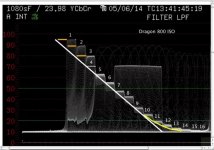
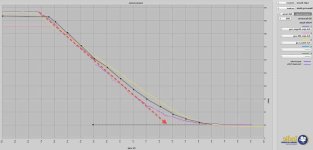
Do you have any "evidence" that he got it wrong? If so, lets see it. The sekonic meter chart that this person posted matches quite well with another posting on here previously. If you look at the attachments you will see that I've drawn a straight line on both the waveform image and the sekonic meter chart (I flipped the meter chart left/right to make it easy to see.) As you can see they both flatten out at the same place. It seems to me the person mapped the log image perfectly right. Note: The black dot line on the meter chart is me mapping out points posted by John Marchand on his sekonic meter chart of the old olpf. Clearly with the new calibration dragon is mapping the exact same reflectance values at a darker spot than the old calibration. You can also see that the new calibration adds about 1 stop more highlight latitude.
 

Attachments

  • Dragon DR Curve jpeg.jpg
    Dragon DR Curve jpeg.jpg
    68.5 KB · Views: 0
  • 30005_Sekonic-ChartDragonAlexaMX copy.jpg
    30005_Sekonic-ChartDragonAlexaMX copy.jpg
    73.6 KB · Views: 0
I withdraw my question about REDLogFilm...the labels clearly showed Log in the name for DRAGON and MX. I did not remember seeing the labels, only hearing the commentary. I always like to see something on the screen that reinforces what's being said. Kudos again to ARRI for having such a log-like log response--very flat over a very long range.
 
i put some redlogfilm crops of my album here

https://www.flickr.com/photos/123436930@N07/sets/72157646031073855/

the redlogfilm crops
https://flic.kr/p/ofWKZo
https://flic.kr/p/ofWNrN

one is ISO 1600, other ISO2000 pushed

no DEB, no ADD. Tungsten light. please notice, that the shadows are intended to be black in the final image.

as said in my thread of this i can´t post r3d because they would show too much skin ;-)

there is noise (as it is pushed without sense in this "noir situation", but actually it so much better than a lot of footage posted here in reduser. the red sparkles were discussed enough, in this case they are no issue, because you wouldn´t use this pushed blacks in a final grading and with "DEB on" they are in good hands. Dragon "grain" is very fine, will have not the red touch with DEB, Colors are stable and neutral (i am not allowed to show stuff from redcine DEB at the moment, but it is an improvement, you will see soon). Actually, i am getting a great image out of the shots, and thy look great on the 4K screen.
... i have both. One Dragon. One MX. Side by Side. Everyday. I always get the better results with Dragon, in every aspect. i am 100% neutral here. but especially the tungsten performance is a huge step. with MX i have a lot of more chroma noise and shadow-details are more muddy.
don´t know, maybe i have another sensor, ... but often i can´t confirm a lot of "tests" out there, and honestly, here at our studio, we are tired of laboratory testings ... i only believe my own tests right now ;-)
and i will upgrade the 2nd MX too. with conviction.
 
Another problem I have with these tests is that he compares DRAGON to EPIC at 1:1 pixel resolution, which basically negates the 6K vs. 5K advantage. To truly evaluate these cameras--including noise--everything should be finished at 4K. If that results in lots of noise being pushed down below perceptible levels, isn't that the point? There *are* tradeoffs making the photosites of the 6K DRAGON smaller than the photosites of the 5K EPIC. Comparing them at 1:1 instead of 4K kinda defeats the whole concept of "Shoot at >4K to finish at 4K".
That's only useful if you have lenses that cover 6K on the Dragon. I think 1:1 comparisons are absolutely useful, since many cinema lenses will only cover 5K-5.5K on the Dragon.
 
16.5 stops

16.5 stops

There is a reason why Arri has stayed with it's sensor for as long as it has. None of the camera companies producing 4K+ cameras(Red, Sony, Canon, Panasonic, JVC, Blackmagic, AJA, Vision Research, Kinifinity) have been able to produce a sensor capable of more dynamic range. Let's hope Red will surpass Arri's current sensor(now almost four years old) with the next iteration of Red sensor. There are still a ton of things to love Red. This forum being one of them:)
30005_Sekonic-ChartDragonAlexaMX.jpg
 
the Sekonic chart can´t show the usable DR and how it really look like - i am a huge fan of Arri since a long time, but honestly, in shadows, Alexa has its limits too - this whole curves and tests are nice, but let´s go to a 4K screen and compare then about the real image-impression, pushed, not pushed and so on
for me, and i compared enough, both are on the same VERY high level - but Dragon delivers more details ... and is more flexible (Copters, Gimbals) ...
 
People seem to forget that the Alexa has perhaps the equivalent of a Low-Con Filter in the OLPF section.

So.... put a Low-Con on the Dragon and then it's even nicer..... perhaps.
 
That's only useful if you have lenses that cover 6K on the Dragon. I think 1:1 comparisons are absolutely useful, since many cinema lenses will only cover 5K-5.5K on the Dragon.

Let's not forget that if you are only covering 5K on DRAGON you are not covering 5K on MX.

If one wants to peep at 1:1, that's great for intermediate commentary, but it does not lead to a sound conclusion. If the finish is to 4K, the results should be compared at 4K. If the finish is to 8K, then the results can be compared at 8K. But saying "Dragon at 6K has slightly more noise than MX at 5K" is a meaningless intermediate result.
 
RYAN is a good test, and of course remain the test, what does that prove?
Nothing and everything.
All of us and some of us will be more favorable to the contrary, those who like and do not like.
Reality 'and now' that Dragon has the best colors in every kind of light compared to Mx and of course compared to Alexa.
You just have to relearn.
It has a great Dr, if he will have Red 'option as a low cow OLPF we would still have a better roll off, I would say "spectacular".
I very much agree with Ryan on the factor highlights, even if it were up to me I would still lose a stop below to put it on, I'd be much more comfortable, and of course 'personal but I bought Red' cause I want images such as cellulose and certainly not the by XDCAM.


Now we wait DEB and new tools OLPF so all we can set the camera as we prefer.


I tried to download the file from here they are:


https://www.dropbox.com/s/d0g0m2czva5yi7j/test.zip


just my thought
 
There does seem to be something off about the shadows in this test. I base this on every other .R3D (dozens of them) from the new OLPF Dragon I've downloaded, examined, scrutinized and graded.

The results Ryan Walters got are the results he got. It's there in the files. However, I think the results are very atypical and don't seem representative of how Dragon usually behaves in the shadows.

It looks more like a worst case scenario result than what you'd normally see from the camera.

If there are other low light shots out there that look this bad from Dragon w/OLPF V2 I haven't seen them, and I make it a point to see as many as I can get my hands on.
 
There does seem to be something off about the shadows in this test. I base this on every other .R3D (dozens of them) from the new OLPF Dragon I've downloaded, examined, scrutinized and graded.

The results Ryan Walters got are the results he got. It's there in the files. However, I think the results are very atypical and don't seem representative of how Dragon usually behaves in the shadows.

It looks more like a worst case scenario result than what you'd normally see from the camera.

Indeed...few people would put a black subject (TENBA bag) with a blacker logo (TENBA) in the shadows and then draw conclusions from *that*. On the other hand, it does go to show how wide-ranging 13+ stops of DR really are. To put that into context, remember when he said that sit-com key:fill lighting ratios are between 2:1 and 3:1, dramatic lighting is 4:1, and VERY dramatic lighting is 8:1? In stops, that's 1-1.5 stops, 2 stops, and 3 stops respectively. Which means that under rational conditions, a "very dramatic" scene can easily give you 13+ stops of DR on the key side and 10+ stops of DR on the fill side. Now, if you are a "no lighting" kind of indie person, where there's really 10 stops of lighting difference between key and fill, then yes, DRAGON (and most other cameras) are going to give you sub-optimal performance in your shadows. But you knew that...
 
i checked the r3ds of the test - what sense is here ? - especially Dragon is underexposed from start on ... plenty much room on the histogram (redlogfilm). this are exactly the tests i am done with.
 
There does seem to be something off about the shadows in this test. I base this on every other .R3D (dozens of them) from the new OLPF Dragon I've downloaded, examined, scrutinized and graded.

The results Ryan Walters got are the results he got. It's there in the files. However, I think the results are very atypical and don't seem representative of how Dragon usually behaves in the shadows.
YOu might want to look at this test. It pretty much confirms what what Ryan Walters was finding. All of which is telling me to rate the camera at 320 ISO.
http://vimeo.com/100207513
 
i checked the r3ds of the test - what sense is here ? - especially Dragon is underexposed from start on ... plenty much room on the histogram (redlogfilm). this are exactly the tests i am done with.

Agreed. This chart kinda shows that:

30005_Sekonic-ChartDragonAlexaMX.jpg


In this test, Alexa gets mid-tone gray (aka "0") with an output level of around 106. (It should be around 125 if dead even between 16 and 235). However, the DRAGON is exposed to give an output of only about 83. The Alexa is around -1.5 for the same output level. As others have pointed out, ISO 800 is sometimes best exposed for real at ISO 320, and this test also shows that the DRAGON was behaving like an ISO 320 camera, not an ISO 800 camera. Which begs the deeper question: what is a proper test methodology? If we know that mid-tone gray is going to be down 1.5 stops for a given ISO and shutter angle, should these be adjusted to compare like-vs-like?
 
what it shows is the difference between the "logs" ;-)
 

Attachments

  • LOGS.jpg
    LOGS.jpg
    78.4 KB · Views: 0
i saw real life comparison Alexa / Dragon on a 4K screen. graded stuff. honestly, it was SO hard to say what camera is left or right ... Dragon has more details actually - but DR and noise, ... maybe i need a doctor, but they are on the same level, and all other stuff is a preference of the logo on the camera ... if you can´t shoot a good movie with Alexa, Dragon, and MX ...
if you only shoot girls sitting with some charts in the hand, there might be differences, but i never will watch a movie with 90 minutes a girl sitting there with a chart in the hand. urghs.
 
Agreed. This chart kinda shows that:

30005_Sekonic-ChartDragonAlexaMX.jpg


In this test, Alexa gets mid-tone gray (aka "0") with an output level of around 106. (It should be around 125 if dead even between 16 and 235). However, the DRAGON is exposed to give an output of only about 83. The Alexa is around -1.5 for the same output level. As others have pointed out, ISO 800 is sometimes best exposed for real at ISO 320, and this test also shows that the DRAGON was behaving like an ISO 320 camera, not an ISO 800 camera. Which begs the deeper question: what is a proper test methodology? If we know that mid-tone gray is going to be down 1.5 stops for a given ISO and shutter angle, should these be adjusted to compare like-vs-like?

you are right, but i see no sense here to compare noise floors ... noone would expose a scene with camera "A" because another camera "B" has a certain"base".
if you shoot Dragon, you shoot Dragon.
if you shoot Red One with M, you will handle it different.
if you shoot with F65, you will expose it different ...

and same with the Dragon / MX comparison : 2 different tools.
 
naked ...

heh heh
there is quite a truth in it ... in this case, noise is really not an issue
 
Back
Top