Welcome to our community

Be a part of something great, join today!

  • Hey all, just changed over the backend after 15 years I figured time to give it a bit of an update, its probably gonna be a bit weird for most of you and i am sure there is a few bugs to work out but it should kinda work the same as before... hopefully :)

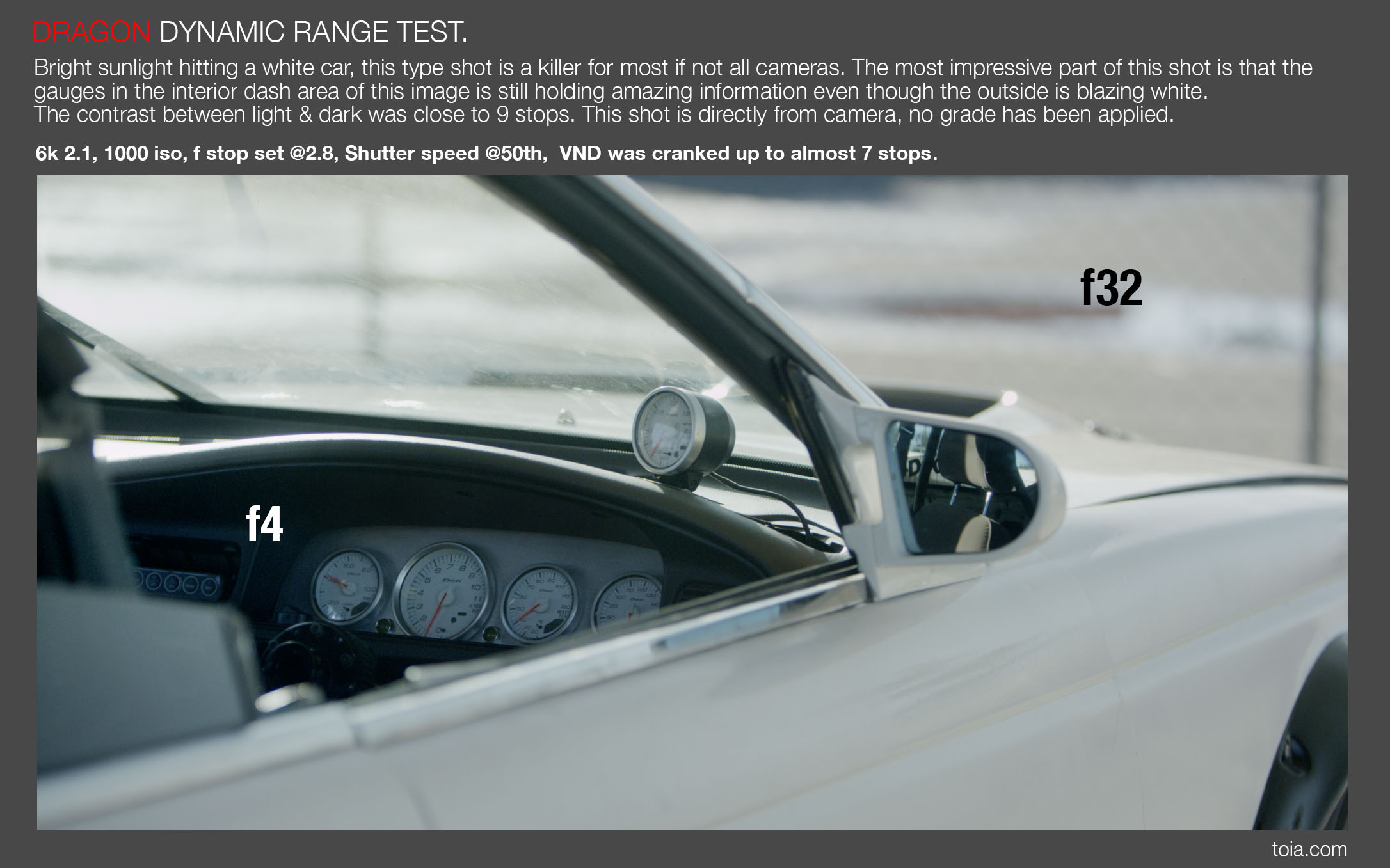
Dragon....

Unreal

red-1.jpg
 
That's all I was asking for. Thanks for the tests Mark.


When you see the world brighter and better than what you can actually see with your naked eye.. thats when Dragon became really interesting !
 
I could be wrong, but I don't believe Mark is using a Motion Mount. He said on the podcast that he is using Canon lenses, and so far there is only a soon-to-be-released PL Motion Mount (Canon next but probably COULD be first if Red wanted to switch gears... hint, hint). He said he was using a VND filter. The Motion Mount has an inherent loss of light -- 1 stop and some change (according to Jarred) but NOT of DR, as far as I understand.

Motion mount is just a form of ND, so there is no possible way for it to cut DR even if it wanted to.
 
Motion mount is just a form of ND, so there is no possible way for it to cut DR even if it wanted to.

And because it controls the electronic shutter I think it also virtually eliminates judder and skew as well. If I am remembering correctly.

David
 
Not true. The Liquid crystal sits in a piece of glass that has a 1 stop-ish light cut due to the nature of the glass. So when it's completely off it still cuts DR.

It DOES NOT cut dynamic range. The sensor will still capture 16 stops DR, but what you will lose is a stop of exposure... That means instead of 2000ISO, you get 1280 or so on. You are still capturing the same DR, just at a loss of exposure. It's the same principle as using ND's, your not losing DR, your cutting exposure...
 
Not true. The Liquid crystal sits in a piece of glass that has a 1 stop-ish light cut due to the nature of the glass. So when it's completely off it still cuts DR.

I could be wrong here, but in my experience, dynamic range is just that: a range. Adding ND just changes the sensitivity of the sensor, not its dynamic range.

Here's how I think about it: imagine a number line, going from 0 to 30. Dynamic range is like taking a chunk of that at a certain length, say, 16. So you can be sensitive to light from 0-16, 1-17, 13-29, etc. The dynamic range doesn't change, just the range of light intensities you're capturing. If the scene has light intensities below the range you capture, they'll be in noise, and if it has light intensities above the range you capture, they'll clip.

So what ND does is lower the range of intensities the camera is sensitive to. If without ND you would be capturing 5-21, with 1 stop of ND, you'd be capturing 4-20. Dynamic range hasn't changed (it's still 16); it's just the range of light intensities you're able to capture has changed.

Of course, if you're already capturing 0-16, you can't go lower than zero, so your effective dynamic range is reduced in that situation if you add ND.

Anyway, that's how I understand things. Please correct me if I'm wrong.

P.s. "Native ISO" is just a way of stating where on the 0-30 the cameras dynamic range naturally falls. For example, it may have 12 stops of dynamic range, starting 'natively' (without ND) at 4, so it'd capture from 4-16 natively. The reason you can set the ISO is because dynamic range doesn't have hard stops at the low end; instead, there's noise. So you can artificially shift the range "into the noise" if you need to when the scene overall doesn't have much light.

What's cool about the Dragon is not only does it have a very high dynamic range (16+, looks more like 18 on the charts), but it's native ISO is higher, which mean instead of starting at 4, it's now starting at 2. That means that with proper application of ND, you can shift those 16-18 stops around from 2-18 all the way to 14-30 (if you put on enough ND). Pretty freaking cool.
 
Last edited:
I could be wrong here, but in my experience, dynamic range is just that: a range. Adding ND just changes the sensitivity of the sensor, not its dynamic range.

Here's how I think about it: imagine a number line, going from 0 to 100. Dynamic range is like taking a chunk of that at a certain length, say, 16. So you can be sensitive to light from 0-16, 1-17, 20-36, etc. The dynamic _range_ doesn't change, just the range of photons you're capturing. If the scene has light below the range you capture, it'll be in noise, and if it has light above the range you capture, it'll clip.

So what ND does is lower the range you're sensitive to. If without ND you would be shooting 50-66, with ND, you're now shooting 49-65. Dynamic range hasn't changed (it's still 16); it's just the range of light you're sensitive to has changed.

Of course, if you're already at 0-16, and you add on ND, you can't go lower than zero, so your effective dynamic range _is_ reduced in that situation.

Anyway, that's how I understand things. Please correct me if I'm wrong.

beat you to it haha. But yes, no DR is lost...
 
beat you to it haha. But yes, no DR is lost...

Actually it's not as simple as this in practice.

The basic truth is yes NDs don't change Dynamic Range captured. That's the overall theory at least.

However, much like lenses, filters are different and sometimes different across not only manufacturers but also batches.

Specifically certain brands actually produce filters that produce lower contrast, essentially the effect of a low power low contrast filter for that matter, and it could actually increase the captured dynamic range within a shot.

More notably, as we are using cameras that are pretty light sensitive, you may notice upper level Neutral Density filters like 1.2 and up may have more of a low contrast effect.

Filters are baked in ovens and there is certainly an artistry to whole process, that's why it's somewhat important to grab them from a manufacturer with experience. I've used some less expensive NDs in the past and the variation between sets sometimes blew my mind. 1/2+ stop variations sometimes between certain densities. Crazy pants. A good deal of the industry leading DPs actually own their filters or have specific sets set aside for them at certain rental houses.

This is actually one of the major reasons I'm excited about the upcoming Motion Mount as it's going to wrangle in a bit of that craziness and provide a very flexible and adjustable internal ND solution behind the lens as well as removing half frame broken strobes, global shutter support, and provide control over other temporal aliasing artifacts. Lots of stuff going on in that.

I think it was also mentioned that the Motion Mount will have some sort of additional IR protection. Combined with Dragon's new IROLPF I think we're going to have a winning combination for a large variety of shooting situations. And hey! No more taped on filters for those looking to save weight and size on a rig :)

But for all *intents and purposes, ND does not reduce DR of a camera sensor. It does however reduce exposure.

* corrected by the english teacher below
 
*for all intents and purposes
 
The more you know. :D

I'm a college graduate, with honors, but it's an honest mistake... We don't use grammar much in the industry or on forums haha, so things get lost to memory. Now I have a refresher! Thanks
 
But for all *intents and purposes, ND does not reduce DR of a camera sensor. It does however reduce exposure.

Bingo. Yes, it should never reduce your DR. There is the possibility of a perceived increase through a lower contrast image. That's about it.

I can get away with murder in the daylight wide open on a 1.8 ND sometimes :)
 
Matt's answer to Jason's assertions was perfectly correct.

Thanks Bill, I feel like some try to over think and over complicate things. That just leads to more confusion and misinformation. KISS ( Keep it simple stupid) would make for a lot less misunderstandings here or anywhere for that matter.
 
Back
Top