Welcome to our community

Be a part of something great, join today!

  • Hey all, just changed over the backend after 15 years I figured time to give it a bit of an update, its probably gonna be a bit weird for most of you and i am sure there is a few bugs to work out but it should kinda work the same as before... hopefully :)

DR ..a good discussion!!

24H - Nürburgring - Felipe Fernandez Laser - Scuderia Glickenhaus

Filmed on Red Weapon Helium 8K

 
Mind Disruption


Shot on RED HELIUM S35 8K, edited and mastered in 8K


My reading of this post is that you both are saying the same thing textually, but that you seem to think that saturation capacity is some kind of magic bullet, which it is not. To pick this apart in greater detail:

Michael, thanks for your input. I think some of what I meant may have been misinterpreted. I’ll try to be clearer and maybe that will make a difference. You bring up magic quite a bit so I’ll try to clarify that as well. Sorry about the length.


I cannot make any meaning out of this because it's not clear how many stops are supposed to be below middle gray, with what kind of noise criteria. Once you define that half of the equation, call it X, then the answer to your question is 9+X.

If 9+X = 13, then X = 4, which means you have 4 stops of dynamic range to represent the chips below middle gray.

That’s not what I meant. I’ve found that, particularly with RED cameras, when people say they want more DR, even though more overall DR is always welcome, what many of them really mean is they want more highlight latitude. What I’m trying to make clear is I’d be happy with 14-15 stops (what’s doable now, if you believe the manufacturer’s claims) so long as I could achieve 9 stops above middle gray at ISO 500-800.

So, I meant something along the lines of it’s impossible to get a billion colors from 8-bit RGB. Or, you have to sample audio at a rate at least twice that of the highest frequency in your source material in order to get an accurate representation of the waveform due to the Nyquist Theorem. You know? Like there might be a mathematical or technical limitation I wasn’t aware of as to why you couldn’t realistically have a sensor that captured 9 stops of DR above middle gray in a range as small as 14 or 15 stops. I wasn’t asking if 9 fits into 9 + X.


Your next two answers broke up two sentences that were part of the same scenario: the one you said was correct and the one preceding it. I’ve highlighted the part of your comment that I wanted to address.

Saturation capacity is not a magic bullet. It simply states where the sensor clips highlights. Definitionally, if you have 9 stops of DR (counting from zero), there exists an exposure level that's 4 stops below clipping and 5 stops above the noise floor. You can call that middle gray. When that middle gray is over-exposed by 4 stops, it clips to white, and when it's underexposed by 5 stops, it fades into the noise that's black. And what none of this tells you (yet) is the extent to which quantization gives you (or does not give you) latitude for getting nice gradations within any given range of stops.

You keep saying saturation capacity isn’t a magic bullet as if it won’t give me exactly what I want, which is a point significantly further into highlights than what is currently possible (on any current RED sensor) before clipping occurs.

That's correct…Compare that to the bottom where our noise floor is at 195 (100,000 / 512), so say black = 200, our first stop above that is 400, and our second stop above that is 800. That's three stops of DR with a difference of fewer than 1,000 electrons. There are 300 1,000-electron gradations between 100,000 and 400,000, which can lead to much smoother gradations of color there.

Finally, a win. Although, it seems like it’s not just how many electrons you have at the bottom to represent the lowest stops that matters. It’s also what’s the fewest number you can get away with before you don’t notice without serious pixel peeping or should reasonably care about in all but a few cases? Put another way, there’s the math and then there’s what the math looks like.


Saturation capacity is not a magic bullet. It's true that opening up more stops at the top gives you math that makes it look like you have much smoother color gradations at the top, but that's not necessarily where they are needed (with everything fading to white).

My ramblings about better highlight latitude boil down to this:

(1) It’s what I want. I’m allowed to want things.
(2) Psychologically, it signals the perception of a higher quality image to our brains much more so than shadow detail.
(3) If RED or anyone else wants to move the needle on feature film and tv market share, based on what the industry has already established they prefer in a camera by way of sheer usage, best cinematography nominations/wins, general consensus, etc., the only thing left is besting Alexa in the one area it has yet to be surpassed and where film still reigns supreme.

People can disagree with (2) and (3) all they want but I can easily and unscientifically prove them to be well worth considering, if not outright true.

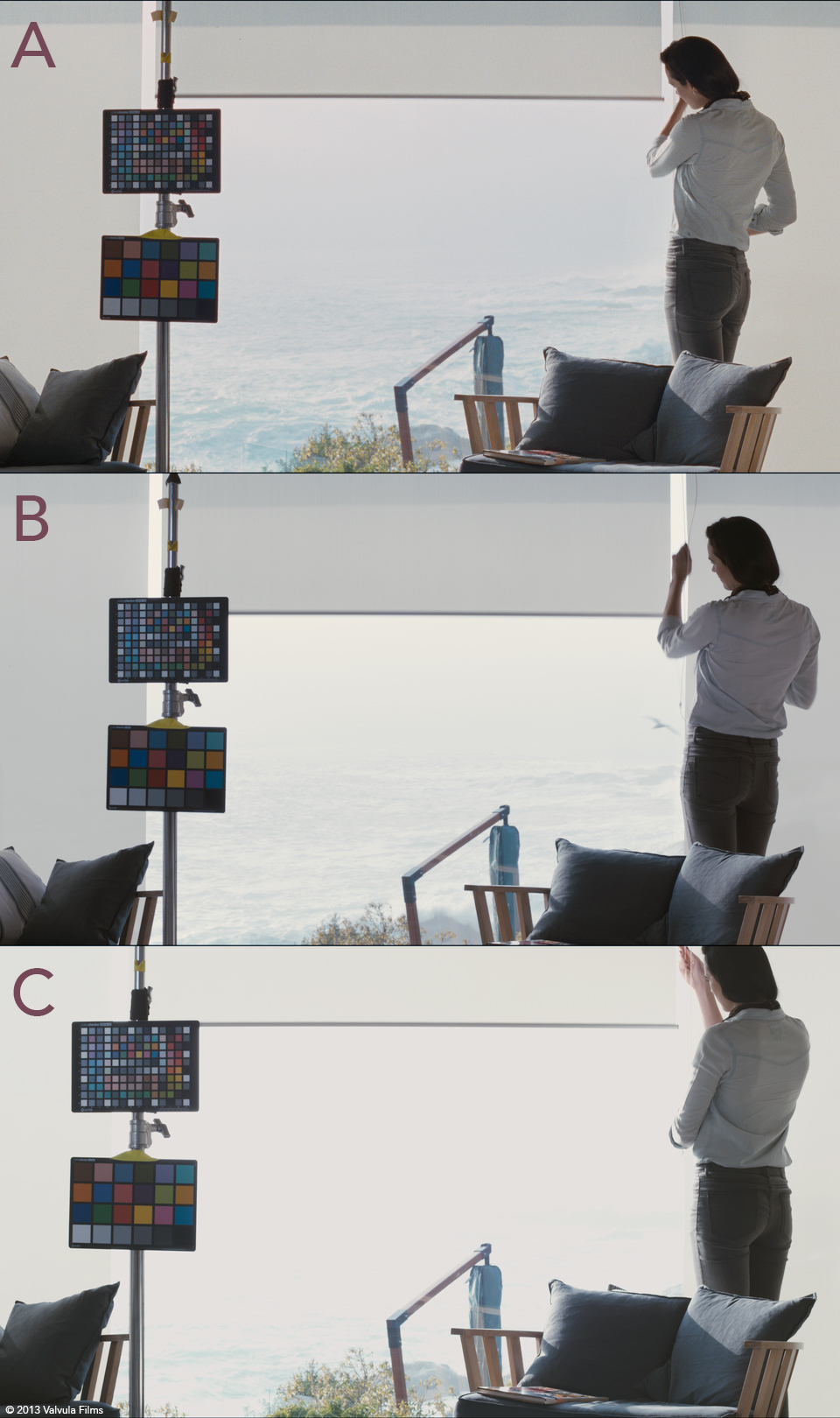
Which image do you all like the best…A, B or C, and why? If you pick a letter other than “A” please provide an extremely compelling argument for doing so or I’m dismissing it. The bird in B isn’t good enough. I know some people might want to get clever and say something like they’re all equally good because the determination of best depends of which image best fits the look or mood the director and cinematographer were going for. Rubbish. If that were true you’d like the look of every film because the cinematographers achieved their desired looks. What you like, which is what I’m asking, should be based on your own tastes and exist outside of what you think someone else believes they achieved.

You can find the details and a video here:


Valvula-Still-Comparison.jpg


These were all shot with an ISO rating of 500. “A” has the most highlight detail. It also has more saturated color in that detail. And, it presents a situation where there’s no room to ETTR for those who try to get the most bang for their bits. Now, if you’re telling me greater sensor saturation capacity won’t help with capturing the highlight detail visible in “A” at those same settings, kindly tell what will and I’ll drop this line of reasoning and advocate for that. If greater saturation capacity is the key to capturing an image like “A,” at the same or similar settings, that seems pretty freaking “magical” to me and it makes me wonder why you wouldn’t think so.

I know there are several techniques for capturing the highlights you want with the highlight latitude we already have. Unfortunately, no one performs camera tests that way and RED loses that contest.


Lowering the noise floor brings lots more color gradations into the middle tones, which is where the real money is.

I agree that meat in the middle tones is important. The mids look equally good in all three images to me. Yet, the highlights in “A” are what’s making the difference. So, it seems there might be a point of diminishing returns beyond which a lower noise floor has little to no impact. If there is, perhaps Alexa’s underexposure ability (approx. 6.5 - 7 stops at EI 800) already satisfies any visually perceptive advantage that might lend an image. I mean, does anyone look at images from cameras with better low light performance than Alexa (like Gemini) and think they look significantly richer or meatier in the mids, even after rigorous grading?

It reminds me of way back when on Reduser before Epic was released and Jim was giving periodic updates on the progress. In one post, he trotted out MTF graphs of both Alexa and Epic M-X and was touting how much thicker the Epic graph was. Without having seen any actual images for comparison, there followed pages of people (embarrassingly, I think) scoffing at the skimpy Alexa graph as if that meant anything to actual or perceived image quality. After Epic came out, time, experience, and taste formed the general consensus that Alexa simply outclassed Epic in overall image quality, despite falling short in some areas technically. M-X is done. Dragon, its successor, with the exception of Raven, is done. The Alev III is still dominating film and narrative tv work. The lesson? Technical advancements/superiority are important to the industry but only to the extent they make the image look better than something else they can use instead. In most cases, the image that looks the best is deemed the best. Btw, I haven’t seen RED publish a graph like that since.


MIT is developing a sensor with much larger dynamic range by essentially counting how many times saturation capacity is reached during an exposure.

Interesting but seems a long way off, especially for 24 fps capture.


To me, that ask is meaningless. Total DR = top highlight - noise stop. If you want better highlight latitude for a given DR, you have to accept more noise, in a 1:1 equation. 4 more stops of highlight latitude will cost you four stops of noise.

That’s not quite what I meant. Yes, for any given DR, increasing either highlight latitude or sensitivity reduces the other one in a 1:1 ratio. It’s not necessarily the case when increasing (or decreasing) the DR from one sensor to the next, which is more what I had in mind. If ISO is set to match or come as close as possible to a 0 digital gain setting working within 14 stops of DR, let’s say there are 6 stops above middle gray and 8 stops below. If a next-gen sensor manages to increase the stops above middle gray by 3 stops but had to give up a stop on the bottom for some reason, you end up with 16 total stops but the trade-off is not 1:1. You could lose 2 stops on the bottom and the ratio wouldn’t be 1:1 but you’d still have a net gain of 1 stop with 3 more where you wanted it, if you’re into highlights and stuff. Added noise might not be a trade-off for better highlight latitude, but I’d take the noise in any trade-off ratio up to 1:1.
 
Sergio and Anthony,

Thanks a lot guys. None of these videos are mine but by other talented users of Red Cinema cameras. We can sometimes here over analyze and grade to death one frame of video from one of these many cameras. So I thought to maybe show the images in motion for a better overall assessment of the cameras.
 
Brian,

While any of us can stand on the sidelines and yell "I want more headroom for highlights before clipping" or "I want more shadow details before noise takes over", all we really have, and all we will ever really get, is a sensor that provides a given number of true stops of DR and a curve that tells us how many gradations of signal we can achieve within each stop of DR. Interlaced within these two equations is a concept of native sensitivity: where does middle gray land when exposed at a given ISO. But even film photographers developed their own understandings of film grain, constrast, highlight and shadow retention, etc., so as to choose the ISO that best suited their needs; they didn't treat the number on the box as if it were a commandment given by God. Comparing cameras at a fixed ISO is particularly meaningless now that RED has two different ISO calibrations (Legacy and IPP2), so let's ignore that and instead focus on how one goes about exposing middle gray so as to achieve a certain amount of light recorded by the sensor (0.18 in linear light = 1/3 in Log3G10). Log3G10 certainly allows for the possibility that some future sensors could have up to 10 stops above middle gray, even if RED's sensors today cannot deliver that (10 stops above correctly-exposed middle gray).

Early on Phil Holland showed (both online and in his Field Ops Guide) showed what charts look like when exposing to the left or exposing to the right. That returns us to the logic of using "photographer's knowledge" of how to expose an image to use the camera's strengths to your advantage and to side the camera's weaknesses. If you need 10 stops of highlight protection, you have have that today, by underexposing 2-3 stops, which raises your noise floor 2-3 stops. With care in the grading suite, you can suck that up and deal with it. If you want 10 stops in the shadows, you can overexpose by 2-3 stops, which lowers your highlight clipping levels 2-3 stops. Again, with care in the grading suite you can suck that up and deal with it. If you want both 10 stops below and 10 stops above, you can futz around with HDRx. In my experience, an image with 20 stops of DR is just a damn hard thing to deal with, especially when trying to work within the small range of REC 709. But it can be done, especially now that AI is getting really good at tweening.

If RED or anybody else do figure out how to hold more electrons at the high-end before clipping, it will mean an expansion of DR that's allocated at the top. If RED or anybody else figures out how to lower the noise floor more, it will mean an expansion of DR that's allocated at the bottom. If RED or anybody else changes the sensitivity so that middle gray needs less (or more) exposure to read 0.18 in linear light or 1/3 in Log3G10, then we'll see a shift in where the DR curves perform best for a given ISO. I think it's much more helpful to work from easily measured math (DR curve and noise/quantization levels) than it is to work from inferences about saturation capacity/noise floors of a given sensor design. They XYLA chart was specifically designed to give one precisely the curves needed to measure actual performance that could then inform exposure strategy. That's really all that's needed, unless what you really need is a sensor that has more DR (however that may be achieved).

Fair enough. And, I'm very aware of Phil's charts. I've referenced them in comments many times. I brought up the math of it all because I wanted to have at least a farthing of an idea what might be needed when talking about the subject.

I honestly just want digital cameras to work a way they currently don't. I don't care how they manage to do it.

If I remember correctly, you once expressed concerns over capturing the various fully saturated colors of buttons and lights on your recording studio mixing desks in the relatively dim lighting of the control room. I still have the R3Ds you provided.

It seems what I’m proposing, however it’s done, would be of great help. I assume you’ve settled on a technique that works well by now, though.

For the record, I'm still rocking a Scarlet Dragon, although it hasn't been on the premises in quite some time. I also have a Sony NEX-3N, which is much noisier and has considerably less DR, that I use when I shoot photos for eBay, Reverb and Reduser.

I grab my light meter, open the living room blinds and go to it. The pics always turn out very nice.

I know I can rate Gemini for ISO 3200, take a light meter reading, set my aperture and/or ND accordingly, capture those highlights and raise the mids and shadows in post with less noise than I'd actually be comfortable with seeing.

I can do the same with the Scarlet Dragon if I allow time for a dash of NR, which no one will ever notice was applied.

Technology barriers aside, developing sensors in the way that companies have for the last 10 years made more sense when it was one sensor to rule them all. Now that RED has a unified body with various sensors from which to choose, more specialized uses make a lot of sense. Otherwise, why bother?

The way it sometimes works is if you don't ask for it no one knows you want it. So I'm asking. I'm also presenting a possible strategy for regaining some lost ground. It's a theory but it can't be disproved without trying it, in which case I get what I want.

An Arri white paper circa 2009/10 revealed they made some technical decisions based on psychological perceptions, favoring DR over resolution, even as they concurrently released a white paper stating the importance of 4K+.

They've always known RED was right about resolution. They just didn't think people would care about it as much as they did DR. As it turns out, they were right. I’m proposing a similar psychological approach to designing future sensors. Until then, I will probably stick with the Scarlet Dragon.

One last thing. Was it A, B or C for you?
 
Rhiannon Jackson shot on the RED Epic-W in Queenstown, NZ


Simple color comparison between the Venice, Monstro, and Mini.

Lens was a Leica Thalia 45mm at T4. Native ISO.


Perchtenlauf Wels | RED EPIC W Helium Sensor 8k S35 Lowlight Test | DJI Ronin


Fishtown Soldier

Red Helium 8k
Zeiss mk1 Superspeeds
Freefly Movi Pro


EN | NOIR x THE PROCESS 4k

Shot on Red Epic-W w/ Canon CNE Primes

 
EPIC-W vs GEMINI

Epic-W 8k Helium with OLPF LowLight vs Gemini.....

 
Back
Top