Welcome to our community

Be a part of something great, join today!

  • Hey all, just changed over the backend after 15 years I figured time to give it a bit of an update, its probably gonna be a bit weird for most of you and i am sure there is a few bugs to work out but it should kinda work the same as before... hopefully :)

DOF & beauty

Don't mean to add to the noise but I just have to go on record to say that this is the best thread I've seen on REDUSER yet.

I can't help but think that this is the result of a few folks being distressed that their 2/3" Scarlets wont be able to produce cinematic imagery. Rather than just moping about it or ignoring the issue the whole community gets together and documents the ins and outs of deep focus cinematography with illustrations, techniques and critiques.

A great big thank you to all contributors.
 
Andrew, that looks awesome (specially the first grab). Congrats.

Deep focus really asks for an outstanding art direction.

Thanks Pietro!

As far as deep focus needing great art direction - This is definitely the case. However, I think great art direction is ALWAYS important to great cinematography. For me, the trick to great lighting? Great sets and costumes. ; )
 
I love the deep focus look. Personally, I like to set up each shot like a painting and let the background help to strengthen the story. I think shallow focus is such a cop out for beginners. Just throw the background out of focus and it now looks all cinematic.... With DSLR's, everyone can do it now, its no longer as cool. I think that deep focus will make a comeback as people grow tired of the shallow look. I hope constant shaky cam will go away also, save a cameraman, use a tripod. I think every technique should be used in moderation and fit the mood of the piece. Shaky cam and shallow DOF work in some situations, not all the time though. We need more creativity from the independent sector, not just lower budget copies of big budget techniques.
 
I'd like to find out if there's similarities in paintings. Are there "deep focus" paintings from the respected masters with proportions that are a bit "extreme"? Is there DOF in painting? Why don't they use split diopters in normal photography unless shooting underwater?

This thread got me thinking along similar lines XiaoSu.

I think as depth of field is a photographic quality, it isn't typically seen in art. I couldn't think of any examples. I think perhaps artists are aiming for similar effects to create depth through light, perspective and composition.

You could consider a dark unlit scene as a blank canvas or block to paint and carve out the images you wish to portray.

I suppose with deep focus, it's not just using light, as Pietro and Andrew pointed out, it's about art direction and also a strong compositional style.

What I find interesting about this, is there's a difference culturally depending on what styles of art you are drawing from.

I think western (US, European) films draw greatly from renaissance and impressionist art.

One example that comes up often is Caravaggio's 'The Calling of Saint Matthew' (1600)

img-deep-focus-example-18_the-calling.jpg


This painting shows Jesus calling Matthew from his gloomy customs table backed by a beam of light.

The differences in light and tone both create depth, seperate the opposing worlds, give life and context to the image and vigour to the actions of it's subjects.

This technique is often referred to as Chiaroscuro, which literally means clear / obscure or dark / light.

I think you can see this type of lighting in 'The Godfather' (1972, Dir. Francis Ford Coppola, Cinematography by Gordon Willis) and subsequent films, and is also the perfect context for those films, rather than just an aesthetic choice.

img-deep-focus-example-21_godfather.jpg

img-deep-focus-example-22_godfather.jpg

img-deep-focus-example-23_godfather.jpg

img-deep-focus-example-24_godfather.jpg


Interestingly, Caravaggio hired actors for his paintings, which got him into trouble as he was depicting religeous subjects.

Rembrandt is also a master of lighting, but is perhaps more expressive in his conveyance of space and depth and moves towards a more deep focus look.

Supper at Emmaus (1628)

img-deep-focus-example-19_rembrandt.jpg


I often notice a lot of influence from impressionist artists, such as Cézanne.

Certainly this can be seen in 1900 (Novecento) which is reminiscent of Van Gogh or Monet.

As an opposite to this, Japanese and Chinese art used different techniques to convey depth and perspective.

They had a more linear style, often as ink or wood carvings, and used an elevated perspective to create depth.

You can see this different approach here in this early line drawing of the Chushingura (47 Ronin) by Hokusai.

img-deep-focus-example-25_hokusai-chushingura.jpg


Kurosawa used this technique alot in Seven Samurai for establising shots and other films of jidai-geki (period theatre) he made. Here's the same elevation in a tighter shot from Ran(1985, Dir Akira Kurosawa).

img-deep-focus-example-30_ran.jpg


And some others from Kaidan (1964).

img-deep-focus-example-26_kaidan.jpg


img-deep-focus-example-27_kaidan.jpg


I think Andrew Rieger is right about shallow focus being overused. I think for some independant film makers, they're under a lot of pressure to be seen as 'professional', and using prime lenses and shallow depth of field is part of that.

So I think it's largely a confidence issue, as the bar for making a film is lower today, but making a film is still as difficult, or perhaps harder.

~ Perhaps culturally, as we are more celebrity / personality focused now, people find faces more appealing?

~ Are modern films and their style more informed by mass media and celebrity photography than art and design?

~ Perhaps as people watch more DVDs than go to the cinema, they are more comfortable with a TV / Drama like experience?

Certainly, the tendency towards Dektoring (shaky cam) is coming from a news gathering / documentary standpoint to give them a more raw or realistic edge.

And films like 'Rec', 'Blair Witch', 'District 9' and 'Paranormal Activity' utilising Cinéma vérité techniques are certainly capitalising on this, and the youTube culture also.

I'm not against all this, I've watched and enjoyed plenty of it, I just wish there was more balance in what I can go and see at the pictures.

And I wish styles were more motivated by context, rather than just what's currently popular.

It's a shame people feel the need to jump on the band wagon, but this has always been the case and is nothing new. Trends come and go.

And I definately agree with you Andrew R, there's not enough imagination coming from the independent sector. Too much cut, copy, paste and repeat.

In relation to depth of field, costumes and art direction, I love 'Russian Ark' (Russkiy kovcheg, 2002, Dir. Aleksandr Sokurov) that was shot in a single take, one steadycam shot on an F900, in four attempts. Pretty amazing.

img-deep-focus-example-28_russian-ark.jpg


img-deep-focus-example-29_russian-ark.jpg


Sorry for the meandering post, all very speculative, I've had too much coffee today. Feel free to disagree.

Again, great thread, very thought provoking, thanks to all for contributing.

Mikey
 
And I wish styles were more motivated by context, rather than just what's currently popular.

I agree, but this is why some films really stand out, and they are usually created by auteurs who hold a complete command of the whole film. Their visual style works hand and glove with the narrative, and often seems inventive as a result.

I think Salvador Dali may have used a sense of depth of field in his works, which is interesting because they are far from being photo realistic, they are surreal. In the Landscape of Butterflies, the definition of the horizon appears softer in the distance, as do the shadows on the earth, beyond the hard shadow in the foreground. Perhaps this is just diffuse shadow and highlight that other wise occurs in nature, but Dali painted in an era that was very influenced by photography.

landscape_of_butterflies.jpg


This painting by Isaack Luttichuys (1616-1673), "Walk to Zandvoort" has a sense of graduated sharpness based on depth. The Church spire in the distance, while discernible, is not nearly as tack sharp as the detail in the family in the foreground. Luttichuys was certainly not influenced by photography, so is the apparent shift in sharpness could based on rendering a natural atmospheric disturbance, but clearly he wants the foreground and background to have very different appearances. Is he basing this on an effect he sees with his own eyes, on how our eyes see things when they are focusing on one thing and not another?

1.jpg


Here is a more contemporary example, Karl Connolly's "Depth of Field". May be a bit obvious, and perhaps technically less refined, but clearly a direct attempt at rendering the illusion.

depth_of_field_2.jpg


I don't think depth of field is limited to photography. The way we all see with our eyes uses depth of field, so why wouldn't artists of other visual art forms try to take advantage of this perceptible effect? The camera as a tool requires us as artists to make a decision on focus and depth of field. How we apply these options or limitations, depending on how you see them, to the context of what we are saying as artists is a decision that should be carefully made.
 
But none of these are really showing a shallow depth of field. While they show some basic atmospheric perspective, I don't think you could equate it to the shallowness we're seeing these days - even in the example that's entitled "Depth of Field."

Here's the trend we're seeing now...

LOOOK
picture.php


LOOOOOOOOOK
picture.php

followed by a prompt and expected rack focus.

LOoOoOk
picture.php


sorry to obliterate the art... "everyone's doing it"
 
The look of shooting in 35mm on a longish lens at a wide aperture is unique to photography; we don't perceive with our eyes that a background is enlarged and a blur of rounded blobs.

Painters generally, starting in the Renaissance, were more inspired by what their eyes could see than what a camera lens could see, though some, like Vermeer, employed a camera obscura and there are some minor recreations of camera lens optical artifacts in their paintings.

Plus, technically, it's hard to paint an out-of-focus background unless you have a photographic frame of reference to copy. It's certainly hard to sketch an out-of-focus background as many storyboard artists can attest to. Most storyboard panels naturally have deep focus compositions when they draw two objects in receding depth. It's only when you get onto the set that you realize that it's hard to hold both in focus.

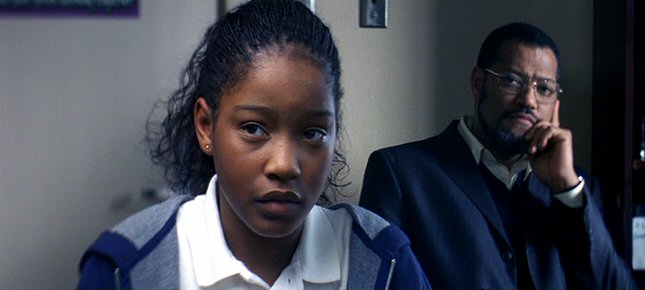
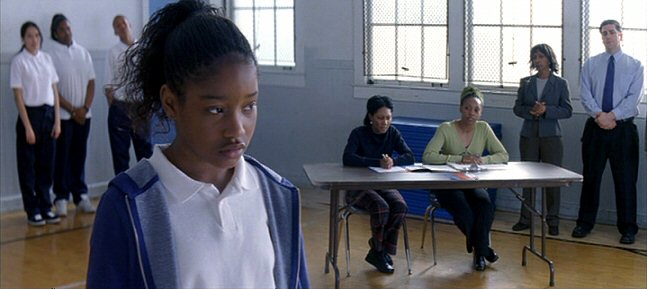
In fact, when I did "Akeelah and the Bee", the director had storyboarded the whole movie and I had to do a couple of trick deep-focus shots to maintain the dramatic effect he drew on paper where naturally everything was "in focus".

For example, here I used a tilt-focus lens:
akeelah2.jpg


Here I used a split-diopter filter:
akeelah3.jpg


In both cases, the director did not want to focus-rack between simultaneous action or dialogue in the background and the foreground, so we created a deep-focus shot to hold both.
 
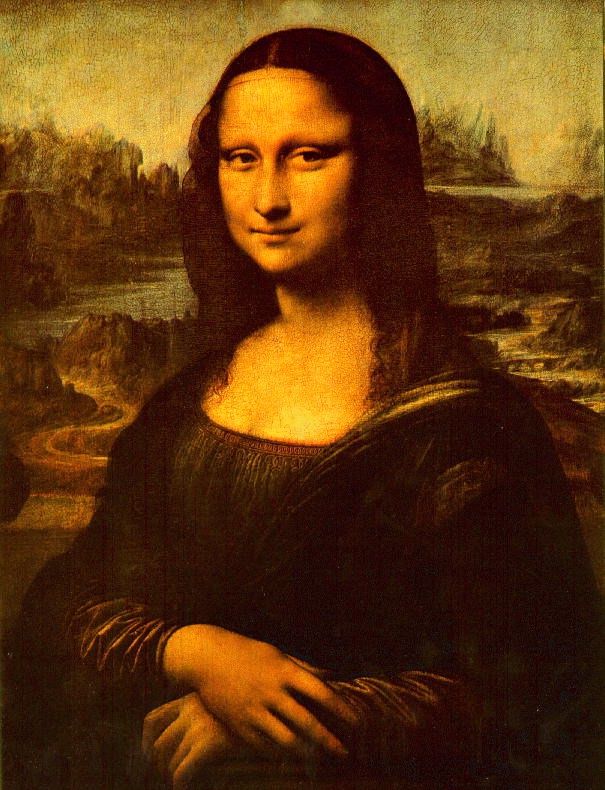
Wow, lots of lovely paintings. Interesting, however, I see no actual bokeh. Perhaps lower contrast in color and tonality, a bit less definition in the edges, or a creative "debeautifying" of the elements as they get deeper in the frame in La Gioconda (If I may be so bold as to try to rationalize any aspect of these paintings).

I think that David is right on that lack of DoF in paintings might be due to how incredibly hard it must be to achieve realistic bokeh. Even with some current sort of spray painting tool, it would be very hard. Could you imagine having to paint a daisy with just enough definition to recognize it? Or a little bit more out of focus so that all you can tell it is a white flower?

Looking at Karl Connolly's "Depth of Field" I see the attempt at blurring the soil, yet no attempt at blurring the sky and the ground together with a technically incorrect horizon line which would be -exponentially- harder. It is a good idea to make your subject that which he chose.

I bet something with more detail has been done before, probably by someone in the times when painting was "cutting edge" back then people put so much more emphasis onto the art, so the rewards were higher as well. However, I also bet people might have thought they were "bad paintings", or a cheap attempt by the artist to work less or something... It might have been hard to convince the guy "paying your bills" that you really should devote the amount of time it might take to master the technique when he would have had a hard time convincing his guests that it was in fact a work of art and not a mistake.

You would also have to paint based on your peripheral by focusing on a guide if you wanted repeatable bokeh. That would be a pain. Or maybe by focusing on a thin strand of cloth.

I would love to see more paintings with shallow DoF. Interesting.

And I wish styles were more motivated by context, rather than just what's currently popular.

I agree, but this is why some films really stand out, and they are usually created by auteurs who hold a complete command of the whole film. Their visual style works hand and glove with the narrative, and often seems inventive as a result.

I wish more people realized the importance of having an auteur. So many shows are "mass produced". One can be collaborative regardless of how well visualized, heard(!), or psychoanalyzed your concept may be. If you truly grasp something to such degree, then suggestions can ONLY help. One with a clear vision cannot be confused, swayed, or lead astray. Instead they can only be illuminated by someone else's creative contribution or interpretation. What more could one with such devotion to a piece of art want, than help making it better! Unless of course the whole thing were purely an ego exercise and didn't have a higher purpose guiding the auteur.

David, after seeing your last post I would mention that it is interesting how there isn't even the slight DoF achievable by our eyes when focusing on a very close object with far deeper background. This is the omission I find interesting. Even in Karl Connolly's "Depth of Field" the horizon clearly should be far more out of focus to be technically correct. Though the closer soil just behind the rock probably shouldn't... unless the artist "cropped into his eyesight" for interpretation -and decided not to attempt the horizon line.
 
Here I used a split-diopter filter:
akeelah3.jpg

You definitely pulled off this shot with the split-diopter filter.

There have been quite a few shots I've seen in movies where they used that filter and it just looks completely unnatural. Like there's a perfect line between what's blurry and what's not. This shot actually simply looks like both subjects are in focus which is exactly what you were going for.
 
An artist would not paint a shallow DOF as it does not exist in the human eye.
John.
 
I don't have my copy of EYES WIDE SHUT, but I seem to recall Kubrick using a good number of really beautiful deep-focus shots, even in situations that appeared to be shot in low light.

2z4e1qd.jpg


I really need to get a 1080p copy of Eyes Wide Shut and watch it again. The film is very underrated, IMO.
 
Would it be possible that because the eye is as sensitive as it is, it would not let the iris open far enough to create out of focus backgrounds when we look at something in "close focus"?

Say the eye has an iso value of 160000, it would then in bright light have a f-stop of around 128 anyways, and in low light maybe become something around 5.6? Would it be possible that in very low light there could be bokeh managable with our eyes?

What I've tried several times though and has worked was when I took my glasses off (I've got quite a strong subscription) everything is bokeh only (haha). But if I focus on something that I still CAN see in focus, the background goes out of focus (because my eyes can't get it in focus anymore?) and I perceive bokeh. With street lights at night I even get those roundy shapes (and not vertical ones, so no anamorphic eyes, bummer!).

It's not natural, but it's a way to create bokeh with my eyes, try it yourself! (if your eyes are broken) :)
 
The film is very underrated, IMO.

Tom L,

get it on BR and it's a great movie.

Also forget the critics...

IMO, it's Kubrick's best film. The tension build-up... Genious!

picture.php

followed by a prompt and expected rack focus.

LOL, loved the rack focus joke. Rack focus is definitely lazier than shallow DOF. :smash:

However we gotta notice that painters have total control of what they leave in or out of the background, control we should have as filmmakers too.
 
While they show some basic atmospheric perspective, I don't think you could equate it to the shallowness we're seeing these days - even in the example that's entitled "Depth of Field." ...sorry to obliterate the art... "everyone's doing it"[/I]

It might not be to the extent or extreme of your "obliterated" examples. The point wasn't to equate what painters have traditionally done against what is a current trend in cinematography. The point is, call it what you will (atmospheric perspective) painters have been using depth control for a long time. It may not look the same as depth of field in cinematography, but it doesn't mean it doesn't have a similar effect.

It seems like it's a matter of scale and scope when you compare the two. The scale of detail is so much greater with photography that to obscure some detail can be more desirable in composition, but in painting where the level of detail is not nearly the same (not photo real, although some painting approaches it) ascetically you need less compressed depth to render a similarly balanced composition.

Painting is intended to be looked at, studied, over and over, for varying durations. A great painting has things in it that you might not notice until you have viewed it 20 times or more. You can say this about films too, but a frame of film goes by in 1/24 of a second. You have less time to hone in on what the artist want's you to take away. This might be why motion shots that have extremely deep depth of field trigger more of an unsettling response in the viewer.
 
Back
Top